You have that knot in your stomach that never quite goes away. That thought looping at 3 a.m. That irresistible need to control everything — your day, your loved ones, every detail. And yet, the tighter you grip, the more it slips away. You're not alone: according to the National Institute of Mental Health, anxiety disorders affect about 19% of US adults every year, and the need for control sits at the heart of many of them. Updated in March 2026, this guide gives you concrete keys to finally let go — not tomorrow, now.
Letting go means consciously choosing to focus your energy on what you can change, while calmly accepting what's beyond your reach. It's neither passivity nor resignation: it's an act of courage and emotional intelligence.
The key takeaways
Letting go is an active, science-backed process of releasing the need to control everything. It reduces stress, improves sleep and strengthens relationships. The key: distinguish what depends on you from what doesn't, then act only within your sphere of influence using concrete exercises like breathing, mindfulness and a gratitude journal.
What is letting go in psychology?
Letting go is a psychological approach that involves accepting what you can't change and freeing yourself from the need to control everything. In modern therapies like Acceptance and Commitment Therapy (ACT), it means making peace with uncertainty and choosing where you place your attention.
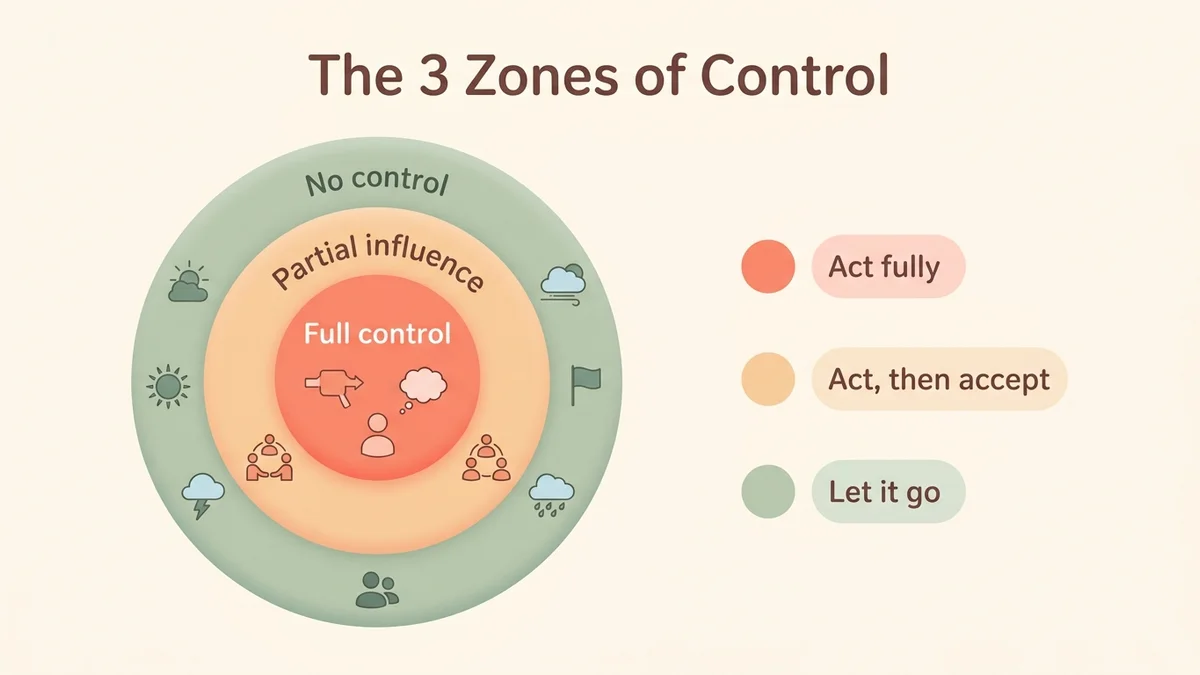
In cognitive psychology, letting go builds on the trichotomy of control, inherited from Stoicism and formalized by philosopher William B. Irvine:
| Zone | What it contains | Your action |
|---|---|---|
| Full control | Your thoughts, your reactions, your choices | Act fully |
| Partial influence | Your relationships, your work, your health | Act, then accept the outcome |
| No control | The past, other people, the weather, the news | Let go completely |
The problem is that our brain doesn't naturally make this distinction. The amygdala, our alarm center, reacts the same way to a real danger and to an imagined worry. The result: you spend as much energy ruminating over an unanswered email as you would escaping a real threat.
Key point: Letting go isn't an innate gift. It's a skill you train, exactly like a muscle. Neuroplasticity research shows that around 8 weeks of regular mindfulness practice can produce measurable changes in brain regions linked to stress.
Why is it so hard for you to let go?
If you're reading this article, letting go probably feels easier said than done. You're right: our brain is biologically wired to anticipate threats and seek control. Here are the mechanisms that trap you.
The need for control: an evolutionary legacy
The prefrontal cortex, the seat of planning, pushes you to anticipate and organize. That's useful when preparing a project, but counterproductive when you're ruminating at 2 a.m. about yesterday's conversation.
Mental rumination
Rumination — repetitive, circular thinking about problems — is one of the strongest predictors of anxiety and depression, according to decades of research by psychologist Susan Nolen-Hoeksema. These repetitive thoughts keep stress hormones elevated, creating a vicious cycle: the more you ruminate, the more stressed you get, and the more you ruminate. Not sure how much you ruminate? Take our free rumination test.
Toxic perfectionism
Wanting to do everything perfectly is the enemy of letting go. A meta-analysis by Hill and Curran (Personality and Social Psychology Review, 2016) linked perfectionistic concerns to a higher risk of burnout. Accepting imperfection is already a way of letting go.
| Controlling behavior | Impact on you | Letting-go alternative |
|---|---|---|
| Checking email 50 times a day | Anxiety, distraction | 3 fixed time slots a day |
| Replaying a past mistake | Guilt, insomnia | Journal to get it out |
| Trying to please everyone | Emotional exhaustion | Accept that it's impossible |
| Planning every minute | Frustration at the slightest surprise | Keep 30% of your time as buffer |
9 practical exercises to learn to let go
Enough theory. Here are exercises you can practice starting today, grounded in positive psychology and neuroscience.
1. Belly breathing (5 minutes)
This is the simplest and most powerful move. Belly breathing activates your parasympathetic nervous system, the one that calms your body.
How to do it:
- Sit comfortably with one hand on your belly
- Breathe in through your nose for 4 seconds — your belly rises
- Breathe out through your mouth for 6 seconds — your belly falls
- Repeat for 5 minutes
According to the HeartMath Institute, slow rhythmic breathing like this lowers cortisol by 23%.
2. Circles of influence (written exercise)
Take a sheet of paper and draw three concentric circles. In the center circle, write what you fully control. In the middle circle, what you can influence. In the outer circle, what's beyond your control.
Then ask yourself: "Where am I spending my energy right now?" If the answer is the outer circle, you've found your problem. You can also do this exercise interactively with our circle of control tool.
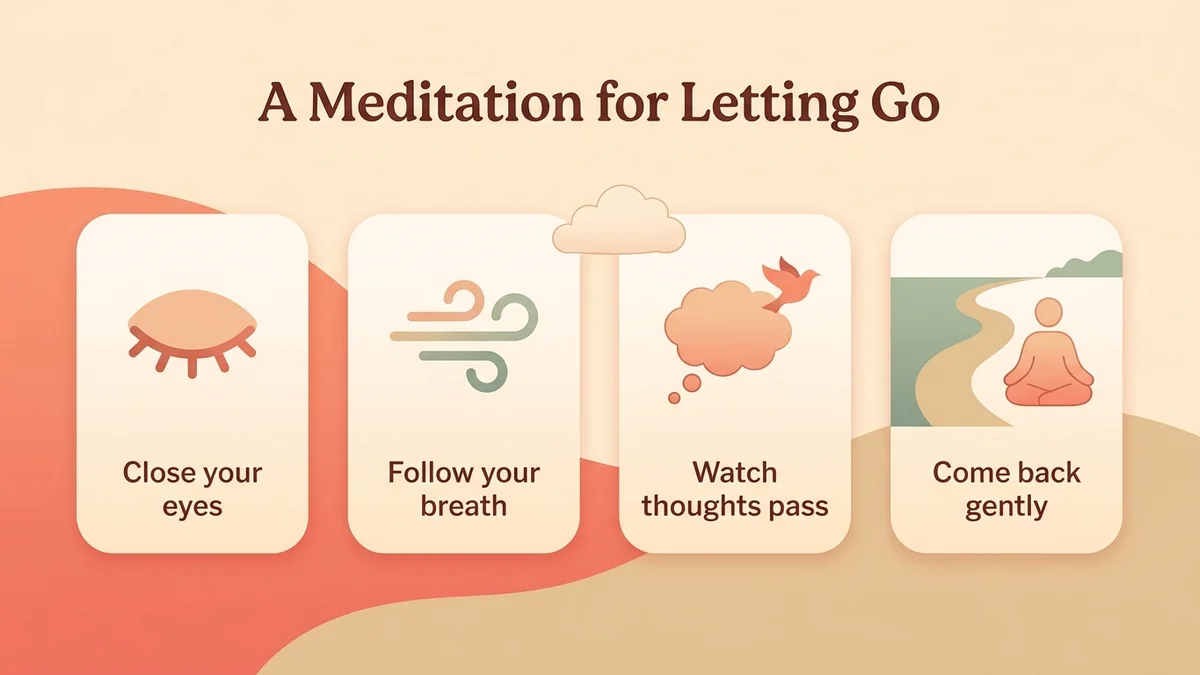
3. Mindfulness meditation (10 minutes)
Mindfulness meditation is direct training in letting go. Every time your mind wanders and you bring it back to your breath, you're practicing letting go.
Quick exercise:
- Close your eyes and focus on your breathing
- When a thought comes up, observe it without judging it — like a passing cloud
- Gently bring your attention back to your breath
- Repeat for 10 minutes
4. The letting-go journal (every evening)
Each evening, take 5 minutes to write in a gratitude journal adapted for letting go:
- 3 things I tried to control today (that weren't worth it)
- 1 thing I let go of (and what happened)
- 1 gratitude for something that happened without my planning it
5. The "so what?" technique
When an anxious thought shows up, ask yourself "So what?" in a cascade. For example:
- "My coworker didn't like my presentation." — So what?
- "He might think less of me." — So what?
- "I might be a little less liked." — So what?
Usually, after 3 or 4 rounds of "so what?", you realize the imagined catastrophe is far less serious than your brain made it seem.
6. Progressive muscle relaxation
Tense and then release each muscle group, from your feet to your head. This technique, developed by American physician Edmund Jacobson, sends a physical signal of letting go to your brain.
Duration: 15 minutes. Ideal frequency: every evening before bed, alongside an evening meditation ritual.
7. The hot air balloon exercise (visualization)
Imagine you're in a hot air balloon. Each sandbag represents a worry. Picture yourself dropping them one by one. With each bag you release, you rise higher and lighter. Name each bag out loud: "I'm letting go of the need to please," "I'm letting go of yesterday's argument."
8. Cognitive reframing
Transform your negative automatic thoughts into more nuanced perspectives:
| Automatic thought | Reframe |
|---|---|
| "This is a disaster" | "This is a problem, not a disaster" |
| "I have to handle everything alone" | "Asking for help is a sign of strength" |
| "If I don't control it, everything will go wrong" | "Plenty of things go fine without my control" |
| "I shouldn't have made that mistake" | "This mistake is teaching me something" |
9. The Serenity Prayer (secular version)
Each morning, repeat to yourself: "I accept the things I cannot change. I have the courage to change the things I can. And I have the wisdom to know the difference." This phrase, adapted from theologian Reinhold Niebuhr and widely used in recovery programs and therapy, recalibrates your mind for the day.
When your body tells you it's time to let go
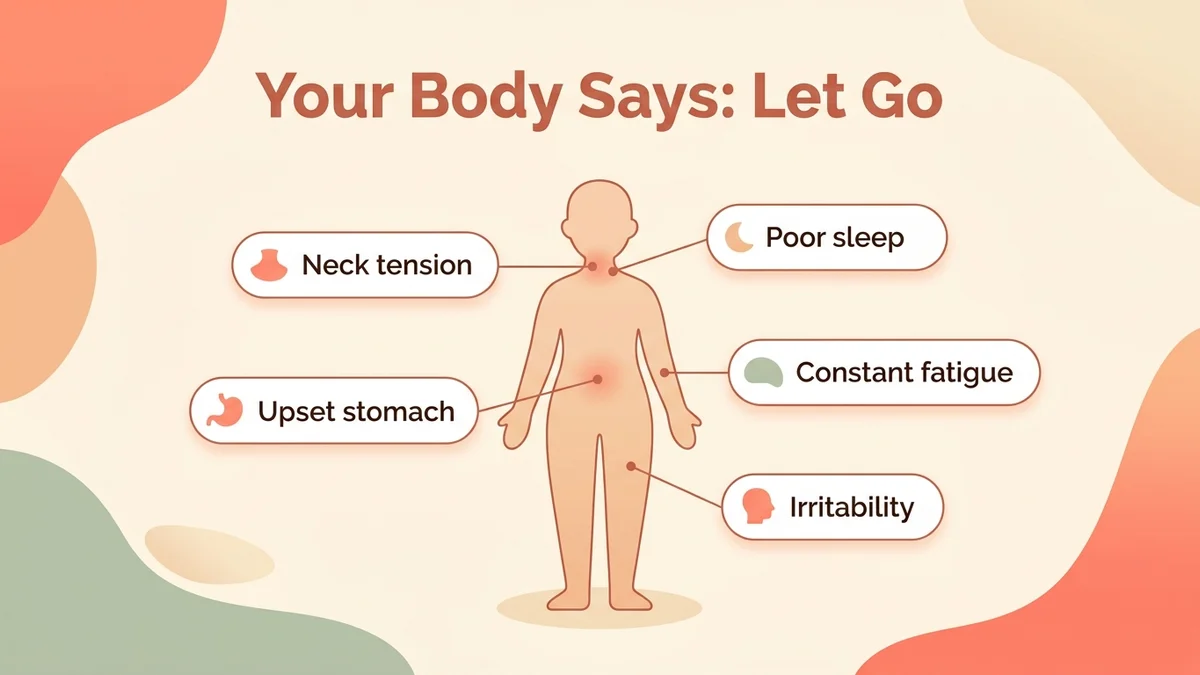
Your body speaks before your mind does. The physical signals that you need to let go are clear:
- Neck tension and headaches: your shoulders are permanently knotted
- Sleep problems: you can't "switch off" your brain at night
- Digestive issues: chronic stress directly affects your digestive system
- Persistent fatigue: even after a full night's sleep, you're exhausted
- Irritability: you overreact to small details
In the American Psychological Association's Work in America survey (2023), 77% of workers reported work-related stress in the past month. If you recognize yourself in these signals, now is the time to act.
Serena Coach tip: Our users who track their mood daily in the app identify their stress triggers 3 times faster. The first step toward letting go is self-awareness.
Learning to let go in life's difficult moments
As Dr. Russ Harris, a leading trainer in Acceptance and Commitment Therapy, explains in this short animation, fighting difficult feelings switches on a "struggle switch" that amplifies them. Letting go starts with a simple gesture: noticing what's happening inside you without trying to fight it. You can extend this practice every day with Serena, which guides you step by step through mindfulness exercises.
Real-life scenarios
The stressful morning before work
You're running late, the kids are dawdling, you spill your coffee. Your reflex: yell, stress, try to make up every lost minute. The letting-go alternative: Take 30 seconds of belly breathing in the car (engine off). Accept that you'll be 5 minutes late. It's not the end of the world — it's just 5 minutes.
The meeting that goes badly
Your proposal is criticized in front of everyone. Your mind races: "They think I'm incompetent." The letting-go alternative: Apply "so what?" silently. Then refocus on what you can do: clarify your point, ask for constructive feedback. What others think doesn't depend on you.
Sunday night insomnia
You're already thinking about the week ahead. Intrusive thoughts pile up. The letting-go alternative: Use the hot air balloon technique. Picture each worry as a sandbag you drop. Then practice cardiac coherence for 5 minutes before falling asleep.
The Serena perspective
Anonymized data from our users reveals a fascinating gap between the theory and the practice of letting go:
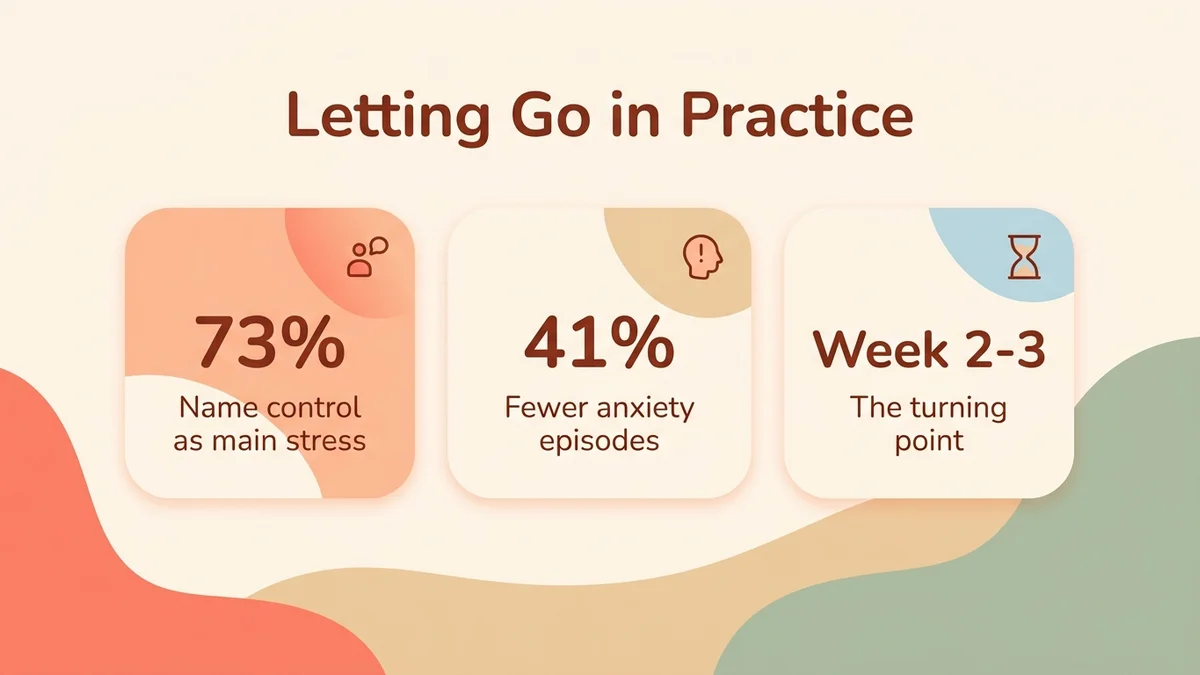
- 73% of Serena users identify the need for control as their main source of stress — far more than external factors
- Users who practice guided breathing at least 3 times a week report a 41% reduction in anxiety episodes after 4 weeks
- The turning point: most users feel a "click" between the 2nd and 3rd week of regular practice
Academic programs typically run for 8 weeks. In the field, we see the first benefits appear within 2 weeks — as long as you practice daily, even for just 5 minutes.
Serena Coach tip: Don't aim for perfection in your practice. Our most consistent users meditate just 7 minutes a day on average. Consistency matters, not duration.
The proven health benefits of letting go
The benefits of letting go aren't just subjective. Science measures them:
| Benefit | Scientific finding | Source |
|---|---|---|
| Less anxiety | 8 weeks of mindfulness matched a common antidepressant for anxiety | Hoge et al., JAMA Psychiatry (2023) |
| Better sleep | Mindfulness improved sleep quality more than sleep education | Black et al., JAMA Internal Medicine (2015) |
| Stronger immunity | Better antibody response to a flu vaccine after 8 weeks of meditation | Davidson et al., University of Wisconsin (2003) |
| Less stress | Slow breathing lowers cortisol | HeartMath Institute |
| Better mood | Improvements in anxiety and depression | Goyal et al., JAMA Internal Medicine (2014) |
Letting go also helps you manage mood swings by strengthening emotional regulation. When you stop fighting your emotions, they pass naturally — like waves.
In a randomized trial published in JAMA Psychiatry in 2023, an 8-week mindfulness program reduced anxiety as much as escitalopram, a first-line medication.
How Serena supports you in letting go
Letting go on your own is possible. But having a guide makes the path easier and faster. Serena was designed for exactly that:
- 6 guided breathing techniques to instantly activate your parasympathetic system
- Daily mood tracking based on the Circumplex model to identify your control patterns
- Built-in gratitude journal to anchor the positive every day
- Guided meditations designed specifically for letting go and mindfulness
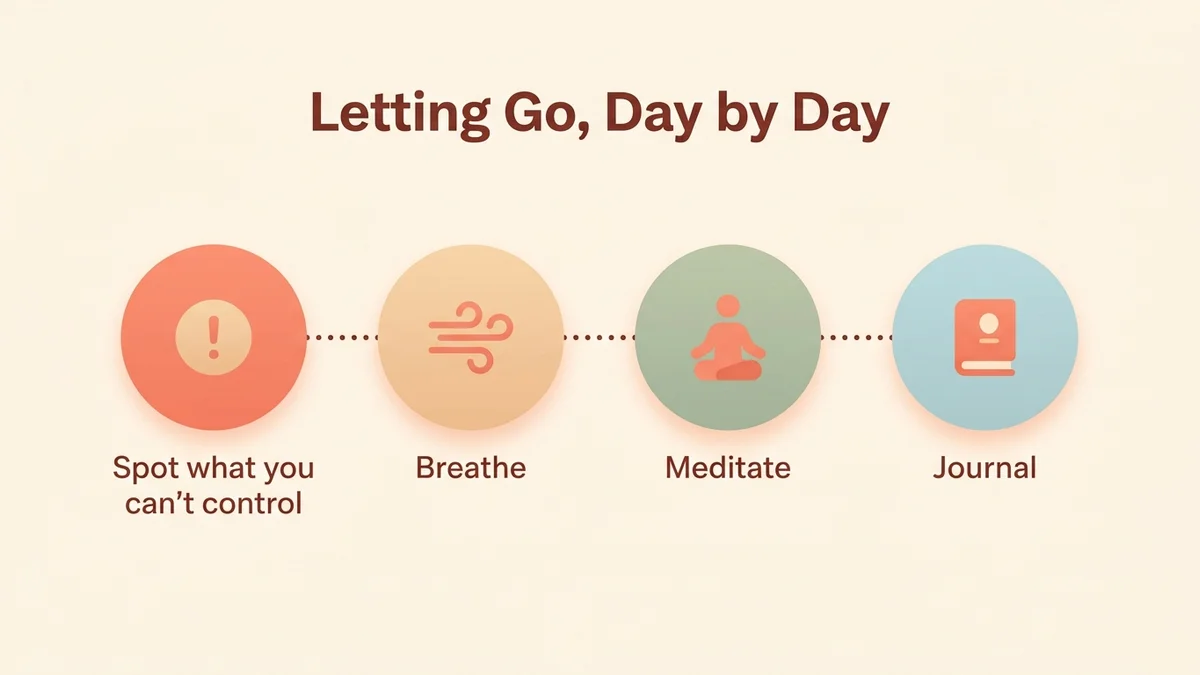
Try Serena for free and start your letting-go journey today.
Frequently asked questions
How do you let go when you're anxious?
Start with belly breathing: breathe in for 4 seconds and out for 6 seconds for 5 minutes. Then identify what's outside your control with the circles of influence exercise. In a 2023 JAMA Psychiatry trial, an 8-week mindfulness program reduced anxiety as effectively as a first-line antidepressant.
Does letting go mean giving up?
No. Letting go doesn't mean giving up or becoming passive. It's a conscious, active decision to focus your energy on what you can truly influence. The Stoic philosopher Epictetus put it this way: "It's not what happens to you, but how you react to it that matters."
How long does it take to learn to let go?
The first effects can be felt from your very first breathing or meditation session. However, to make letting go a lasting reflex, allow 4 to 8 weeks of daily practice. Serena data shows a "click" between the 2nd and 3rd week.
Can letting go help at work?
Absolutely. The World Health Organization estimates that 12 billion working days are lost every year to depression and anxiety. Letting go at work means delegating, accepting imperfection and managing work stress.
What's the difference between letting go and just letting things happen?
Letting things happen implies passive disengagement. Letting go is an active process: you analyze the situation, distinguish what you can change from what you can't, then act only within your sphere of influence. It's clear-eyed, not defeated.
Does meditation help you let go?
Yes, mindfulness meditation is the most direct training for letting go. Every time your mind wanders and you bring it back to your breath, you're literally practicing letting go. Sophrology can also complement this approach.
What are the signs you need to let go?
Warning signs include constant rumination, sleep problems, persistent muscle tension, irritability and emotional exhaustion. If these symptoms have lasted more than two weeks, letting go — and possibly professional support — become priorities.
Can you let go without professional help?
Yes, many techniques can be practiced on your own: breathing, journaling, guided meditation with Serena. However, if anxiety is disabling or you experience chronic hypervigilance, a psychologist trained in cognitive behavioral therapy is recommended.
Conclusion
Letting go isn't a goal to reach — it's a daily practice. Like a muscle, the more you train it, the more natural it becomes. Start small: 5 minutes of breathing tomorrow morning. A circle of influence this weekend. And gradually, you'll feel that space opening up inside you — the space where calm replaces control.
Taking care of your psychological wellbeing is no longer a luxury: it's a necessity. And letting go is one of its most powerful keys.
Start your letting-go journey with Serena — your daily companion for finding calm again.