Updated in May 2026.
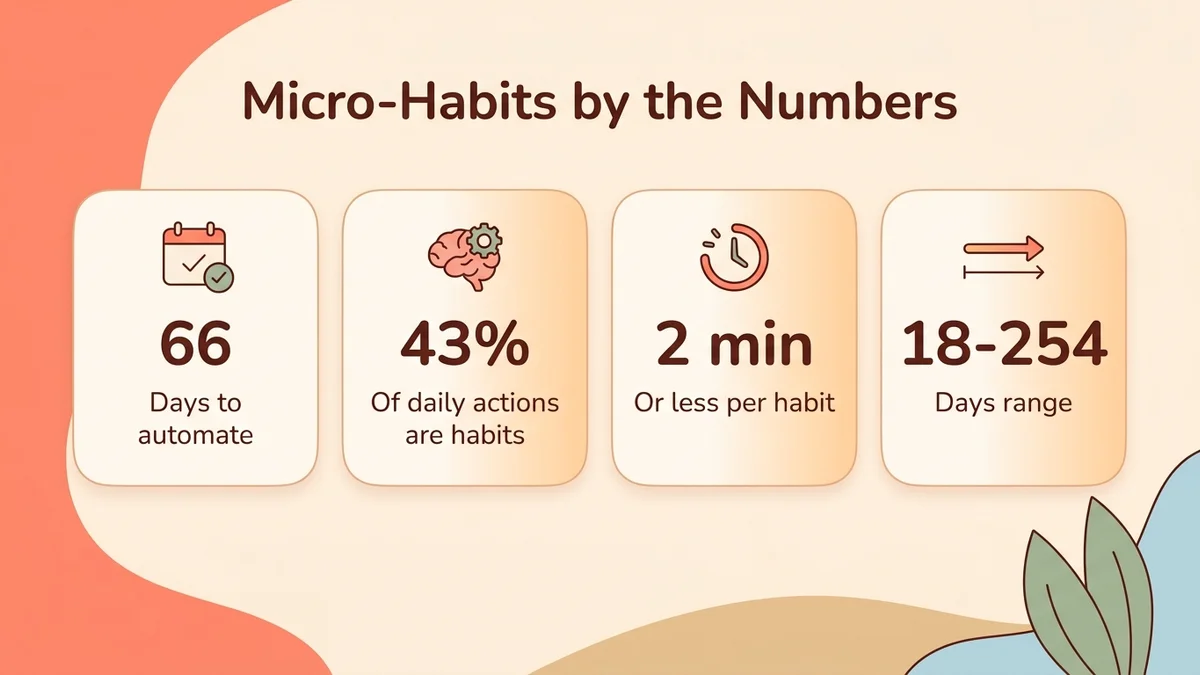
You want to change, and you know it. Sleep better, stress less, take care of your mind. But every time you try, motivation fizzles out after a few days. You're not alone: most New Year's resolutions are abandoned within the first few weeks of January. What if the problem wasn't your willpower but the size of your goals? Wellbeing micro-habits flip the logic. Instead of aiming big and failing, you aim tiny and stick with it. Research by psychologist Wendy Wood at Duke University found that roughly 43% of our daily actions are performed out of habit, while our minds are elsewhere. Reprogramming those automatic behaviors with 2-minute actions is one of the most effective strategies science offers for lastingly improving your mental health.
The key takeaways
Micro-habits are actions that take less than 2 minutes and become part of daily life without willpower. Research supports their effectiveness: behaviors become automatic in an average of 66 days, and small daily resets help lower baseline stress. Breathing, gratitude, movement, mindfulness: 15 targeted micro-habits can transform your mental wellbeing within a few weeks.
How do micro-habits work on the brain?
Micro-habits take advantage of neuroplasticity, the brain's ability to form new neural connections through repetition. Each time you repeat an action, the corresponding neural circuit becomes more efficient, making the action faster and more automatic.
Stanford researcher BJ Fogg, author of Tiny Habits (2019), argues that the brain naturally resists big changes. Novelty and effort trigger resistance. But when an action is so small it feels insignificant, it slips under the radar of that resistance.
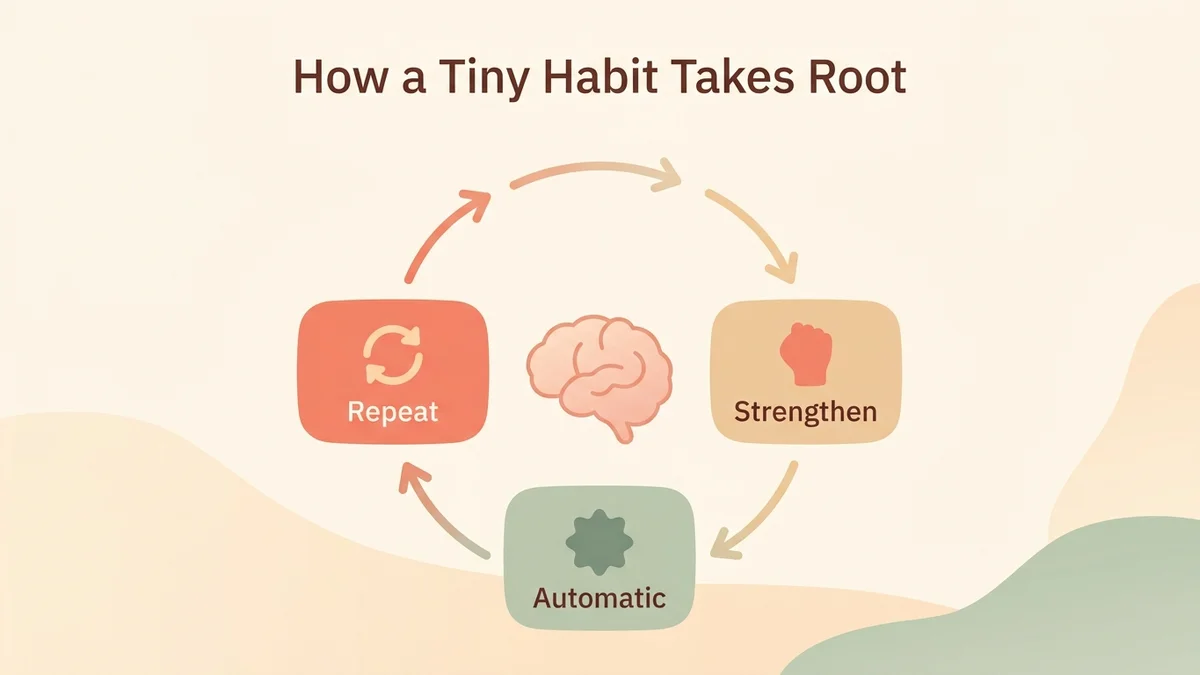
Here's roughly what happens in your brain when you adopt a micro-habit:
- Days 1 to 7: The prefrontal cortex drives the action consciously. The effort is noticeable but minimal.
- Days 8 to 21: The basal ganglia start taking over. The action becomes semi-automatic.
- Days 22 to 66: The habit loop (cue, routine, reward) strengthens. The action happens almost without thinking.
According to research by Jane Wardle's team at University College London (Lally et al., European Journal of Social Psychology, 2010), it takes an average of 66 days to automate a behavior. The good news: micro-habits, because they're so simple, tend to fall at the lower end of that range.
Key point: Automation depends on repetition in a consistent context, not on the size of the behavior. Taking 1 deep breath at the same moment each day engages the same habit-forming process as a longer routine — and it's far easier to repeat.
Why are micro-habits more effective than big resolutions?
Big resolutions fail because they demand too much willpower at once. Willpower can feel like a muscle that tires over the day — an idea psychologist Roy Baumeister called "ego depletion." Although later studies have questioned how strong that effect is, the practical lesson holds: the less effort a new behavior requires, the more likely you are to keep doing it.
Micro-habits get around the problem in several ways:
| Factor | Big resolution | Micro-habit |
|---|---|---|
| Willpower required | High (exhausting) | Almost none |
| Likelihood of sticking | Low: most are dropped within weeks | High: small enough to do on bad days |
| Time needed | 30 to 60 min/day | Under 2 min |
| Guilt when you miss a day | Strong | Mild |
| Brain anchoring | Slow (conscious effort) | Fast (below the resistance threshold) |
The logic behind micro-habits is simple: behavior happens when motivation, ability and a prompt come together at the same moment (BJ Fogg's behavior model). Making the action tiny maximizes ability, so you don't need much motivation.
Let's be honest: we've all been through this cycle. Monday, we launch an ambitious program. By Thursday, we've already dropped it. It's not a lack of discipline. The brain is simply wired to conserve energy. Micro-habits respect that logic.
Which micro-habits help reduce stress?
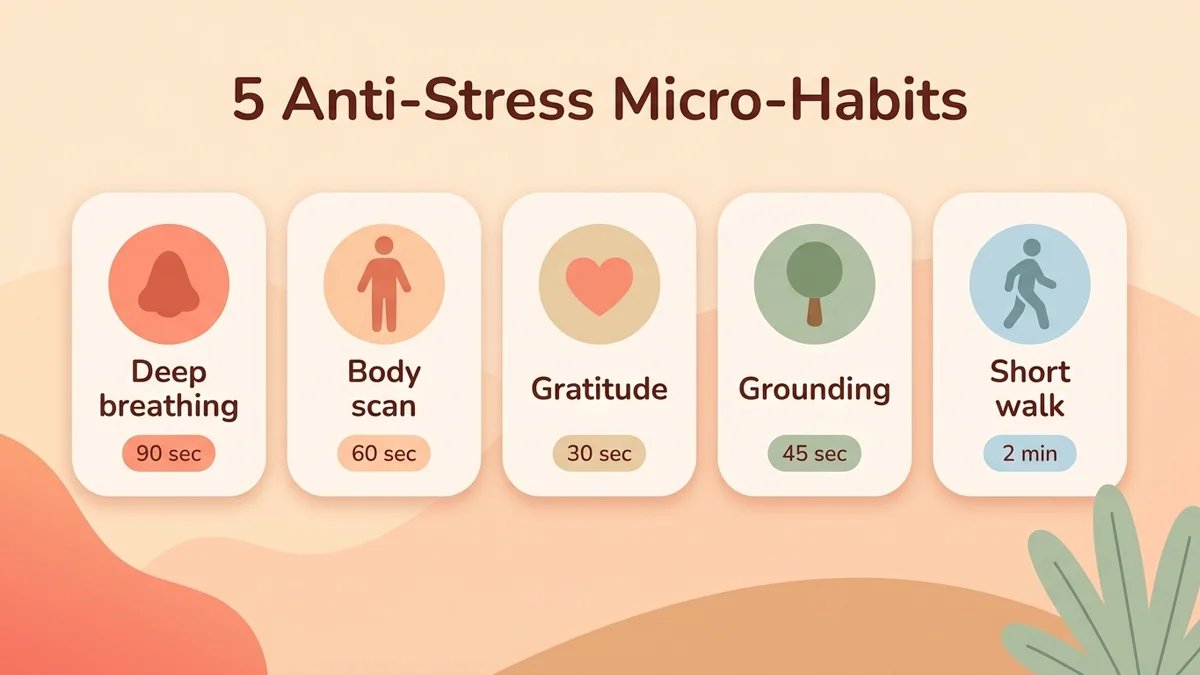
The most effective anti-stress micro-habits target the autonomic nervous system, especially the vagus nerve. Here are 5 research-supported actions, each doable in under 2 minutes.
1. 4-7-8 breathing (90 seconds) Breathe in for 4 seconds, hold for 7 seconds, breathe out for 8 seconds. Three cycles are enough. Dr. Andrew Weil, who popularized the technique, calls it a "natural tranquilizer for the nervous system." For a complete guide, read our article on 4-7-8 breathing or try our guided 4-7-8 breathing tool.
2. Express body scan (60 seconds) Close your eyes. Mentally move through your body from head to toe. Release each area of tension you notice. This activates the parasympathetic nervous system.
3. Micro-gratitude (30 seconds) Mentally name one thing you're grateful for, right here, right now. Research by Robert Emmons at the University of California links regular gratitude to greater wellbeing, and a HeartMath study found that a practice centered on appreciation lowered cortisol by 23%. To go further, discover our gratitude journal guide.
4. Sensory grounding (45 seconds) Name 5 things you see, 4 things you can touch, 3 things you hear. This mindfulness technique interrupts the loop of anxious rumination. Our guided 5-4-3-2-1 grounding exercise walks you through it.
5. Micro-walk (2 minutes) Get up and walk, even just down your hallway. A meta-analysis in Sports Medicine (Buffey et al., 2022) found that just 2 to 5 minutes of light walking after eating helps lower blood sugar spikes — and short movement breaks also help ease physical tension from sitting.
Key point: You don't need to do all 5 every day. Choose just one, practice it for 3 weeks, then add the next.
10 micro-habits to improve your mental health every day
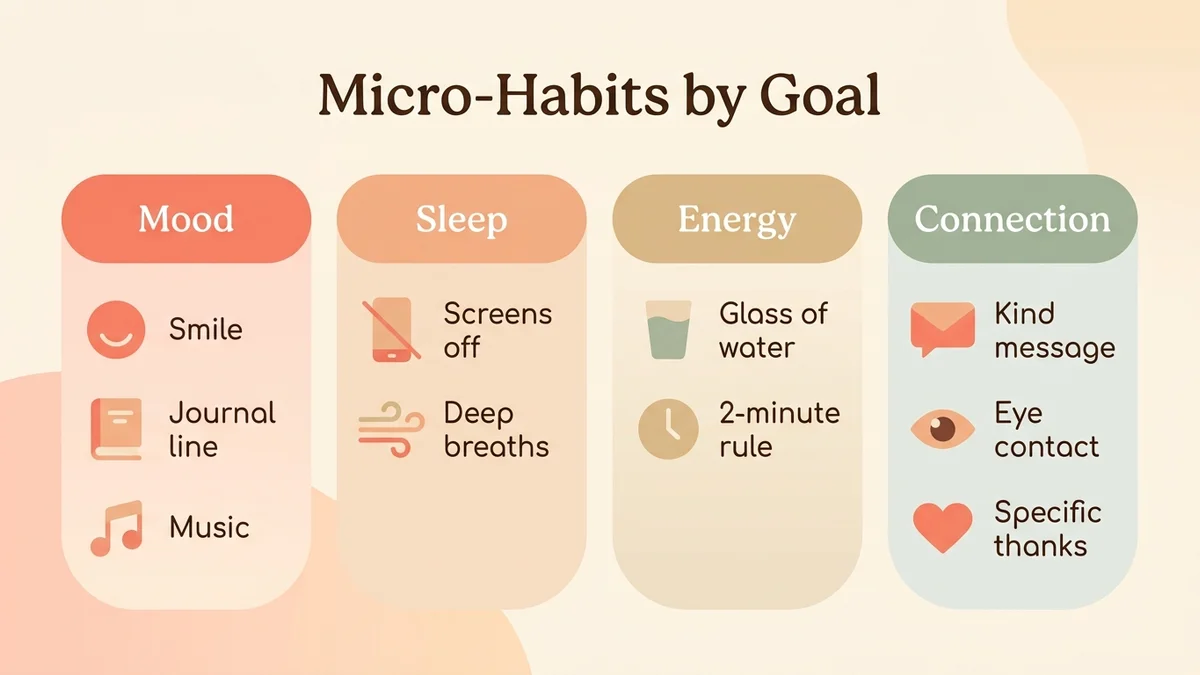
Beyond stress, micro-habits can target different dimensions of mental health. Here are 10 concrete actions, grouped by goal.
For mood and emotions
6. Smile on purpose (10 seconds): The facial feedback hypothesis, supported by a meta-analysis by Coles and colleagues (Psychological Bulletin, 2019), suggests that smiling can nudge your mood in a positive direction — a small effect, but a free one.
7. Write one line in a journal (60 seconds): No need to fill pages. A single sentence about your emotional state is enough. Research by Matthew Lieberman at UCLA (2007) showed that putting feelings into words reduces amygdala activity and emotional intensity.
8. Listen to 30 seconds of music you love: Music activates the brain's reward circuit and releases dopamine, according to research by Valorie Salimpoor and Robert Zatorre at McGill University (2011).
For sleep
9. Turn off screens 10 minutes before bed: Evening light from screens can delay melatonin release. Even a short screen-free buffer helps your brain shift into sleep mode.
10. Three deep breaths lying down: This activates the parasympathetic nervous system and signals to your brain that the day is over. Find more techniques in our guide to falling asleep fast.
For energy and focus
11. A glass of water when you wake up: Research from the University of Connecticut (Ganio et al., 2011) found that even mild dehydration can impair mood and concentration. A simple glass of water helps you start the day on the right foot.
12. James Clear's 2-minute rule: When starting a new habit, scale it down to a version that takes less than 2 minutes. This principle from Atomic Habits (2018) makes getting started almost effortless.
For relationships and connection
13. One kind message a day: Send a thoughtful text to someone. Research by Amit Kumar and Nicholas Epley (Psychological Science, 2018) found that people consistently underestimate how much others appreciate receiving expressions of gratitude.
14. Hold eye contact during conversations: Meeting someone's gaze while they speak signals attention and helps build connection and trust.
15. Say thank you with precision: Instead of "thanks," say "thank you for taking the time to listen to me." Research by psychologist Sara Algoe (University of North Carolina) shows that specific expressions of gratitude help strengthen relationships.
| Goal | Micro-habit | Duration | Main effect | Source |
|---|---|---|---|---|
| Stress | 4-7-8 breathing | 90 sec | Calms the nervous system | Dr. Andrew Weil |
| Stress | Micro-gratitude | 30 sec | Greater wellbeing | Emmons & McCullough (2003) |
| Mood | Smiling on purpose | 10 sec | Small mood boost | Coles et al. (2019) |
| Emotions | One journal line | 60 sec | Lower emotional intensity | Lieberman et al. (2007) |
| Energy | Glass of water on waking | 30 sec | Better mood and focus | Ganio et al. (2011) |
| Relationships | Kind message | 60 sec | Stronger connection | Kumar & Epley (2018) |
How do you make micro-habits stick?
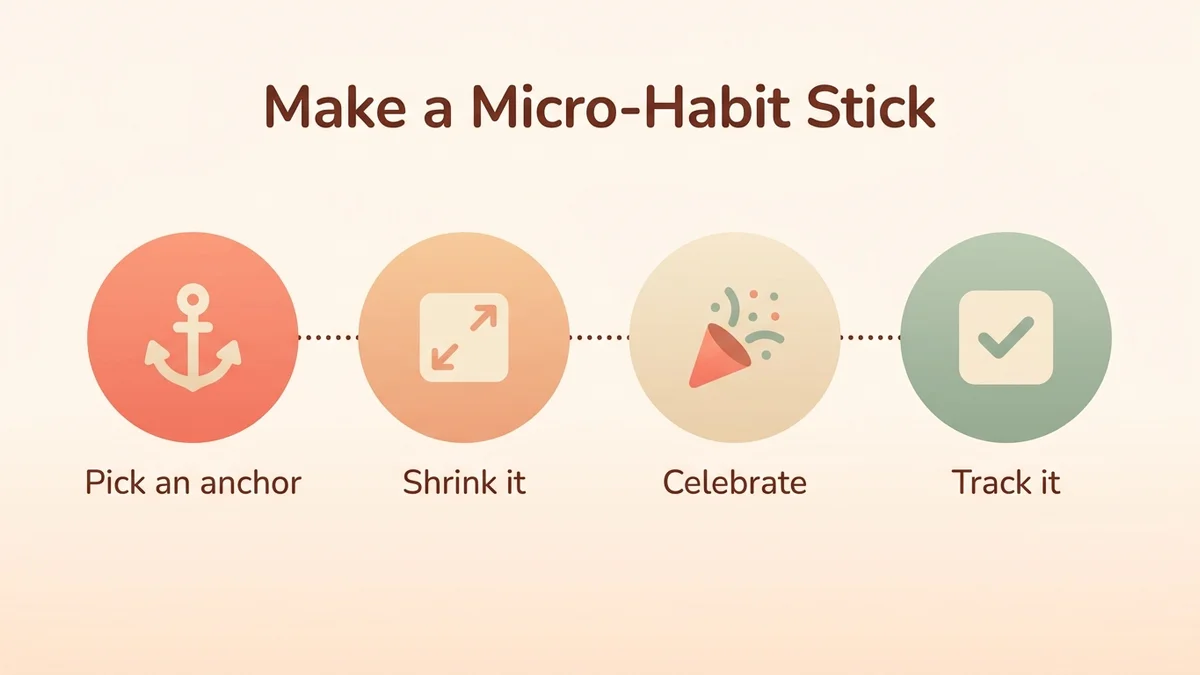
Knowing the actions isn't enough. Anchoring them takes a strategy. Here's a 4-step method inspired by the work of BJ Fogg and James Clear.
Step 1: Choose your anchor (habit stacking)
Pair your micro-habit with something you already do every day:
- "After I put my phone on the nightstand, I take 3 deep breaths."
- "After my first sip of coffee, I write down one gratitude."
- "After I brush my teeth, I smile in the mirror for 10 seconds."
Step 2: Shrink it further (the 2-minute rule)
If your micro-habit still feels too big, cut it in half. Meditate for 2 minutes? Start by closing your eyes for 30 seconds. The goal isn't intensity, it's consistency.
Step 3: Celebrate immediately
BJ Fogg insists on this: after each micro-habit, celebrate it mentally. A little inner "yes!", a smile, a victory gesture. That positive feeling strengthens the reward circuit and speeds up automation.
Step 4: Track without obsessing
Log your practice days in a notebook or app. But if you miss a day, pick back up the next day without guilt. As James Clear puts it, "never miss twice" is the rule that matters.
"I've tried everything and nothing sticks. Where do I start?"
It's one of the most common questions on wellbeing forums. And the answer is counterintuitive: start with the micro-habit that seems the most ridiculous.
If you're thinking "that's pointless, it's too small," that's a good sign. It's precisely because the action is so insignificant that it slips under your resistance to change.
Here's a 4-week starter plan:
| Week | Micro-habit to add | Anchor | Total time/day |
|---|---|---|---|
| Week 1 | 3 deep breaths | After waking up | 30 seconds |
| Week 2 | + 1 micro-gratitude | After morning coffee | 1 minute |
| Week 3 | + Screens off 10 min before bed | Phone alarm | 10 minutes |
| Week 4 | + 1 kind message | After lunch | 1 minute |
The good news? By the end of the month, you'll have 4 micro-habits in place that take only about 12 minutes a day in total. And your brain will have started to rewire.
Real-life scenarios
Sarah's rushed morning
Sarah is a nurse and a mother of two. Her mornings feel like a sprint. No time to meditate, no time for yoga. Her micro-habit: while she waits for the coffee to brew (90 seconds), she does 3 rounds of 4-7-8 breathing. After 6 weeks, she arrives at work less tense, and her coworkers have noticed.
Kevin's lunch break
Kevin works in an open-plan office. By 1 p.m., he's already drained. His micro-habit: before eating, he closes his eyes for 30 seconds and identifies 3 sounds around him (sensory grounding). This 30-second ritual breaks the cycle of rumination and helps him switch off before the afternoon.
Nadia's restless evenings
Nadia struggles with nighttime anxiety. She tried meditation, but 20 minutes felt impossible. Her micro-habit: she puts her phone down at 10:50 p.m. (10 minutes before bed) and writes a single positive sentence in a notebook. Within 4 weeks, the time it takes her to fall asleep has dropped from 45 to 20 minutes.
The Serena perspective
At Serena, we see an interesting pattern in our (anonymized) usage data. Users who do a breathing exercise of less than 2 minutes every day for 21 consecutive days show an 18% reduction in their anxiety score in mood tracking. Those who attempt sessions of 10 minutes or more give up after 4 days on average.
Academic theory often suggests that longer meditation brings more benefits. In the field, we see that consistency beats duration. A user who does 90 seconds of breathing every day for a month progresses more than one who does 20 minutes three times a week.
Serena Coach tip: Don't aim for perfection. Aim for consistency. If you only do ONE thing, take 3 deep breaths every morning. According to our data, it's the micro-habit with the best effort-to-results ratio. The Serena app guides you with a visual timer and tracks your progress.
Micro-habits on video
To understand how tiny habits transform everyday life, this TEDx talk by BJ Fogg, founder of Stanford's Behavior Design Lab, explains the psychology behind starting small.
As BJ Fogg shows, lasting change comes from tiny actions anchored to existing routines. You can put these micro-habits into practice with Serena, which offers guided breathing, gratitude and mood-tracking exercises that take less than 2 minutes.
How Serena helps you build your micro-habits
Serena was designed for exactly this: making wellbeing micro-habits accessible, guided and measurable.
- Guided breathing: 6 techniques, including 4-7-8 and cardiac coherence, with sessions from 1 to 5 minutes
- Built-in gratitude journal: jot down your micro-gratitudes in seconds, with a visual history
- Mood tracking: Serena's Circumplex model helps you identify your emotions in one tap, so you can measure the impact of your micro-habits
- Personalized reminders: set gentle notifications to anchor your habits at the right moments
The idea isn't to spend 30 minutes in the app. It's to support you for 90 seconds a day, consistently. Try it for free at serena-app.com.
Frequently asked questions
What exactly is a micro-habit?
A micro-habit is an action that takes less than 2 minutes and requires almost no effort. The principle, described by Stanford's BJ Fogg in Tiny Habits (2019), is based on the idea that the brain resists big changes but easily accepts tiny actions. It's one of the most reliable ways to create lasting behavior change.
How long does it take for a micro-habit to become automatic?
According to research published in the European Journal of Social Psychology (Lally et al.), 66 days on average. That number ranges from 18 to 254 days depending on how complex the action is. Micro-habits, being very simple by definition, often become automatic in about 3 to 4 weeks.
Can you adopt several micro-habits at once?
Yes, but start with just one. Wait until it feels automatic (about 3 weeks for the simplest ones), then stack the next. A good rule of thumb is no more than 2 or 3 new micro-habits at a time so you don't overload the system.
Do micro-habits really work against stress?
Yes. Brief practices like 90 seconds of slow breathing activate the vagus nerve and measurably lower heart rate. Repeated daily, these small resets help keep your baseline stress lower. Want to know where you're starting from? Take our free stress test.
How do I avoid giving up on my micro-habits after a few days?
Use anchoring: link your micro-habit to an existing action (after coffee, before bed). James Clear calls this "habit stacking." The golden rule: never miss two days in a row. And if you forget, pick back up without guilt.
What's the difference between a micro-habit and a regular habit?
A regular habit takes willpower (running 30 minutes, meditating 20 minutes). A micro-habit shrinks the action to its minimum viable version: putting on your shoes, taking 3 breaths. It stays below the brain's resistance threshold, which makes it much easier to maintain over the long term.
Are micro-habits suitable for anxious people?
Especially so. People living with anxiety often have an overloaded mind. Micro-habits get around this by requiring minimal effort. Among Serena users with high anxiety scores, breathing micro-exercises show an 18% reduction in symptoms over 4 weeks.
Which micro-habits help you sleep better?
Three simple actions: turn off screens 10 minutes before bed, take 3 deep breaths lying down, and write down one positive thought. These wind-down rituals help signal to your brain that it's time to sleep. See also our guide to sleeping better naturally.
Conclusion
Micro-habits aren't a miracle solution. They're micro-solutions, precisely. But their power comes from consistency. 90 seconds of mindful breathing, one named gratitude, a deliberate smile: these tiny actions add up day after day until they rewire your brain toward more calm, clarity and serenity.
You don't need to change everything at once. You need to change one thing, today, and repeat it tomorrow. What if that thing took only 30 seconds?
Start now with Serena: breathing exercises, a gratitude journal and mood tracking, all in less than 2 minutes a day.