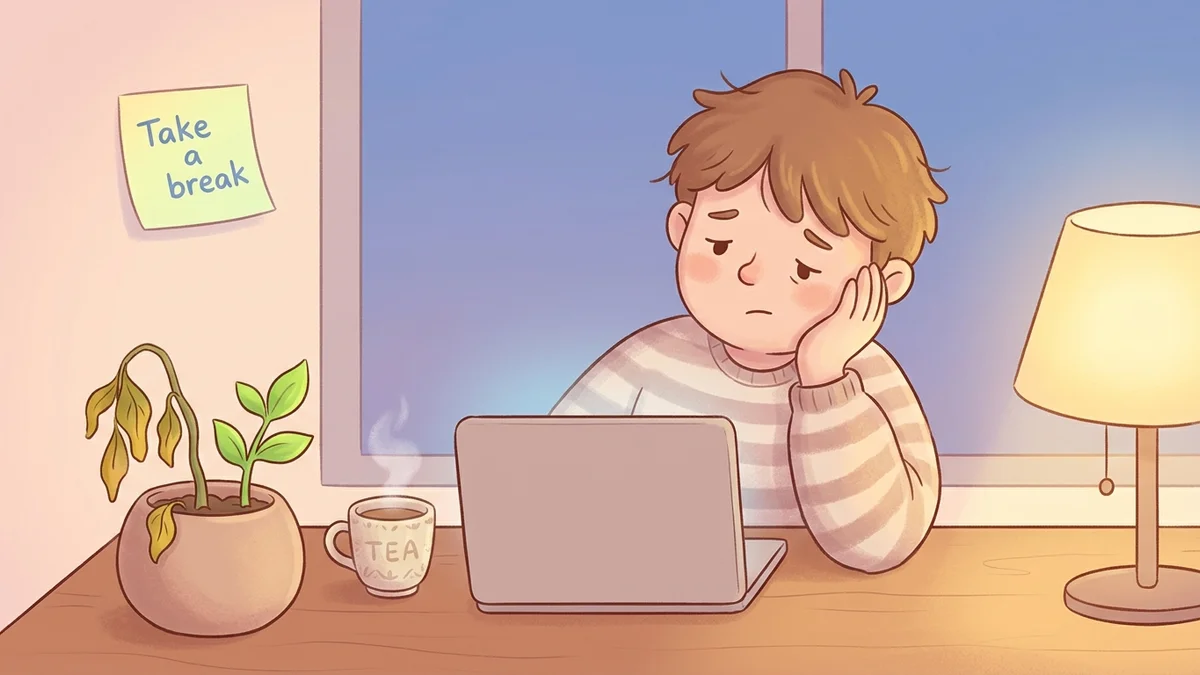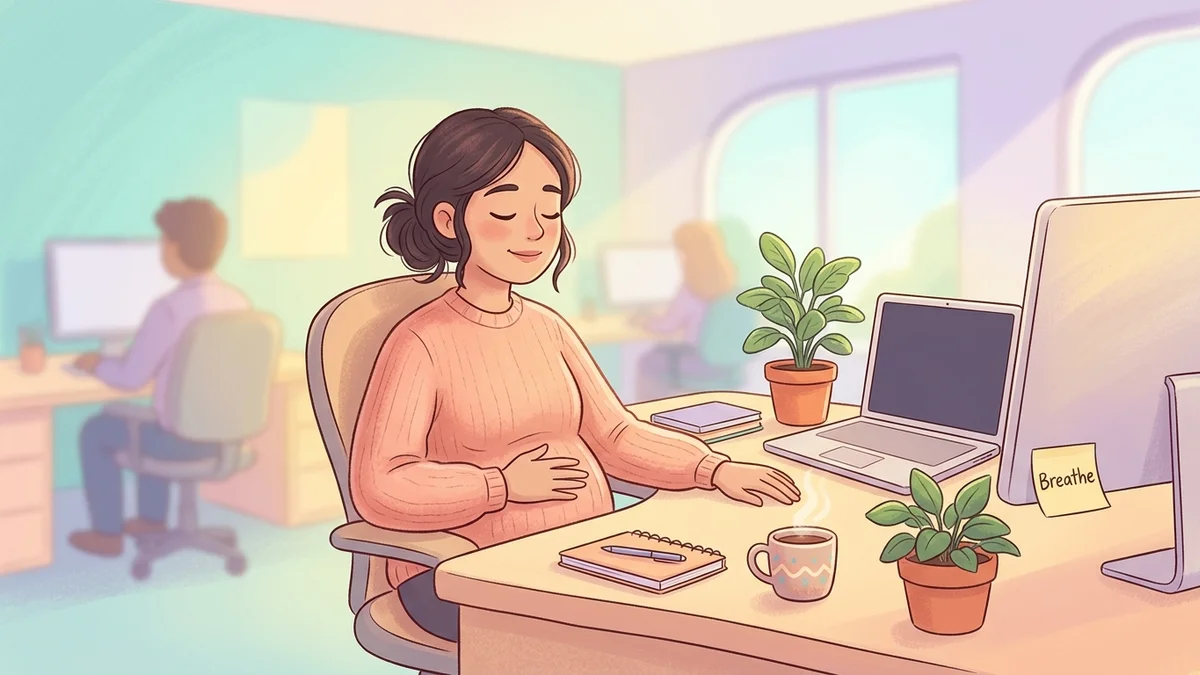
Your alarm goes off. Before you even open your eyes, that knot in your stomach is already there. You think about the 9 a.m. meeting, the 47 unread emails, the report your boss needed yesterday. Your jaw is clenched, your neck stiff. If this scenario sounds familiar, you're not alone — and above all, concrete solutions exist.
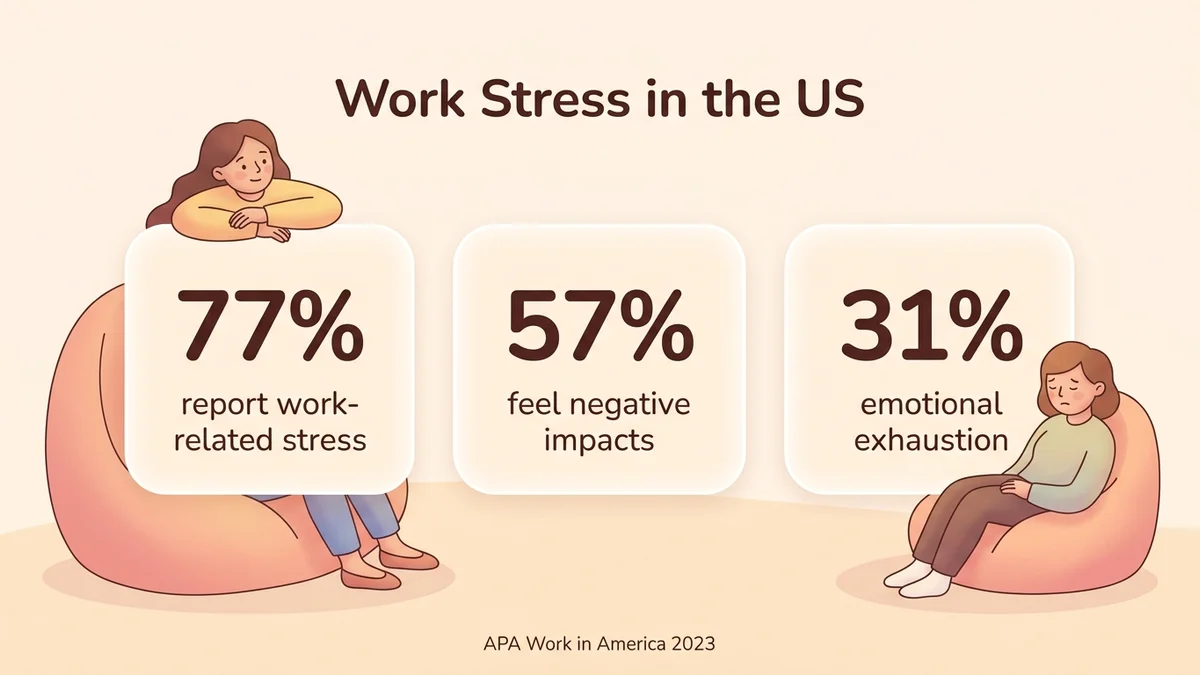
Updated in March 2026 — Work stress management has become a major issue. According to the American Psychological Association's Work in America survey (2023), 77% of US workers reported work-related stress in the past month, and 57% felt its negative effects. In this guide, you'll discover 12 scientifically proven techniques to take back control, with exercises you can do today — even between two meetings.
The key takeaways
Managing stress at work relies on science-backed techniques: cardiac coherence, belly breathing, mindfulness meditation and time management. Work stress is extremely common, and the first effects of controlled breathing are immediate. Regular practice for 4 to 8 weeks lastingly lowers cortisol and anxiety.
What are the signs of stress at work?
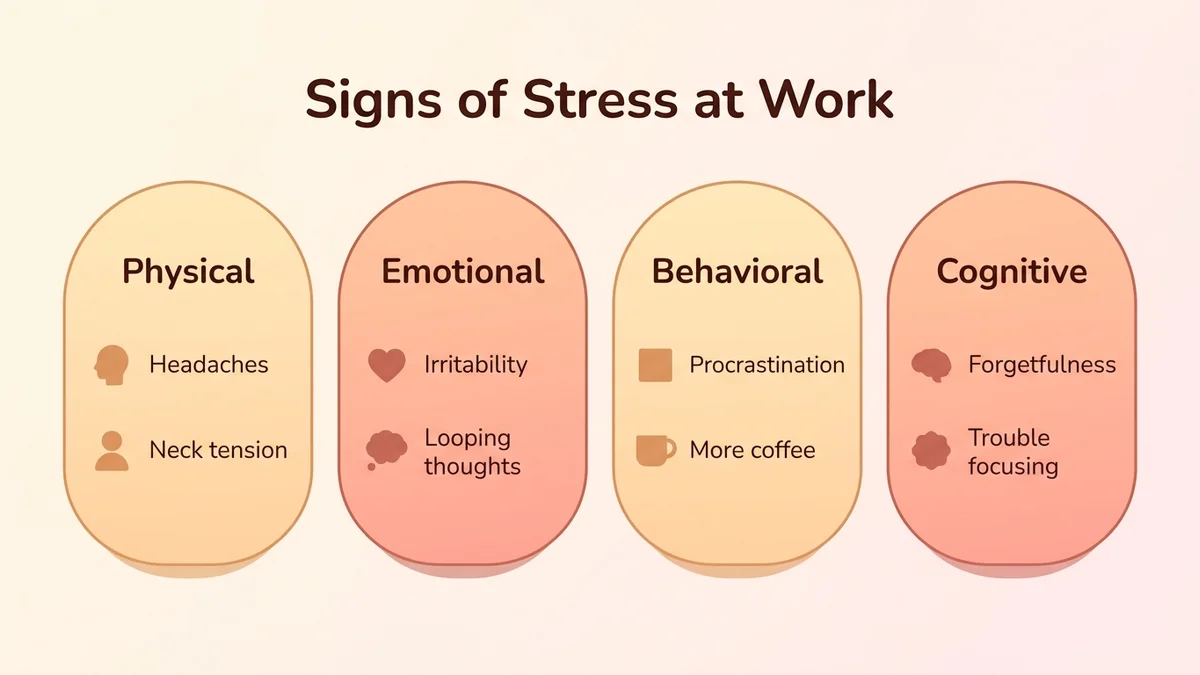
Work stress shows up through identifiable physical, emotional and behavioral symptoms. Warning signs include persistent fatigue, muscle tension, irritability, sleep problems and trouble concentrating. Recognizing these signs is the first step toward doing something about them.
You may be so used to your stress that you no longer see it. Here are the signals your body and mind are sending you:
| Category | Warning signs | What's happening |
|---|---|---|
| Physical | Headaches, neck tension, back pain | Cortisol keeps your muscles constantly tense |
| Physical | Digestive problems, morning nausea | The gut-brain axis reacts to chronic stress |
| Physical | Fatigue despite sleep, frequent infections | Your immune system weakens |
| Emotional | Irritability, impatience, unstable mood | The brain's amygdala is overactivated |
| Emotional | Anticipatory anxiety, looping thoughts | The prefrontal cortex loses its ability to regulate |
| Behavioral | Procrastination, withdrawal, more coffee or alcohol | Coping mechanisms in the face of exhaustion |
| Cognitive | Forgetfulness, unusual mistakes, trouble focusing | Your mental load exceeds your processing capacity |
Key point: If you check three or more signs in this table and they've lasted more than two weeks, your stress is no longer occasional — it's chronic. That's your signal to take action. You can gauge your level with our free stress test.
What are the main causes of work stress in 2026?
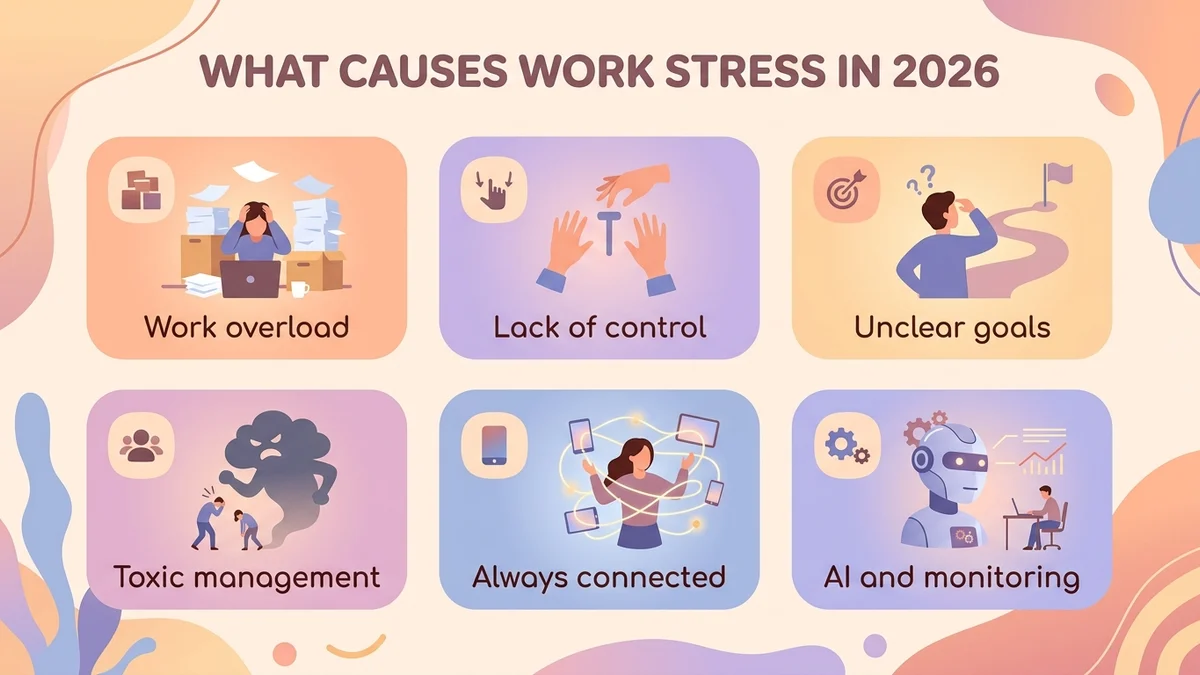
The causes of work stress are multifactorial. Workload, lack of control and job uncertainty make up the top trio, and new pressures have joined the classic ones.
In 2026, new factors are adding to the classic causes:
Organizational factors
- Work overload and mental load: too many tasks and too many channels competing for your attention
- Lack of autonomy: feeling you have little control over your decisions
- Unclear or conflicting goals: not knowing exactly what's expected of you
- Constant time pressure: ever-shorter deadlines and urgent tasks piling up
Relational and digital factors
- Toxic or absent management: lack of recognition is one of the leading causes of psychological strain at work, and can trigger anxious hypervigilance
- Hyperconnectivity and information overload: notifications, emails, instant messaging — the brain never switches off
- The impact of AI: AI and algorithmic monitoring are becoming a new source of worry and psychological pressure for many workers, according to the APA's 2023 Work in America survey
- Blurred work-life boundaries: especially when working remotely
According to the World Health Organization, depression and anxiety cost the global economy an estimated 12 billion working days and about $1 trillion in lost productivity every year.
Key point: Cognitive overload has become a leading stress factor in 2026. It's no longer just the volume of tasks that wears people out most, but the constant scattering of attention between emails, meetings, messaging and notifications.
12 proven techniques to manage stress at work
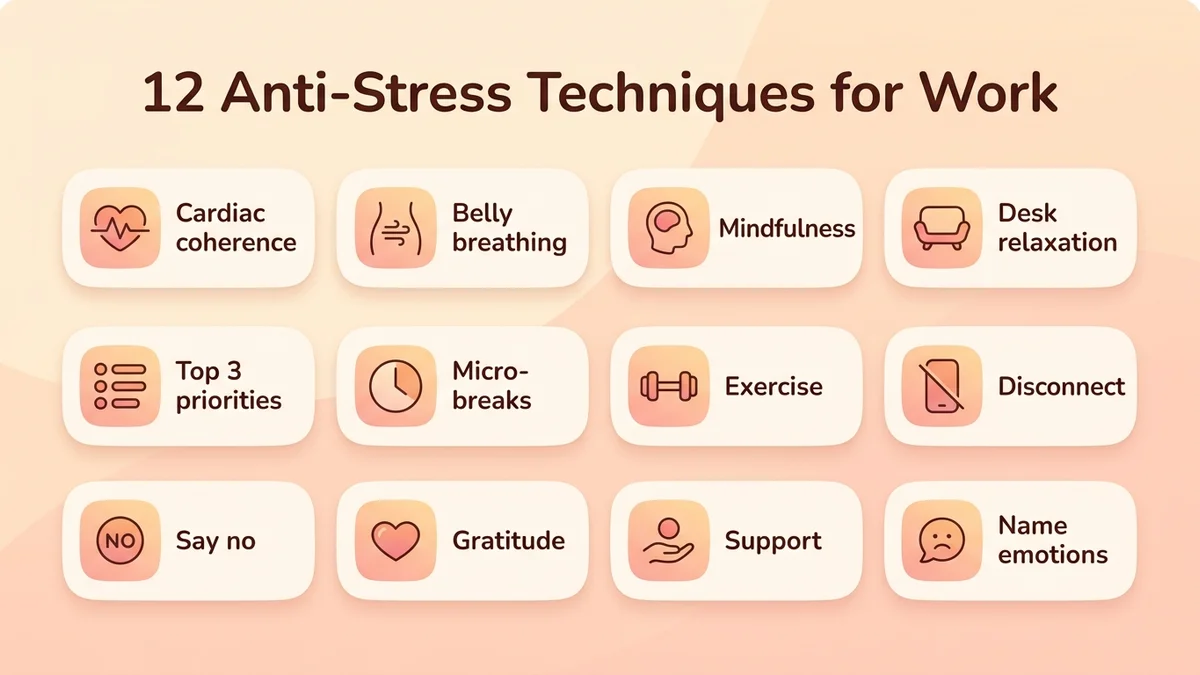
How do you actually manage stress at work? The key is to combine immediate-action techniques (breathing, relaxation) with foundational habits (organization, physical activity). Here are 12 research-backed methods, ranked by how easy they are to put into practice.
1. Cardiac coherence (the 3-6-5 method)
The fastest and best-documented technique. Cardiac coherence involves breathing 6 times per minute for 5 minutes, 3 times a day. Breathe in for 5 seconds, breathe out for 5 seconds.
Cardiac coherence at 6 breaths per minute activates the parasympathetic nervous system and lowers cortisol by 23% according to the HeartMath Institute (2023).
When to use it: before a stressful meeting, after a tense exchange, or simply morning, noon and afternoon. Try our free cardiac coherence timer.
2. Anti-stress belly breathing
Even simpler than cardiac coherence. Place a hand on your belly, breathe in through your nose, expanding your belly (not your chest), and breathe out slowly through your mouth. Five breaths are enough to activate the vagus nerve and calm the nervous system.
3. Mindfulness meditation
Ten minutes a day is enough. Focus on your breath, observe your thoughts without judging them, come back to your breath. According to a meta-analysis published in JAMA Internal Medicine, this practice significantly reduces anxiety within 8 weeks. Our mindfulness meditation guide walks you through it.
4. Quick relaxation at your desk
Relaxation techniques from sophrology and yoga combine breathing, muscle release and movement. A simple exercise: tense all the muscles in your body for 5 seconds as you breathe in, then release completely as you breathe out. Repeat 3 times.
As this desk yoga session from Yoga With Adriene shows, stress relief at work can fit into any office setting, right from your chair. You can practice a guided approach with Serena, which offers breathing exercises adapted to every situation.
5. Organization and time management
Stress often comes from feeling out of control. Every morning, identify your 3 priorities for the day. Use the Eisenhower matrix: urgent + important → do it now; important + not urgent → schedule it; urgent + not important → delegate it.
6. Active micro-breaks
Every 90 minutes, stand up for 2 minutes. Stretch your neck, roll your shoulders, walk to the window. These micro-breaks interrupt the tension cycle and restore focus. Research shows they can boost productivity by 15%.
7. Regular physical activity
Exercise releases endorphins and lowers cortisol. According to a meta-analysis in the British Journal of Sports Medicine (2024), 30 minutes of moderate activity 3 times a week reduce stress symptoms by 40%. Even a 20-minute walk at lunch makes a real difference.
8. Intentional digital disconnection
Turn off non-essential notifications. Set email-free windows (for example, before 10 a.m. and after 4 p.m.). If you work remotely, create an end-of-day ritual — close your laptop, change rooms. Disconnecting digitally is one of the most effective levers for preventing burnout.
9. Assertive communication
Learn to say "no" without guilt and to express your needs clearly. The DESC formula works well: Describe the situation, Express how you feel, Specify your request, Conclude positively. It reduces interpersonal tension, a major source of stress.
10. A work gratitude journal
Every evening, write down 3 positive things from your workday — even small ones. According to the University of California (2023), this practice increases subjective wellbeing by 25% in 4 weeks. You can keep your journal in Serena, which includes a dedicated gratitude module.
11. A support network
Don't stay isolated. Talk to a colleague you trust, reach out to an employee assistance program (EAP) if your company has one, or see a therapist. Workplace mental health is increasingly discussed openly, and asking for help is a sign of strength, not weakness.
12. Daily emotional tracking
Identifying your emotions is the first step toward regulating them. Take 30 seconds each day to name what you're feeling: stressed, frustrated, anxious, tired? Research in affective neuroscience shows that simply putting feelings into words ("affect labeling") calms amygdala activity.
| Technique | Duration | Immediate effect | Long-term effect |
|---|---|---|---|
| Cardiac coherence | 5 min | Cortisol -23% | Greater resilience |
| Belly breathing | 2 min | Nervous system calm | Automatic regulation |
| Mindfulness meditation | 10 min | Mental clarity | Less anxiety in 8 weeks |
| Active micro-breaks | 2 min | Muscle release | Productivity +15% |
| Physical activity | 30 min | Endorphins | Stress -40% |
| Gratitude journal | 5 min | Positive perspective | Wellbeing +25% |
Anti-stress exercises to do at your desk in 5 minutes
You don't need a yoga mat or a meditation room. Here are three exercises you can do sitting at your desk, discreetly, in under 5 minutes.
Exercise 1 — Box breathing (2 minutes) Breathe in for 4 seconds → Hold for 4 seconds → Breathe out for 4 seconds → Hold with empty lungs for 4 seconds. Repeat 6 cycles. Ideal right before a presentation or a stressful call.
Exercise 2 — Express body scan (2 minutes) Close your eyes. Mentally move through your body from head to toe. At each area of tension you notice (jaw, shoulders, belly), breathe into that area and release it as you breathe out.
Exercise 3 — 5-4-3-2-1 sensory grounding (1 minute) Silently name 5 things you can see, 4 you can hear, 3 you can touch, 2 you can smell, 1 you can taste. This exercise instantly brings you back to the present and cuts off anxious thoughts. It's an effective technique for letting go quickly.
Real-life scenarios
Monday morning with a knot in your stomach
You're on the train, and your week is already replaying in your head. Your heart speeds up. What you do: put in your earbuds and start 5 minutes of guided cardiac coherence in Serena. Breathe in for 5 seconds, breathe out for 5 seconds. By the time you reach the office, your heart rate has come down and your mind is clear. You start with your 3 priorities for the day — not your emails.
A meeting with your boss's boss in 10 minutes
A senior executive has called you into a meeting. Your stomach knots up, your palms are sweaty. What you do: in the restroom, 6 deep belly breaths. Then the 5-4-3-2-1 grounding to bring yourself back to the present. You walk into the room focused, not panicked. You listen first, then respond.
A critical email at 6 p.m. on a Friday
A coworker copies you on an accusatory email. The adrenaline rises. The temptation is to reply right away. What you do: close the email. Log your emotion in Serena (frustration, anger). Apply the 24-hour rule: you'll reply on Monday, with a cool head, using the DESC method. Over the weekend, you do an evening meditation to set down the emotional weight.
The Serena perspective
Anonymized Serena usage data reveals an interesting finding: users who do 2-minute breathing micro-sessions 3 to 4 times a day get better results on their perceived stress level than those who do a single long 15-minute session. This matches research on cardiac coherence and Dr. O'Hare's 3-6-5 method.
Another real-world observation: the most popular time for a breathing session is 8:45 a.m. — right before the workday begins. The second peak is 1:30 p.m., after the lunch break. That confirms transitions are the most stressful moments.
Theory recommends 10 minutes of meditation a day. In practice, our most consistent users do 3 to 5-minute sessions — and that's enough to see measurable improvements within 4 weeks.
Serena Coach tip: Don't aim for perfection. Start with a single breathing micro-session a day, always at the same time. The habit matters more than the duration. Within 2 weeks, you'll feel the difference — and you'll naturally want to add a second session.
Which anti-stress solution fits your profile?
Every work stress situation is unique. Here are personalized recommendations for your profile:
If you're new to stress management
Never tried guided breathing or meditation? Start with cardiac coherence: it's the simplest technique (breathe in for 5 seconds, breathe out for 5 seconds) and the effects are immediate. Serena offers a visual guided mode that walks you through it breath by breath — no prior experience needed.
For anxiety around meetings and public speaking
Does your stress spike before every presentation or important meeting? Combine box breathing (2 minutes beforehand) with 5-4-3-2-1 sensory grounding. Serena includes short 2-minute sessions designed for exactly these urgent moments.
For busy working parents
You're juggling meetings, school runs and household tasks. Your mental load is maxed out. Favor 2-minute micro-breaks and an evening gratitude journal (3 positive things). Serena sends you a gentle reminder at the time you choose — not one more notification, but a moment for yourself.
For remote work and isolation
Without a physical boundary between office and home, your bearings get blurry. Create transition rituals: cardiac coherence in the morning to "open" the day, an evening meditation to "close" it. Serena helps you structure your remote workday, with mood tracking to catch dips before they settle in.
To find out which approach suits you best, check out our comparison of meditation and wellbeing apps.
Frequently asked questions
How do you talk to your manager about stress?
Choose a calm moment, one-on-one. Describe concrete facts — workload, deadlines, interruptions — rather than just your emotions. Propose solutions: reorganizing priorities, adjusting your schedule. Managers are more receptive when the problem is presented in a factual, constructive way.
Do employers have obligations to prevent stress?
In the US, no federal law specifically requires employers to prevent work stress, but workers do have protections. The Americans with Disabilities Act (ADA) may require reasonable accommodations for mental health conditions, the Family and Medical Leave Act (FMLA) can give eligible employees job-protected leave, and OSHA encourages employers to address psychosocial risks as part of overall worker wellbeing.
What's the difference between normal stress and chronic stress?
Normal stress is occasional and energizing — it fades once the situation is resolved. Chronic stress persists for weeks or months, keeping cortisol permanently high. If symptoms last beyond 3 weeks, it's recommended that you see a health professional.
Is meditation really effective against work stress?
Yes. Research shows that a regular mindfulness practice significantly reduces anxiety within 8 weeks. It acts directly on the amygdala — the brain's fear center — by reducing its overactivation. Mindfulness pioneers like Jon Kabat-Zinn recommend it as an everyday tool.
How long does it take to reduce stress at work?
The first effects of controlled breathing are immediate: cortisol drops within 5 minutes. For lasting results, allow 4 to 8 weeks of regular practice. The key is consistency: 3 minutes every day beats 30 minutes once a week.
Does remote work reduce or increase stress?
Both. It reduces the stress of commuting and the constant interruptions of open-plan offices. But it increases social isolation and makes it harder to disconnect. The key is to structure your day with clear rituals to start and end work.
Which apps help manage stress at work?
Apps that combine guided breathing, emotional tracking and meditation show the best results. Serena offers 6 breathing techniques, mood tracking based on the Circumplex model and a gratitude journal. The basic breathing exercises are free.
What are the benefits of cardiac coherence at the office?
Cardiac coherence at 6 breaths per minute lowers cortisol by 23%, increases DHEA (an anti-stress hormone) by 100% and improves focus according to the HeartMath Institute (2023). Five minutes is enough to feel the effects — the perfect length between two meetings.
Conclusion
Managing stress at work isn't a luxury — it's a necessity. With more than three-quarters of US workers reporting work-related stress, it's time to move from awareness to concrete action.
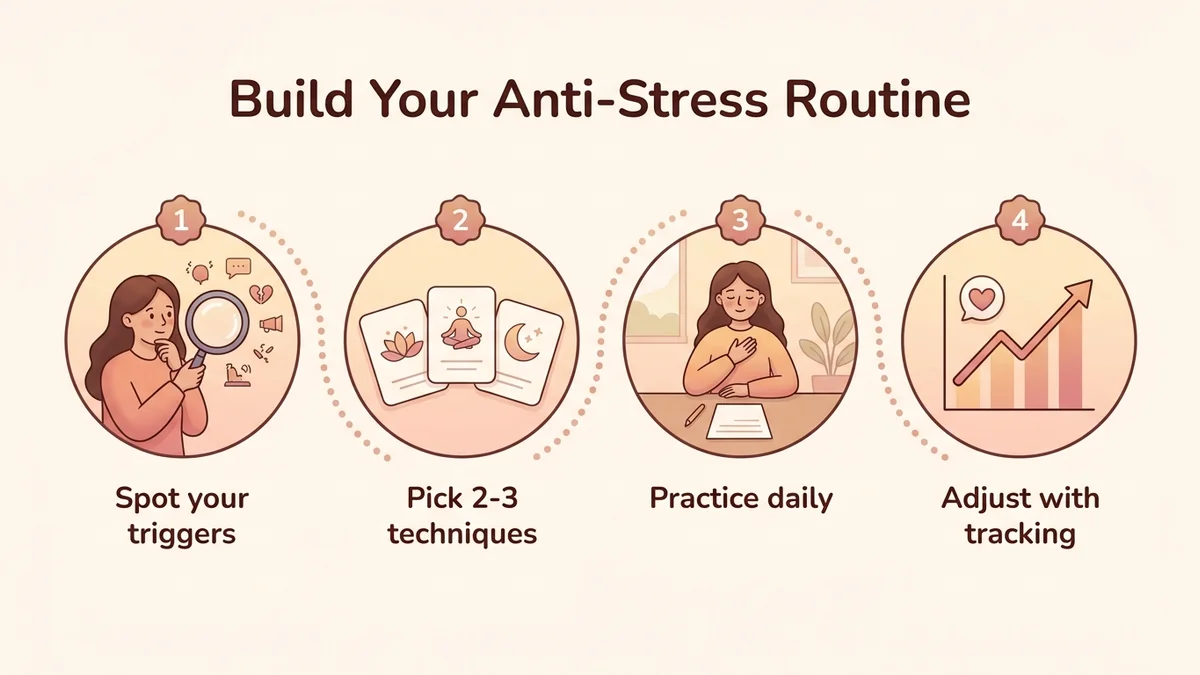
You don't need to change everything at once. Start with a single technique — 5 minutes of cardiac coherence, an active micro-break, or simply naming the emotion you're feeling right now. Add more gradually, at your own pace.
Workplace mental health is finally being talked about more openly. That's a collective first step. Yours is to take 5 minutes today to give it a try.
Serena supports you every day with guided breathing exercises, smart mood tracking and a gratitude journal — everything you need to transform your relationship with work stress. The basic exercises are free: try your first cardiac coherence session now.