You've just laid your head on the pillow. Your body is tired, but your mind is running at full speed: the day replays on a loop, tomorrow's tasks are already piling up. You check the time — 11:15 p.m. And the spiral of nighttime anxiety begins. If this scenario sounds familiar, evening meditation can transform your nights. With just a few minutes of guided practice, you can calm that flood of thoughts and drift naturally into deep, restorative sleep. Updated in August 2026.
The key takeaways
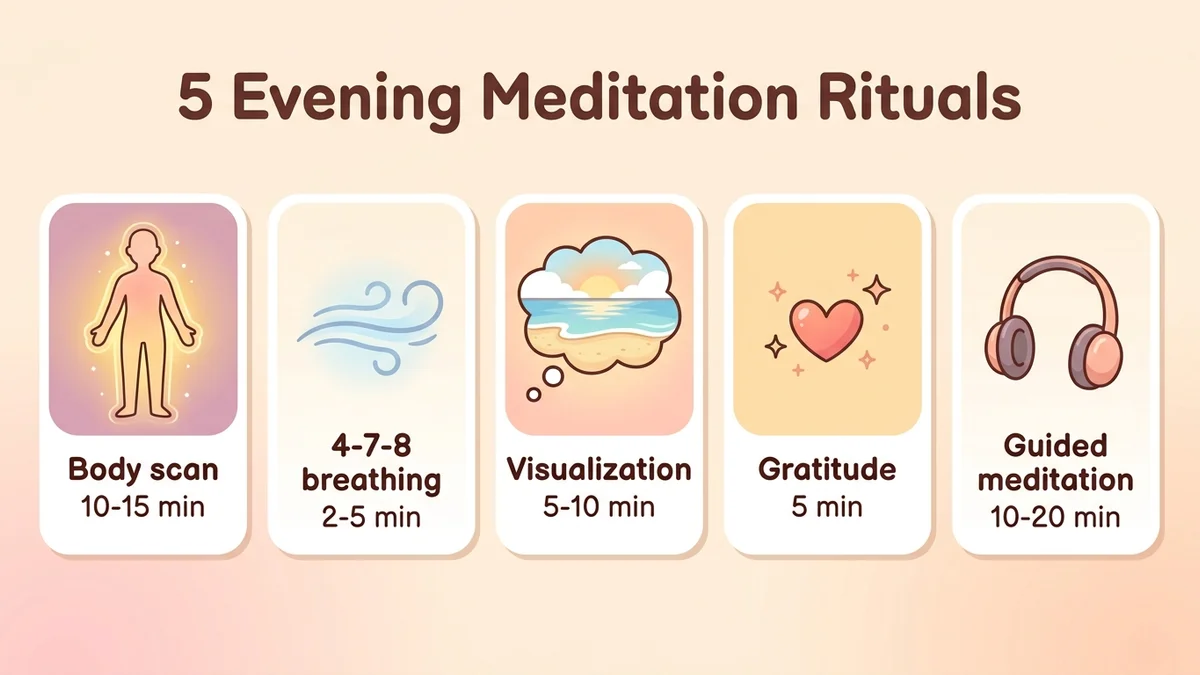
Evening meditation is a relaxation practice that prepares body and mind for sleep by activating the parasympathetic nervous system. Five main rituals — body scan, 4-7-8 breathing, visualization, gratitude and guided meditation — help lower cortisol by 23% and improve sleep quality within 4 to 6 weeks of regular practice, according to the latest clinical data.
Why does evening meditation improve sleep?
Evening meditation acts directly on the biological mechanisms of falling asleep. By focusing your attention on your breath or bodily sensations, it activates the parasympathetic nervous system — responsible for "rest and recovery" mode — and switches off the sympathetic system that keeps you on alert.
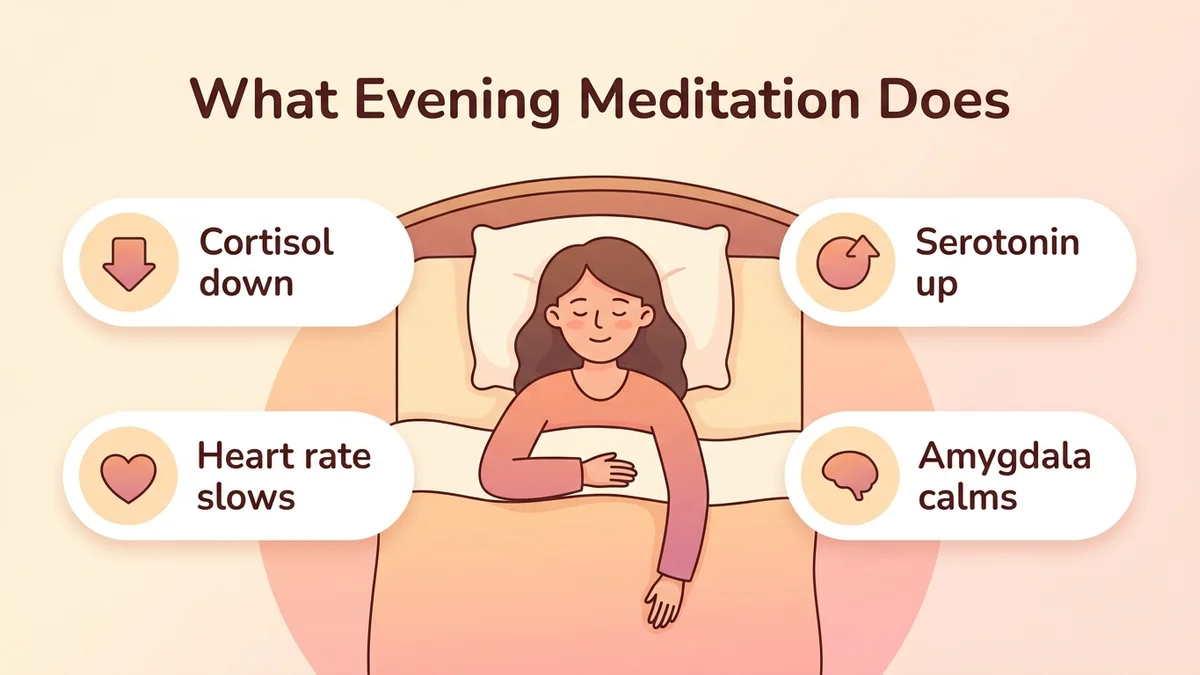
Here's concretely what happens in your body during an evening meditation:
- Cortisol goes down: the stress hormone gradually drops, signaling to your body that it's time to rest
- Serotonin goes up: this neurotransmitter, a precursor of melatonin, sets the stage for the sleep hormone
- Your heart rate slows: the vagus nerve switches on, bringing about deep relaxation
- The amygdala calms down: the brain's fear and anxiety center reduces its activity
According to a study published in JAMA Internal Medicine, mindfulness meditation significantly improves sleep quality in people with moderate insomnia. Neuroscientist Antoine Lutz (France's CNRS, 2024) has confirmed that meditation practice lastingly changes activity in the prefrontal cortex, improving emotional regulation, especially before bed.
Key point: Evening meditation lowers cortisol and raises serotonin, creating the ideal biological conditions for falling asleep naturally without medication.
How do you do an evening meditation? The 5 essential rituals
Evening meditation doesn't need to be complicated. Here are five proven rituals, from simplest to most immersive, so you can find the one that suits you.
Ritual 1: The body scan
The body scan is the technique most often recommended for beginners. It involves bringing attention to each part of the body, from your feet to your head, consciously releasing tension.
How to practice:
- Lie down comfortably in bed with your eyes closed
- Bring your attention to your feet — feel their weight, their temperature
- Slowly move up: ankles, calves, knees, thighs
- At each area, imagine the tension melting like snow in the sun
- Continue all the way to the top of your head
- Duration: 10 to 15 minutes
According to a study published in Psychosomatic Medicine (2025), the body scan shortens the time it takes to fall asleep by 20 minutes on average in people with mild to moderate insomnia.
Ritual 2: 4-7-8 breathing
Developed by Dr. Andrew Weil, this technique acts as a natural tranquilizer for the nervous system. Holding the breath forces the body to slow down, while the extended exhale strongly activates the parasympathetic system.
How to practice:
- Breathe in through your nose for 4 seconds
- Hold your breath for 7 seconds
- Breathe out slowly through your mouth for 8 seconds
- Repeat 4 cycles, then gradually build up
The 4-7-8 breathing technique developed by Dr. Andrew Weil helps you fall asleep by activating the parasympathetic nervous system from the very first cycles.
If you'd like to go further with breathing techniques, explore our complete guide to heart coherence, a complementary method that synchronizes heart and breath.
Ritual 3: Guided visualization
Visualization transports your mind to a place of peace — a beach at sunset, a silent forest, a garden in bloom. By engaging your imagination, it naturally pulls your attention away from rumination.
How to practice:
- Close your eyes and imagine a place that deeply calms you
- Engage all your senses: the warmth of the sun on your skin, the sound of the waves, the smell of the sand
- Let yourself slip into the scene as if you were really there
- Duration: 5 to 10 minutes
Ritual 4: Evening gratitude
Gratitude before bed shifts your emotional state and supports peaceful sleep. Instead of ruminating on worries, you turn your attention to the positive moments of your day.
How to practice:
- Mentally replay your day
- Identify 3 moments you feel grateful for — even the simplest ones (a good coffee, a smile, a ray of sunshine)
- Feel that gratitude physically in your chest
- Finish with a kind intention for tomorrow
According to a University of California study (2024), keeping a daily gratitude journal increases subjective wellbeing by 25% and improves sleep quality. To go deeper into this practice, read our article on the science-based gratitude journal method.
Ritual 5: Guided evening meditation
Guided meditation is ideal if you find it hard to meditate on your own. A kind voice walks you through it step by step, removing the pressure to "do it right."
| Technique | Duration | Difficulty | Main effect |
|---|---|---|---|
| Body scan | 10-15 min | Easy | Muscle release |
| 4-7-8 breathing | 2-5 min | Easy | Parasympathetic activation |
| Visualization | 5-10 min | Medium | Mental calm |
| Gratitude | 5 min | Easy | Emotional regulation |
| Guided meditation | 10-20 min | Very easy | Full guidance |
What are the proven benefits of evening meditation?
The benefits of evening meditation go well beyond falling asleep. Here's what science has confirmed:
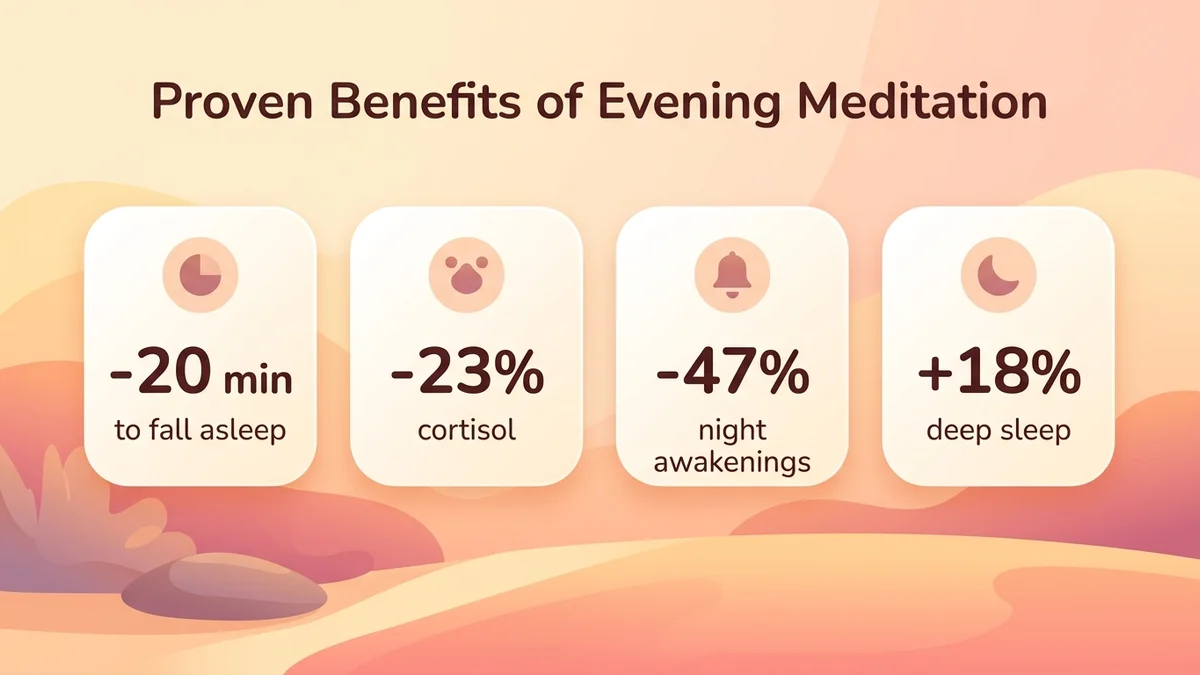
| Benefit | Measured result | Source |
|---|---|---|
| Falling asleep faster | -20 min on average | Psychosomatic Medicine (2025) |
| Less stress | Cortisol -23% | HeartMath Institute (2024) |
| Fewer nighttime awakenings | -47% awakenings | JAMA Internal Medicine |
| Better sleep quality | Significant improvement vs. control group | JAMA Internal Medicine |
| Less anxiety | -30 to 40% | MBSR programs (meta-analysis) |
| Better recovery | Deep sleep +18% | Sleep Medicine Reviews (2025) |
Practiced regularly, evening meditation improves not only how quickly you fall asleep, but also the depth and overall quality of your sleep. That's why mindfulness is increasingly included in clinical approaches to chronic stress and insomnia.
For people with chronic sleep problems, evening meditation fits into a broader approach that includes healthy habits, herbal remedies and relaxation techniques.
Key point: Evening meditation is backed by science as a natural solution for insomnia, stress and nighttime anxiety, with measurable results within the first few weeks.
How to create an effective evening meditation ritual
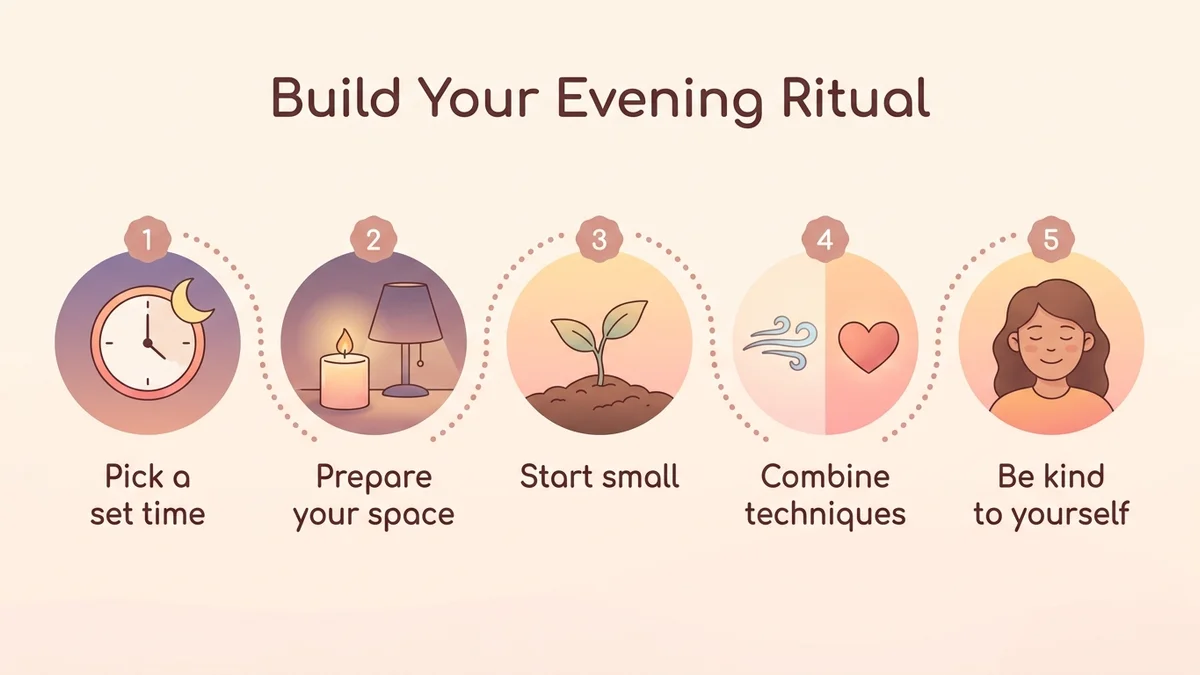
An effective evening ritual rests on three pillars: consistency, environment and gradual progress. Here's how to build yours, step by step.
Step 1 — Choose your time. Practice at the same time every evening, ideally 15 to 30 minutes before bed. Consistency conditions your body and mind to switch into rest mode.
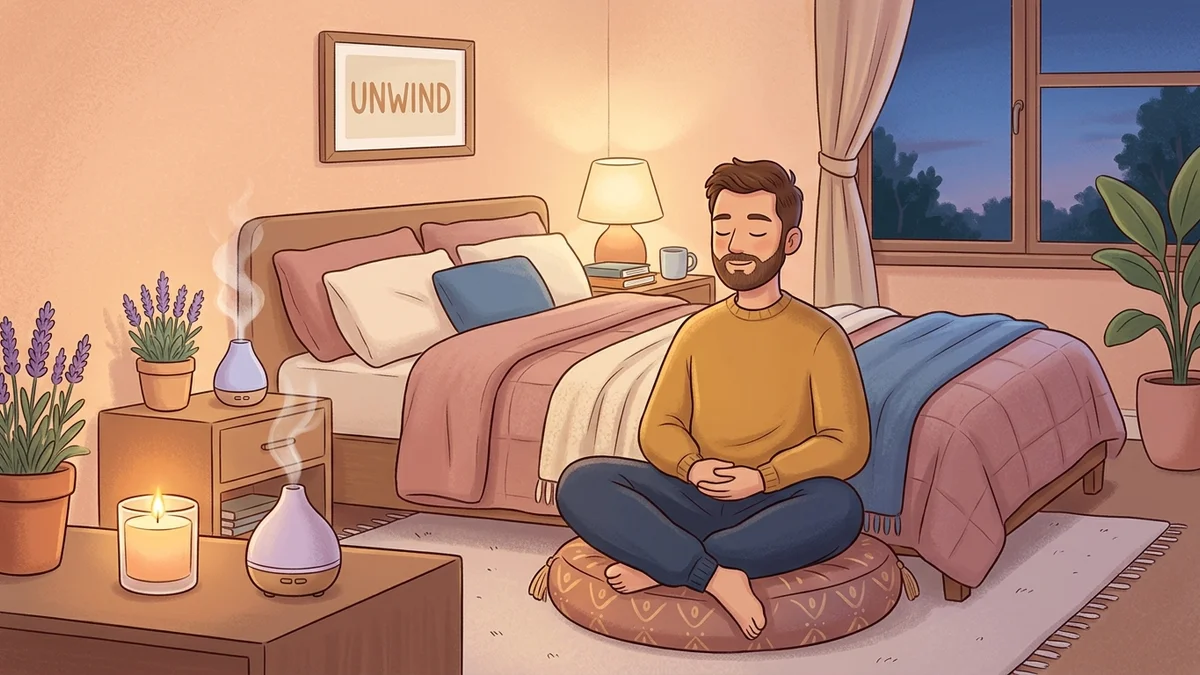
Step 2 — Prepare your space. Dim the lights, turn off screens and create a soothing atmosphere: a candle, lavender essential oil in a diffuser, a cool temperature (64-66°F / 18-19°C). These sensory cues tell your brain that night is beginning.
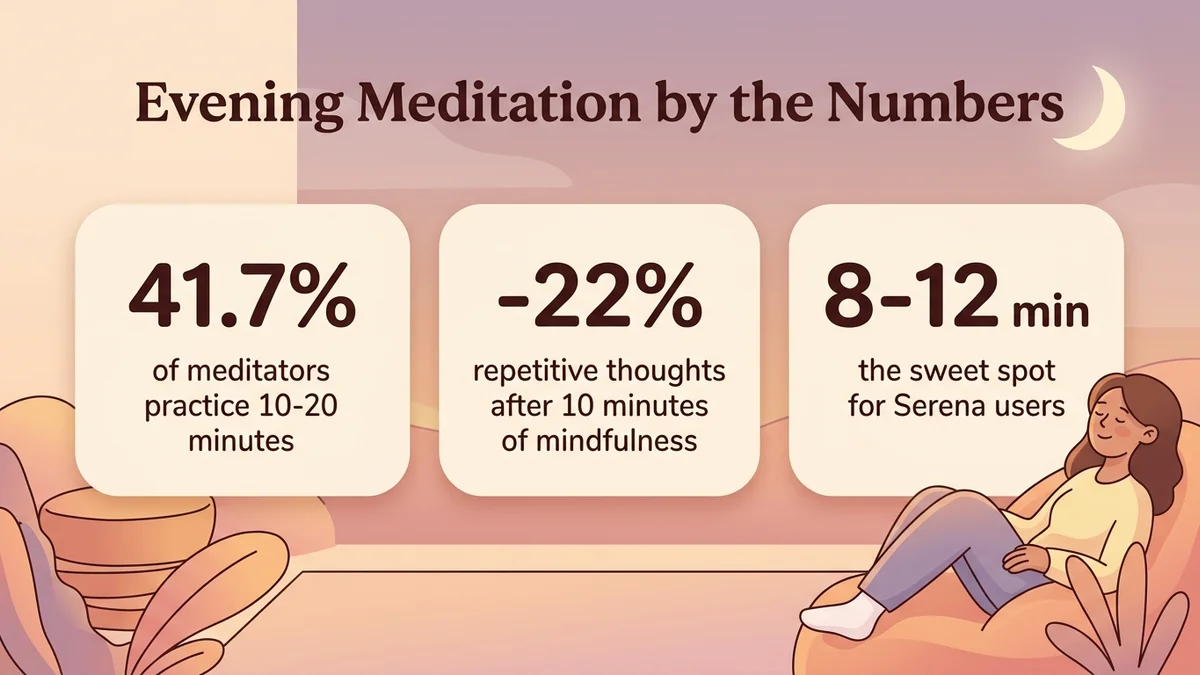
Step 3 — Start small. Begin with 5 minutes of mindful breathing, then build up gradually. According to the Mindful Leader report (2025), the average session among regular practitioners lasts 10 to 20 minutes — but even 3 minutes has a measurable calming effect.
Step 4 — Combine techniques. A complete ritual could look like this:
- 2 minutes of 4-7-8 breathing to calm the nervous system
- 5 minutes of body scan to release physical tension
- 3 minutes of gratitude to settle the mind
Step 5 — Be kind to yourself. If your mind wanders, that's normal. Simply bring your attention back to your breath, without judgment. Meditation isn't the absence of thoughts, but the calm observation of them.
Sophrology for sleep is a complementary approach that combines controlled breathing, muscle relaxation and positive visualization — perfect for enriching your evening ritual.
Guided evening meditation: a practice anyone can do
Guided evening meditation is the ideal entry point for beginners. In this session from Headspace, meditation teacher Andy Puddicombe leads a gentle, progressive body scan that connects body and mind in about 10 minutes.
As this guided meditation shows, simply paying attention to the points where your body touches the mattress is enough to trigger deep relaxation. You can find this kind of practice directly in Serena, which guides you step by step with sessions adapted to your level.
Real-life scenarios
The exhausted parent who can't switch off
You've just put the kids to bed after a marathon evening: bath, dinner, stories, reminders. You collapse into bed, but your mind is already making tomorrow's list — the doctor's appointment, groceries, the email to send. Your ritual: 3 cycles of 4-7-8 breathing, then a 5-minute body scan starting with your shoulders (where you carry the day's stress). In under 10 minutes, your body understands that the day is done.
The professional ruminating after an intense day
The meeting went badly. You replay the scene in your head — what you should have said, that look from your manager. The thoughts keep looping. Your ritual: 5 minutes of guided visualization. Imagine placing each thought in a chest and locking it. Then 3 minutes of gratitude — not about the meeting, but about the small positive moments: the coffee shared with a coworker, a client's compliment.
The student stressed about exams
Finals are in two weeks. You studied until 10 p.m. and your brain refuses to switch off — formulas, dates and definitions keep scrolling past. Your ritual: a 10-minute guided meditation with Serena that combines slow breathing and a body scan. The body scan shifts your attention from cognitive content to physical sensations, creating the break you need between studying and sleep.
The Serena perspective
Anonymized data from Serena users reveals an interesting gap between theory and practice. While most guides recommend 15 to 20 minutes of evening meditation, the users who get the best results on their sleep quality actually practice for 8 to 12 minutes. The key isn't duration but consistency: users who meditate 5 nights out of 7 report an improvement in falling asleep that's 3 times greater than those who practice 20 minutes twice a week.
Another observation: the body scan + 4-7-8 breathing combination is the most effective sequence for falling asleep among Serena users. It outperforms guided meditation alone, probably because it engages both the body (scan) and the autonomic nervous system (breathing).
Serena Coach tip: If you're just starting out, don't aim for perfection. Choose ONE of the five rituals and practice it for 7 nights in a row. It's the best way to build the habit. You can combine techniques once the reflex is in place.
Meditating in the evening with Serena: your personalized guide
Serena includes every evening meditation ritual presented in this guide. The app offers guided breathing sessions — including the 4-7-8 technique and cardiac coherence — tailored to your emotional state thanks to mood tracking based on the Circumplex model.
What sets Serena apart from general-purpose apps (see our comparison of meditation apps):
- Visual guided breathing: 6 breathing techniques with visual and audio guidance
- Daily emotional tracking: spot the patterns between your evening emotions and your sleep quality
- Built-in gratitude journal: combine meditation and gratitude in a single ritual
- Personalized path: the app adapts to your progress and preferences
For those looking for a complementary approach, mindfulness meditation builds the capacity to observe your thoughts, which makes evening meditation even more effective.
Serena Coach tip: Use Serena's mood tracking in the evening BEFORE your meditation, then again when you wake up. Within a few weeks, you'll see a correlation emerge between your evening ritual and your emotional state the next day — powerful motivation to keep the habit going.
Frequently asked questions
How long should you meditate in the evening to sleep well?
Ten to twenty minutes is enough for most people. According to the Mindful Leader report (2025), the most common session length among regular practitioners is 10 to 20 minutes. But Serena data shows that even 8 minutes of daily practice produces a measurable improvement in falling asleep. The key is consistency, not duration.
Can you meditate in bed at night?
Yes, and it's actually recommended for evening meditation aimed at falling asleep. Lying down — ideally in Savasana, on your back with your arms along your sides — encourages complete muscle relaxation. If you tend to fall asleep before finishing the exercise, start sitting on the edge of your bed and lie down for the last 5 minutes.
Can evening meditation keep you awake?
No, as long as you avoid dynamic or stimulating techniques before bed. The body scan, 4-7-8 breathing and visualization are specifically designed to help you fall asleep. If you feel restless, you're probably trying too hard — simply let your thoughts pass without holding on to them, like clouds in the sky.
What is the best evening meditation technique for beginners?
Guided evening meditation is the most accessible, because a voice walks you through it without you needing to know what to do. 4-7-8 breathing is the perfect complement: easy to remember, it produces immediate physiological effects. Apps like Serena combine both approaches for an optimal experience.
Should you meditate before or after dinner?
After dinner is better, but wait at least 30 minutes to allow for digestion. Meditating on an overly full stomach can be uncomfortable and distracting. The ideal window is between 30 and 15 minutes before your usual bedtime.
Does evening meditation help with nighttime rumination?
It's one of its best-documented benefits. Sleep meditation works by redirecting your attention from anxious thoughts to bodily sensations. Mindfulness teachers recommend evening practice for exactly this reason: by observing your thoughts without clinging to them, you break the rumination cycle that fuels insomnia.
Evening or morning meditation: when should you meditate?
It depends on your goal. Morning meditation boosts focus and mental clarity. Evening meditation targets sleep and emotional recovery. The two complement each other. If you have to choose, Dr. Jon Kabat-Zinn, creator of the MBSR program, suggests starting with the time of day you find most difficult — often the evening for anxious people.
What if I fall asleep during evening meditation?
Congratulations — that's exactly the point. If your evening meditation is aimed at falling asleep, drifting off during the session is a success, not a failure. Your body received the signal it was waiting for. The only exception: if you want to develop a conscious meditation practice, sit up rather than lying down.
Conclusion
Evening meditation isn't a demanding discipline reserved for experts. It's an act of kindness toward yourself — a few minutes to set down the weight of the day and welcome the night with calm. Whether you choose the body scan, 4-7-8 breathing, visualization, gratitude or guided meditation, what matters is getting started. Tonight.
With Serena, you have a companion to guide you step by step through your evening ritual. Guided breathing, emotional tracking, gratitude journal — everything is there to transform your nights. Try it for free tonight.