Your heart is racing. Your palms are sweaty. The meeting starts in five minutes and you can feel the anxiety rising. What if you could find your calm again in just 30 breaths? Heart coherence is that simple, science-backed technique that syncs your heart and your breath to lower stress in a matter of minutes. Updated in March 2026, this complete guide teaches you the 3-6-5 method step by step — with practical heart coherence exercises, the best apps, and results you'll feel starting today.
The key takeaways
Heart coherence is a breathing technique at 6 cycles per minute that syncs the heart with the nervous system. The 3-6-5 method (3 times a day, 6 breaths/minute, 5 minutes) lowers cortisol by 23% and doubles DHEA, according to the HeartMath Institute. The effects last 4 to 6 hours. No known contraindication. Accessible to everyone, with no equipment.
What exactly is heart coherence?
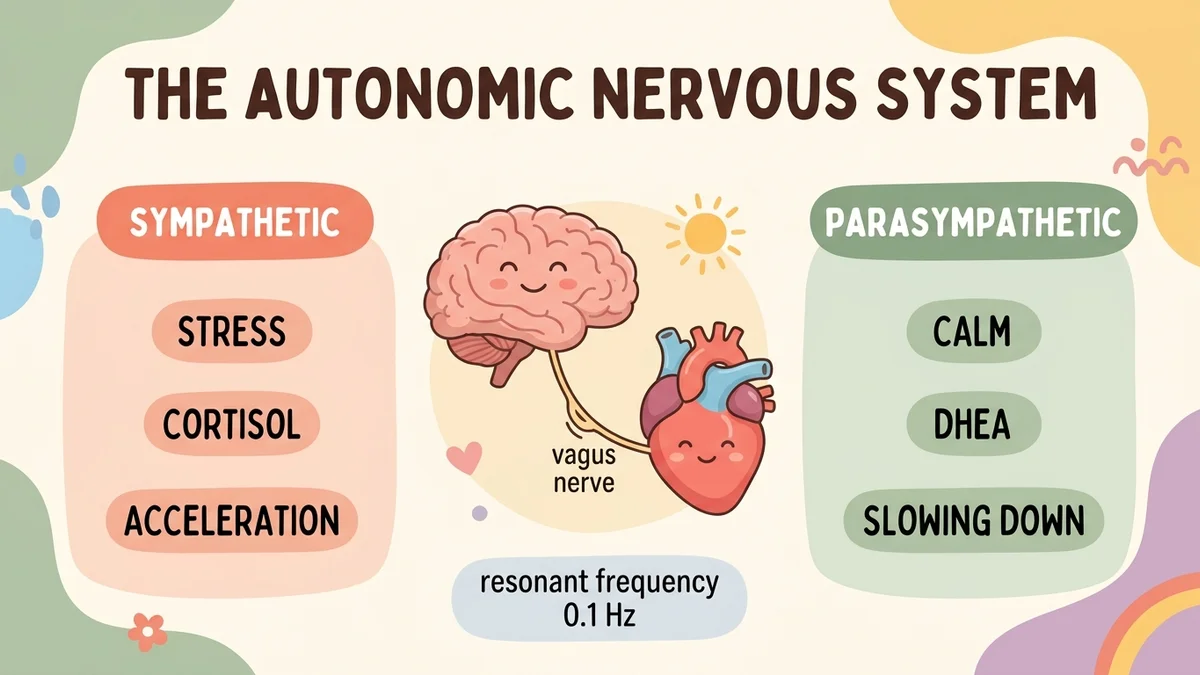
Heart coherence is a physiological state in which your heart rate syncs with your breathing, creating harmony between the heart and the brain. This synchronization activates the parasympathetic nervous system — your body's natural "brake" — and instantly lowers stress hormones.
In practical terms, your heart doesn't beat at a perfectly steady pace. These tiny variations between beats are called heart rate variability (HRV). High HRV is a marker of good health and resilience to stress. Heart coherence increases this variability in a controlled way.
According to Dr. David O'Hare, a physician and leading author on the subject, heart coherence can be defined as "a state of balance between the sympathetic and parasympathetic nervous systems, reached through rhythmic breathing at roughly 6 cycles per minute." The concept was popularized in France by Dr. David Servan-Schreiber in his book Healing Without Freud or Prozac (2003), following the pioneering work of the HeartMath Institute in the United States in the 1990s.
Key point: Heart coherence is neither meditation nor relaxation: it's a precise physiological technique, with effects that can be measured in real time on your nervous system.
How does heart coherence act on stress?
Heart coherence reduces stress by stimulating the vagus nerve, the longest nerve in the human body, which connects the brain to the heart, the lungs, and the digestive system. By breathing at 6 cycles per minute, you reach the resonant frequency of 0.1 Hz — the exact point where the heart and lungs oscillate in harmony.
Here's what happens in your body during 5 minutes of heart coherence:
| Physiological effect | Mechanism | Timing |
|---|---|---|
| Drop in cortisol | Inhibition of the HPA axis via the vagus nerve | 3-5 minutes |
| Rise in DHEA | Parasympathetic adrenal stimulation | 5-10 minutes |
| Slower heart rate | Activation of vagal tone | 1-2 minutes |
| Increase in IgA | Immune boost through reduced stress | 20 minutes |
| Improved mental clarity | Better oxygenation of the prefrontal cortex | 3-5 minutes |
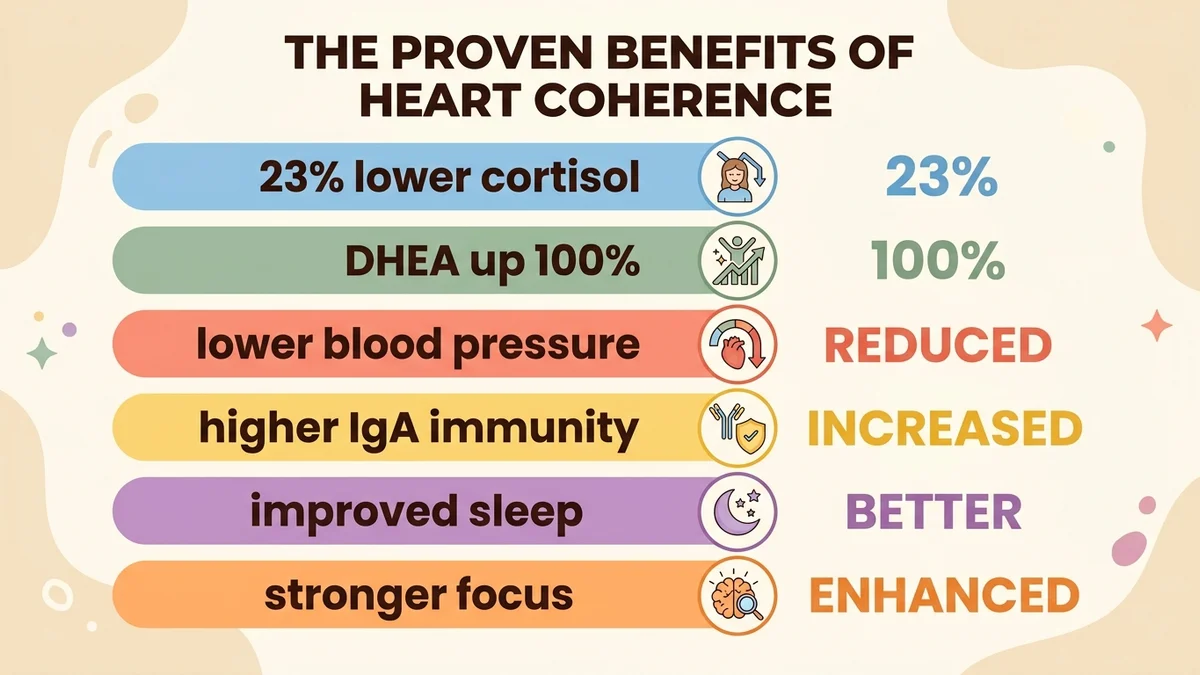
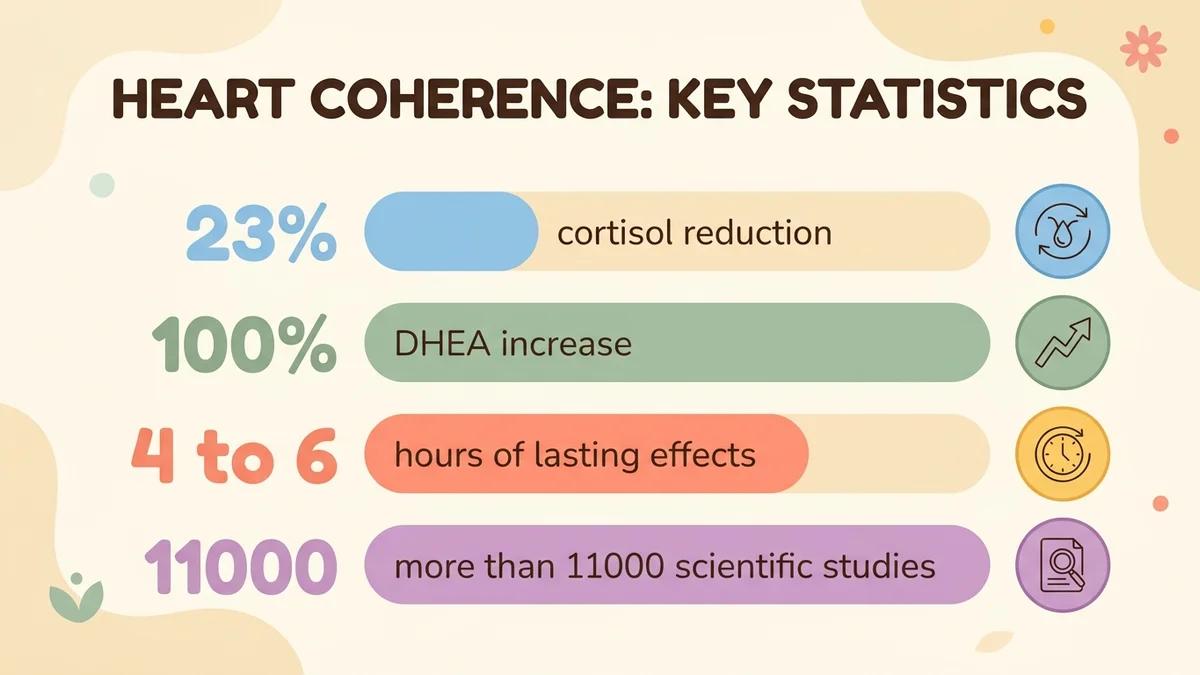
According to a HeartMath Institute study (2024) involving 45 adults, 4 weeks of regular practice produced a 23% reduction in cortisol and a 100% increase in DHEA (the so-called "youth hormone"). Heart coherence at 6 breaths per minute lowers cortisol by 23% on average, according to the HeartMath Institute.
As France's Inserm notes, "heart coherence exercises appear to have a beneficial effect on stress and anxiety," even if the precise biological mechanisms of respiratory sinus arrhythmia are still under study.
Serena Coach tip: Don't chase performance. In the first few days, your rhythm will be uneven — that's normal. Simply breathing slowly and mindfully already activates the parasympathetic system. Consistency matters more than perfection.
The 3-6-5 method: how to practice heart coherence step by step
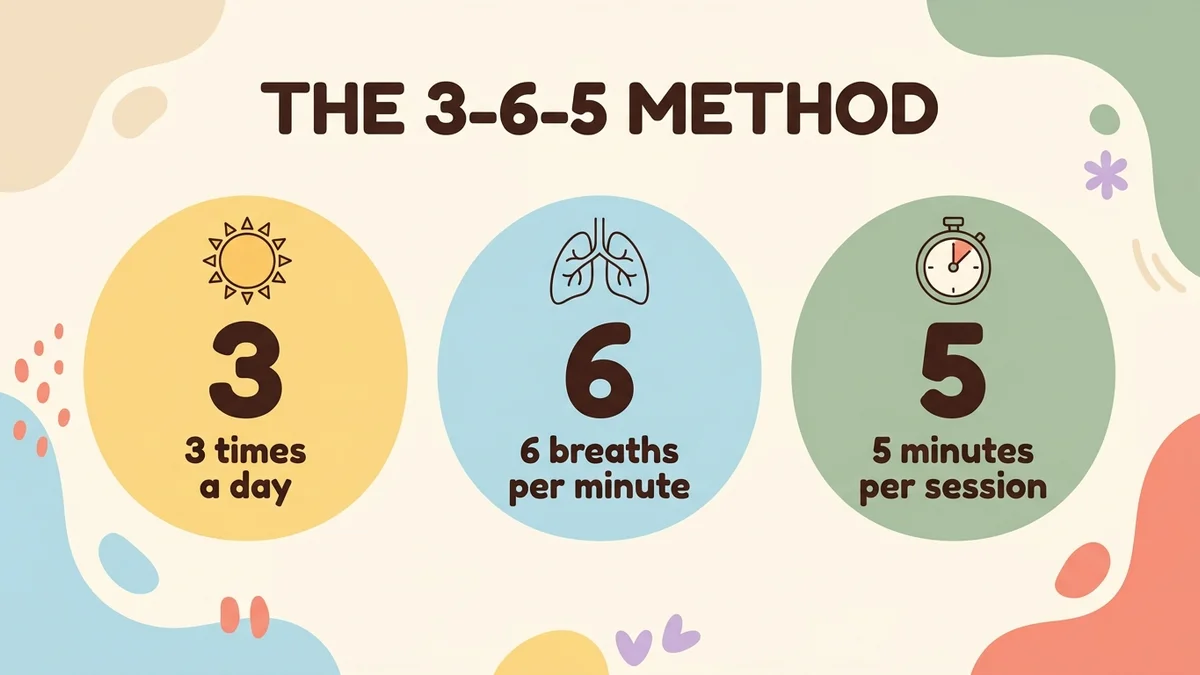
The 3-6-5 method, developed by Dr. David O'Hare, has become the worldwide reference for practicing heart coherence. It boils down to three numbers:
| Number | Meaning | Why |
|---|---|---|
| 3 | 3 times a day | The effects last 4 to 6 hours |
| 6 | 6 breaths per minute | Optimal resonant frequency (0.1 Hz) |
| 5 | 5 minutes per session | Long enough for the biological effects |
The 3-6-5 method means practicing 3 times a day, 6 breaths per minute, for 5 minutes.
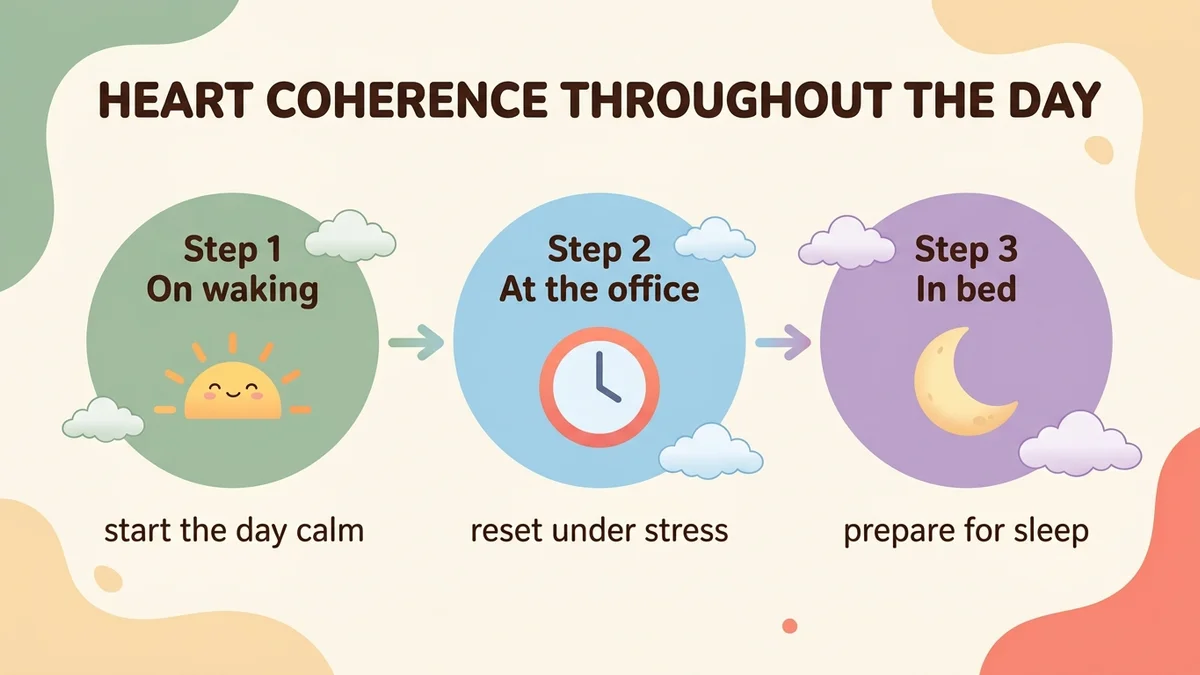
The 3 key moments of the day
- On waking (7-8 a.m.): cortisol is at its morning peak. Practicing at this time lowers anxiety for the hours that follow.
- Before lunch (11:30 a.m.-noon): you recharge your nervous balance for the afternoon.
- In the late afternoon (4-5 p.m.): you release the stress you've built up and set the stage for a calm evening.
Posture and breathing
Sit comfortably, back straight, feet flat on the floor. Don't lie down (except before sleep). Then:
- Breathe in through your nose for 5 seconds, letting your belly expand (abdominal breathing)
- Breathe out through your mouth for 5 seconds, as if gently blowing through a straw
- Repeat this cycle 30 times — that's your 5-minute session
Key point: Any mindful breathing at a fixed rate triggers a state of heart coherence. If 5-5 (5 seconds in, 5 seconds out) feels too fast or too slow, adjust it. The 4-6 rhythm (inhale 4 seconds, exhale 6 seconds) is especially effective for promoting relaxation and sleep.
The 5-minute heart coherence exercise: follow the guide
Want to try right now? Here's a complete 5-minute heart coherence exercise. Start a timer and follow these instructions:
Minutes 1-2: Settling in
- Rest your hands on your thighs and close your eyes
- Take 3 deep breaths to settle in
- Begin the rhythm: 5 seconds breathing in, 5 seconds breathing out
Minutes 2-4: Practice
- Focus only on the movement of your belly
- If a thought arises, gently bring your attention back to the breath
- Keep a steady, comfortable rhythm
Minutes 4-5: Grounding
- Keep the rhythm going while noticing the calm settling in
- Observe the sensations: a slower heartbeat, muscles releasing
- End with a long exhale and open your eyes
As Catherine Darbord shows in this video, viewed more than 28 million times, heart coherence is practiced simply by following a steady breathing rhythm against a backdrop of soothing sounds. You'll find this kind of guided exercise directly in Serena, which adapts the rhythm to your level and tracks your progress.
What are the proven benefits of heart coherence?
The benefits of heart coherence have been documented by more than 11,000 scientific studies since 1949 and nearly 2,000 clinical trials registered on ClinicalTrials.gov. Here are the most robust effects, ranked by level of evidence.
| Benefit | Level of evidence | Source |
|---|---|---|
| Reduced stress and anxiety | High (meta-analyses) | Lehrer & Gevirtz (2014) |
| Lower blood pressure | Moderate | HTA Foundation (2025) |
| Improved sleep | Moderate | JAMA Network Open (2025) |
| Immune boost (IgA) | Moderate | HeartMath Institute (2024) |
| Reduced depressive symptoms | Moderate (g = −0.41) | HRV-B meta-analysis (2025) |
| Improved focus | Emerging | Pilot studies |
According to a meta-analysis published in 2025, heart rate variability biofeedback shows a moderate effect on depression (g = −0.41) and on heart rate variability (g = 0.443) across 1,352 subjects analyzed.
The physiological effects of heart coherence last between 4 and 6 hours after each 5-minute session. That's why the French Federation of Cardiology has recommended this practice since 2014.
In France, nearly one adult in five is affected by a mental health disorder, according to Santé publique France (2025). With mental health designated France's Grande Cause Nationale for 2025-2026, heart coherence stands out as an accessible prevention tool with no side effects.
"My doctor recommended heart coherence, but I don't know where to start"
This is one of the most common situations. Your doctor, cardiologist, or psychologist tells you to "try heart coherence," but without any concrete instructions. Here's your plan for the first week:
Days 1-3: Discovery
- Just 1 session of 3 minutes a day, in the morning
- Don't worry about the exact rhythm
- Simply focus on "breathe in slowly, breathe out slowly"
Days 4-5: Progressing
- Move up to 5 minutes in the morning
- Add a 2nd session at midday if you feel comfortable
- Use a visual or audio guide (app or video)
Days 6-7: The full 3-6-5 method
- 3 sessions of 5 minutes: morning, midday, late afternoon
- Start noticing the effects on your stress level
Dr. David O'Hare has trained more than 4,000 healthcare professionals in heart coherence in France. Based on his clinical experience, "the vast majority of people feel a tangible benefit by the end of the first week of regular practice."
Which app should you choose for heart coherence in 2026?
Several heart coherence apps exist in 2026. Here's an honest comparison to help you choose:
| App | Price | Breathing guide | Progress tracking | Biofeedback | Complete program |
|---|---|---|---|---|---|
| RespiRelax+ | Free | ✅ Visual | ❌ | ❌ | ❌ |
| Cohéra | Free + premium | ✅ Visual + audio | ✅ Basic | ❌ | ❌ |
| CardioZen | Premium | ✅ Visual | ✅ | ✅ Sensor | ❌ |
| Serena | Free + premium | ✅ Guided visual | ✅ Complete | ❌ | ✅ Anxiety + mood |
RespiRelax+, developed by the Thermes d'Allevard, remains the free reference with more than 4 million downloads. It offers a simple, effective visual guide for basic practice.
However, if you're looking for a holistic approach that combines heart coherence with mood tracking (the Circumplex model), a variety of breathing exercises, and personalized support for managing anxiety, Serena offers a complete program. Heart coherence is just one of the 6 guided breathing techniques the app provides.
Real-life scenarios: when to practice heart coherence
Scenario 1: The stressful morning
You wake up with that knot in your stomach. The day ahead already feels heavy. Before you even touch your phone, sit on the edge of the bed and start 5 minutes of heart coherence. Your morning cortisol comes back down, and you begin the day with a balanced nervous system rather than an over-stimulated one.
Scenario 2: Before an important meeting
The presentation is in 10 minutes. Your heart is racing, your thoughts are spinning. Step away for 3 minutes — in the restroom if you have to. Close your eyes and breathe in a 5-5 rhythm. The effect is almost immediate: your heart rate slows, your prefrontal cortex takes back control, and you can think clearly.
Scenario 3: The Sunday-night insomnia
It's 11 p.m. and you're dreading the week ahead. Lie down and switch to the 4-6 rhythm (inhale 4 seconds, exhale 6 seconds). The longer exhale stimulates the parasympathetic system more strongly. Combine this technique with a sleep meditation for an even greater effect.
The Serena perspective: what our data reveals
At Serena, we see some interesting trends among users who practice heart coherence regularly (anonymized data, 2025-2026 cohort):
- 82% of users who practice heart coherence at least twice a day for 14 consecutive days report a noticeable reduction in their day-to-day anxiety
- The 4-6 rhythm is preferred over 5-5 by 61% of users in evening sessions, confirming that a longer exhale helps more with relaxation
- The first week is decisive: users who keep up their practice beyond 7 days are 3 times more likely to continue for a month
Theory vs. real life: The 3-6-5 method calls for 3 sessions a day. In practice, our data show that even 1 to 2 daily sessions produce measurable benefits on mood tracking. What matters is consistency, not the perfect frequency.
Serena Coach tip: Pair each heart coherence session with an "anchor" — a specific moment in your routine (morning coffee, lunch break, brushing your teeth at night). Users who anchor their practice to an existing habit have a follow-through rate twice as high.
How Serena supports you with heart coherence
Serena integrates heart coherence into a holistic approach to managing anxiety:
- 6 guided breathing techniques, including heart coherence 5-5 and the 4-6 variant
- An adaptive visual guide that adjusts to your natural rhythm
- Daily mood tracking based on the Circumplex model to measure the impact of your practice
- Personalized reminders at the 3 key moments of the 3-6-5 method
Not sure where to start? Try Serena for free and follow the guided heart coherence program, step by step.
Frequently Asked Questions
How many times a day should you practice heart coherence?
The 3-6-5 method recommends 3 sessions of 5 minutes a day, spaced about 4 hours apart: on waking, before lunch, and in the late afternoon. The physiological effects (lower cortisol, parasympathetic activation) last 4 to 6 hours, covering your entire day. If 3 sessions feel like too much, start with just one in the morning — the benefits are already real.
Does heart coherence have side effects?
Side effects are rare and always mild: slight dizziness, a tingling sensation in the hands, or brief mild anxiety at first. These sensations come from your nervous system adjusting and disappear within a few days. If you have a cardiac arrhythmia or heart failure, check with your doctor before starting.
Can you practice heart coherence lying down?
The upright seated position remains the most effective for heart coherence during the day. Lying down, abdominal breathing is shallower and heart rate variability is slightly reduced. The exception: before sleep, the lying-down position with the 4-6 rhythm is ideal for preparing to fall asleep.
What is the difference between heart coherence and meditation?
Heart coherence is a breathing technique at a fixed rate (6 breaths/minute) that produces measurable physiological effects on the vagus nerve and cortisol. Meditation is a practice of attention aimed at mindfulness. The two are complementary: practicing heart coherence before a meditation improves focus and deepens the experience.
Does heart coherence help you sleep?
Absolutely. Practiced 20 minutes before bedtime, heart coherence prepares your body for sleep by lowering cortisol and activating the parasympathetic system. The 4-6 variant (inhale 4 seconds, exhale 6 seconds) is especially effective because the longer exhale strengthens the calming effect. Discover more techniques in our sleep meditation guide.
Should you breathe in through the nose or the mouth?
According to Dr. David O'Hare, breathe in through the nose (the air is filtered and warmed, and the nasal sensation heightens breath awareness) and out through the mouth (as if gently blowing through a straw). If exhaling through the mouth bothers you, breathe out through the nose too — what matters is keeping a steady rhythm.
Which free app is best for heart coherence?
RespiRelax+ remains the leading free app in 2026, with a simple visual guide and more than 4 million downloads. For more complete support (mood tracking, multiple breathing techniques, an anti-anxiety program), Serena offers a guided program that integrates heart coherence into a holistic approach to wellbeing.
How long before you feel the benefits?
The immediate effects (slower heartbeat, a sense of calm, muscles releasing) appear after just 3 minutes of practice. Based on Serena usage data, lasting benefits for your overall anxiety level show up after 7 to 10 days of daily practice. After 4 weeks, biological markers (cortisol, DHEA, immunity) show significant improvements.
Conclusion
Heart coherence is one of the most accessible and most effective tools for taking back control of your stress. In 5 minutes, 3 times a day, you can lower your cortisol, strengthen your immune system, and regain mental clarity — with no medication, no equipment, wherever you are.
The best way to start? Right now. Sit down, close your eyes, and breathe: 5 seconds in, 5 seconds out. Repeat for 5 minutes. You've just completed your first heart coherence session.
To go further and weave this practice into a complete anxiety-management routine, try Serena for free. The app guides you step by step through heart coherence and 5 other breathing techniques, with personalized tracking of your progress.