
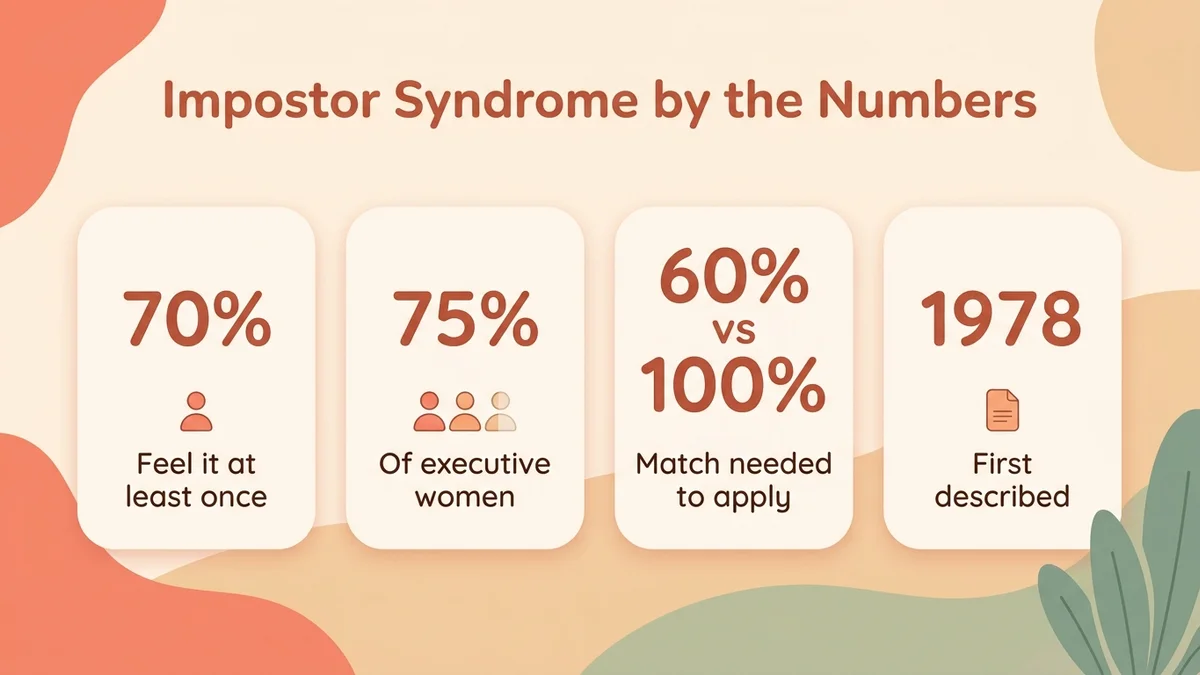
You just landed a promotion, a client congratulates you, your manager praises your work. And yet that little voice persists: "They're going to realize I don't deserve to be here." If this scenario sounds familiar, you're in good company: an estimated 70% of people experience impostor feelings at some point, according to a review published in the International Journal of Behavioral Science. Updated in April 2026, this article gives you the keys to understand this phenomenon and rebuild solid self-esteem.
The key takeaways
Impostor syndrome is an attribution bias that leads you to dismiss your successes despite objective evidence of competence. It affects around 70% of people at some point and shows up in 5 distinct forms. It isn't an illness but a thought pattern you can change with cognitive restructuring, emotional regulation and documenting your successes.
What exactly is impostor syndrome?
Impostor syndrome — or the "impostor phenomenon" — was identified in 1978 by psychologists Pauline Rose Clance and Suzanne Imes. It's characterized by a persistent inability to take credit for your own successes, combined with the fear of being "exposed" as incompetent.
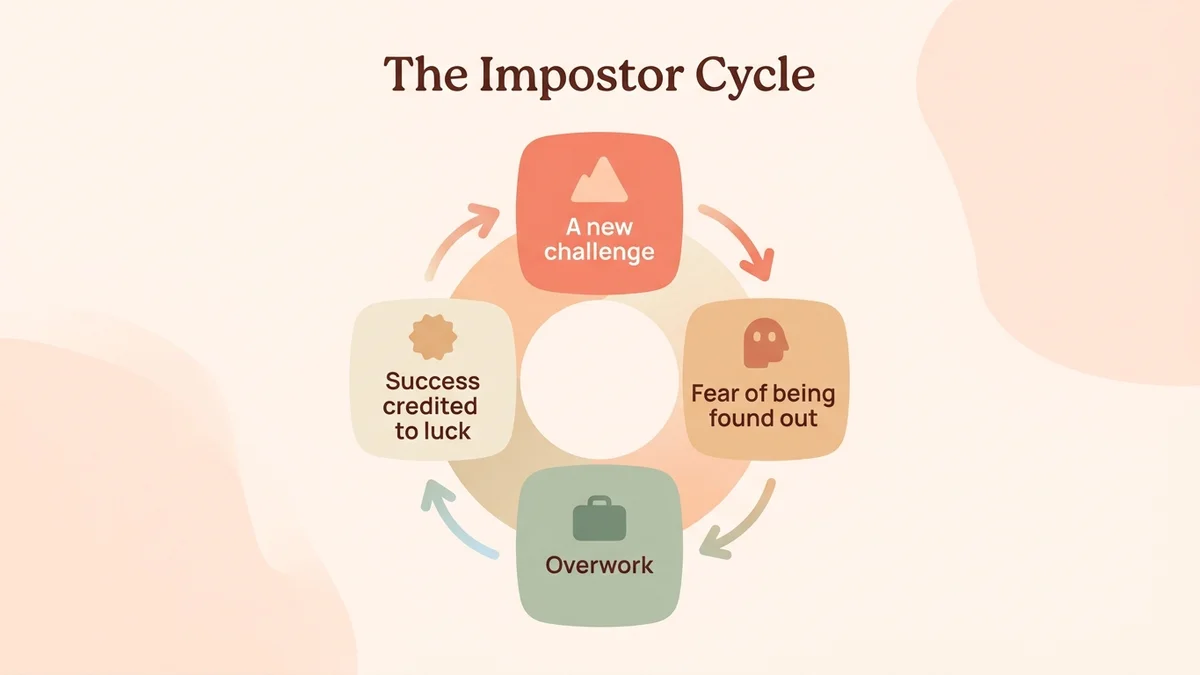
Unlike simple low confidence, impostor syndrome appears despite tangible evidence of success. You have the degrees, the results, the positive feedback. But your brain refuses to take that data in. It prefers to attribute your successes to luck, timing or other people's mistaken judgment.
A systematic review of 62 studies published in the Journal of General Internal Medicine (Bravata et al., 2020) found prevalence rates ranging from 9% to 82% depending on the population and the measure used — with especially high rates among students, healthcare workers and people starting new roles.
Key point: Impostor syndrome isn't in the DSM-5. It isn't a psychiatric diagnosis but a thought pattern you can change with the right tools.
What are the 5 types of impostor syndrome?
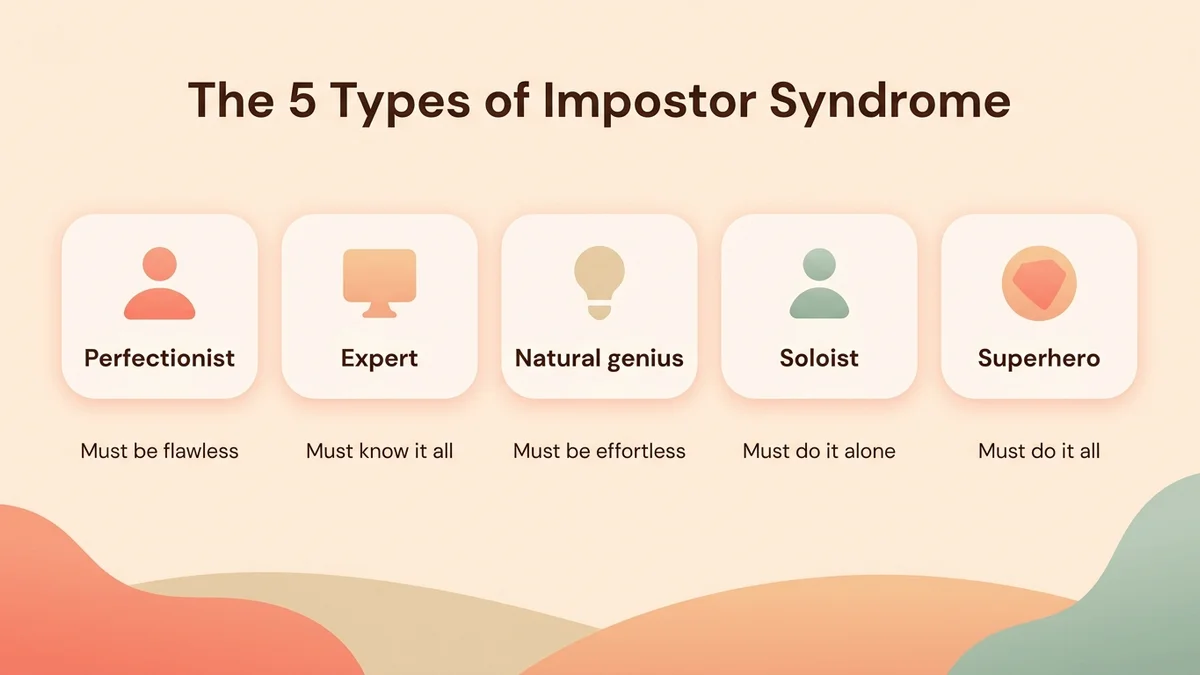
According to Dr. Valerie Young, author of The Secret Thoughts of Successful Women and co-founder of the Impostor Syndrome Institute, there are five distinct profiles. Each shows up differently and calls for a tailored approach.
The perfectionist sets impossible standards and considers anything below 100% a failure. The expert believes they must know everything before starting and feels like a fraud whenever they don't know something. The natural genius suffers when learning takes time or effort, because for them competence should come naturally. The soloist refuses outside help and sees asking for assistance as proof of incompetence. The superhero piles on responsibilities to "prove" their worth through sheer volume of work.
| Type | Limiting belief | Warning sign | Main risk |
|---|---|---|---|
| Perfectionist | "If it isn't perfect, it's worthless" | Procrastination, endless revisions | Decision paralysis |
| Expert | "I don't know enough" | Compulsive training, holding back | Underselling yourself professionally |
| Natural genius | "This should be easy" | Quickly giving up on challenges | Avoiding growth |
| Soloist | "Asking for help = weakness" | Isolation, overload | Silent exhaustion |
| Superhero | "I have to excel at everything" | Overtime, wearing every hat | Burnout |
Serena Coach tip: Identify your dominant profile before working on it. Among our users, those who target their specific type progress twice as fast as those who apply generic advice.
How does impostor syndrome erode self-esteem?
Impostor syndrome creates a vicious cycle with self-esteem. Every success you don't take in reinforces the feeling of illegitimacy, which weakens self-esteem, which amplifies the feeling of being a fraud. It's a self-feeding downward spiral.
This spiral often begins in childhood, when successes are attributed to external factors ("You got lucky," "That was easy") rather than internal ones ("You worked hard"). Clance and Imes noted early on how family messages about ability shape the impostor phenomenon.
The core problem is external attribution bias. When something works, it's "thanks to luck" or "because it was easy." When something fails, it's "because I'm incompetent." This cognitive double standard systematically undermines the value you place on yourself.
Neuroscience helps explain the mechanism. The amygdala, in hypervigilance mode, interprets evaluation situations as threats. Cortisol rises, thinking becomes rigid, and confirmation bias does the rest: you only retain the evidence that confirms your "fraud."
To understand the physical signs of this chronic stress, see our guide to the signs of stress in the body.
"I got promoted, but I'm sure it was a mistake": the telltale signs
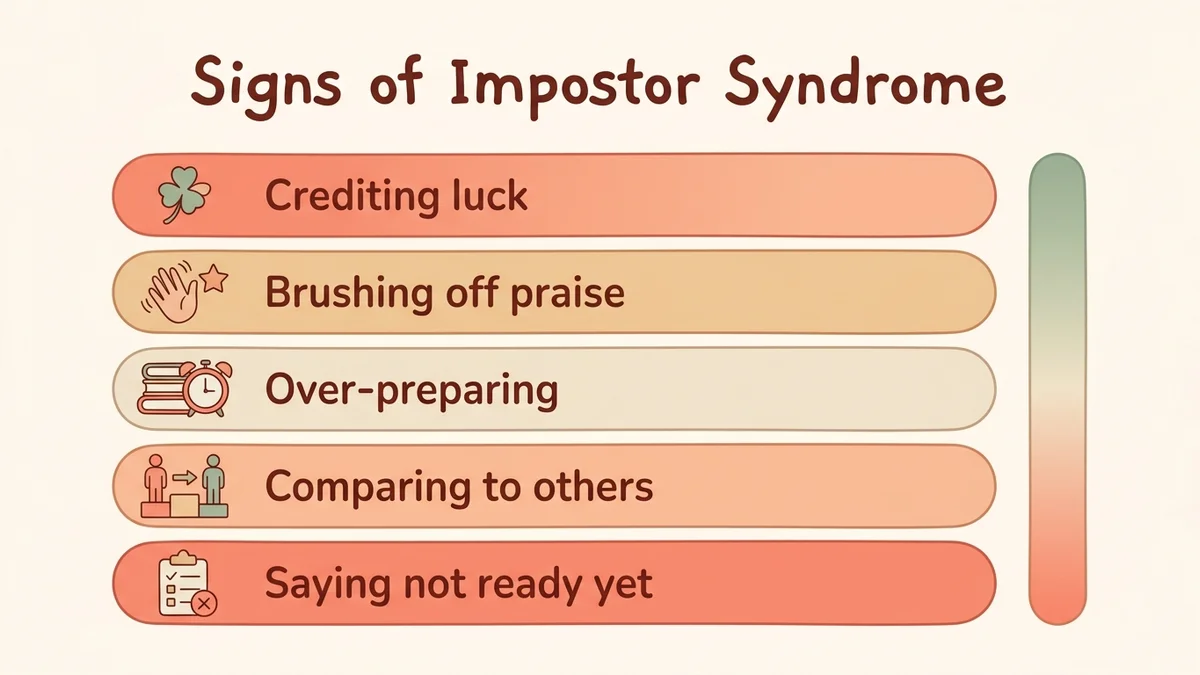
You systematically attribute your successes to outside factors. You minimize your accomplishments when people congratulate you. You over-prepare for everything out of fear of "not measuring up." You compare your behind-the-scenes to other people's highlight reels. You turn down opportunities, telling yourself you're "not ready yet."
If you check 3 of these 5 signs, impostor syndrome is probably active in your life. The Clance Impostor Phenomenon Scale (CIPS), developed by the psychologist who first described the concept, allows a more precise assessment in 20 questions.
One often-overlooked signal: difficulty accepting compliments. When someone says "Great job, excellent work," is your automatic reaction to think "If only they knew..."? That's the central mechanism of the syndrome.
The new impostor syndrome in the age of AI (2026)
Here's an angle few wellbeing guides cover yet. The arrival of artificial intelligence at work has created a new form of impostor feeling.
The question "Is it really MY work if AI helped me?" has become the new face of the syndrome. Developers using AI coding assistants, writers relying on AI tools, designers prototyping with image generators: all of them can feel a gap between the final result and their "real" contribution. Younger workers, who are often the heaviest users of these tools, seem especially prone to this unease.
The answer is simple: using a tool doesn't cancel your expertise. A chef who uses a stand mixer is still a chef. Your judgment, your direction and your creative choices are irreplaceable.
Real-life scenarios
Scenario 1: The team meeting. You have a relevant idea but you don't share it. "Someone more qualified has probably already thought of it." The meeting ends, and a coworker proposes exactly that idea 20 minutes later. Frustration, plus confirmation of the bias: "See, if it were really a good idea, you would have said it."
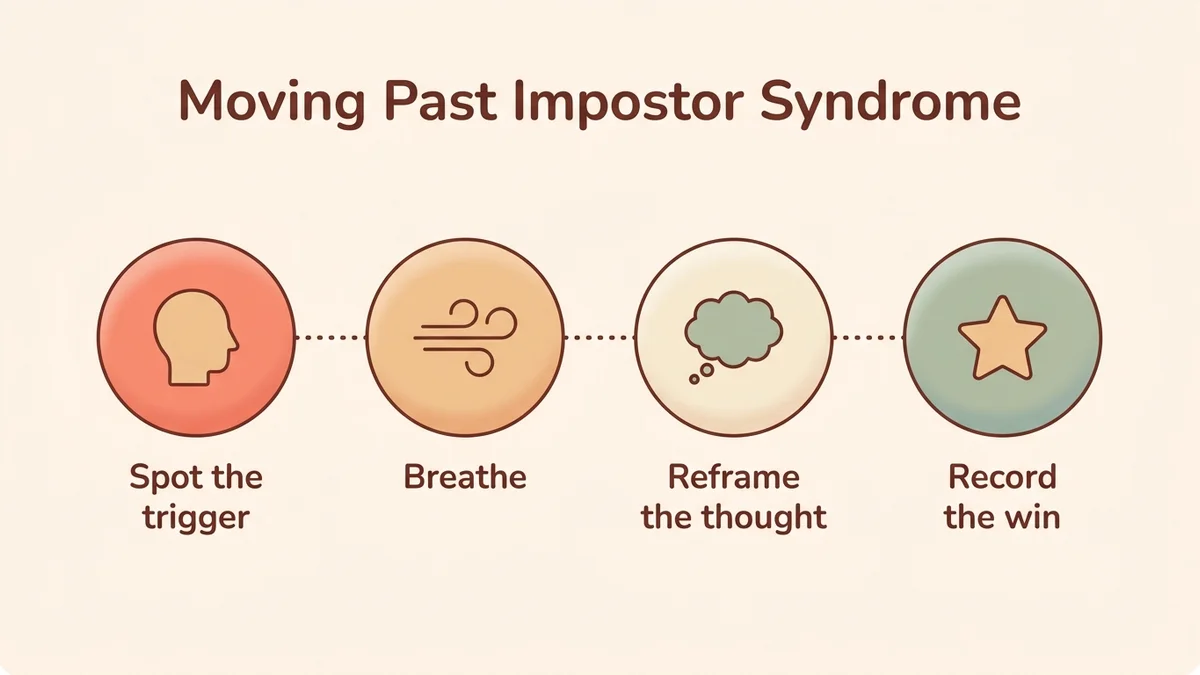
Express technique: Before each meeting, write down 2 contributions you plan to make on a sticky note. Simply seeing them written lowers the barrier to speaking up. If you practice cardiac coherence breathing for 3 minutes beforehand, you calm the stress response that blocks your voice.
Scenario 2: The job application. You read a job posting that matches 80% of your profile. You don't apply. The reason: "I don't meet all the requirements." A widely cited Hewlett-Packard internal report found that men apply when they meet about 60% of the qualifications, while women tend to apply only when they meet 100%.
Express technique: Open a document and list 5 concrete achievements, with numbers. Reread it before every application. This "evidence file" short-circuits the attribution bias.
Scenario 3: Public recognition. Your manager singles you out as an example in front of the team. Your internal reaction: tingling, wanting to disappear, the thought "He doesn't know I struggled for 3 days on this." The discomfort is physical.
Express technique: Practice "Thank you, period." Say thanks without qualifying or minimizing. "Thank you, I'm glad it helped." Not "Thanks, but it really wasn't that hard." This micro-habit gradually rewires how you respond to compliments.
7 exercises to rebuild your self-esteem in the face of impostor syndrome
1. The evidence journal (5 min/day)
Every evening, write down 3 things you accomplished on your own merit. Not "I got lucky," but "I did X because I know how to do Y." Documenting your competence regularly trains your brain to attribute success to yourself — the direct antidote to impostor thinking.
2. Cognitive reframing
When the thought "I'm a fraud" pops up, reframe it: "I'm learning and growing, like everyone else." Cognitive behavioral therapy (CBT) uses this technique to challenge the distorted beliefs at the heart of the syndrome. You can practice it with our CBT thought record.
3. Reverse feedback
Ask 3 people you trust: "What specific skill do you appreciate in me?" Collect their answers in writing. Reread them when doubt returns. This isn't external validation: it's an objective mirror held up to a distorted reflection.
4. Vertical comparison
Stop comparing yourself to others (horizontal comparison). Compare yourself to who you were 6 months, 1 year or 3 years ago. List 5 skills you didn't have back then. Personal progress is the only metric that matters.
5. Gradual disclosure
Share your doubts with a trusted coworker. Very often, the answer will be "I feel that way too." Normalizing the syndrome immediately reduces its power. Let's be honest: talking about your doubts takes courage, but the relief is almost instant.
6. Emotional regulation through breathing
4-7-8 breathing (4 seconds in, 7 seconds hold, 8 seconds out) activates the parasympathetic nervous system within about 90 seconds. Use it before any evaluation situation. The Serena app offers this technique with audio guidance for critical moments, and you can also try our free 4-7-8 breathing tool.
7. Contextual mood tracking
Identify your triggering situations. The syndrome doesn't strike at random: it activates in specific contexts (speaking up, new responsibilities, social comparison). Keeping an emotional journal helps you map your triggers.
As this TED-Ed lesson explains, impostor feelings are remarkably common among high achievers, and simply talking about them openly is one of the most effective ways to defuse them. You can practice emotional regulation exercises directly with Serena, which guides you step by step through breathing and tracking your progress.
The Serena perspective
At Serena, we see a recurring pattern among users who describe feeling like a fraud: their anxiety levels are higher at the start of the week (Monday-Tuesday) than at the end. The work context acts as a measurable trigger.
Anonymized data also shows that users who combine daily mood tracking with breathing exercises see a 38% drop in their anticipatory anxiety within 4 weeks. Theory suggests "6 to 12 weeks" for significant results. In practice, when you document your emotional states every day, the simple act of observation already reduces the syndrome's intensity.
Using the Circumplex model in Serena, people with active impostor syndrome often place themselves in the "high energy, negative" quadrant (anxious, restless) before evaluation situations. After 3 weeks of regular practice, they shift toward "low energy, positive" (calm, confident).
Serena Coach tip: Don't try to "cure" the syndrome all at once. Target ONE triggering situation per week. Practice breathing BEFORE (not during). Document AFTERWARD. Within a month, that situation loses its power over you.
How Serena helps you overcome impostor syndrome
Serena's mood tracking lets you pinpoint exactly when and where the syndrome kicks in. By naming the emotion as it appears, you create space between the stimulus (the meeting, the compliment) and your automatic reaction (self-devaluation).
Guided breathing gives you a concrete tool for critical moments. Rather than staying paralyzed by doubt, 3 minutes of cardiac coherence is enough to bring your prefrontal cortex back online and regain control over your intrusive thoughts.
Try Serena for free and start documenting your daily wins.
Key impostor syndrome statistics
| Statistic | Source | Year |
|---|---|---|
| About 70% of people experience it at least once | Sakulku & Alexander, International Journal of Behavioral Science | 2011 |
| Prevalence of 9% to 82% depending on the population | Bravata et al., Journal of General Internal Medicine | 2020 |
| 75% of executive women have experienced it | KPMG Women's Leadership Study | 2020 |
| Men apply at ~60% match, women at ~100% | Hewlett-Packard internal report | 2014 (reported) |
| First described in high-achieving women | Clance & Imes | 1978 |
Which therapies work for impostor syndrome?
Cognitive behavioral therapy (CBT) is one of the most commonly recommended approaches. It works directly on attribution biases and limiting beliefs, often within a few months of regular sessions. Research on the impostor phenomenon itself is still growing, but CBT's effectiveness for the anxiety and perfectionism that accompany it is well established.
Acceptance and Commitment Therapy (ACT) offers an alternative: rather than fighting the syndrome, you learn to act despite it. "Yes, I feel doubt. And I'm doing it anyway."
As a complement, mindfulness meditation helps calm the stress response and lets you observe impostor thoughts without identifying with them.
| Approach | Typical duration | What it targets | Best for |
|---|---|---|---|
| CBT | 8-16 sessions | Attribution bias, limiting beliefs | All types |
| ACT | 10-12 sessions | Acting despite doubt | Perfectionists, experts |
| Mindfulness meditation | 6-8 weeks | Stress response, rumination | Natural geniuses, superheroes |
| Professional coaching | Several months | Career-specific situations | Work contexts |
| Evidence journal | Daily | Self-attribution of success | Everyone (self-guided) |
For those who prefer a gentle, everyday approach, combining breathing and journaling is an excellent starting point before considering therapy. What matters is starting somewhere. Our article on emotional intelligence can also help you develop self-awareness, the first pillar of change.
Frequently asked questions
Is impostor syndrome a mental illness?
No, impostor syndrome doesn't appear in the DSM-5 and isn't a recognized psychiatric disorder. It's a widespread psychological phenomenon that about 70% of people experience at least once. It can, however, coexist with anxiety or depression and warrant professional support if the impact is significant.
How do I know if I have impostor syndrome?
The Clance Impostor Phenomenon Scale (CIPS), created by Pauline Rose Clance in 1985, is the reference tool. It has 20 questions. The main signs: attributing your successes to luck, minimizing your accomplishments, fearing being "found out," and feeling a gap between your results and how you see yourself.
What's the difference between impostor syndrome and low confidence?
Low confidence concerns your perceived abilities before you act ("I can't do this"). Impostor syndrome shows up despite objective successes ("I succeeded, but not because of me"). To explore this distinction further, see our self-confidence guide.
Are women more affected by impostor syndrome?
Recent research shows that people of all genders are affected at comparable rates in the general population. In the workplace, context matters: KPMG found that 75% of executive women had experienced it during their careers. Context and stereotypes play a bigger role than gender itself.
Can impostor syndrome be cured?
You don't "cure" it in the medical sense. You learn to recognize the mechanism when it activates, reduce its intensity and act despite it. CBT, an evidence journal and emotional regulation produce noticeable results within 6 to 12 weeks of regular practice.
What's the link between impostor syndrome and burnout?
Overcompensation is the connecting mechanism. People affected overwork to "prove" their legitimacy. The Bravata review (2020) found impostor feelings are frequently associated with burnout, depression and anxiety. It's an underestimated risk factor. Techniques exist to help you let go of this perfectionism.
Does impostor syndrome affect gifted or highly sensitive people?
Often, yes. Gifted people frequently notice a gap between their deep thinking and the apparent ease of others. Highly sensitive people, who process feedback and criticism deeply, are also especially prone to impostor feelings.
Does artificial intelligence amplify impostor syndrome?
It's an emerging phenomenon in 2026. Many employees who use AI say they feel uncomfortable when praised for work the technology helped with. This new "digital impostor syndrome" seems to affect younger workers in particular. Remember: your judgment, direction and choices are what make the work yours.
Conclusion
Impostor syndrome isn't inevitable. It's a thought pattern you can learn to identify, understand and gradually reduce. The good news? You're not alone — most people share this silent struggle at some point.
Start by identifying your type (perfectionist, expert, natural genius, soloist or superhero). Then target a single triggering situation. Use breathing before, reframing during and documentation after. Within a month, you'll see results.
Serena supports you along the way with mood tracking to identify your triggers, guided breathing for critical moments and a journal to document your progress. Start your journey for free.