You're going in circles. The same thoughts come back every night, the same knot in your stomach every morning. You've tried talking about it, rationalizing, "moving on." Nothing works. What if the answer came through something as simple as writing? Therapeutic journaling isn't a diary. It's a practice supported by hundreds of scientific studies that turns chaotic thoughts into a structured story. The result: less stress, less anxiety, and a mind that can move forward again. Updated in May 2026.
The key takeaways
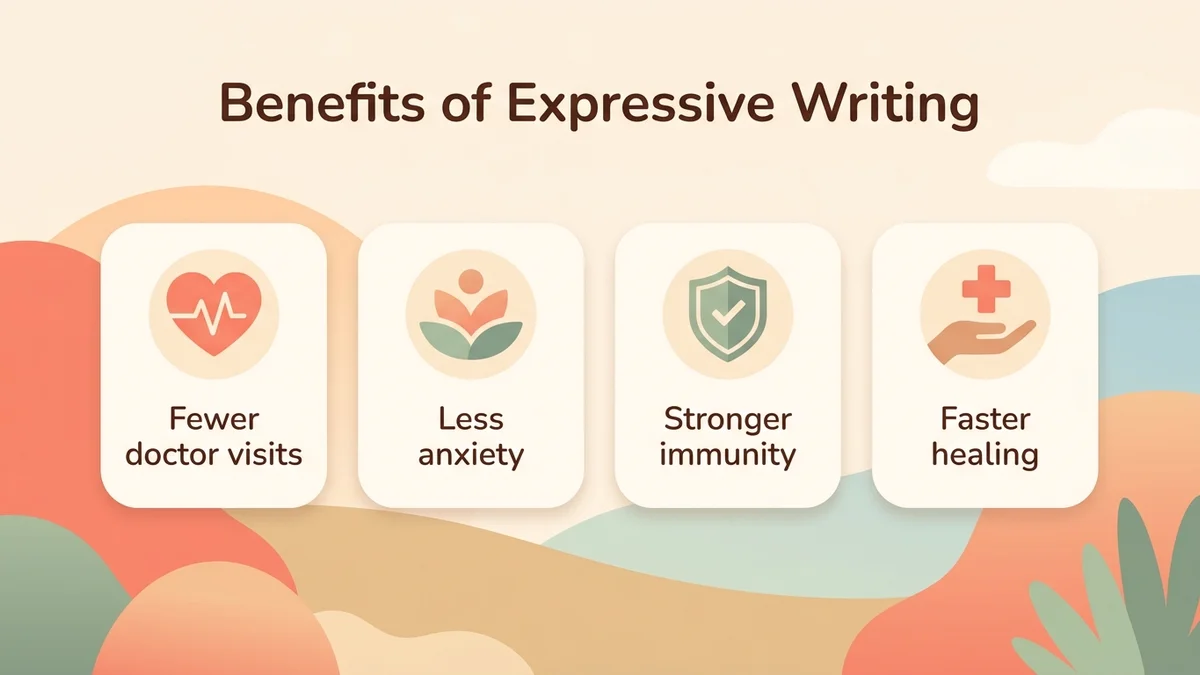
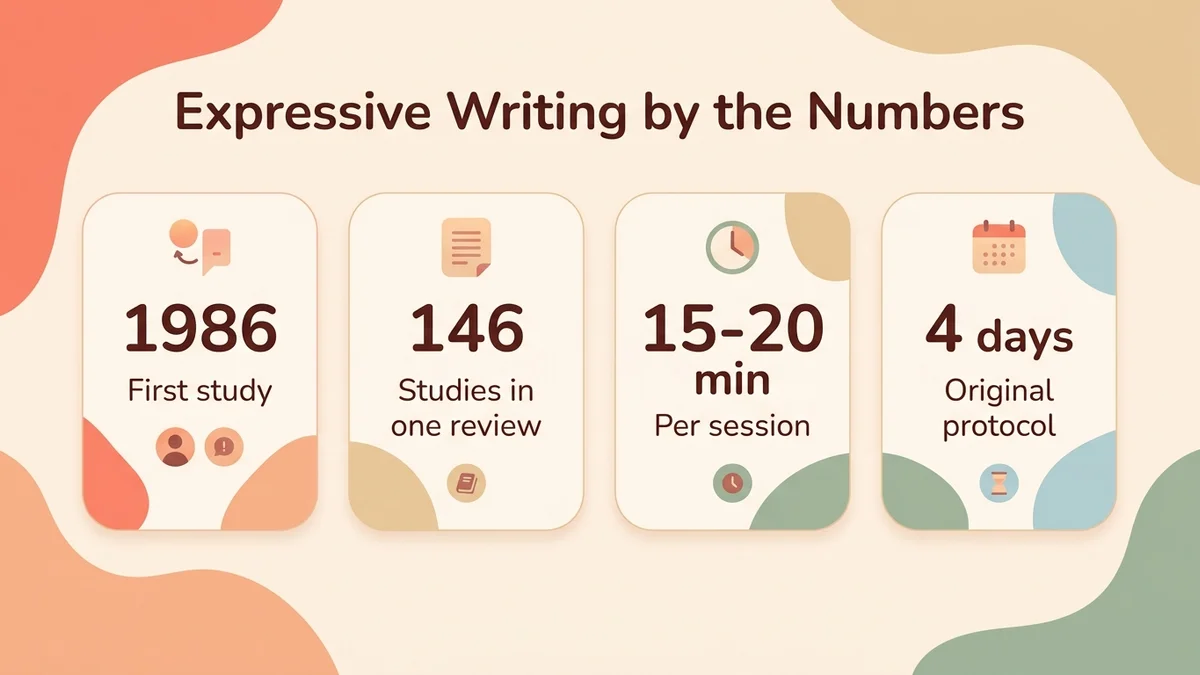
Therapeutic journaling means writing about your deepest emotions for 15 to 20 minutes at a time. Studied by Dr. James Pennebaker since 1986, expressive writing has been linked to fewer doctor visits, better immune function and lower anxiety. Five simple techniques let you start with no experience. Combined with guided breathing, it becomes a powerful tool for inner change.
What exactly is therapeutic journaling?
Therapeutic journaling is a structured writing practice that explores your thoughts and deeper emotions with the goal of feeling better. Unlike a diary that recounts your day, therapeutic journaling invites you to dig beneath the surface to understand what you're really feeling and why.
Psychologist James W. Pennebaker, a professor at the University of Texas at Austin, laid the scientific foundations for this practice in the 1980s. His expressive writing protocol, tested with thousands of participants, rests on one principle: write about an emotionally charged experience for 15 to 20 minutes over 3 or 4 consecutive days. The results surprised the scientific community.
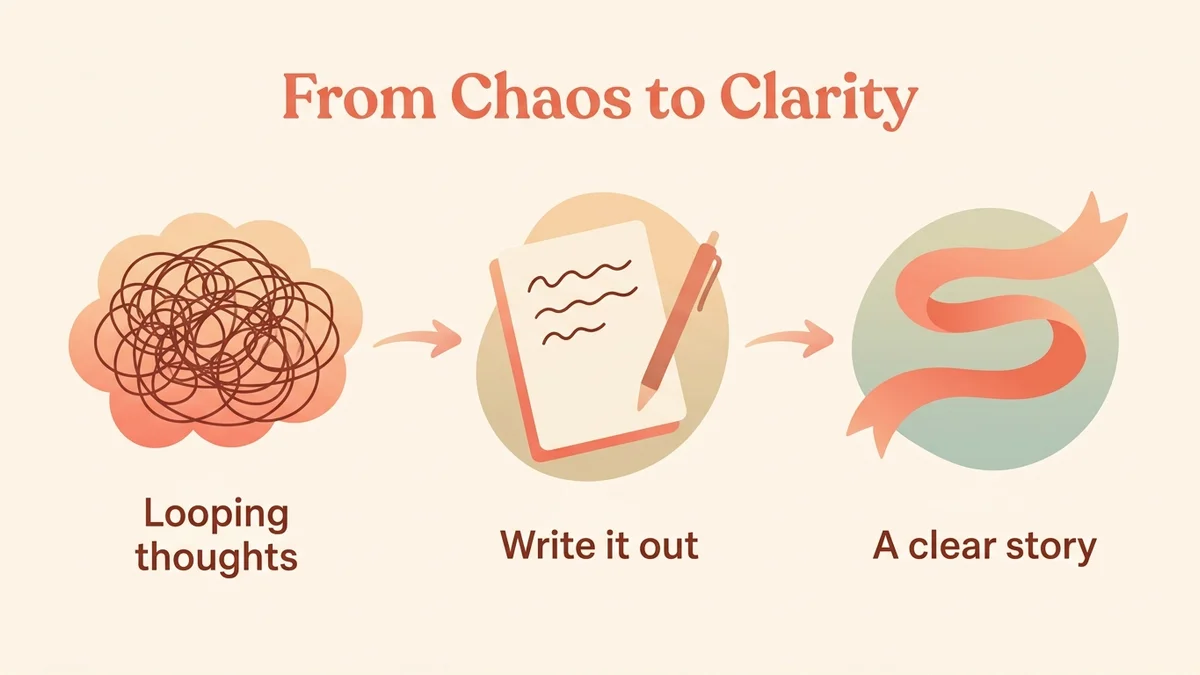
A key insight from Pennebaker's research: simply venting emotions isn't what helps most. People who benefit the most are those who gradually build understanding and meaning — their writing shows more words like "because," "realize" and "understand" over the days. Writing to complain without reflecting doesn't work. Writing to understand does.
Key point: Therapeutic journaling requires no literary talent. No one will read what you write. Spelling, style and grammar don't matter at all. All that counts is the inner movement that writing sets in motion.
How it differs from other kinds of writing
| Practice | Goal | Approach | Scientific support |
|---|---|---|---|
| Diary | Document your life | Chronological, descriptive | Limited |
| Gratitude journal | Cultivate appreciation | 3 to 5 positive items/day | Strong (Emmons, 2003) |
| Therapeutic journaling | Transform emotions | Deep exploration, reflection | Very strong (hundreds of studies) |
| Creative writing | Artistic expression | Free, fictional | Moderate |
What are the proven benefits of therapeutic journaling?
The benefits of therapeutic journaling go beyond simple emotional relief. Hundreds of studies since 1986 have documented measurable effects on physical and mental health. Here's what the research has found.
For mental health
A large meta-analysis by Joanne Frattaroli (Psychological Bulletin, 2006), covering 146 studies, found that expressive writing had a significant positive effect on psychological health. And in a randomized trial published in JMIR Mental Health (Smyth et al., 2018), 12 weeks of online journaling reduced anxiety and mental distress compared with a control group.
Therapeutic writing works on rumination by turning a loop of repetitive thoughts into a linear story. Your mind shifts from "alarm" mode to "analysis" mode. The amygdala calms down and the prefrontal cortex takes back control. Curious about your own rumination level? Try our free rumination test.
For physical health
The physical results are just as striking. Research by Pennebaker, Joshua Smyth and colleagues has linked expressive writing to:
- Fewer visits to the doctor or health center in the months after writing
- Better immune function (for example, a stronger antibody response to the hepatitis B vaccine in a study by Petrie and colleagues, 1998)
- Faster wound healing in older adults (Koschwanez et al., 2013)
- Improvements in some physical symptoms in people with chronic conditions like asthma and rheumatoid arthritis (Smyth et al., JAMA, 1999)
For emotional wellbeing
Writing about difficult experiences helps the brain organize them into a coherent narrative. Research on "narrative identity" by psychologist Dan McAdams at Northwestern University shows that people who tell their life stories with themes of growth and redemption tend to report greater wellbeing. It's a bit like defragmenting a cluttered hard drive.
Expressive writing works best when it moves from raw emotion toward understanding — a pattern Pennebaker observed repeatedly in the language of participants who benefited most.
Key point: Therapeutic journaling is one of the few wellbeing practices that acts on mental, physical and emotional health at the same time. And it costs nothing.
How do you practice therapeutic journaling? 5 concrete techniques
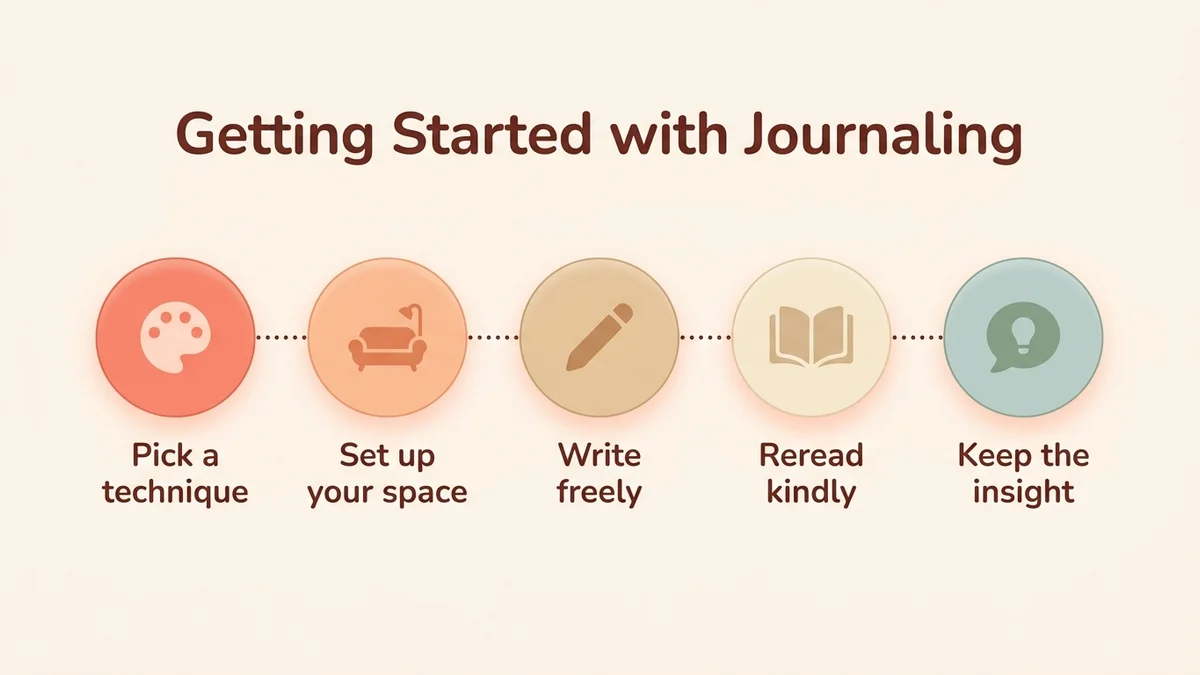
You don't need to follow a rigid protocol. Here are 5 proven techniques, from simplest to deepest. Try them and keep the ones that resonate with you.
1. Timed free writing (5 minutes)
The most accessible technique. Set a timer for 5 minutes. Write whatever comes to mind without lifting your pen. No filter, no rereading. If you get stuck, write "I don't know what to write" until a thought arrives. It will.
Removing the filter of self-censorship lets you reach thoughts your conscious mind usually blocks — a technique similar to Julia Cameron's popular "morning pages."
2. The Pennebaker protocol (20 minutes, 4 days)
The original, research-tested protocol. Choose an emotionally charged experience. Write about it for 20 minutes, 4 days in a row. Explore both your thoughts AND your feelings. The first day is often hard. By the fourth day, something clicks.
According to Pennebaker, the participants who get the best results are those whose perspective shifts over the days. Day 1, you tell the story. Day 2, you analyze it. Day 3, you step back. Day 4, you find meaning.
3. Unsent letters
Write a letter to someone you have an unresolved conflict with, a complicated relationship, or a silent hurt. That person will never read the letter. The goal isn't communication. It's release.
This technique is especially effective for grief, breakups and situations where speaking directly isn't possible.
4. The three-version reframe
Tell the story of a difficult situation from three angles:
- The "I'm hurting" version: let out the raw pain, unfiltered
- The "I choose" version: identify where you have room to act in this situation
- The "I'm becoming" version: imagine what this challenge is teaching you
This technique draws on narrative reconstruction, a process that resilience research considers central to recovering from adversity. You move from being a victim of your story to being its author.
5. The evening emotional scan
Every evening, answer three questions in 5 minutes:
- Which emotion dominated my day?
- What triggered it?
- What could I have done differently?
This ritual pairs perfectly with a calming evening routine. It helps you avoid taking your worries to bed. To challenge a specific thought, you can also use our CBT thought record.
| Technique | Duration | Frequency | Difficulty | Best for |
|---|---|---|---|---|
| Free writing | 5 min | Daily | Easy | Beginners, mental load |
| Pennebaker protocol | 20 min | 4 days | Medium | Trauma, difficult events |
| Unsent letters | 15 min | As needed | Medium | Conflict, grief |
| Three-version reframe | 15 min | Weekly | Advanced | Resilience, change |
| Emotional scan | 5 min | Daily | Easy | Emotional regulation |
Journaling and mental health: what the data says in 2026
According to the National Institute of Mental Health, more than one in five US adults lives with a mental health condition — yet many never receive treatment. Cost, waitlists and stigma remain real barriers.
In this context, therapeutic journaling stands out as an accessible complementary tool. It doesn't replace professional care, but it fits naturally into a care plan. Many therapists recommend writing as a self-care practice between sessions.
Let's be honest: seeing a therapist is still hard for a lot of people. Waitlists, cost, stigma. Journaling doesn't remove those barriers, but it offers a concrete first step. Writing for 10 minutes in the evening will never replace a session with a professional. But it can be the moment of clarity that prompts you to book an appointment.
Across decades of research, Dr. James Pennebaker and colleagues found that people who wrote about emotional experiences made fewer visits to the doctor in the months that followed.
Real-life scenarios
Sunday night dread
You're lying on the couch. Tomorrow is Monday. The knot in your stomach starts to build. Instead of scrolling on your phone, you open your notebook. You write: "I'm scared of tomorrow's meeting. I don't feel legitimate. My boss is going to correct me in front of everyone again." Rereading it, you realize this fear is a projection, not a certainty. The knot loosens. Not completely, but enough to sleep.
Silent anger at work
A coworker took credit for your work during a presentation. You're seething inside but you didn't say anything. That evening, you write an unsent letter to that coworker. You say everything. The anger comes out. Rereading it the next day, you identify the real issue: it isn't the coworker, it's your difficulty setting boundaries. That realization is worth weeks of rumination.
The overwhelmed parent's insomnia
It's 11 p.m. You've put the kids to bed, cleaned the kitchen and answered emails. Your head is spinning. You take 5 minutes for an emotional scan: "Which emotion dominates? Exhaustion. What triggered it? Doing everything alone. What could I change? Ask my mom for help on Wednesday." You have a plan. Your mind can let go.
Therapeutic writing on video: hearing from the pioneer
To deepen your understanding of therapeutic journaling, here's a conversation with the researcher who started it all.
In this episode of the American Psychological Association's Speaking of Psychology podcast, James Pennebaker explains how he discovered the benefits of expressive writing, who it helps most and how to try it yourself. You can pair these writing sessions with the guided breathing exercises in Serena to ground your practice in the body.
The Serena perspective
At Serena, we see that users who combine journaling with guided breathing get faster results than those who use only one technique. Anonymized data shows that people who use the app's daily emotion journal identify their anxiety triggers about 40% faster than those who rely on passive mood tracking alone.
Theory says writing organizes your thoughts. In practice, we see something more: writing reveals patterns you had never noticed. One user writes "I'm stressed" every Wednesday evening. Rereading a month of entries, they realize it's the night they have dinner with their in-laws. Without writing, that link would have stayed invisible.
Serena Coach tip: Don't reread your entries the same day. Wait 48 hours. That time gap turns rereading into a powerful analysis exercise. You'll see your emotions with the perspective of a kind observer, not an overwhelmed participant.
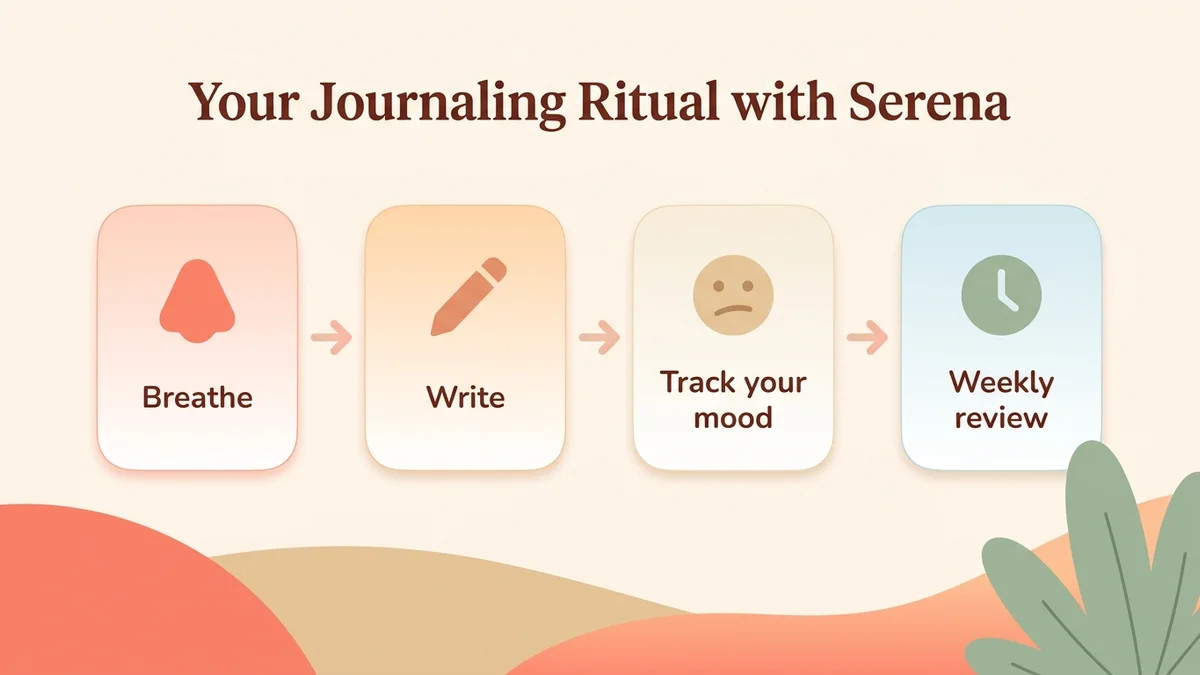
Writing works even better when it's preceded by 3 minutes of cardiac coherence. Your nervous system settles, and the words flow more freely. Serena offers exactly this combination: breathing, then writing, in a single 10-minute ritual.
Serena Coach tip: If you're stuck in front of a blank page, start with 4-7-8 breathing. Three breathing cycles are enough to shift your mind from "action" mode to "reflection" mode. To learn more, see our 4-7-8 breathing guide.
How Serena supports your writing practice
Keeping a paper journal is wonderful. But in real life, we forget, we lose the notebook, or we don't feel like pulling out a journal on the subway. That's where digital tools come in.
Serena includes a guided emotion journal that brings together the best practices of therapeutic journaling:
- Personalized daily prompts based on your mood of the day
- Mood tracking with the Circumplex model to visualize how your emotions evolve
- Breathing exercises to do before writing to calm your nervous system
- Gentle reminders to stay consistent without pressure
The good news is that you don't have to choose between paper and digital. Many Serena users combine both: a notebook for deeper weekend sessions, and the app for a quick 5-minute daily emotional check-in.
Mistakes that sabotage your journaling practice
Before you begin, here are the most common traps. Knowing them will keep you from dropping off after two weeks.
Trap #1: Trying to write perfectly. Therapeutic journaling isn't a style exercise. If you reread every sentence to fix the grammar, you engage your analytical, critical mind instead of your emotional one. The result: you miss what matters.
Trap #2: Ruminating on paper. Writing "I hate my job, I hate my job, I hate my job" isn't therapeutic journaling. It's rumination with a pen. Therapeutic writing looks for the why and the how, not the repetition of the pain.
Trap #3: Forcing yourself. If you don't feel like writing one day, don't. Guilt is the enemy of consistency. Three sessions a week that you want to do are better than seven forced ones.
Trap #4: Keeping everything. Some therapists suggest destroying what you write after rereading it. The act of destroying can be as freeing as the writing itself. Burning an unsent letter isn't just symbolic: it's a ritual of closure.
Frequently asked questions
How long should I write each day for journaling to be effective?
In Dr. James Pennebaker's protocol, 15 to 20 minutes a day for 3 to 4 consecutive days was enough to produce measurable benefits. For a lasting daily practice, 5 to 10 minutes can make a noticeable difference in stress and mood within the first weeks. Consistency matters more than duration.
What's the difference between therapeutic journaling and a regular diary?
A diary describes events. Therapeutic journaling explores your deeper emotions and tries to make sense of them. It's based on research-tested approaches like Pennebaker's expressive writing and aims for inner change. The question isn't "what happened?" but "what am I feeling, and why?"
Can therapeutic journaling replace therapy?
No. Journaling is a valuable complement, not a substitute. It reinforces the work done in sessions and helps you integrate insights between appointments. If you're dealing with persistent low mood or a serious condition, see a mental health professional. If you're in crisis, call or text 988 at any time.
Should I write by hand or in an app?
A University of Tokyo study (Umejima et al., 2021) found stronger brain activity during recall in people who wrote on paper rather than on a tablet or phone. Digital journaling offers practical advantages: reminders, progress tracking and privacy. In our experience, what truly matters is consistency. Choose the format that fits best into your daily life.
Does therapeutic journaling help with anxiety?
Yes. In a randomized trial published in JMIR Mental Health (2018), people who journaled online for 12 weeks reported less anxiety and mental distress than a control group, with benefits appearing after the first month. The practice is also especially useful for managing work stress.
I don't know what to write. How do I start?
Start with "How am I feeling right now?" Write without filtering for 5 minutes. No structure or style needed. If you get stuck, try Serena's guided prompts or ask yourself simple questions: "What stood out to me today?" "Which emotion would I like to let go of?"
Can you practice therapeutic journaling in a group?
Yes. Therapeutic writing groups bring a sense of validation and reduce isolation. Many therapists, community centers and hospitals offer writing workshops, in person and online. The group setting adds a dimension of sharing that solo practice doesn't have.
Is therapeutic journaling suitable for teenagers?
Absolutely. Teens often find it hard to put emotions into words out loud, and journaling gives them a safe, private space to do so. It's a great complementary tool for developing emotional intelligence from a young age.
Conclusion
Therapeutic journaling isn't a miracle cure. It's a simple, free tool backed by decades of research. 15 minutes a day, a pen and a notebook. Or an app on your phone. The hardest part isn't writing — it's starting.
If you've read this far, something in you needs this practice. Don't overthink it. Tonight, before bed, open a notebook or launch Serena. Write one sentence. Just one. "How am I feeling right now?" The rest will follow.