You've tried meditating, but your mind keeps wandering. Thoughts scroll by, your body fidgets, and you end up wondering whether meditation is really for you. Rest assured: that's exactly what 90% of beginners experience. Mindfulness meditation doesn't ask you to "empty your mind" — it teaches you to observe what's happening in it, without judgment. Updated in August 2026.
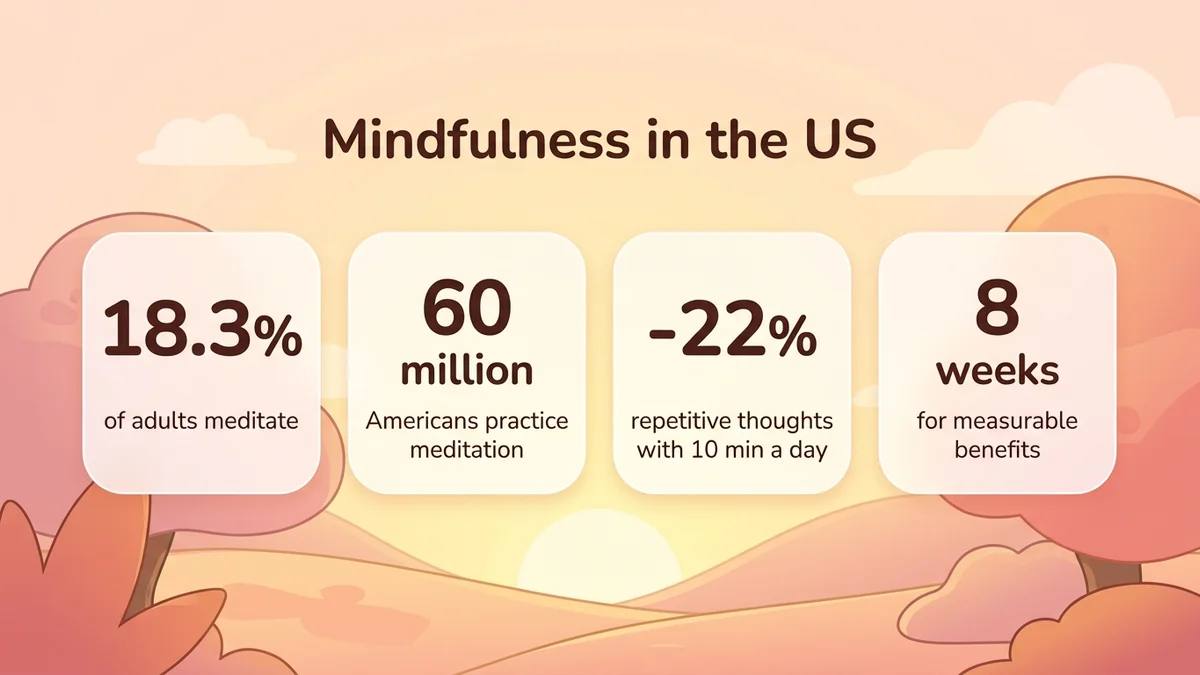
The short answer: mindfulness meditation means bringing your attention to the present moment — your breath, your sensations, your thoughts — intentionally and kindly. Five minutes a day is enough to start, and studies show measurable benefits after 8 weeks of regular practice.
The key takeaways
Mindfulness meditation is a secular, scientifically validated practice that reduces stress and anxiety and improves focus. Popularized by Jon Kabat-Zinn in 1979 with the MBSR program, it's now one of the most widely used mind-body practices in the United States: meditation use among US adults more than doubled between 2002 and 2022, reaching 18.3% (Scientific Reports, 2024). Five to ten minutes a day is enough. No prior experience is needed.
What is mindfulness meditation?
Mindfulness meditation is the art of paying attention to the present moment, deliberately and without judgment. Contrary to popular belief, it doesn't aim to empty your head, but to observe your thoughts like clouds drifting across the sky.
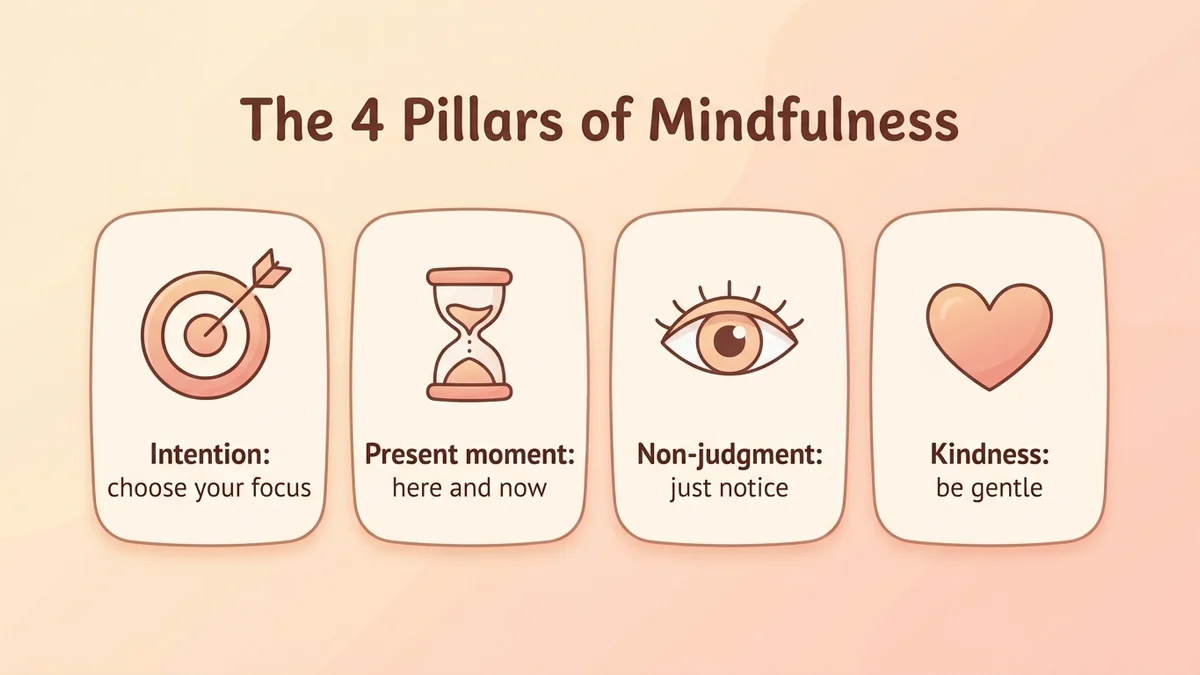
This practice rests on four fundamental pillars:
- Intentional attention: you consciously choose where to direct your attention
- The present moment: no rumination about the past, no anticipation of the future
- Non-judgment: observing without labeling things "good" or "bad"
- Kindness: welcoming whatever comes up with gentleness
Jon Kabat-Zinn, the founder of Mindfulness-Based Stress Reduction, famously defines mindfulness as "paying attention in a particular way: on purpose, in the present moment, and non-judgmentally." That simple definition opened the door to its use in hospitals and clinics around the world.
Key point: Mindfulness is neither a religion nor a philosophy. It's a mental skill anyone can develop, like training a muscle.
Mindfulness vs. meditation: what's the difference?
Meditation is a formal practice — you sit down, close your eyes and set aside dedicated time for the exercise. Mindfulness is a quality of attention you can bring to any moment of your day: while eating, walking or listening to someone.
| Aspect | Meditation | Mindfulness |
|---|---|---|
| Format | Formal practice, dedicated time | Everyday attitude |
| Duration | 5 to 30 minutes | Any moment of the day |
| Posture | Sitting or lying down | Any position |
| Goal | Training attention | Living with awareness |
Mindfulness meditation combines the two: it's a formal practice that strengthens your ability to be present in everyday life.
What are the proven benefits of mindfulness meditation?
The benefits of mindfulness meditation are documented by hundreds of scientific studies. In the US, the National Center for Complementary and Integrative Health (NCCIH) notes that mindfulness-based programs may help people manage anxiety, depression and stress.
On stress and anxiety
Neuroscientist Antoine Lutz, a researcher at the Lyon Neuroscience Research Center (CNRS, France), has shown that meditation changes the structure of the brain. It acts on the prefrontal cortex (emotional regulation) and the insular cortex (body awareness), improving our ability to manage chronic stress and anxiety.
Mindfulness meditation significantly lowers cortisol — the stress hormone — after just 8 weeks of regular practice, according to a meta-analysis published in Psychoneuroendocrinology (2024).
On sleep
If you struggle with sleep problems, mindfulness can help. A JAMA Internal Medicine study showed that 6 weeks of practice significantly improve sleep quality by reducing the nighttime rumination that keeps you from falling asleep.
On focus and memory
Regular practice improves sustained attention and working memory. According to the European Age-Well study coordinated by Gaëlle Chételat at Inserm, meditation may also help protect the brain against age-related cognitive decline.
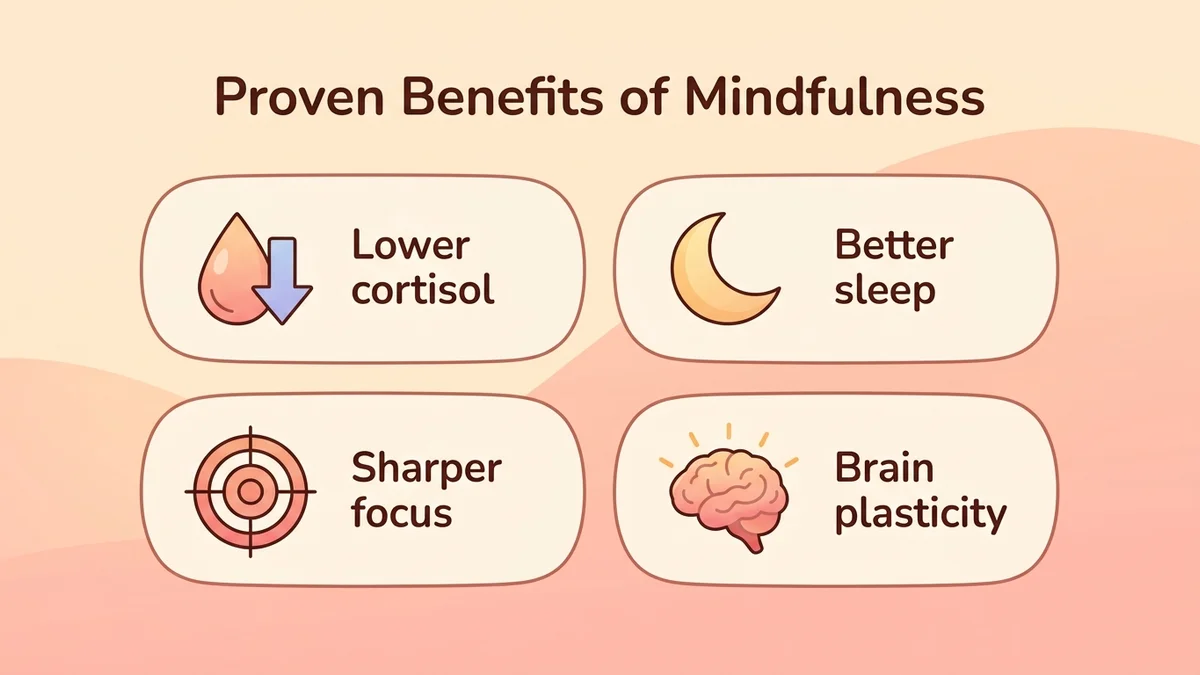
| Benefit | Reference study | Result |
|---|---|---|
| Less stress | JAMA Psychiatry meta-analysis (2025) | Significant improvement vs. control group |
| Sleep quality | JAMA Internal Medicine (2015, confirmed 2024) | Improvement in 6 weeks |
| Neuroplasticity | Antoine Lutz, CNRS (2023) | Changes in the prefrontal and insular cortex |
| Cognitive protection | Age-Well study, Inserm (2024) | Slower age-related decline |
"Meditation acts directly on our stress" — Antoine Lutz, neuroscientist at France's CNRS, Lyon Neuroscience Research Center.
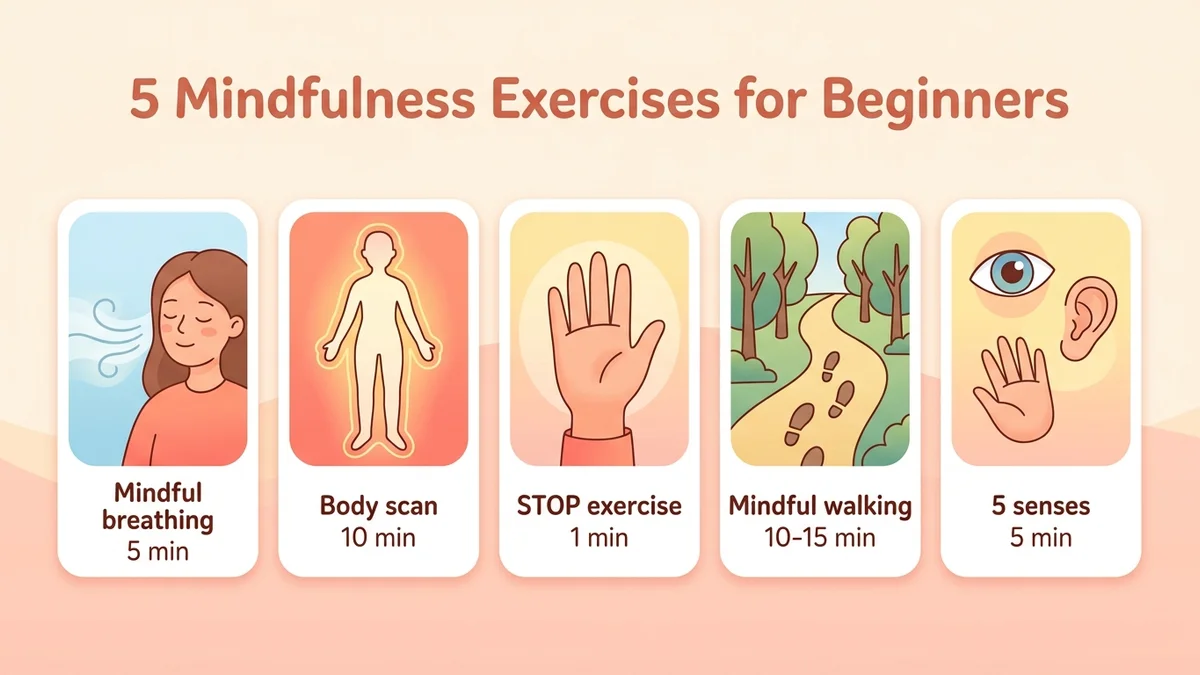
How do you practice mindfulness meditation? 5 exercises for beginners
You don't need a special cushion, a mantra or any prior experience. Here are five progressive exercises to bring mindfulness into your daily life, from simplest to most complete.
1. Mindful breathing (5 minutes)
This is the foundational exercise. It simply involves observing your breath without changing it.
How to do it:
- Sit comfortably, back straight but relaxed
- Close your eyes or rest your gaze on the floor
- Notice the air entering through your nostrils
- Feel your belly rise, then fall
- When a thought shows up, note it without judging it and come back to your breath
This mindful breathing exercise pairs perfectly with cardiac coherence for amplified effects on the nervous system.
2. The body scan (10 minutes)
The body scan reconnects you with your body, which often gets neglected when anxiety dominates the mind.
How to do it:
- Lie down or sit comfortably
- Bring your attention to your feet: temperature, sensations, tension
- Slowly move up: ankles, calves, knees, thighs...
- Observe each area without trying to change it
- Finish at the top of your head
Serena Coach tip: Our users who practice the body scan in the evening report falling asleep 40% faster on average. Start with your feet — sensations are easier to notice there.
3. The STOP exercise (1 minute)
Ideal at the office or on public transportation, this exercise can be done anywhere.
- S — Stop: pause whatever you're doing
- T — Take a breath: breathe in deeply
- O — Observe: notice your sensations, thoughts and emotions
- P — Proceed: return to your activity with awareness
4. Mindful walking (10-15 minutes)
Walking mindfully turns an ordinary trip into a meditation exercise.
How to do it:
- Walk at a slightly slower pace than usual
- Feel your feet make contact with the ground at each step
- Notice the movement of your legs and arms
- Widen your attention to sounds, smells and light
5. The 5 senses meditation (5 minutes)
This exercise is perfect for anchoring your attention in the present when intrusive thoughts take over.
Silently name:
- 5 things you can see
- 4 things you can touch
- 3 things you can hear
- 2 things you can smell
- 1 thing you can taste
Key point: Mindfulness isn't limited to the meditation cushion. Every daily activity can become an exercise: brushing your teeth, eating, doing the dishes, listening to music.
How do you add guided meditation to your routine?
A guided meditation makes practice easier, especially for beginners. A voice accompanies you, brings you back when your mind wanders and helps you structure your session.
As this guided breathing meditation from UCLA's Mindful Awareness Research Center shows, mindfulness starts with a simple gesture: noticing what's there, without trying to change it. You can deepen this approach with Serena, which offers guided exercises adapted to your level and your needs in the moment.
Building your daily ritual
| Time of day | Recommended exercise | Duration | Main benefit |
|---|---|---|---|
| When you wake up | Mindful breathing | 5 min | Mental clarity |
| Lunch break | STOP exercise | 1 min | Refocusing |
| After work | Mindful walking | 10 min | Decompression |
| Before bed | Body scan | 10 min | Easier to fall asleep |
To take your evening ritual further, check out our guide to sleep meditation. And if you're looking for a tool to practice every day, our comparison of meditation apps will help you choose.
Real-life scenarios
A morning that starts badly
Your alarm goes off, and the first thought that crosses your mind is the endless list of things to do. Your heart speeds up before your feet even touch the floor.
The mindfulness solution: Before getting up, stay lying down for 3 minutes. Feel the weight of your body on the mattress. Observe three complete breaths. This simple gesture recalibrates your nervous system and cuts off the cycle of anticipatory anxiety.
The nerve-racking meeting
You're at the office, and your presentation starts in 5 minutes. Your palms are sweaty, your throat tightens — the signs of stress are all there.
The mindfulness solution: Use the STOP exercise. Pause. Take a deep breath, counting 4 seconds in and 4 seconds out. Notice your feet planted firmly on the floor. Proceed with awareness. Two minutes is enough to activate your parasympathetic nervous system.
3 a.m. insomnia
You wake up and your thoughts start going around in circles. The harder you try to sleep, the more sleep slips away.
The mindfulness solution: Start a mental body scan, from your feet to your head. Don't try to sleep — just observe your sensations. This paradoxical approach reduces mental overactivation and encourages a natural return to sleep.
The Serena perspective
According to anonymized Serena usage data, users who combine mindfulness meditation with cardiac coherence exercises see a 35% reduction in their perceived anxiety within 4 weeks — compared with 20% for meditation alone.
The gap between theory and practice is revealing. Studies recommend 20 to 45 minutes of daily practice (the MBSR program). In real life, Serena users practice an average of 8 minutes a day — and still get significant results. The key isn't duration, but consistency and personalized support.
Serena Coach tip: Users who set a daily reminder at a fixed time in Serena are 3 times more likely to keep up their practice beyond 30 days. The hardest part isn't meditating — it's remembering to.
How Serena supports your mindfulness practice
Serena combines guided exercises, breathing and emotional tracking in a holistic approach to mental wellbeing:
- Guided mindfulness exercises adapted to your mood of the day
- 6 breathing techniques, including cardiac coherence and 4-7-8 breathing
- Mood tracking with the Circumplex model to identify your emotional patterns
- A built-in gratitude journal to cultivate kindness
- Personalized reminders to keep your routine going effortlessly
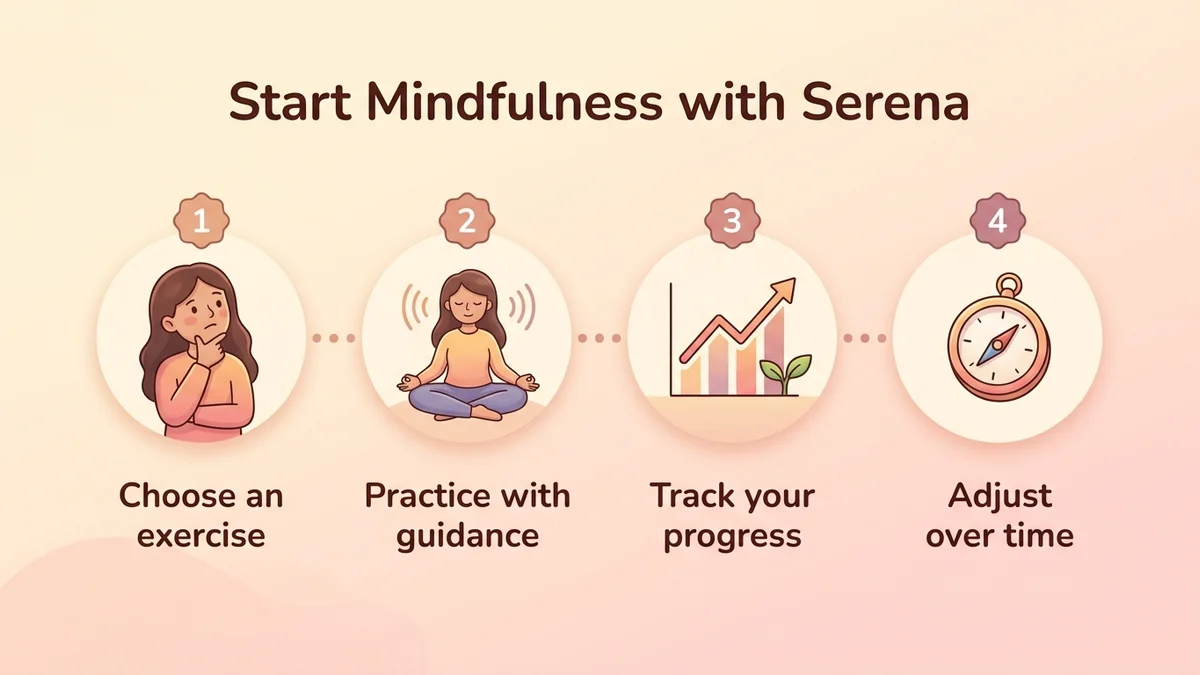
Taking care of your mind has never been more accessible. Try Serena for free and start your first guided practice today.
Frequently asked questions
How long do you need to meditate each day to feel the benefits?
Five to ten minutes a day is enough to see measurable improvements. According to a University of Waterloo study (2025), 10 minutes of mindfulness a day reduces repetitive thoughts by 22%. Consistency is more important than duration: 5 minutes every day beats 30 minutes once a week.
Is mindfulness meditation scientifically proven?
Yes. A JAMA Internal Medicine meta-analysis of 47 clinical trials demonstrated significant reductions in anxiety and depression. In the US, meditation use among adults has more than doubled in twenty years, and the NCCIH recognizes mindfulness-based programs as a promising approach for stress, anxiety and depression.
Does mindfulness help you sleep better?
According to a JAMA Internal Medicine study (2015, confirmed in 2024), mindfulness meditation significantly improves sleep quality after 6 weeks of regular practice. It reduces the nighttime rumination and mental overactivation that keep you from falling asleep.
How do you avoid falling asleep during meditation?
Meditate sitting up rather than lying down, keep your eyes half open and choose a time when you're naturally alert. If drowsiness persists, try mindful walking or the 5 senses meditation, which engage your attention more actively.
Does mindfulness meditation reduce anxiety?
Yes. Neuroscientist Antoine Lutz (CNRS) has shown that meditation changes the prefrontal cortex and the insular cortex, two key areas for emotional regulation. MBSR programs significantly reduce anxiety according to available meta-analyses (2024).
Can you practice mindfulness without meditating?
Absolutely. Informal mindfulness means paying attention to your everyday activities: savoring each bite as you eat, feeling your feet on the ground as you walk, listening to a conversation without thinking about something else. It's an accessible entry point for anyone hesitant to sit down and meditate.
What posture should you use to meditate?
Sit on a chair or cushion with your back straight but not rigid. Your shoulders are relaxed and your hands rest on your thighs. You can also meditate lying down (body scan) or while walking. What matters is being comfortable without being too relaxed.
Which app should you choose to start guided meditation?
Serena offers guided breathing and mindfulness exercises combined with complete emotional tracking. Unlike general-purpose apps, Serena brings together cardiac coherence, a gratitude journal and mood tracking in a personalized approach to mental wellbeing.
Conclusion
Mindfulness meditation isn't reserved for Buddhist monks or people who are "naturally zen." It's a concrete tool, validated by science and accessible to everyone, that transforms your relationship with stress, sleep and emotions — one minute at a time.
Start today with the simplest exercise: 5 minutes of mindful breathing. Observe your breath, let your thoughts pass, and come back. That's it. No need for perfection — just presence.
Try Serena for free and let yourself be guided through your first mindfulness practice. Your mind will thank you.