You drag yourself to work every morning with a knot in your stomach. On Sunday evenings, a dull dread washes over you at the mere thought of Monday. You're making unusual mistakes, forgetting meetings, feeling nothing about your work anymore. If you recognize yourself, this isn't just a rough patch. It may be job burnout.
Updated in April 2026. In the United States, 77% of workers reported work-related stress in the past month, and 57% reported negative effects often associated with burnout, including emotional exhaustion (31%), according to the American Psychological Association's Work in America survey (2023). In this guide, you'll learn to recognize the 15 symptoms of burnout, understand how it develops and discover how to act before you hit a breaking point.
The key takeaways
Job burnout shows up through 15 symptoms in three categories: physical (chronic fatigue, aches, sleep problems), emotional (cynicism, detachment, loss of meaning) and cognitive (mistakes, forgetfulness, indecision). The WHO describes it through three dimensions: exhaustion, mental distance from your job and reduced professional efficacy. Caught early, it resolves within 3 to 6 months with the right support.
What exactly is job burnout?
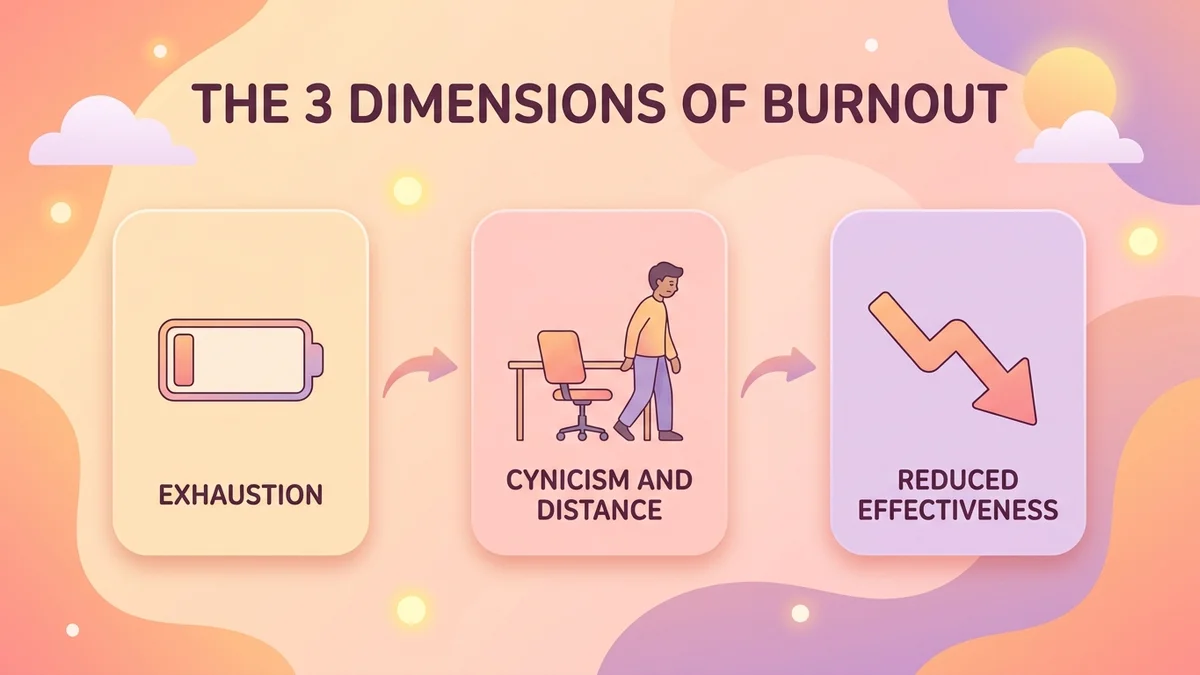
Job burnout is a syndrome of exhaustion caused by chronic workplace stress that hasn't been successfully managed. The WHO defines it as a phenomenon tied to the work context, characterized by three dimensions: energy depletion, increased mental distance or cynicism toward one's job, and reduced professional efficacy.
It's neither a simple bout of fatigue nor a lack of motivation. Psychologist Herbert Freudenberger described the syndrome in 1974 after observing caregivers who were "burning out from the inside" from giving without ever recharging.
Burnout differs from ordinary stress in that it builds gradually and doesn't resolve without intervention. You can be stressed and still function. In burnout, you can no longer function.
Key point: According to the APA's 2023 Work in America survey, 57% of US workers report negative impacts of work stress associated with burnout — a sign that this is a widespread, systemic problem, not a personal failing.
What are the 15 symptoms of job burnout?
Burnout symptoms fall into physical, emotional and cognitive signs. They appear gradually over 6 to 18 months and get worse if nothing is done. Here are the 15 warning signs to watch for.
Physical symptoms (1-6)
Your body speaks before your mind does. Physical symptoms are often the first signals people notice.
| # | Symptom | What's happening in your body |
|---|---|---|
| 1 | Chronic fatigue that rest doesn't fix | Your stress system is overworked and cortisol loses its daily rhythm |
| 2 | Sleep problems (insomnia or oversleeping) | An overactive nervous system prevents recovery |
| 3 | Muscle pain (neck, back, jaw) | Cortisol keeps muscles constantly tense |
| 4 | Frequent headaches and migraines | Blood pressure fluctuates under continuous stress |
| 5 | Digestive problems (nausea, knotted stomach) | The gut-brain axis is disrupted by high cortisol |
| 6 | Repeated infections (colds, sore throats) | The immune system weakens under prolonged stress |
If you recognize 3 of these signs and they've lasted more than 4 weeks, your body is sending you a clear signal. Chronic stress is the breeding ground for burnout: the longer it lasts, the higher the risk.
Emotional symptoms (7-11)
This is where burnout differs from simple overwork. Emotional detachment is the hallmark of the syndrome.
| # | Symptom | How it shows up |
|---|---|---|
| 7 | Cynicism and detachment from work | You no longer feel anything for what used to excite you |
| 8 | Disproportionate irritability | You blow up over small things and don't recognize yourself |
| 9 | Feelings of failure and low self-worth | You feel like you can't do anything right anymore |
| 10 | Loss of empathy for coworkers and clients | You start treating people like numbers |
| 11 | Anticipatory anxiety (the Sunday scaries) | Just thinking about work triggers physical distress |
Cynicism is the most characteristic sign of burnout. According to Professor Christina Maslach, creator of the benchmark Maslach Burnout Inventory (MBI), depersonalization is what sets burnout apart from simple mental exhaustion.
Serena Coach tip: Tracking your emotions every day lets you detect the downward slope before a collapse. An energy score that steadily declines over 3 weeks is an objective warning sign — more reliable than a gut check.
Cognitive and behavioral symptoms (12-15)
| # | Symptom | Day-to-day impact |
|---|---|---|
| 12 | Trouble concentrating, frequent forgetfulness | You reread the same email 5 times without taking it in |
| 13 | Indecision, inability to prioritize | The smallest decision paralyzes you |
| 14 | Lower productivity despite working longer hours | You work more and get less done |
| 15 | Social withdrawal | You avoid coffee breaks and team lunches |
These cognitive symptoms are explained by the impact of high cortisol on the prefrontal cortex. When this part of the brain is overloaded, your ability to reason, plan and decide collapses.
How do you know it's really burnout and not just stress?
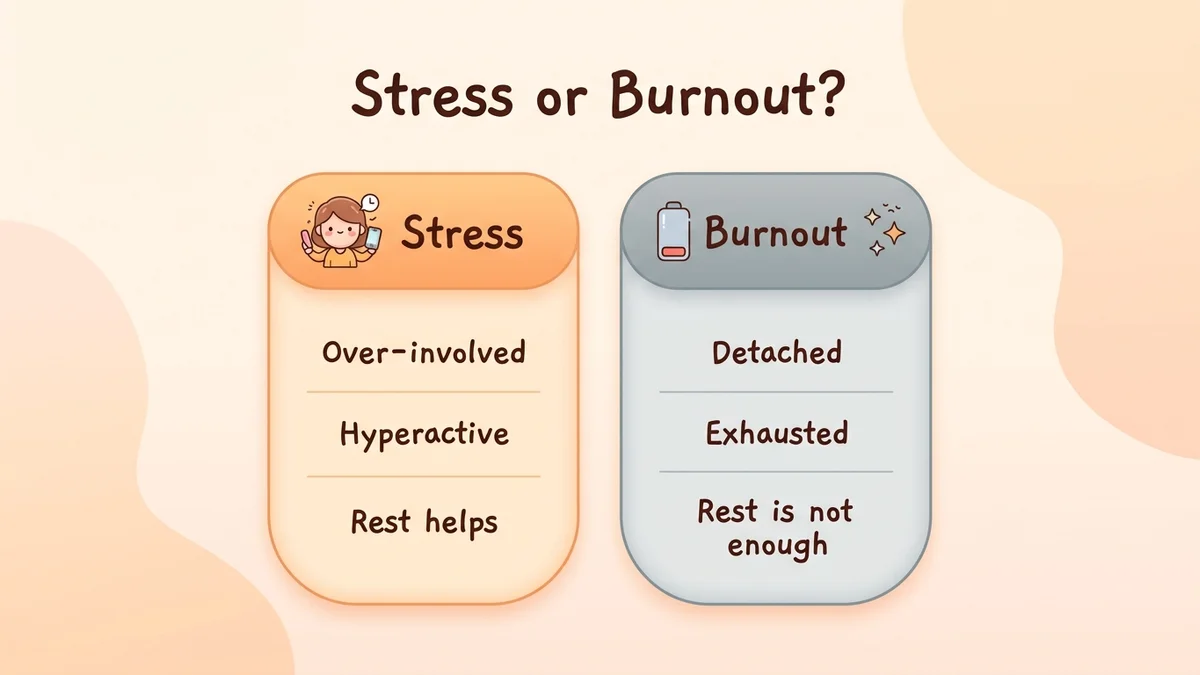
The line between intense stress and burnout comes down to three criteria. Stress is an adaptive response that can even be energizing. Burnout is a state of collapse where adapting is no longer possible.
| Criterion | Intense stress | Burnout |
|---|---|---|
| Dominant emotion | Over-engagement, anxiety | Detachment, emotional emptiness |
| Energy | Hyperactivity, a need to control everything | Total exhaustion, nothing motivates you |
| Recovery | A weekend or vacation is enough | Even 3 weeks off changes nothing |
| Relationship with work | Too involved | No longer involved at all |
| Duration | Weeks | Months (6 to 18 months to set in) |
If you come back from vacation just as exhausted as before you left, that's a strong indicator. Burnout doesn't resolve with rest alone, unlike passing stress.
Who is most at risk of burnout in 2026?
Anyone can burn out, but certain profiles and contexts increase the risk:
| Population | Risk level | Aggravating factors |
|---|---|---|
| Young adults under 35 | High | Performance pressure, job insecurity |
| Women | High | Double load (work + home), emotional labor |
| Healthcare workers | Very high | Constant exposure to suffering, understaffing |
| Senior managers | High | Responsibility, always-on availability, presenteeism |
| Fully remote workers | High | Isolation, difficulty disconnecting |
| Teachers | High | Administrative load, lack of recognition |
In 2026, burnout is also hitting newer groups: freelancers, content creators and developers facing the acceleration brought by AI at work.
The 5 stages of burnout: where are you?
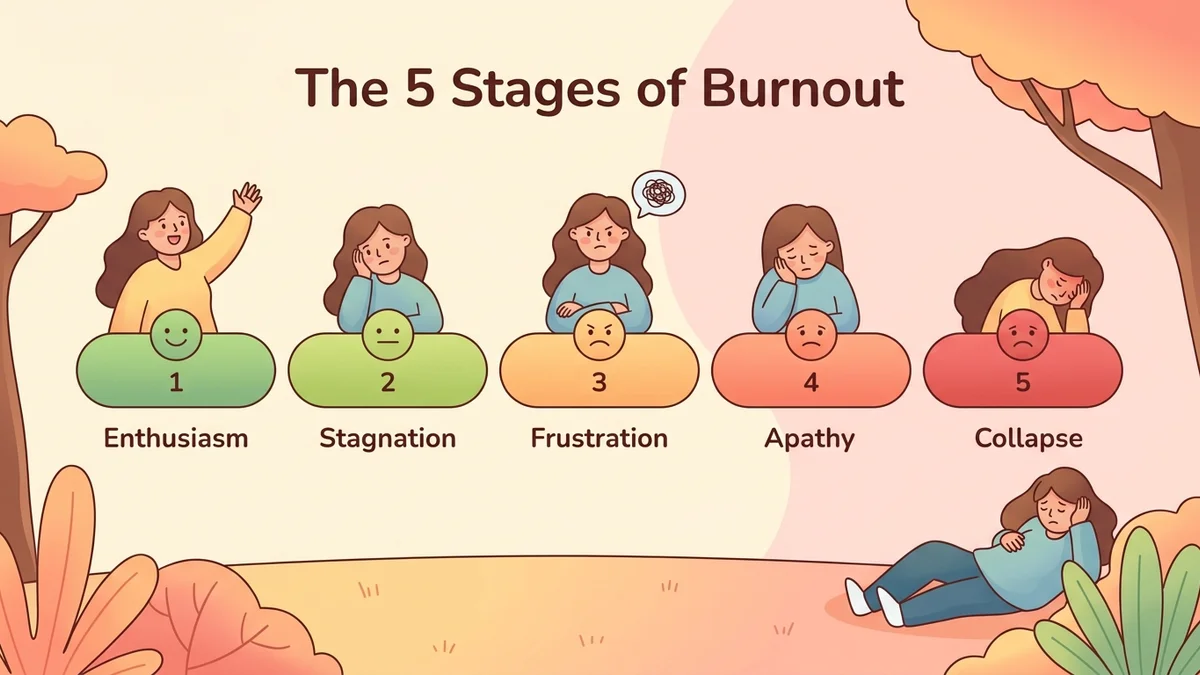
Burnout doesn't strike overnight. It's a 5-stage process documented by Herbert Freudenberger. Identifying your stage lets you act at the right time.
- Enthusiasm: you're motivated, you do more than asked, you feel indispensable
- Stagnation: the first doubts appear, fatigue sets in, but you keep up the pace
- Frustration: you become cynical and irritable, your work relationships deteriorate
- Apathy: you do the bare minimum, you're on autopilot, your body starts giving out (infections, aches)
- Collapse: total inability to work, an abrupt stop, sometimes hospitalization
Intervening at stages 2-3 allows recovery within 3 to 6 months. At stage 5, expect 12 to 24 months.
Real-life scenarios
Scenario 1: The always-connected manager Jason, 38, IT project manager. He answers Slack at 11 p.m. and works weekends "just to get ahead." For 4 months: insomnia, daily headaches, angry outbursts at his kids. He thinks "it'll pass once I take a vacation." What finally alerts him: his vacation changes nothing. He comes back just as exhausted as before.
Scenario 2: The nurse who no longer feels anything Olivia, 29, has been an ER nurse for 3 years. She used to cry over patients' suffering; now she feels nothing. She goes through the motions mechanically. She lost 15 pounds in 2 months without noticing. Cynicism set in without her realizing it.
Scenario 3: The isolated remote worker Omar, 32, fully remote software developer. He works from his living room, alone, 10 hours a day. No more breaks, no more line between work and personal life. Last month he turned off his Slack notifications — not by choice, but because he can no longer stand even a single message.
The Serena perspective
At Serena, we see that users who track their energy level every day spot signs of overload 3 to 4 weeks earlier than those who wait for physical symptoms. Emotional tracking works like a warning light on your internal dashboard.
We also see a gap between theory and practice. In theory, experts recommend "stepping back" and "setting boundaries." In reality, people in stages 3-4 of burnout no longer have the cognitive capacity to do that on their own. That's why guided micro-practices of 2 to 5 minutes (breathing, body scan) work better than an ambitious meditation program nobody can stick to when they're exhausted.
77% of US workers reported work-related stress in the past month, and 31% reported emotional exhaustion, according to the APA's Work in America survey (2023).
Serena Coach tip: Start with 2 minutes of cardiac coherence in the morning. Not 20 minutes. Not an 8-week program. Just 2 minutes, every day. That's what Serena users who stick with it do, even in the middle of recovery.
Understanding burnout: Christina Maslach explains
To better understand the psychology of burnout, this episode of the American Psychological Association's Speaking of Psychology podcast features Christina Maslach, the researcher who created the most widely used burnout assessment. She explains why burnout is about the job, not just the person.
As Christina Maslach explains, burnout goes beyond fatigue: it affects your relationship with meaning and your professional identity, and it's shaped by workplace conditions. You can work on rebuilding your day-to-day emotional footing with Serena, which offers breathing exercises and mood tracking designed for people in recovery.
How do you respond to burnout symptoms?
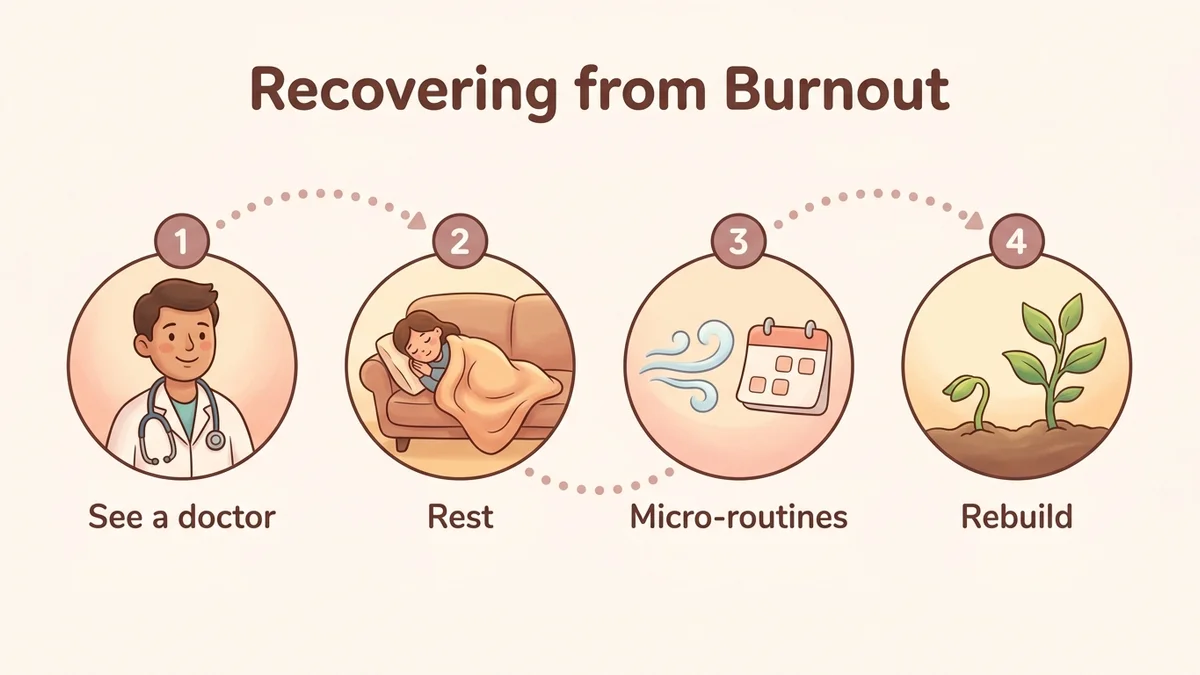
You've identified several symptoms. Here are the concrete steps, in order of priority.
Step 1: See your doctor
This is non-negotiable. Only a professional can assess what's going on and how serious it is, and rule out other causes. They can document the need for time off (often essential) and refer you to a psychologist or psychiatrist.
Step 2: Accept the break
Without stepping away from work, recovery is nearly impossible. Your nervous system needs complete rest to reset. Check whether you're eligible for FMLA leave or short-term disability, and whether your employer offers an employee assistance program (EAP).
Step 3: Set up recovery micro-routines
In the acute phase, your brain can't follow a complex program. Start with:
- 2 minutes of guided breathing in the morning (detailed techniques here)
- Daily tracking of your energy and emotions
- A 20-minute walk without your phone
Step 4: Identify the organizational causes
Burnout isn't just an individual problem. Research consistently shows that its causes are largely organizational: workload, lack of control, insufficient reward, a breakdown of community, lack of fairness and values conflicts — the six areas Christina Maslach identified. Letting go alone isn't enough if the environment stays toxic.
How Serena can support you
Serena offers concrete tools for the recovery phase:
- 6 guided breathing techniques (including cardiac coherence) that fit into 2 to 5 minutes
- Daily mood tracking based on the Circumplex model to objectively measure your progress
- A gratitude journal to rebuild a positive relationship with your daily life
The app doesn't replace medical care. It complements it by offering support between appointments. Try Serena for free.
Key burnout statistics in the US
| Indicator | Figure | Source |
|---|---|---|
| Workers reporting work-related stress in the past month | 77% | APA Work in America (2023) |
| Workers reporting negative impacts of work stress | 57% | APA Work in America (2023) |
| Emotional exhaustion | 31% | APA Work in America (2023) |
| Not motivated to do their best | 26% | APA Work in America (2023) |
| Desire to quit | 23% | APA Work in America (2023) |
| Irritability or anger with coworkers or customers | 19% | APA Work in America (2023) |
| Average recovery time | 6-24 months | Work & Stress (2025) |
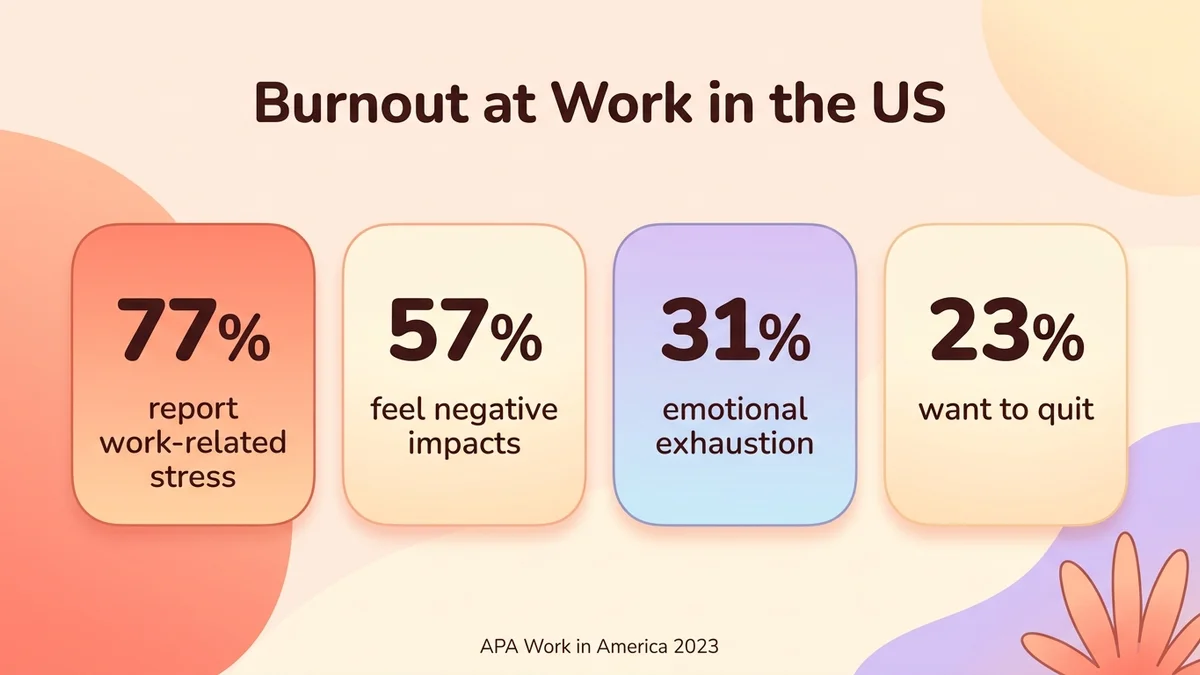
57% of US workers report negative effects of work stress often associated with burnout, including emotional exhaustion, lack of motivation and a desire to quit, according to the APA (2023).
Frequently asked questions
What is the difference between burnout and depression?
Burnout is directly tied to work: it's characterized by gradual exhaustion, cynicism about your job and reduced effectiveness. Depression affects every area of life, with persistent sadness and a general loss of interest. However, untreated burnout can develop into clinical depression. A professional can tell the difference.
How long does job burnout last?
Recovery time ranges from 6 months to 2 years. Burnout caught at stages 2-3 resolves within 3 to 6 months with the right support. Severe burnout (stage 5) requires 12 to 24 months of rebuilding, often including a career change.
Is burnout a medical diagnosis?
The WHO's ICD-11 classifies burnout as an "occupational phenomenon," not a medical condition. In the US, burnout itself isn't a formal diagnosis, but related conditions such as depression, anxiety or insomnia can be diagnosed and may qualify for FMLA leave or ADA accommodations.
Can you burn out while working remotely?
Yes. Remote work can increase the risk because it's harder to disconnect, you become socially isolated and the boundaries blur. Protect yourself with fixed start and stop times, a dedicated workspace and regular contact with colleagues.
What are the first signs of burnout?
The first signs are fatigue that no longer goes away with rest, unusual irritability, sleep problems and a gradual loss of motivation. Keeping an eye on your daily stress level helps you catch these signals before they get worse.
Who should you see about burnout?
Your primary care doctor is the first point of contact. They assess the situation, document the need for time off if necessary and refer you to a specialist (CBT psychologist, psychiatrist). Many health plans cover therapy, and employee assistance programs (EAPs) often provide a few free confidential sessions.
Does exercise help you recover from burnout?
Yes, carefully. Moderate physical activity (walking, yoga, swimming) lowers cortisol and boosts endorphins. Intense exercise can worsen exhaustion. According to Sports Medicine (2024), 30 minutes of walking a day is enough during early recovery.
Does my employer have obligations regarding burnout?
There's no US law specifically about burnout, but employees do have protections. Under the Americans with Disabilities Act (ADA), employers may need to provide reasonable accommodations for mental health conditions, and the Family and Medical Leave Act (FMLA) gives eligible employees up to 12 weeks of unpaid, job-protected leave for a serious health condition.
Conclusion
Job burnout isn't a weakness. It's the logical consequence of a system that demands too much, for too long, without the necessary resources. If you recognized 5 or more symptoms in this article, don't stay alone with it. See your doctor. Talk to someone you trust.
At the same time, start with small actions: 2 minutes of breathing in the morning, day-to-day tracking of your energy, a real break in the evening. Serena can support you through these first steps with guided exercises adapted to your energy level.
Your mental health isn't negotiable. And the good news is: people do recover.