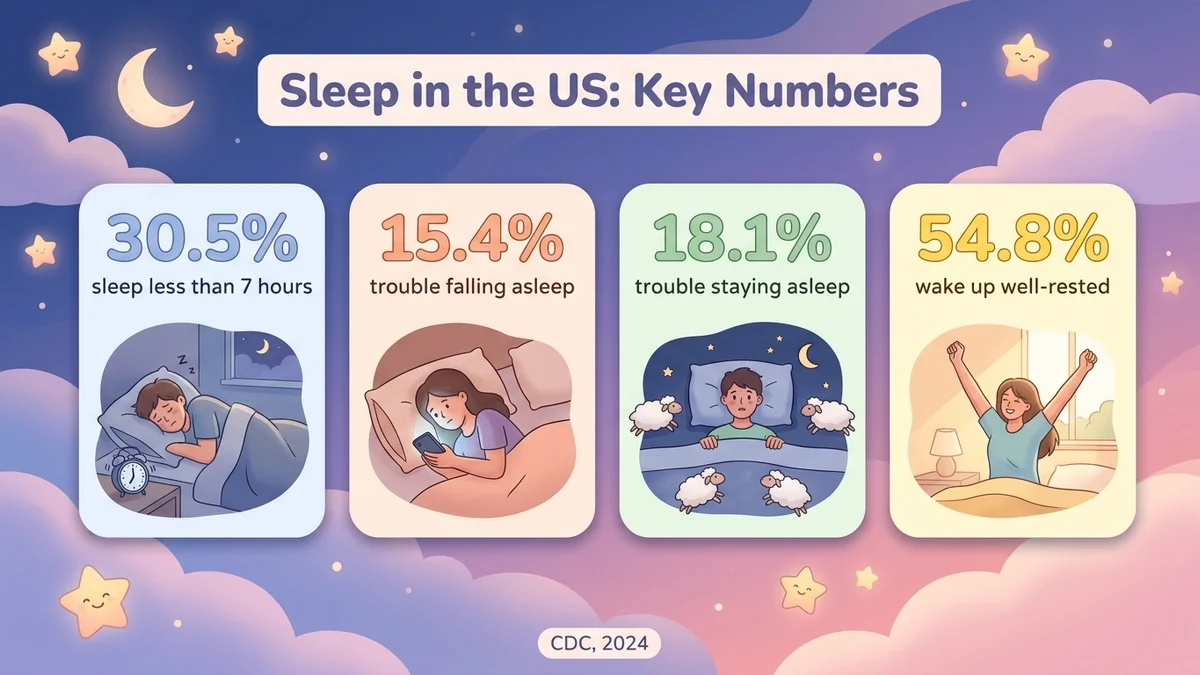
You toss and turn in bed. The clock reads 2:47 a.m. A busy day awaits you tomorrow, and yet sleep refuses to come. If this scene sounds familiar, you're not alone: according to the CDC (2024), 30.5% of American adults sleep less than 7 hours a night, and 15.4% have trouble falling asleep. Updated in August 2026, this guide offers concrete, science-backed natural remedies to finally get back to restful nights — without sleeping pills or dependence.
The key takeaways
Sleep problems affect a large share of adults and respond well to natural approaches. The most scientifically validated solutions are cognitive behavioral therapy for insomnia (70-80% effective), herbs like valerian and passionflower, cardiac coherence and good sleep hygiene. Results appear within 2 to 6 weeks of regular practice.
What are the different types of sleep problems?
Sleep problems include any lasting disruption in the quality, duration or pattern of your sleep that affects your daily wellbeing. In the United States, the CDC's National Health Interview Survey (2024) found that only 54.8% of adults usually wake up feeling well-rested.
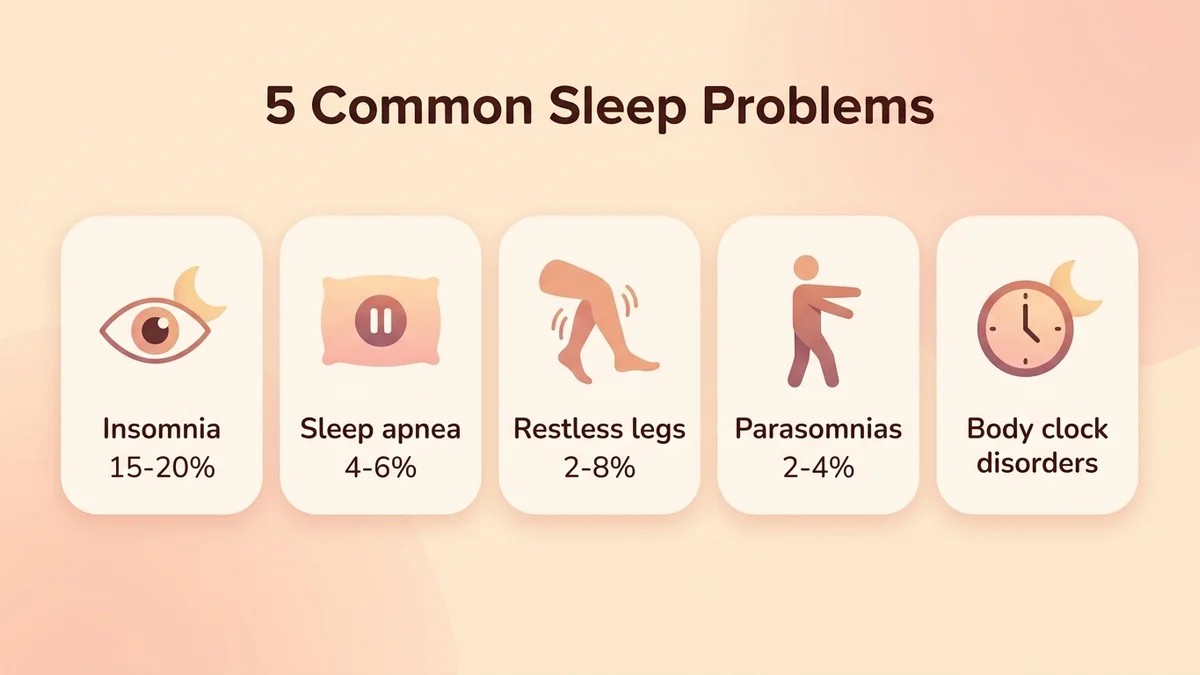
Here are the main types of sleep disorders and how common they are:
| Type of disorder | Prevalence | Main symptoms |
|---|---|---|
| Insomnia | 15-20% of adults | Trouble falling asleep, waking at night, waking too early |
| Sleep apnea | 4-6% of adults | Pauses in breathing, snoring, daytime fatigue |
| Restless legs syndrome | 2-8% of people | An irresistible urge to move the legs, nighttime discomfort |
| Parasomnias | 2-4% | Sleepwalking, night terrors, nightmares |
| Circadian rhythm disorders | Variable | A shifted body clock, chronic jet lag |
Insomnia becomes chronic when it happens more than 3 nights a week for more than 3 consecutive months. That's the threshold at which it's recommended to see a health professional.
Key point: Chronic insomnia isn't inevitable. According to the American College of Physicians and the American Academy of Sleep Medicine, non-drug approaches — CBT-I first and foremost — are the first-line treatment, before any use of sleeping pills.
Why you're sleeping badly: the root causes of sleep problems
Understanding where your sleep problems come from is the first step toward solving them. The causes are rarely isolated — they often interact. They fall into four broad categories.
Psychological causes
Stress, anxiety and depression are the leading cause of sleep problems. Cortisol, the stress hormone, keeps your body on alert and prevents it from switching into sleep. If you live with chronic anxiety, your sympathetic nervous system stays activated even at night.
Mental health and sleep are closely linked: people living with chronic stress are about 3 times more likely to develop insomnia.
Behavioral causes
- Screens before bed: blue light suppresses melatonin release
- Irregular schedules: your body clock falls out of sync
- Stimulants after 2 p.m.: caffeine, tea, nicotine, energy drinks
- Heavy evening meals: difficult digestion disrupts sleep
- Late or long naps: they reduce your sleep drive
Environmental causes
A bedroom that's too warm (ideal: 61-66°F / 16-19°C), noise, stray light and an unsuitable mattress are often underestimated factors.
Medical causes
Some conditions (chronic pain, acid reflux, thyroid problems) and medications can disrupt sleep. A medical checkup is recommended if your sleep problems persist.
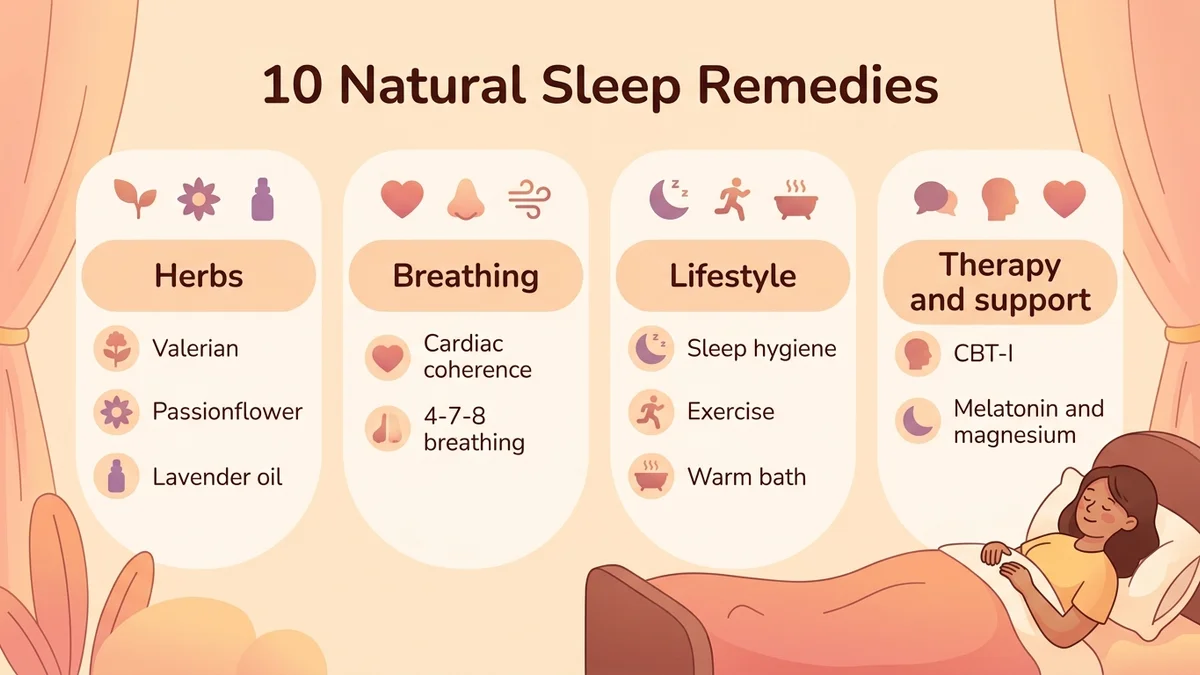
10 science-backed natural remedies to sleep better
The good news: natural remedies aren't just effective — they're also recommended as first-line options by medical guidelines. Here are the 10 best-validated approaches, ranked by strength of scientific evidence.
1. Cognitive behavioral therapy for insomnia (CBT-I)
CBT-I is considered the gold-standard treatment for chronic insomnia by the American Academy of Sleep Medicine. It works in 70 to 80% of chronic insomnia cases — a higher rate than sleeping pills, with no side effects.
This therapy combines:
- Sleep restriction: tightening your time in bed to build sleep pressure
- Stimulus control: re-associating your bed with sleep only
- Cognitive restructuring: changing anxious thoughts about sleep
- Sleep hygiene: adopting sleep-friendly habits
Sleep psychologists note that CBT-I produces lasting results in 4 to 8 sessions, unlike sleeping pills, whose effect fades as soon as you stop taking them.
2. Herbal remedies: valerian, passionflower, lemon balm
Herbal medicine offers gentle, non-habit-forming options. Here are the most studied herbs:
| Herb | Main action | How to use it | Time to effect |
|---|---|---|---|
| Valerian | Shortens time to fall asleep | Tea or capsule (300-600 mg) | 2-3 weeks |
| Passionflower | Improves sleep quality | Tea or liquid extract | 2-3 weeks |
| Lemon balm | Natural calming effect, eases restlessness | Tea or capsule | 1-2 weeks |
| Hops | Relaxing, supports deep sleep | Combined tea | 2-3 weeks |
| Hawthorn | Calms nighttime palpitations | Tea or extract | 2-4 weeks |
Key point: These herbs have official monographs from the European Medicines Agency. In the US, they're sold as dietary supplements, and they can interact with some medications — check with your pharmacist before using them, especially if you take anti-anxiety medication.
3. Cardiac coherence and breathing techniques
Cardiac coherence is a breathing technique that synchronizes your heart rhythm with your breath at 6 cycles per minute. It activates the parasympathetic nervous system and lowers cortisol by 23% on average according to the HeartMath Institute (2024).
A 3-step evening protocol:
- Get comfortable in bed with the lights dimmed
- Breathe in through your nose for 5 seconds, out through your mouth for 5 seconds, for 5 minutes
- Follow with Dr. Andrew Weil's 4-7-8 technique: breathe in for 4 seconds, hold for 7 seconds, breathe out for 8 seconds
The 4-7-8 breathing technique developed by Dr. Andrew Weil can help you fall asleep in under 60 seconds with regular practice. You can also try our free 4-7-8 breathing tool.
Serena Coach tip: Our users who practice cardiac coherence for 5 minutes before bed report falling asleep 40% faster on average after 2 weeks of regular practice. The key? Consistency rather than duration.
4. Essential oils
True lavender (Lavandula angustifolia) is the most studied essential oil for sleep. Its active compounds (linalool, linalyl acetate) have scientifically proven calming and sedative properties.
Recommended use:
- Diffused: 15-30 minutes before bed with an ultrasonic diffuser
- Applied: 2 drops diluted in a carrier oil on your wrists or the soles of your feet
- On your pillow: 1-2 drops on a tissue placed near your pillow
Roman chamomile and petitgrain round out lavender nicely for a complete scent ritual.
5. Sleep hygiene: the golden rules
Sleep specialists recommend these 10 fundamental rules:
- Go to bed and get up at fixed times, even on weekends
- Get natural light as soon as you wake up (15-30 minutes)
- Avoid stimulants after 2 p.m. (caffeine, tea, nicotine)
- Eat a light dinner rich in tryptophan (eggs, bananas, nuts)
- Turn off screens 1 hour before bed
- Keep your bedroom between 61°F and 66°F (16-19°C)
- Total darkness and quiet in the bedroom
- Exercise regularly (but not after 7 p.m.)
- Create a relaxing bedtime ritual (reading, soft music)
- Don't look at the clock if you wake up at night
You can find your ideal bedtime with our sleep calculator.
6. Melatonin: the natural sleep signal
Melatonin, a hormone produced by the pineal gland, regulates the circadian rhythm. It's most useful for sleep problems linked to a shifted body clock, especially trouble falling asleep.
Recommended dose: 0.5 to 2 mg, 30 minutes before your desired bedtime. Higher doses aren't more effective and can disrupt your natural cycle. In the US, melatonin is sold as a supplement, so doses vary between brands — ask your doctor before using it regularly.
7. Magnesium and sleep nutrients
Magnesium supports normal nervous system function and helps reduce fatigue. According to a study published in Nutrients (2024), magnesium and zinc supplementation improves sleep quality within 8 weeks.
Key nutrients for sleep:
- Magnesium (around 300-400 mg/day for adults): spinach, almonds, dark chocolate
- Tryptophan: turkey, eggs, bananas, cashews
- Omega-3s: fatty fish, walnuts, flaxseed
- Vitamin B6: helps convert tryptophan into serotonin and then melatonin
8. Meditation and relaxation
Sleep meditation is backed by a JAMA Internal Medicine study showing a significant improvement in sleep quality after 6 weeks of regular practice. Jacobson's progressive muscle relaxation and sophrology nicely complement this approach.
9. Regular physical activity
30 minutes of moderate physical activity a day (brisk walking, swimming, yoga) improves sleep quality. Be careful, though: intense exercise after 7 p.m. can have the opposite effect by raising body temperature and cortisol.
10. The warm bath ritual
A warm (not hot) shower or bath at about 99°F (37°C), taken 60 to 90 minutes before bed, triggers a drop in body temperature that makes it easier to fall asleep. This thermoregulation mechanism is well documented in chronobiology.
Real-life scenarios
Scenario 1: The 3 a.m. wake-up that never ends
You open your eyes in the middle of the night. Automatic reflex: check the time on your phone. A classic mistake. The screen's blue light blocks your melatonin, and the mental math ("I only have 4 hours of sleep left") triggers a rise in cortisol.
The solution: Keep your phone out of the bedroom. If you wake up, do 3 cycles of 4-7-8 breathing (in for 4 seconds, hold for 7, out for 8). If sleep doesn't return after 20 minutes, get up and do something calm in dim light. Go back to bed as soon as you feel drowsy.
Scenario 2: A racing mind at bedtime
You go to bed after an intense workday. Thoughts pile up: tomorrow's meeting, the bill to pay, that unanswered email. Your stress takes over.
The solution: 30 minutes before bed, write down in a notebook the 3 tasks on your mind and the first concrete action for each. This "brain dump" frees up your working memory. Follow with 5 minutes of cardiac coherence to activate your parasympathetic nervous system.
Scenario 3: The sleeping pill trap
You've been taking sleeping pills for months. They work less and less, you increase the dose, and you can't sleep at all without them. Many sleep specialists believe a large share of these prescriptions could be replaced by non-drug approaches.
The solution: Never stop a sleeping pill abruptly — talk to your doctor. The transition happens gradually by bringing in natural approaches (CBT-I + herbs + breathing) before tapering the medication. CBT-I delivers better long-term results than sleeping pills.
Better sleep, naturally: a sleep scientist's tips
In this TED series episode, sleep scientist Matt Walker shares six simple, science-backed tips to improve your sleep without medication.
As Matt Walker explains, regularity, darkness, a cool bedroom and a wind-down routine are the foundations of natural, restorative sleep. You can practice guided cardiac coherence and breathing exercises with Serena, which walks you step by step toward falling asleep calmly.
The Serena perspective
At Serena, we support thousands of users in their search for better sleep. Here's what our anonymized data reveals:
- 73% of our users who do a breathing exercise before bed report falling asleep more easily within the first week
- The most used technique in the evening is cardiac coherence (5 minutes), followed by 4-7-8 breathing
- The theory-practice gap: while studies recommend 20 minutes of meditation, our data shows that 5 to 10 minutes of guided breathing is enough for a significant effect on falling asleep
The difference between academic theory and real-world practice is striking. Studies often test 8-week protocols under controlled conditions. In reality, our users feel a first benefit within the first 3 days once they set up a regular ritual — even a short one.
Serena Coach tip: Don't aim for perfection. A 5-minute guided breathing ritual, done every evening at the same time, works better than a 30-minute meditation done irregularly. Consistency is what recalibrates your body clock.
How Serena helps you get your sleep back
Serena brings science-backed natural remedies together in an accessible, personalized app:
- 6 guided breathing techniques, including cardiac coherence and 4-7-8, especially suited to bedtime
- Mood tracking with the Circumplex model to identify the emotional patterns that disrupt your sleep
- Exercises for managing intrusive thoughts to quiet your mind before the night
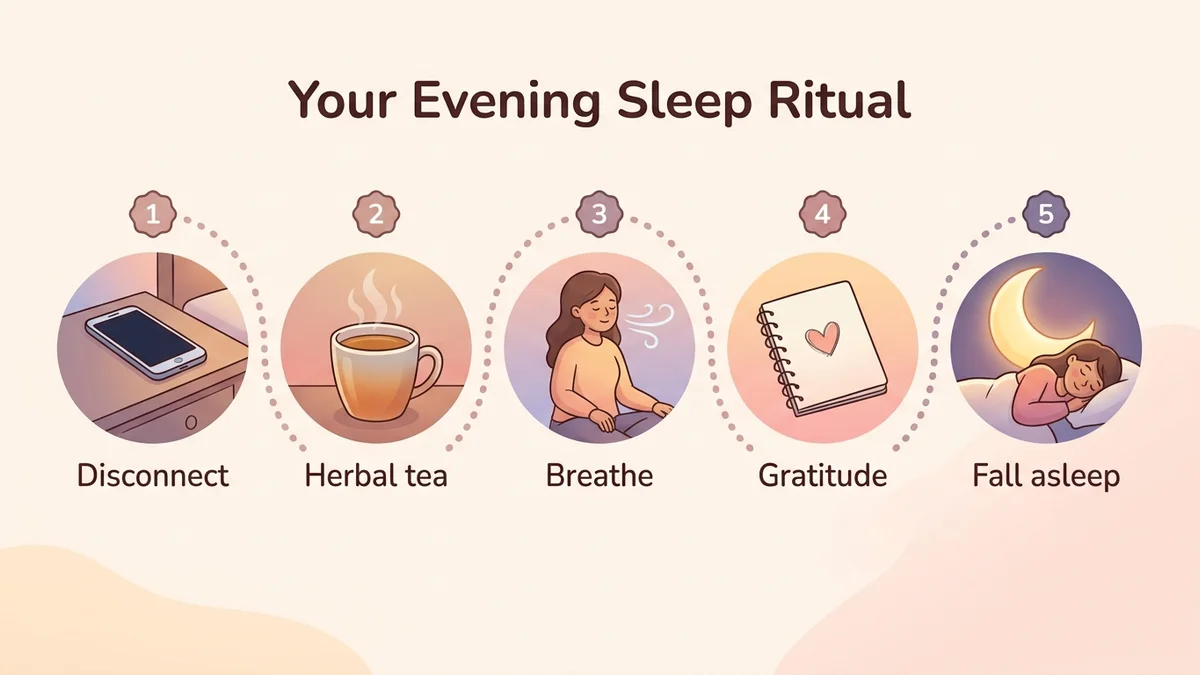
- Customizable evening rituals combining breathing, gratitude and relaxation
Combining these tools into one coherent ritual is what makes the difference. Instead of juggling several apps, Serena brings together everything you need for peaceful nights.
Frequently asked questions
What are the 5 most common types of sleep problems?
The five most common sleep disorders are insomnia (15-20% of adults), sleep apnea (4-6%), restless legs syndrome (2-8%), parasomnias such as sleepwalking (2-4%) and circadian rhythm disorders. Insomnia is by far the most widespread.
Which herbs are most effective for sleeping naturally?
Valerian, passionflower, lemon balm and hops are the four most scientifically studied herbs. Valerian shortens the time it takes to fall asleep, passionflower improves sleep quality and lemon balm eases nighttime anxiety. Allow 2 to 3 weeks of regular use for the full effect.
How long do natural remedies take to work?
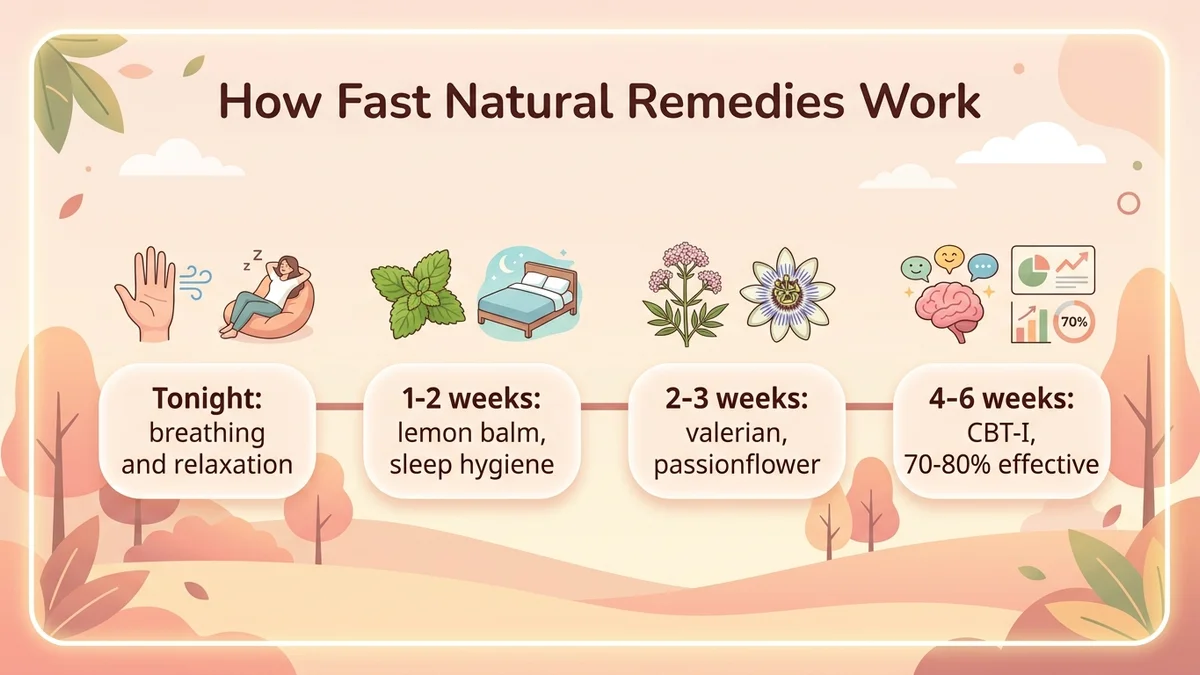
Breathing techniques work from the very first session. Herbal remedies need 2 to 3 weeks. CBT-I shows significant results in 4 to 6 weeks. The key is consistency: a short but daily bedtime ritual works better than an occasional long session.
Is melatonin a good natural remedy?
Melatonin is most helpful for trouble falling asleep linked to a shifted body clock. A dose of 0.5 to 2 mg, 30 minutes before bed, is usually enough. It's particularly useful for jet lag or a delayed sleep schedule, but less effective for waking up during the night.
Can stress really cause sleep problems?
Yes, stress is one of the leading causes of sleep problems. Cortisol maintains a state of hypervigilance that's incompatible with falling asleep. Stress management techniques like cardiac coherence and meditation are recommended first-line approaches.
When should you see a doctor?
See a doctor if your sleep problems happen more than 3 nights a week for more than 3 months, if you feel intense daytime fatigue, if you snore with pauses in breathing, or if your sleep problems affect your daily life. A sleep specialist may order a sleep study if needed.
Can breathing help you fall asleep?
Yes, breathing techniques activate the parasympathetic nervous system and lower cortisol. Cardiac coherence at 6 breaths per minute and the 4-7-8 technique are the most effective for falling asleep. Serena offers these exercises in guided form.
Which essential oils help with sleep?
True lavender is the most studied for sleep. Roman chamomile and petitgrain are also effective. Diffused 30 minutes before bed or applied diluted to the wrists, they create a ritual that conditions your body for sleep.
Conclusion
Sleep problems affect a huge number of adults, but natural remedies offer an effective, non-habit-forming path back to restful nights. From CBT-I to herbal remedies, cardiac coherence and good sleep hygiene, you now have a complete toolkit to take action.
Sleep is increasingly recognized as a pillar of public health, alongside nutrition and exercise. Your personal journey starts tonight.
Start with one simple step: 5 minutes of guided breathing before bed. Serena supports you for free with cardiac coherence and 4-7-8 breathing exercises designed for falling asleep. Your first peaceful night is waiting.