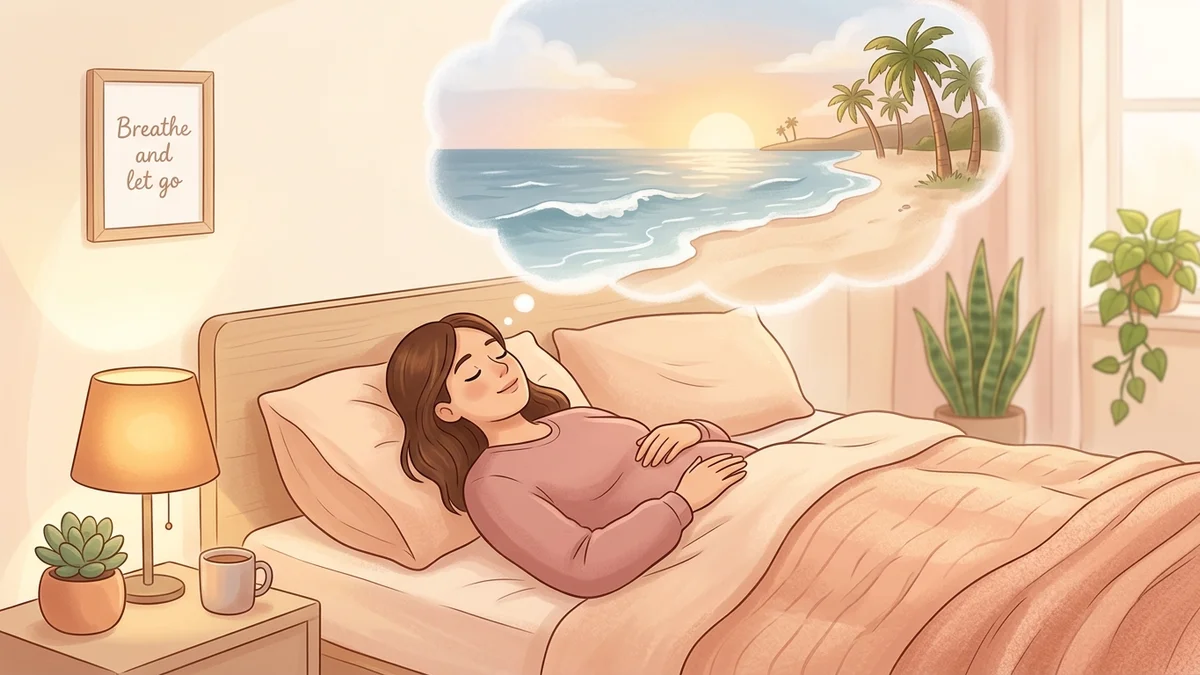
You've been tossing and turning in bed for an hour, your mind flooded with thoughts from the day. The clock shows a late hour, and the anxiety of not sleeping makes things even worse. Know that spiral? Sophrology for sleep offers a concrete, natural solution: by combining controlled breathing, muscle relaxation and positive visualization, it helps your body and mind shift into sleep within minutes. Updated in August 2026, this guide walks you through it step by step.
The key takeaways
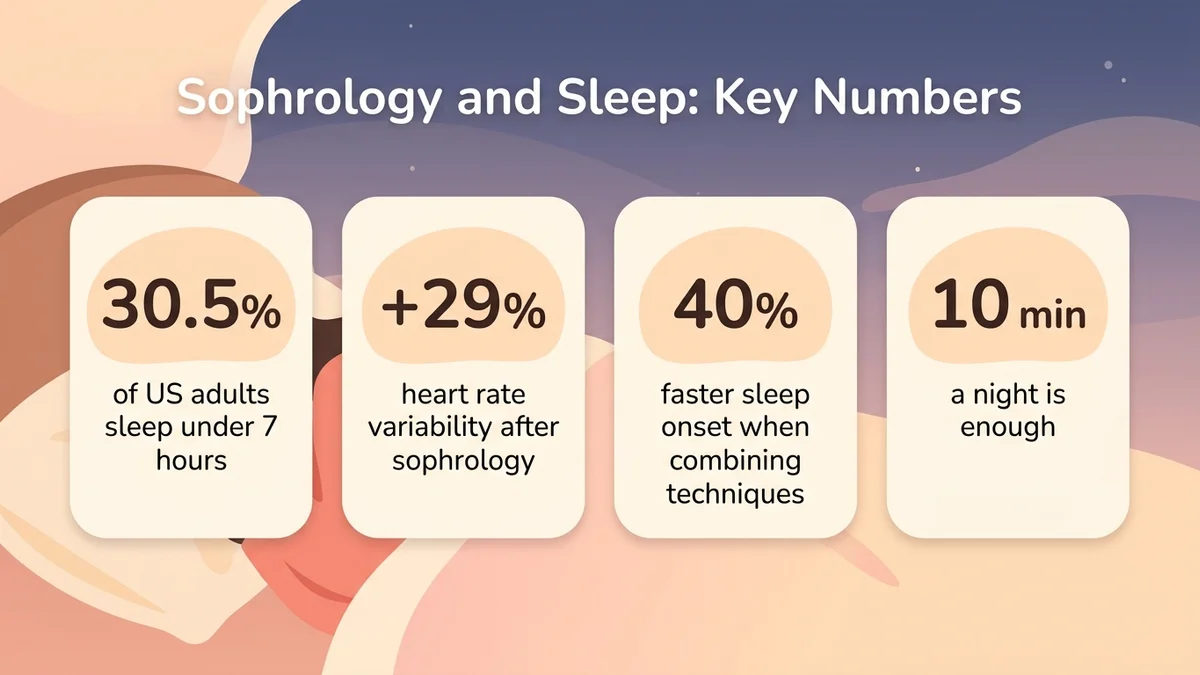
Sophrology for sleep works on three levers: slow breathing activates the parasympathetic nervous system, muscle relaxation releases the body's tension, and positive visualization quiets racing thoughts. According to the CDC (2024), 30.5% of American adults sleep less than 7 hours a night. Ten minutes of sophrology in the evening is enough to lower cortisol and prepare for natural sleep.
How does sophrology help you sleep better?
Sophrology shortens the time it takes to fall asleep by activating the parasympathetic nervous system through controlled breathing exercises. Created in the 1960s by neuropsychiatrist Alfonso Caycedo, this mind-body method — very popular in France and Switzerland and gaining ground in the US and UK — works on body and mind at the same time to bring about a state of deep calm.
In practical terms, here's what happens when you practice:
- Your heart rate slows down: slow breathing sends a safety signal to the brain, which reduces the production of cortisol (the stress hormone)
- Your muscles relax: dynamic relaxation exercises release the tension built up during the day
- Your brain shifts into alpha waves: this in-between state between wakefulness and sleep, called the sophronic state, naturally prepares you to fall asleep
The SO-WELL study, conducted with 200 healthcare workers, showed a 29% increase in heart rate variability (HRV) after a sophrology protocol (2023). This physiological marker reflects the body's improved ability to switch between activity and rest.
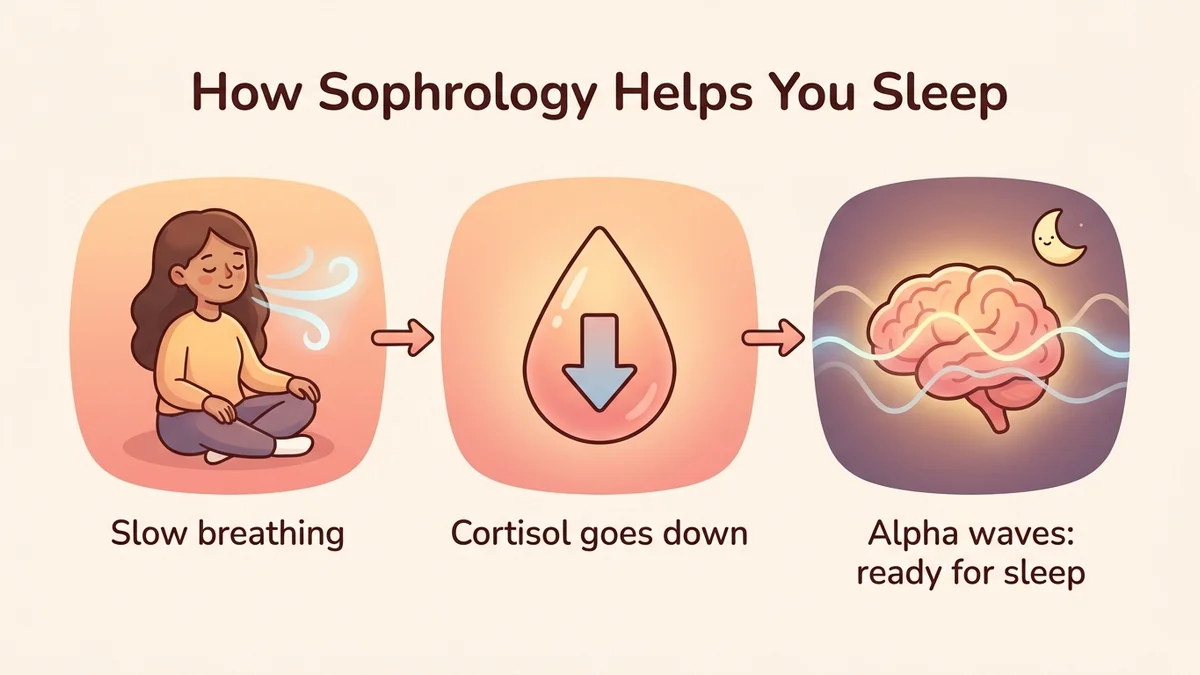
Key point: Sophrology doesn't "force" you to sleep. It creates the physiological conditions for sleep to come naturally, with no dependence on medication and no side effects.
What are the proven benefits of sophrology for sleep?
Sophrology improves overall sleep quality by acting on falling asleep, nighttime awakenings and how rested you feel in the morning. According to a study published in the journal Hegel (2020), a structured "Better sleep & sophrology" program significantly reduces symptoms of moderate chronic insomnia.
| Benefit | Mechanism | Time to effect |
|---|---|---|
| Falling asleep faster | Parasympathetic activation, lower cortisol | From the 1st session |
| Fewer nighttime awakenings | Less nighttime hypervigilance | 2-3 weeks |
| Better deep sleep | Alpha waves easing the transition into slow-wave sleep | 4-6 weeks |
| Less bedtime anxiety | Positively rewiring your evening ritual | 1-2 weeks |
| Feeling rested on waking | Deep muscle relaxation during the night | 3-4 weeks |
Stress is one of the most commonly cited causes of sleep problems. That's exactly where sophrology shines: by breaking the vicious circle of stress, insomnia, fatigue and more stress.
The stakes are real. According to the CDC's National Health Interview Survey (2024), 30.5% of US adults sleep less than 7 hours, and only 54.8% usually wake up feeling well-rested. Regularly sleeping too little is associated with a higher risk of depression and weight gain.
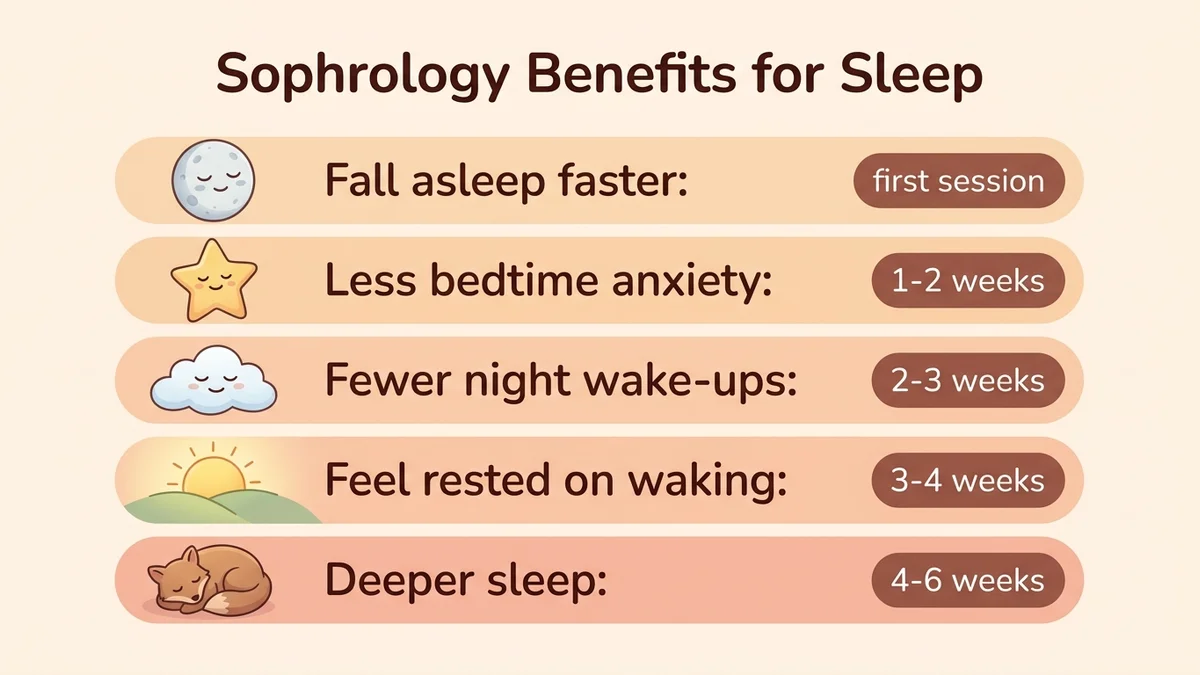
Key point: Most people who try sophrology for sleep report feeling calmer at bedtime within the first few sessions — the quickest win is often less anxiety about not sleeping.
5 sophrology exercises to fall asleep quickly
Here are the most effective exercises, from simplest to most complete. You can do them right in bed, in order or separately.
1. Belly breathing (5 minutes)
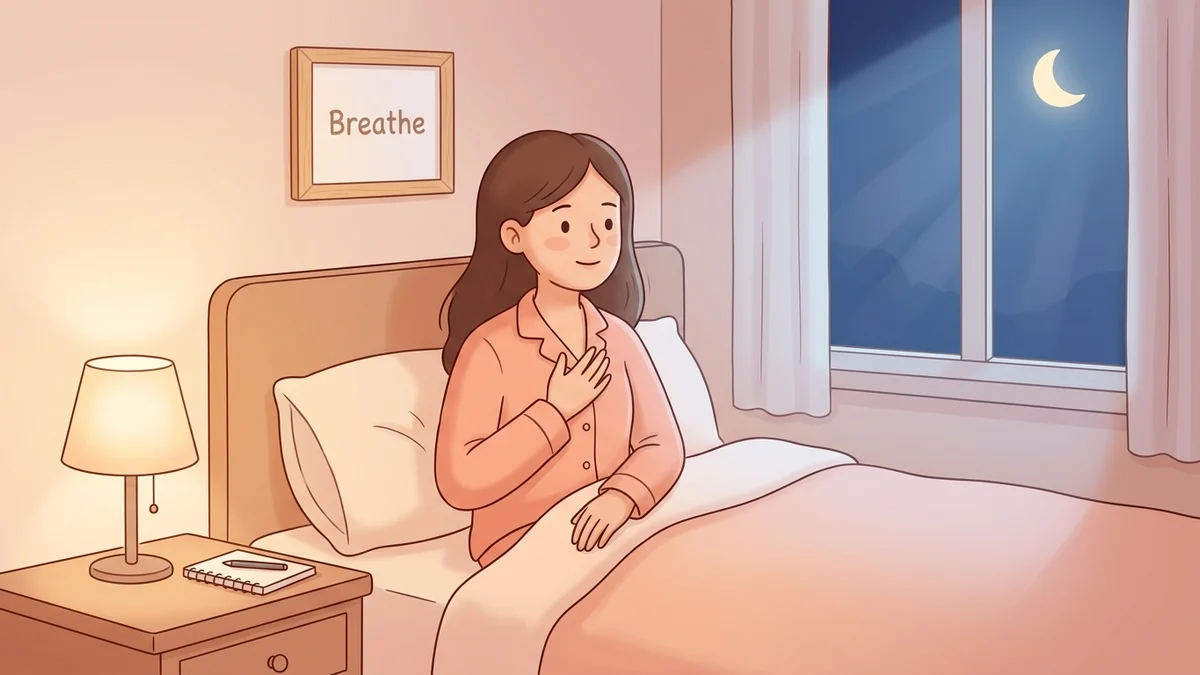
This is the foundation of every sophrology session. Lying in bed:
- Place one hand on your belly and the other on your chest
- Breathe in through your nose for 4 seconds, expanding your belly (the hand on your chest doesn't move)
- Breathe out through your mouth for 6 to 8 seconds, letting your belly fall
- Repeat 10 cycles
Your exhale should be twice as long as your inhale. This ratio directly activates the vagus nerve and the parasympathetic nervous system, which is responsible for relaxation.
2. Box breathing (4 minutes)
A structured technique that keeps your mind busy and stops rumination:
- Breathe in for 4 seconds
- Hold the air for 4 seconds
- Breathe out for 4 seconds
- Stay with empty lungs for 4 seconds
- Repeat 8 to 10 cycles
This technique is especially effective if you struggle with intrusive thoughts at bedtime.
3. Evening dynamic relaxation (8 minutes)
Done standing beside your bed, this exercise releases the physical tension of the day:
- Tense: breathe in deeply and tense your whole body (fists clenched, shoulders raised, face scrunched) for 5 seconds
- Hold: hold your breath while keeping the tension for 3 seconds
- Release: breathe out all at once and let your whole body go, like a puppet whose strings have been cut
- Feel the difference between tension and relaxation for 10 seconds
- Repeat 3 times, then lie down
Serena Coach tip: Our users say dynamic relaxation is the most effective exercise when their body feels "wired" after a stressful day. The key is to deliberately exaggerate the tension to amplify the release.
4. Positive visualization (10 minutes)
Positive visualization in sophrology generates alpha brain waves, the in-between state between wakefulness and sleep that makes falling asleep easier. Lying down, eyes closed:
- Imagine a place where you feel completely safe (a beach, a forest, the mountains)
- Engage every sense: the warmth of the sun on your skin, the sound of the waves, the smell of pine trees
- Feel the pleasant heaviness of your body sinking into the sand or grass
- Let the images grow blurrier and blurrier, like a dream beginning
5. The sophrology body scan (10 minutes)
Move through your body from head to toe, relaxing each area:
- Focus on your forehead and release the tension → feel the pleasant heaviness
- Move down to your eyes, cheeks, jaw (often very tense)
- Continue with your neck, shoulders, arms, hands
- Move on to your chest, belly, pelvis
- Finish with your legs and feet
At each area, breathe out slowly, imagining the tension leaving with your breath.
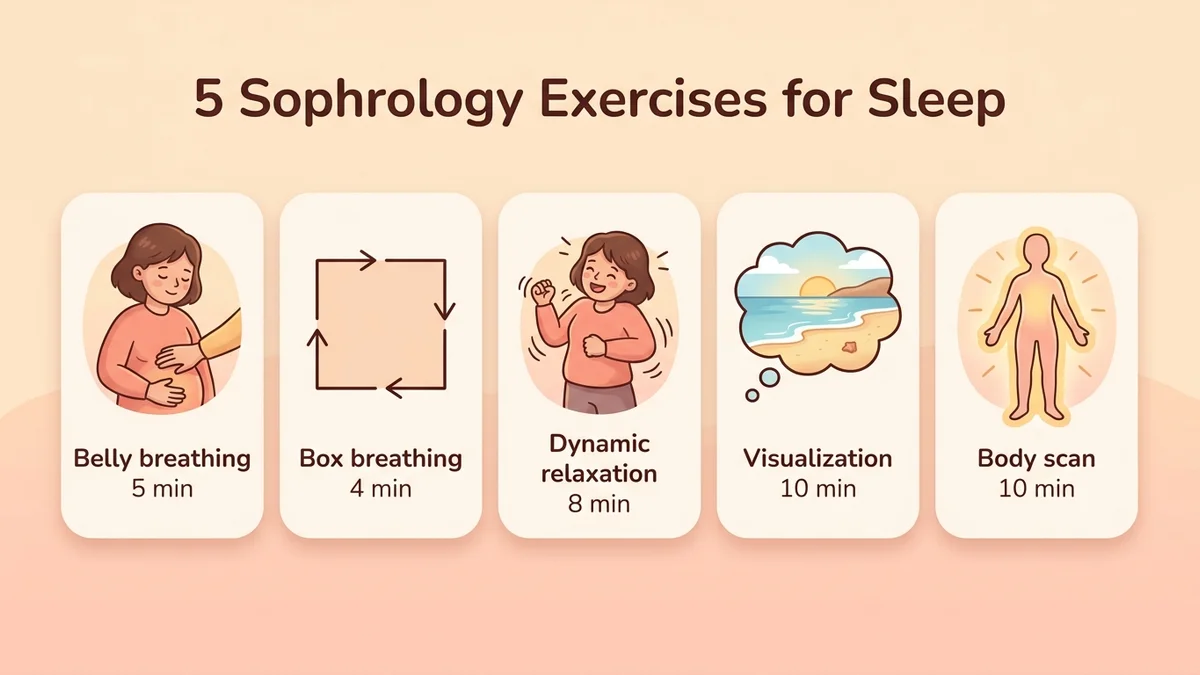
| Exercise | Duration | Difficulty | Best for |
|---|---|---|---|
| Belly breathing | 5 min | Beginner | Every night |
| Box breathing | 4 min | Beginner | Racing thoughts |
| Dynamic relaxation | 8 min | Intermediate | Physical tension |
| Positive visualization | 10 min | Intermediate | Bedtime anxiety |
| Body scan | 10 min | Advanced | Chronic insomnia |
Sophrology or meditation: which is better for sleep?
Sophrology differs from meditation in its structured, guided approach, which makes it more accessible to stressed people who "can't meditate." Here are the key differences:
| Criterion | Sophrology | Meditation |
|---|---|---|
| Approach | Guided (step-by-step instructions) | Open (free observation) |
| Body work | Yes (active muscle relaxation) | Minimal (still posture) |
| Visualization | Central (guided positive scenarios) | Optional |
| Breathing | Specific techniques (box, 4-7-8) | Natural observation |
| Sleep goal | Direct (dedicated protocols) | Indirect (general calm) |
| Suited to stressed beginners | Very well suited | Can be frustrating at first |
In reality, the two approaches complement each other. Mindfulness meditation builds your capacity for observation, while sophrology provides active relaxation tools. A sleep meditation can easily be combined with the sophrology exercises described above.
Guided session: sophrology for sleep on video
This English-language sophrology session from LiveSophroLife guides you through relaxation and breathing designed to prepare you for a good night's sleep:
As this session shows, combining slow breathing with progressive muscle release creates a state of deep relaxation that invites sleep. You'll find similar guided breathing exercises in Serena, which adapts the length and intensity to your stress level.
Real-life scenarios
The evening after an intense day at work
You get home at 8 p.m., your mind still in "problem-solving" mode. Your body is tired, but your brain refuses to switch off.
The technique: Start with 3 cycles of dynamic relaxation standing up (tense and release) to clear out the physical tension. Then lie down and follow with 5 minutes of belly breathing. Moving from physical effort to release signals to your brain that the day is over.
Sunday night insomnia
Anticipating the week ahead keeps you awake. Thoughts go around in circles: Monday's meeting, the project that's behind, the unanswered emails.
The technique: Positive visualization is your best ally. Picture yourself on Monday evening, the day successfully behind you. Feel the relief. Then add box breathing to keep your mind busy and cut off rumination. If chronic stress is a frequent visitor, consider deeper work on managing your anxiety.
The parent awake at 3 a.m.
Your child woke you up and you can't fall back asleep. The silence of the night amplifies anxious thoughts.
The technique: The sophrology body scan is ideal for nighttime awakenings. Slowly move through each area of your body, breathing out slowly. Don't try to sleep: focus only on letting go. Sleep will return on its own once your body is relaxed enough.
The Serena perspective
Anonymized data from our users reveals an interesting gap between theory and practice. In theory, experts recommend practicing sophrology for 20 to 30 minutes before bed. In practice, the Serena users who get the best results practice for only 8 to 12 minutes, but every single day.
Another observation: belly breathing is the exercise beginners choose most, but it's the combination of breathing + visualization that produces the most lasting results over 30 days. Users who combine the two techniques report falling asleep 40% faster than those who use just one method.
Serena Coach tip: Don't look for the "perfect" exercise. Start with belly breathing for one week, then add positive visualization the following week. Gradual progress is what anchors the habit and produces lasting results.
How Serena supports your practice
Practicing sophrology on your own can feel intimidating at first. A guided app removes that hurdle — our comparison of meditation apps reviews the main options. Serena offers guided breathing sessions built on the sophrology techniques that work best for sleep:
- 4-7-8 breathing: the technique developed by Dr. Andrew Weil, guided step by step with haptic vibrations
- Cardiac coherence: 5 minutes of breathing at 6 cycles per minute to balance your nervous system
- Guided body scan: move through each area of your body with gentle audio guidance
- Sleep tracking: identify the exercises that work best for you through your mood journal
Accessible tools like Serena let anyone start caring for their sleep today, without waiting for an appointment with a specialist.
Frequently asked questions
How long should you practice sophrology to sleep better?
Ten minutes a night is enough to see results within the first week. Studies show that significant improvement sets in after 4 to 6 weeks of regular practice. The key is consistency: 10 minutes every night beats 30 minutes twice a week.
Can you practice sophrology on your own at home for sleep?
Yes — in fact, it's one of sophrology's great strengths. Once you've learned the basics (ideally in 2-3 sessions with a certified sophrologist, in person or online), you can practice completely on your own. Apps like Serena offer guided breathing and relaxation sessions based on the principles of sophrology.
Is sophrology covered by health insurance?
In the US, sophrology is generally not covered by health insurance. Certified sophrologists are also less common than in France or Switzerland, where the method is widely used, but many offer online sessions. The good news: the core exercises in this guide are free and easy to learn.
When should you practice sophrology in the evening?
Ideally 15 to 30 minutes before bed, in a calm, dimly lit environment. Breathing exercises (belly breathing, box breathing) can be done right in bed. Dynamic relaxation, on the other hand, is done standing and works best earlier in the evening as a way to decompress.
What's the difference between sophrology and meditation for sleep?
Sophrology is more structured and guided: you're led step by step through breathing, muscle relaxation and visualization exercises. Meditation is more about observing your thoughts without judgment. For sleep, sophrology is often more effective for beginners because it gives them a clear framework to follow.
Is sophrology suitable for children's sleep?
Yes, sophrology works for children from around age 5 or 6. The exercises are simplified into games: the balloon that inflates for belly breathing, the puppet for muscle relaxation. It's a particularly effective natural option when a child's sleep problems are linked to anxiety.
Sophrology or hypnosis: which is better for sleep?
Sophrology teaches self-care tools you can practice on your own every night. Hypnosis works more deeply on the unconscious but usually requires a practitioner. For a daily approach to sleep, sophrology is more practical. The two methods can be combined depending on your needs — see our guide to yoga nidra and sleep hypnosis.
What if sophrology doesn't work for my sleep?
If results are insufficient after 4 to 6 weeks of regular practice, see a doctor to rule out a medical cause (sleep apnea, restless legs syndrome). Sophrology complements good sleep hygiene habits; it isn't a medical substitute. Also consider exploring other natural remedies for sleep problems and natural anxiety remedies.
Conclusion
Sophrology for sleep is a natural, accessible and proven method for getting back to quality sleep. Whether you're dealing with stress-related insomnia, nighttime awakenings or simply trouble falling asleep, breathing exercises, dynamic relaxation and positive visualization deliver concrete results from the very first sessions.
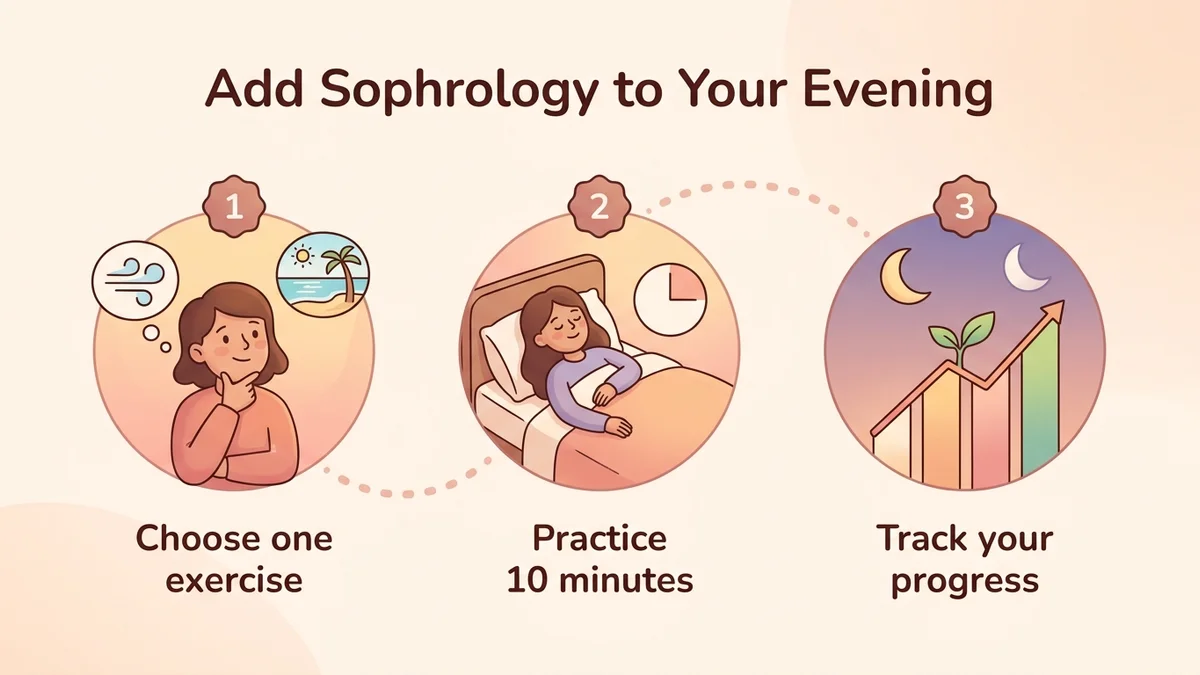
Start tonight: choose just one exercise (belly breathing is ideal for beginners), practice for 10 minutes before bed and notice the difference. To be guided step by step, download Serena and discover breathing and relaxation sessions designed to lead you toward deep, restorative sleep.