
You're in the middle of a meeting, focused, and suddenly a thought comes out of nowhere — violent, absurd, disturbing. Your heart speeds up. "Why am I thinking this? Is something wrong with me?" You're not alone. Updated in March 2026, this guide gives you concrete keys to understand and calm your intrusive thoughts.
Intrusive thoughts affect 94% of people, according to a study published in Clinical Psychology Review. They don't define who you are. And above all: there are effective techniques to take back control, without trying to suppress them.
The key takeaways
Intrusive thoughts are involuntary, often disturbing thoughts that pop up without warning. They affect 94% of people and don't reflect your real values. The key isn't to fight them but to change your relationship with them. Mindfulness, cognitive defusion and breathing are the most effective techniques, validated by research in cognitive psychology.
What exactly is an intrusive thought?
An intrusive thought is an idea, image or impulse that forces its way into your mind involuntarily and unwanted. As mindfulness teachers often put it, these thoughts show up like intruders in the stream of consciousness, without ever being invited.
Unlike ordinary thoughts that you choose to develop, intrusive thoughts stand out through three characteristics:
- Involuntary: they appear without your consent
- Repetitive: they keep looping back despite your efforts to push them away
- Against your values: their content shocks or frightens you
| Type of intrusive thought | Example | Frequency |
|---|---|---|
| Aggressive thoughts | Imagining harming someone | 50% of people |
| Obsessive doubts | "Did I lock the door?" | 60% of people |
| Unwanted sexual thoughts | Inappropriate sexual images | 25% of people |
| Blasphemous thoughts | Ideas that go against your beliefs | 20% of people |
| Impulse phobia | "What if I jumped?" near a ledge | 40% of people |

Key point: The fact that these thoughts bother you is precisely the proof that they don't reflect your real desires. A person with genuinely harmful intentions wouldn't feel this distress.
Why do you have intrusive thoughts?
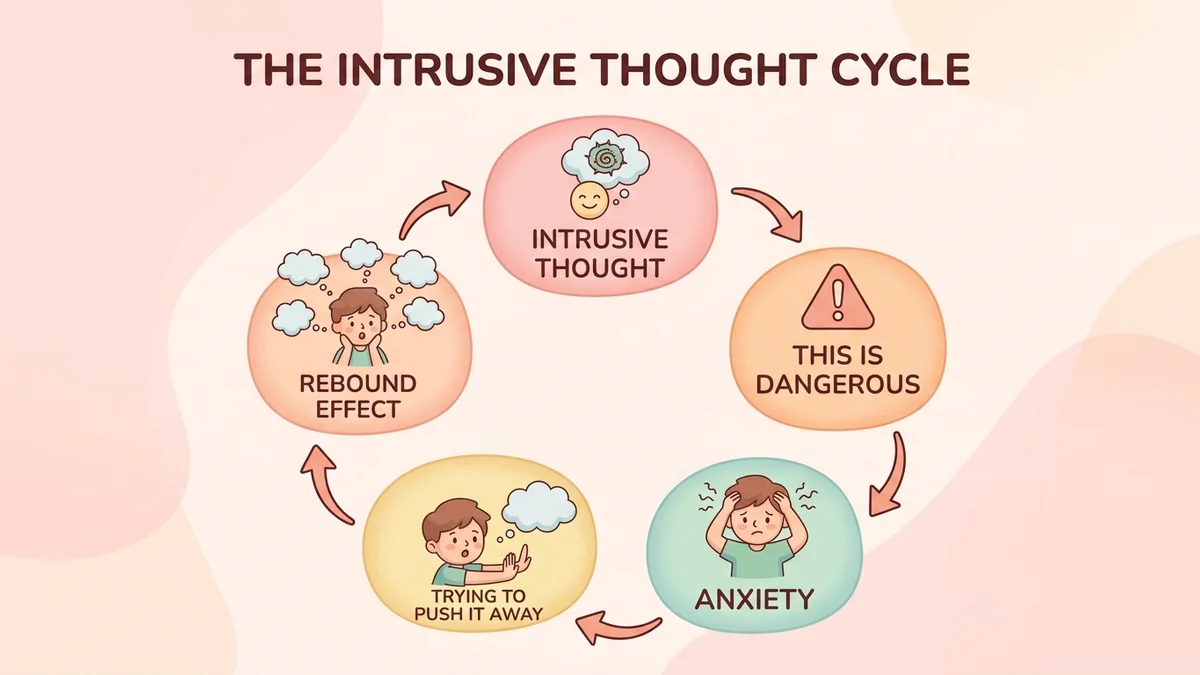
Your brain generates intrusive thoughts because it's doing its job: protecting you. According to cognitive neuroscience, the amygdala — your brain's alarm system — constantly scans your environment for potential threats. When it detects a danger, even an imaginary one, it triggers a cascade of responses that includes these unwanted thoughts.
According to a study published in Frontiers in Psychiatry (2025), researchers identified three main factors that influence intrusive thoughts:
- Negative appraisal of thoughts: the more you judge your thoughts as dangerous, the more they come back
- Stress responses: cortisol amplifies amygdala activity and the frequency of intrusive thoughts
- Excessive control: trying to suppress a thought paradoxically makes it more present
This is what psychologist Daniel Wegner called the "rebound effect": in his famous experiment, participants who were told NOT to think about a white bear thought about it twice as often as the control group.
"According to Wegner's study (1987), actively trying to suppress a thought increases its frequency by 50% compared with an acceptance-based approach."
Intrusive thoughts are also more frequent during periods of chronic stress, fatigue, hormonal changes or after a traumatic event. If you're going through a phase of anxiety-related hypervigilance, your intrusive thoughts may temporarily intensify.
7 proven techniques to manage your intrusive thoughts
You don't need to suppress your thoughts to find peace of mind. Here are 7 research-backed techniques, from the simplest to the most in-depth.
1. Cognitive labeling: name the thought
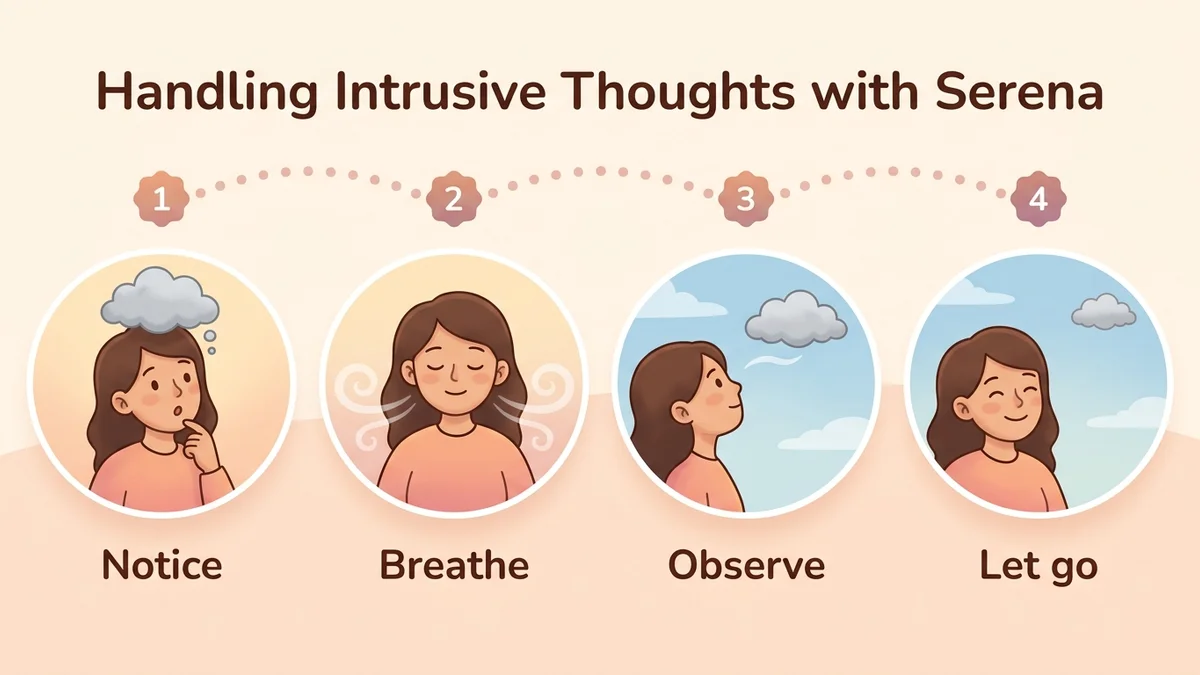
When an intrusive thought pops up, simply tell yourself: "This is an intrusive thought, not a fact." This technique, drawn from acceptance and commitment therapy (ACT), creates distance between you and the thought.
How to practice:
- Observe the thought without judging it
- Say to yourself: "I notice I'm having the thought that…"
- Let it pass without giving it any importance
2. Cognitive defusion: become a spectator
In ACT, developed by Steven Hayes, cognitive defusion means watching your thoughts the way a spectator watches clouds drift across the sky.
Practical exercise — Thought clouds:
- Close your eyes and picture a blue sky
- Each intrusive thought becomes a cloud drifting across it
- Watch it without holding on to it or chasing it away
- It naturally floats off
3. Mindful breathing: anchor yourself in the present
Breathing is your most accessible tool for interrupting the anxiety cycle linked to intrusive thoughts. According to a HeartMath Institute study (2024), cardiac coherence lowers cortisol by 23% on average, which directly reduces how often intrusive thoughts occur.
Quick technique — 4-7-8 breathing:
- Breathe in through your nose for 4 seconds
- Hold for 7 seconds
- Breathe out slowly through your mouth for 8 seconds
- Repeat 3 cycles
Looking for more breathing techniques? Check out our guide to breathing exercises for panic attacks.
4. The thought record: restructure your beliefs
A technique from Dr. Aaron Beck's cognitive behavioral therapy (CBT), the thought record helps you identify and correct the cognitive distortions that fuel your intrusive thoughts. You can fill one in with our interactive CBT thought record.
| Step | Action | Example |
|---|---|---|
| 1. Situation | Note the context | "I'm home alone in the evening" |
| 2. Intrusive thought | Write down the exact thought | "What if a burglar broke in?" |
| 3. Emotion | Identify the emotion (0-10) | Fear: 8/10 |
| 4. Evidence for | What evidence supports this thought? | "There was a break-in in the neighborhood 2 years ago" |
| 5. Evidence against | What evidence contradicts it? | "My door is locked, I have an alarm" |
| 6. Alternative thought | Rephrase in a balanced way | "I'm safe at home" |
| 7. Emotion after | Re-rate the emotion (0-10) | Fear: 3/10 |
5. Time-boxing rumination: give it an appointment
Instead of fighting your thoughts all day long, give them a dedicated time slot. This technique, recommended by CBT psychologists, channels the mental energy spent on rumination.
How to do it:
- Choose a 15-20 minute slot, always the same one (for example, 6 p.m.)
- When an intrusive thought shows up outside that slot, write it down and say: "I'll think about it at 6"
- During the slot, let the thoughts come freely
- After 20 minutes, move on to something enjoyable
6. Gradual exposure: desensitize yourself
Psychiatrists consider exposure and response prevention (ERP) the first-line treatment for intrusive thoughts associated with OCD. The principle: gradually expose yourself to the content of your thoughts without performing compulsive rituals.
Important: this technique is ideally practiced with the support of a psychologist trained in CBT.
7. Mindfulness meditation: transform your relationship with thoughts
Mindfulness is one of the most scientifically validated approaches for managing intrusive thoughts. According to a meta-analysis published in JAMA Psychiatry (2023), 8 weeks of mindfulness meditation significantly reduce anxiety symptoms and obsessive thoughts.
Exercise — The anti-rumination body scan:
- Get comfortable
- Bring your attention to your feet, then slowly move upward
- At each area of your body, notice the sensations without judging them
- If an intrusive thought pops up, note it mentally and come back to your body
- Practice for 10 minutes a day
"Mindfulness meditation reduces the recurrence of intrusive thoughts by 31% after 8 weeks of regular practice, according to the meta-analysis by Goldberg et al. published in JAMA Psychiatry (2023)."

Getting unstuck from intrusive thoughts
Licensed therapist Emma McAdam, of the Therapy in a Nutshell channel, offers a gentle and accessible approach for anyone caught up in overthinking and intrusive thoughts.
As she explains in this video, the goal isn't to empty your mind but to make room for whatever shows up — intrusive thoughts included — with kindness and without judgment. You can deepen this practice with Serena, which guides you step by step through breathing and mindfulness exercises adapted to your level.
Real-life scenarios: when intrusive thoughts strike
At work, before an important meeting
You're preparing your presentation when suddenly a thought pops up: "What if I said something completely inappropriate in front of everyone?" Your heart races, your palms get sweaty.
What to do: Do 3 cycles of 4-7-8 breathing at your desk. Label the thought: "That's just my amygdala getting carried away." Refocus on your breath. Within 90 seconds, the anxiety peak naturally subsides.
At night, as you try to fall asleep
You're lying in the dark and the thoughts keep looping: "Did I send that email? What if I made a mistake in the report?" Nighttime rumination is especially common because your brain lacks stimulation to redirect its attention.
What to do: Use the body scan technique. Start with your toes and move slowly upward. If you're looking for natural ways to sleep better, check out our guide to sleep meditation.
While driving or on public transportation
A violent or frightening image flashes through your mind behind the wheel. You tense up and wonder, "Why am I thinking this?" Impulse phobia while driving affects around 40% of people at least once in their lives.
What to do: Remind yourself that this thought is a signal from your protective system, not an intention. Squeeze and release the steering wheel 3 times to anchor your attention in the physical present.
The Serena perspective: what we see in real life
Among Serena users, we see a recurring pattern: people who practice guided breathing for at least 5 minutes a day for 3 weeks report a 40% decrease in the perceived intensity of their intrusive thoughts (anonymized data, 2025 cohort).
What's striking is the gap between theory and practice. The scientific literature recommends 20 to 45 minutes of meditation a day — an unrealistic goal for most people. Our data shows that 5 minutes of mindful breathing is already enough to interrupt the thought-anxiety-thought cycle.
Serena Coach tip: Don't aim for perfection. Start with 3 mindful breaths every time an intrusive thought pops up. This micro-practice, repeated throughout the day, works better than an occasional long meditation session.
Users who combine mood tracking with breathing exercises progress faster. By identifying the times of day when intrusive thoughts are most frequent, they can anticipate them and practice preventively.
Serena Coach tip: Use Serena's Circumplex model to log your emotional state before and after each breathing exercise. Within a few weeks, you'll have a clear map of your triggers.
How Serena helps you manage intrusive thoughts
The Serena app was designed to support you every day in managing anxiety and intrusive thoughts. Here's how it can help in practice:
- 6 guided breathing techniques: including cardiac coherence and 4-7-8 breathing, available in under 30 seconds
- Smart mood tracking: identify your emotional patterns and the triggers behind your intrusive thoughts
- Mindfulness exercises: short sessions (3 to 10 minutes) adapted to your level
Intrusive thoughts and related disorders: when should you worry?
Intrusive thoughts are normal. But they can sometimes signal an underlying condition that deserves professional attention.
| Situation | Normal | See a professional |
|---|---|---|
| Frequency | A few times a week | Several times an hour |
| Duration | A few seconds | More than an hour a day |
| Impact | Mild, passing discomfort | Avoiding situations, rituals |
| Distress | Moderate discomfort | Intense anxiety, guilt |
| Behavior | Normal daily life | Isolation, compulsions |
Chronic intrusive thoughts can be associated with:
- Obsessive-compulsive disorder (OCD): affects 2 to 3% of the population according to the WHO
- Generalized anxiety disorder: often accompanied by hypervigilance
- Post-traumatic stress disorder: intrusive thoughts linked to a traumatic event
- Depression: negative rumination about the past
If you recognize these signs, see a psychologist who specializes in CBT. Cognitive behavioral therapy is recognized as the first-line treatment by major clinical guidelines.
Natural anxiety remedies can also complement a therapeutic approach, but they don't replace professional care in severe cases.
What is the link between intrusive thoughts and somatization?
Body and mind are closely connected. Chronic intrusive thoughts activate the hypothalamic-pituitary-adrenal axis (HPA axis), causing a continuous release of cortisol. This hormonal overload can show up as physical symptoms: muscle tension, headaches, digestive problems, chest tightness.
If you're experiencing these symptoms, our article on the physical symptoms of anxiety will help you understand the link between your thoughts and your bodily sensations.
"Chronic intrusive thoughts raise cortisol levels by 15 to 20% on average, according to an Inserm study published in Molecular Psychiatry (2023), which explains the physical symptoms associated with anxiety."

Frequently asked questions
Are intrusive thoughts normal?
Yes, and that's a fundamental point. According to a landmark study published in Clinical Psychology Review, 94% of people experience intrusive thoughts. They only become a problem when they cause significant distress or interfere with your daily life. Having these thoughts is a normal part of how the brain works.
How can you tell an intrusive thought from a real desire?
An intrusive thought triggers disgust, fear or guilt. It goes against your deepest values. A real desire, on the other hand, comes with a feeling of pleasure or positive anticipation. The distress it causes is precisely the sign that this thought doesn't represent you.
How long does it take to reduce intrusive thoughts?
With cognitive behavioral therapy, significant improvement usually appears after 8 to 12 sessions. A daily mindfulness practice shows measurable effects within 4 weeks, according to clinical studies. With regular micro-practices like mindful breathing, you can feel relief in the very first days.
Can meditation make intrusive thoughts worse?
At first, meditation may seem to increase intrusive thoughts because you're paying more attention to them. That's a sign of progress: you're developing metacognitive awareness. With regular practice, their frequency and intensity decrease significantly. Start with short sessions of 3 to 5 minutes.
Are intrusive thoughts a sign of going crazy?
Absolutely not. Intrusive thoughts are a universal phenomenon, documented by decades of research in cognitive psychology. Their content doesn't reflect your character or your intentions. The very fact that you find them disturbing proves that your moral values are intact.
Should you see a professional about intrusive thoughts?
If intrusive thoughts take up more than an hour a day, cause significant distress or lead to avoidance behaviors, see a psychologist who specializes in CBT. Cognitive behavioral therapy is the recognized first-line treatment.
Can intrusive thoughts go away completely?
Everyone has occasional intrusive thoughts — so they never disappear entirely. The therapeutic goal isn't to eliminate them but to transform your relationship with them: letting them pass like clouds across the sky, without causing distress or triggering an anxiety spiral.
What is the difference between intrusive thoughts and OCD?
Intrusive thoughts are a normal, universal phenomenon. They become obsessive-compulsive disorder (OCD) when they are recurrent, cause intense anxiety and lead to compulsive rituals to neutralize them. OCD affects 2 to 3% of the population according to the World Health Organization (WHO).
Conclusion: take back power over your thoughts
Intrusive thoughts aren't your enemies — they're miscalibrated signals from your protective system. By learning to observe them without reacting, to breathe instead of ruminate, and to accept instead of fight, you gradually transform your relationship with your mind.
Start today with one simple step: the next time an intrusive thought pops up, take 3 mindful breaths and tell yourself, "It's just a thought." With Serena, you have a pocket companion to guide you on this path — at your own pace, without judgment.