Do you feel like you're running nonstop, jumping from one task to the next without ever enjoying the present moment? That vague dissatisfaction, the sense that "something's missing" despite everything you have... you're not the only one who feels it. A gratitude journal is one of the simplest and best-researched tools for finding a positive emotional anchor, lowering stress and lastingly improving your wellbeing. Updated in March 2026, this guide walks you through it step by step.
The key takeaways
A gratitude journal means writing down 3 to 5 things you're thankful for on a regular basis. Supported by dozens of studies in neuroscience and positive psychology, this practice is linked to lower stress, greater wellbeing and better sleep. Five minutes a day is enough to start seeing results within the first weeks.
What is a gratitude journal, and why does it work?
A gratitude journal is a space — a notebook, an app or a simple file — where you regularly record what you're grateful for. Far from being a simple positive-thinking exercise, this practice rests on solid scientific foundations.
Robert Emmons, a professor at the University of California, Davis, and a pioneer of gratitude research, found that people who regularly practice gratitude report higher levels of positive emotions, optimism and life satisfaction (Emmons and McCullough, 2003). Gratitude performs a cognitive reframe: it shifts your attention from what's missing to what's already there.
Key point: Gratitude isn't an innate character trait. It's a skill that develops with practice, exactly like a muscle you train every day.
What neuroscience says
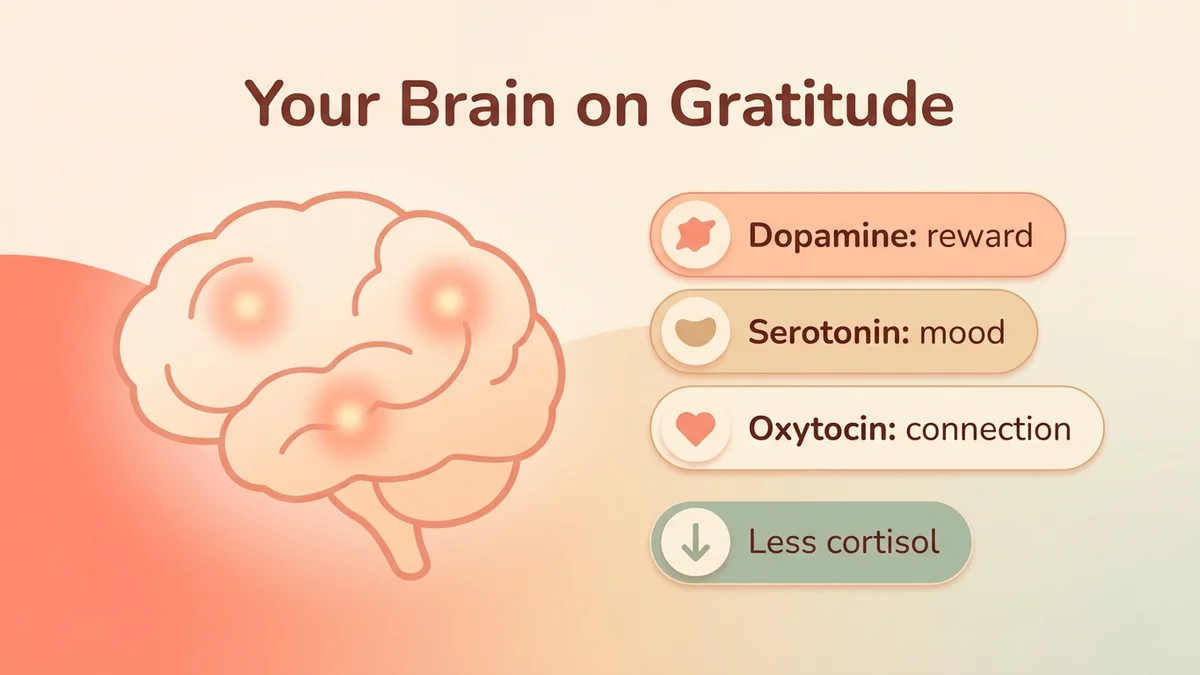
When you feel gratitude, your brain engages three key neurochemical systems:
| Neurotransmitter | Main role | Effect of gratitude |
|---|---|---|
| Dopamine | Motivation and reward | Creates a virtuous cycle: the more you practice, the more your brain wants to |
| Serotonin | Mood regulation | Supports a more stable, positive mood |
| Oxytocin | Social bonding and trust | Strengthens relationships and a sense of belonging |
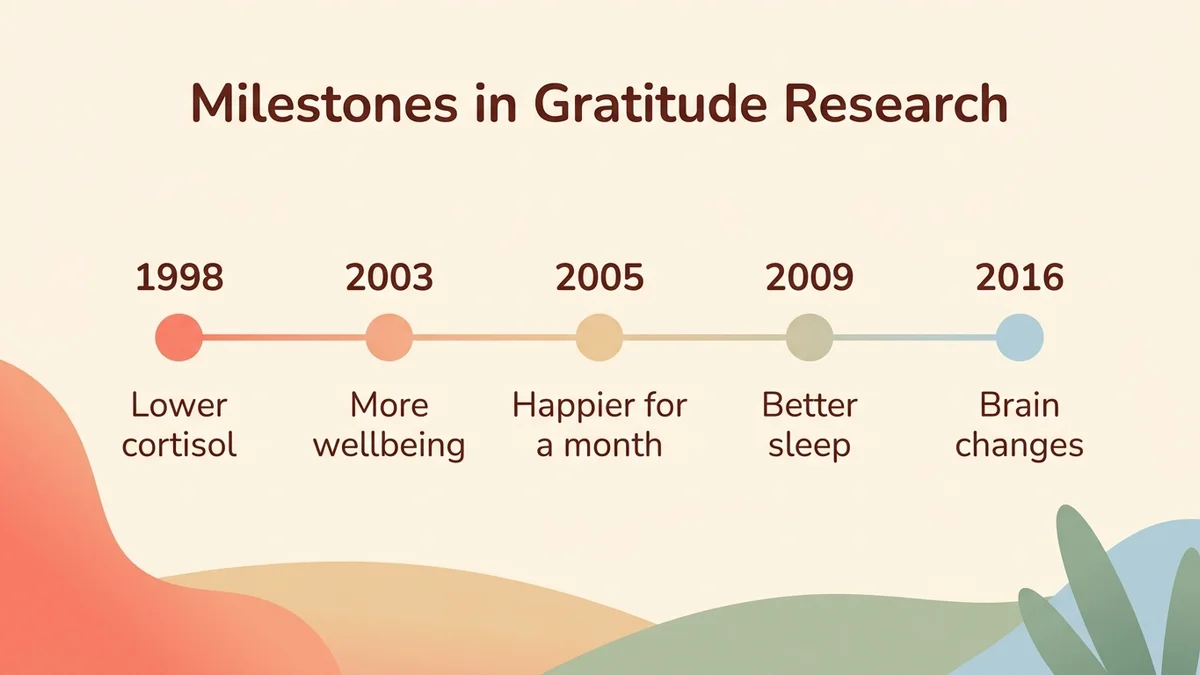
In a study published in NeuroImage (Kini et al., 2016), researchers at Indiana University found that people who wrote gratitude letters showed greater gratitude-related activity in the medial prefrontal cortex three months later — a brain region involved in emotional regulation and decision-making.
What are the proven benefits of a gratitude journal?
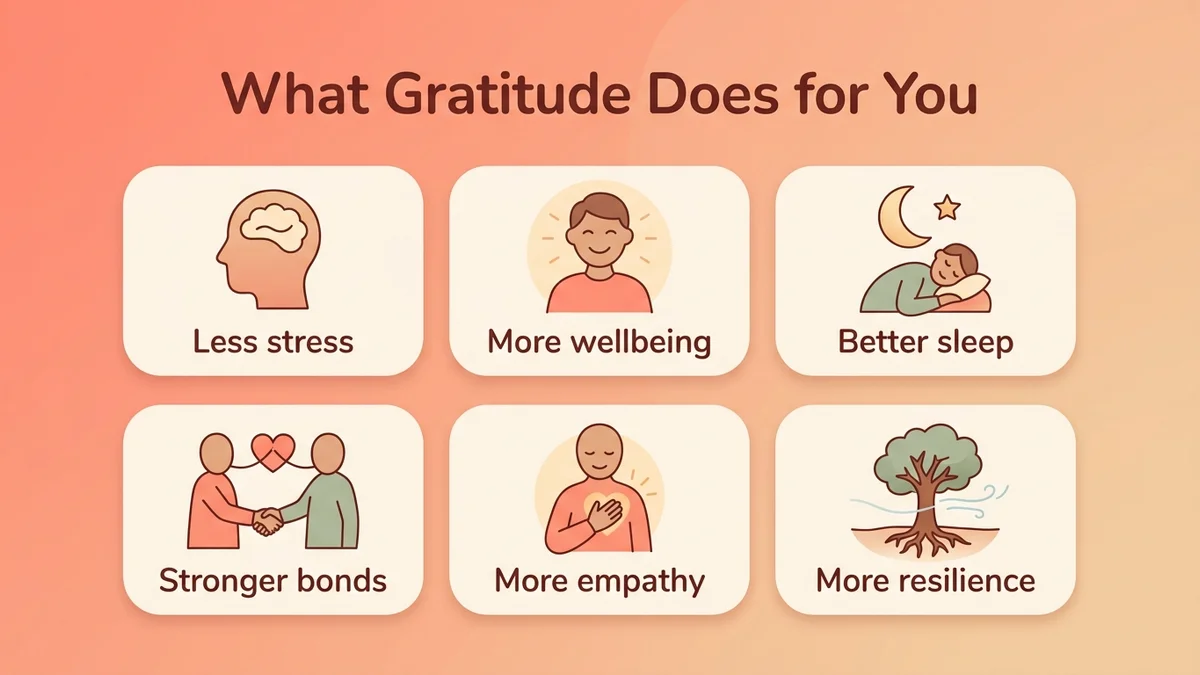
Regular gratitude practice produces measurable effects on mental, physical and relational health. Here's what the research shows, study after study.
For mental health
- Lower stress: in a HeartMath study (McCraty et al., 1998), a technique centered on appreciation lowered cortisol by 23%
- Fewer depressive symptoms: in Martin Seligman's research (2005), gratitude exercises reduced depressive symptoms and increased happiness
- Greater wellbeing: in Emmons and McCullough's founding study (2003), ten weeks of gratitude journaling left people feeling more positive about their lives — an improvement often estimated at around 25%
For physical health
- Better sleep quality: a University of Manchester study (Wood et al., 2009) linked gratitude to more positive thoughts before bed and better sleep
- In Emmons' research, grateful participants reported fewer physical symptoms and exercised more
- Gratitude has been associated with healthier heart-related markers in patients with heart failure (Mills et al., 2015)
For relationships
- Expressing gratitude to others amplifies the positive effects on mental health
- Grateful people tend to show more empathy and less aggression, according to research by Nathan DeWall and colleagues at the University of Kentucky (2012)
Key point: The benefits of gratitude aren't just a subjective feeling. They show up in brain imaging, biological markers and validated clinical psychology questionnaires.
Serena Coach tip: Our users who combine the gratitude journal with mood tracking notice an improvement in their perceived wellbeing within the first 10 days on average. The key? Pairing emotional awareness with active appreciation.
How to write a gratitude journal: the step-by-step method
You're convinced by the science. Now, how do you actually start? Here's a structured method inspired by the work of Martin Seligman, founder of positive psychology.
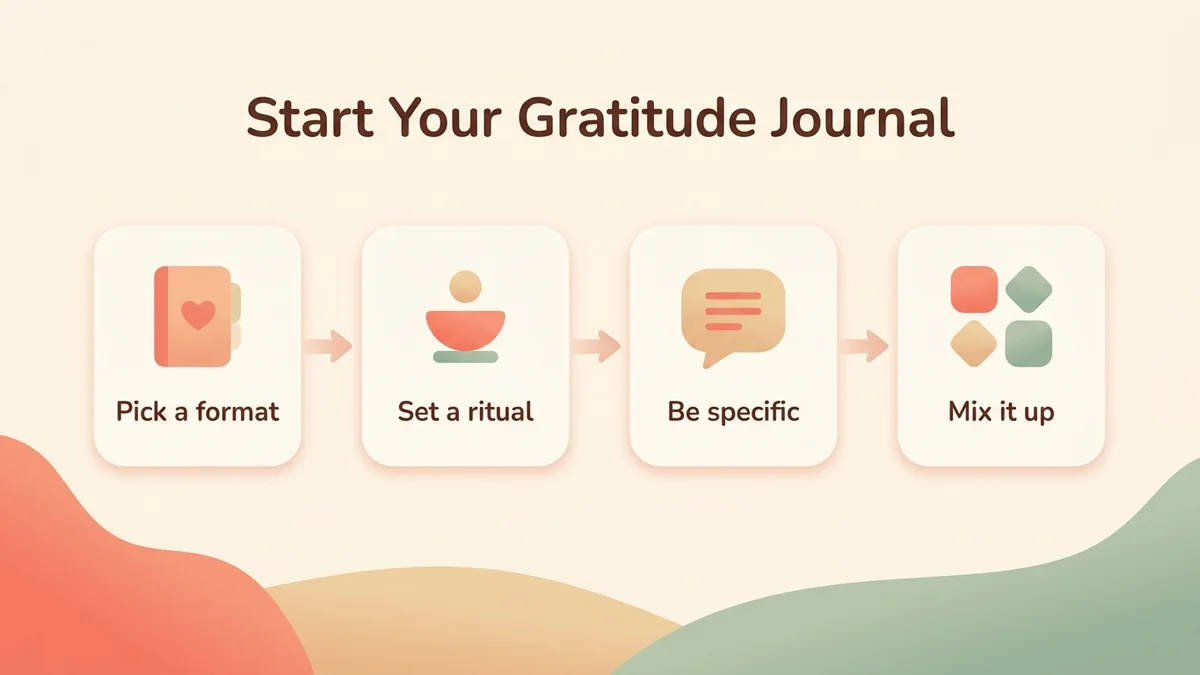
Step 1: Choose your format
| Format | Advantages | Drawbacks |
|---|---|---|
| Paper notebook | Sensory connection, stronger memory, no distractions | No reminders, easy to forget |
| App (Serena) | Daily reminders, progress tracking, guided exercises | Screen exposure |
| Digital document | Flexible, easy to search | Less emotional engagement |
Step 2: Set your ritual
Choose a fixed time. Research by Sonja Lyubomirsky (University of California, Riverside, 2005) revealed a surprising finding: the group that benefited most from gratitude journaling wrote once a week, not three times a week. Why? Writing less often avoids the habituation effect.
That said, if you're just starting out, try a daily practice for 21 days to build the habit, then adjust the frequency based on how you feel.
Step 3: Write with precision
The difference between an effective practice and a mechanical exercise comes down to one word: specificity.
❌ "I'm grateful for my health." ✅ "I'm grateful for the energy I felt this morning, which let me run for 20 minutes in the park under the March sun."
The more specific you are, the more your brain engages emotionally — and the stronger the feel-good response.
Step 4: Vary your sources of gratitude
Explore different categories each week:
- People: a friend, a coworker, a kind stranger
- Experiences: a delicious meal, a walk, a fit of laughter
- Lessons: something learned from a failure, a new skill
- Your body: your senses, your health, your energy
- Simple things: a hot coffee, the morning quiet, the evening light
Real-life scenarios: gratitude in your daily life
Theory is great. But how do you fit gratitude into a busy, stressful and sometimes exhausting day? Here are three concrete situations.
The tough morning
Your alarm goes off, you slept badly, and the day ahead looks long. Before you even get up, take 60 seconds. Think of three simple things: the warmth of your comforter, having a roof over your head, the coffee waiting for you. Note them mentally or on your phone. This micro-exercise points your brain toward the positive from the moment you wake up.
The nerve-racking meeting
You're at the office with an important meeting in 10 minutes, and your heart is racing. Open your journal (or the Serena app) and write one thing you're grateful for right now: "I have the skills for this presentation, and my team has my back." Pair that gratitude with a few slow breaths of cardiac coherence. Stress eases and mental clarity returns.
When insomnia sets in
10:30 p.m., you can't sleep, your thoughts keep looping. Instead of ruminating, grab your notebook and list five positive moments from your day. Research from the University of Manchester (Wood et al., 2009) found that grateful people have more positive thoughts before sleep, which predicts falling asleep faster and sleeping better. You can also pair this exercise with an evening meditation for an extra calming effect.
Gratitude as an antidote to anxiety: what the science shows
Wondering whether writing three good things in a notebook can really help when anxiety takes over? The answer is yes, and the mechanisms are well documented.
Gratitude supports the parasympathetic nervous system — the one that calms your body after a stress response. By focusing your attention on the positive, you interrupt the loop of hypervigilance and intrusive thoughts that fuels anxiety.
Many therapists now recommend gratitude journaling as a complement to therapy, especially during difficult periods, because it helps build emotional resilience without denying what's hard.
"A practice focused on appreciation lowered cortisol levels by 23% in a HeartMath study, supporting the parasympathetic nervous system and resilience in the face of chronic stress."
As interest in mental health keeps growing, gratitude journals have become one of the most widely recommended self-care tools — precisely because they're free, simple and backed by research.
Gratitude meditation: pairing writing with mindfulness
A gratitude journal and mindfulness meditation make a powerful duo. One engages writing and reflection; the other anchors appreciation in the body.
As Brother David Steindl-Rast explains in this TED talk, it isn't happiness that makes us grateful — it's gratefulness that makes us happy. His simple method, "stop, look, go," is exactly the spirit of a gratitude journal: pause, notice what's good, then act on it. You can extend this exercise with Serena, which offers daily reminders and breathing exercises to anchor gratitude in your body.
Practical exercise: a 5-minute gratitude meditation
- Get comfortable and close your eyes
- Take three deep breaths (in for 4 seconds, out for 6 seconds)
- Think of a person who mattered to you today
- Picture a specific moment with that person
- Feel the gratitude in your body — warmth, relaxation, a smile
- Write that moment down in your journal after the meditation
The Serena perspective: theory vs. practice
Academic studies show impressive results, but what about everyday practice? Anonymized Serena usage data reveals interesting patterns.
What theory predicts: benefits appear after 4 to 12 weeks of regular practice.
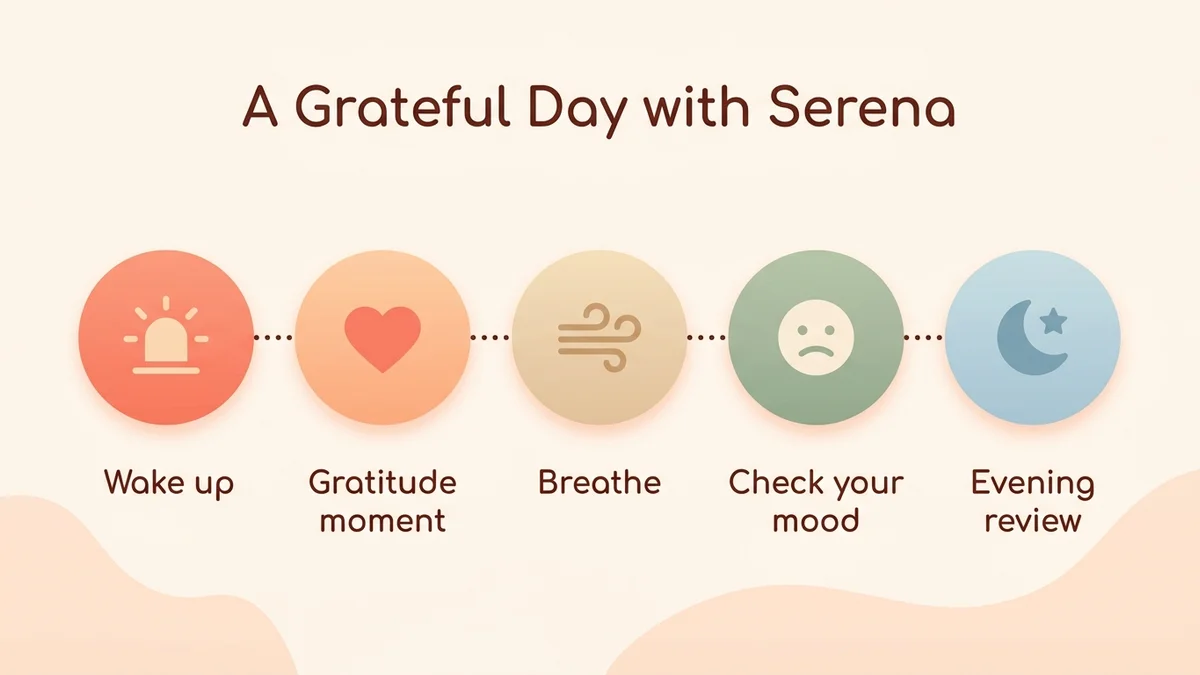
What we observe: Serena users who combine the gratitude journal with breathing exercises report an improvement in their mood within the first 7 days. The key isn't duration, but combining practices — writing + breathing + mood tracking.
The main obstacle: 60% of users abandon their gratitude journal before the end of the first month. Personalized reminders and gentle gamification (streaks, varied exercises) triple retention.
Serena Coach tip: If the routine starts to feel stale, change the format. Instead of listing 3 gratitudes, write a thank-you letter to someone (even if you never send it). Martin Seligman showed that delivering a gratitude letter produces a measurable happiness boost that lasts for a month.
| Practice | On its own | Combined with Serena |
|---|---|---|
| Gratitude journal | Greater wellbeing (Emmons, 2003) | Greater wellbeing + progress tracking |
| Gratitude meditation | Less rumination | Guided breathing + gratitude |
| Gratitude letter | One-month happiness boost (Seligman, 2005) | Built-in exercise + reminders |
How Serena supports your gratitude practice
Keeping a gratitude journal on your own may seem simple, but staying consistent over the long term is the real challenge. That's where Serena comes in.
Serena builds gratitude into a holistic approach to mental wellbeing:
- Personalized daily reminders so you never forget your gratitude moment
- Mood tracking with the Circumplex model to see the impact of your practice on your emotions
- Guided breathing exercises (6 techniques available) to pair with your journal
- Visible progress: track your streaks and watch your wellbeing evolve
The advantage of an integrated approach? You don't practice gratitude in isolation. You build a wellbeing ecosystem where each habit reinforces the others — exactly what positive psychology research recommends.
Try Serena for free and discover how gratitude can transform your daily life.
Frequently asked questions
What is a gratitude journal?
A gratitude journal is a notebook where you regularly write down 3 to 5 things you feel thankful for. This practice, supported by neuroscience, engages the brain's reward circuits and lastingly improves mental wellbeing and emotional resilience.
How long does it take to feel the benefits?
Mood effects can appear within the first week or two. Lasting changes take longer: Robert Emmons' founding study ran for 10 weeks, and brain imaging research at Indiana University detected gratitude-related changes in brain activity three months after a short gratitude-writing exercise.
Is it better to write in the morning or the evening?
Each offers distinct benefits. In the morning, it points your brain toward the positive for the day. In the evening, it encourages a calming review and can improve sleep quality. Choose the moment that fits most naturally into your daily routine.
What should I write when I'm going through a hard time?
Even in the darkest moments, micro-gratitudes exist: a ray of sunshine, a hot coffee, a stranger's smile. Gratitude doesn't erase what's hard, but it's especially powerful during difficult periods for strengthening resilience.
Does a gratitude journal replace therapy?
No. A gratitude journal is a complementary tool that supports therapeutic work. If you're dealing with severe anxiety or depression, see a mental health professional. Gratitude accompanies care; it doesn't replace it. If you're in crisis, call or text 988.
How do I avoid routine and stay motivated?
Vary the format: lists, thank-you letters, drawings, photos. Change categories each week (people, experiences, lessons). The Serena app offers varied prompts to keep your practice fresh and avoid the habituation effect identified by Lyubomirsky (2005).
Does gratitude work for children?
Yes. School-based studies led by psychologist Jeffrey Froh found that gratitude exercises — journaling, thank-you notes, gratitude lessons — increase gratitude and positive emotions in children and teens.
Can you practice gratitude without writing?
Yes, gratitude meditation and visualization are effective alternatives. However, writing amplifies the benefits by engaging the prefrontal cortex and anchoring positive emotions in long-term memory.
Conclusion: start tonight
You don't need a special notebook, training or perfect conditions. Tonight, before bed, take 3 minutes. Write down three things you're grateful for. Be specific. Feel the emotion.
Tomorrow, do it again. And the day after. Within a week, you'll feel the difference. Within a month, your brain will start naturally rewiring toward the positive.
And if you'd like a companion for the journey, Serena is here to guide you, remind you and show you how far you've come. Because cultivating gratitude means cultivating calm — and you deserve it.