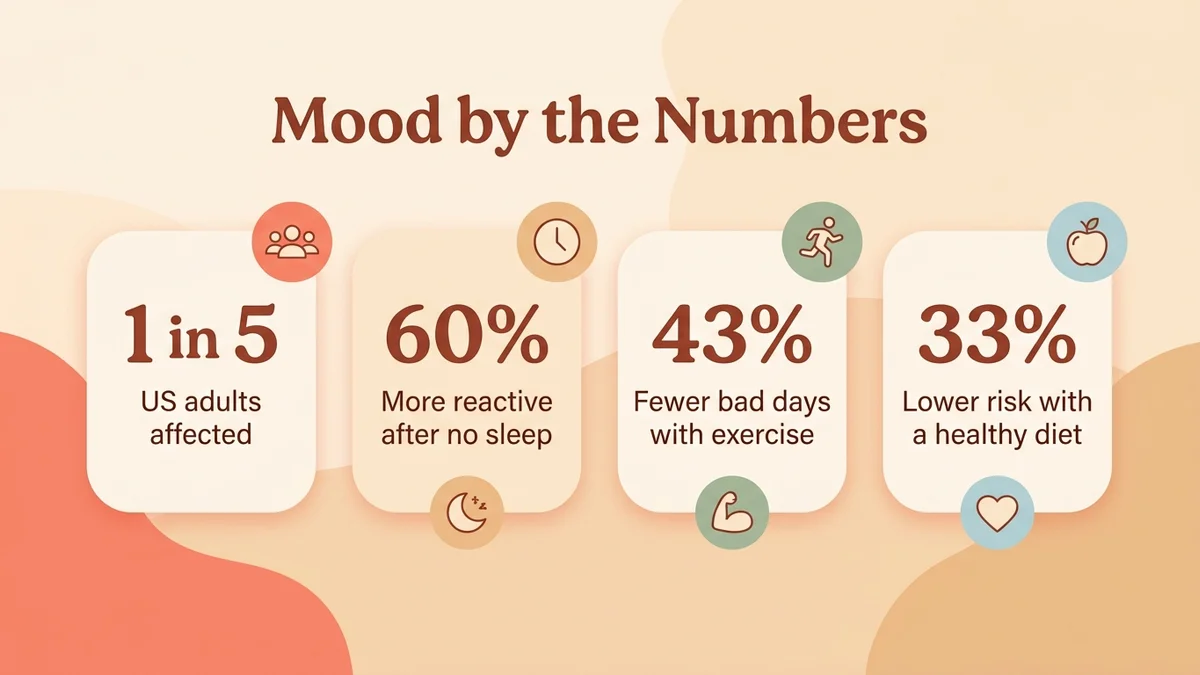
Do you go from laughing to irritated in a matter of minutes? Everything's fine in the morning, then one offhand comment derails your whole day? You're not alone. According to the National Institute of Mental Health, more than one in five US adults lives with a mental health condition, and mood swings are among the most common ways emotional distress shows up day to day. Updated in March 2026.
The good news: mood swings aren't inevitable. Understanding their causes is already a way to regain control. And with the right techniques, you can find lasting emotional balance.
The key takeaways
Mood swings are rapid emotional shifts caused by stress, hormones, lack of sleep or diet. They're extremely common and differ from bipolar disorder in their short duration. Conscious breathing, mindfulness meditation and a mood journal are the three most effective techniques to stabilize them, with results after just 2 weeks of regular practice.
What exactly is a mood swing?
A mood swing is a sudden emotional change that's often out of proportion to the situation. You can go from joy to sadness, or from calm to irritability, in a few minutes — sometimes with no apparent trigger.
It's not a sign of weakness. It's your nervous system reacting to internal or external signals you don't always perceive consciously.
Think of your emotions as your inner weather: they change constantly, and that's normal. The problem arises when those changes become too abrupt or too frequent.
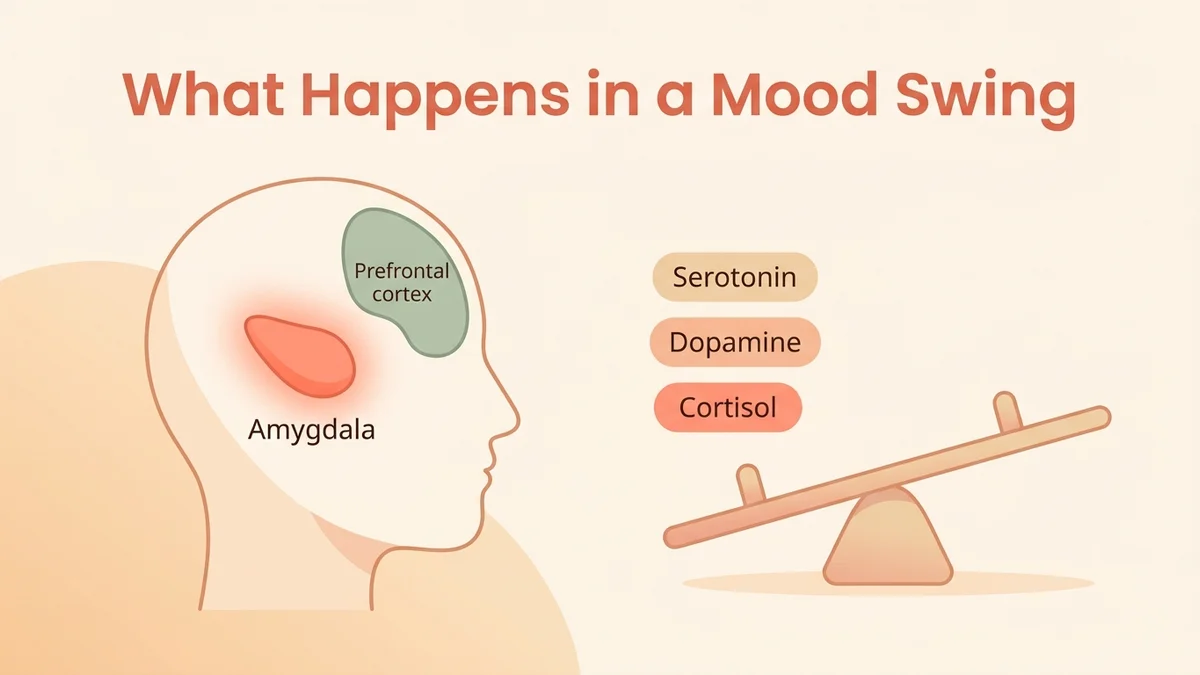
Key point: Mood swings involve the amygdala (the emotion center) and the prefrontal cortex (the reasoning center). When stress or fatigue weakens the prefrontal cortex, the amygdala takes over and emotions become hard to control.
What are the 7 main causes of mood swings?
Mood swings rarely have a single cause. They result from a combination of biological, psychological and environmental factors that disrupt emotional balance.
1. Chronic stress
Prolonged stress keeps cortisol elevated, which disrupts serotonin — the neurotransmitter of a stable mood. Research shows that chronic stress weakens the connections between the amygdala and the prefrontal cortex, making emotional regulation harder.
2. Lack of sleep
In a well-known study from UC Berkeley and Harvard (Yoo, Walker et al., 2007), one night of sleep deprivation made the amygdala about 60% more reactive to negative images, while weakening its connection to the prefrontal cortex. The result: the slightest annoyance can trigger an outsized reaction. If you struggle with recurring insomnia, discover our natural remedies.
3. Hormonal imbalances
Fluctuations in estrogen and progesterone during the menstrual cycle, pregnancy or menopause directly influence serotonin and dopamine. Women are nearly twice as likely as men to experience depression.
4. An unbalanced diet
Blood sugar spikes from refined sugars create an emotional roller coaster. Tryptophan, the precursor of serotonin, is lacking in diets low in protein. A meta-analysis published in Molecular Psychiatry (Lassale et al., 2019) found that a Mediterranean-style diet was linked to a 33% lower risk of depression.
5. Anxiety and intrusive thoughts
Anxiety creates a state of hypervigilance that amplifies every emotional stimulus. Intrusive thoughts create a cycle in which worry fuels irritability, which in turn strengthens anxiety. This vicious circle is one of the most underestimated causes of mood swings.
6. A sedentary lifestyle
Lack of physical activity deprives the brain of endorphins — the body's natural painkillers. According to a study of 1.2 million Americans in The Lancet Psychiatry (Chekroud et al., 2018), people who exercise report 43% fewer days of poor mental health than those who don't.
7. Social isolation and screens
Chronic loneliness and excessive screen time (especially social media) disrupt dopamine circuits. In a University of Pennsylvania experiment (Hunt et al., 2018), limiting social media to 30 minutes a day significantly reduced loneliness and depressive symptoms.
| Cause | Main mechanism | Warning sign | Quick fix |
|---|---|---|---|
| Chronic stress | High cortisol → low serotonin | Constant irritability | Cardiac coherence 5 min |
| Lack of sleep | Weakened prefrontal cortex | Emotional reactivity | Fixed sleep routine |
| Hormones | Fluctuating estrogen/progesterone | Cyclical changes | Tracking journal |
| Diet | Blood sugar spikes | Energy crashes | Regular balanced meals |
| Anxiety | Emotional hypervigilance | Rumination | Conscious breathing |
| Sedentary lifestyle | Endorphin deficit | Low morale | 30-min daily walk |
| Screens/isolation | Dopamine disruption | Social comparison | 30-min social media limit |
How do I know if my mood swings are normal or a problem?
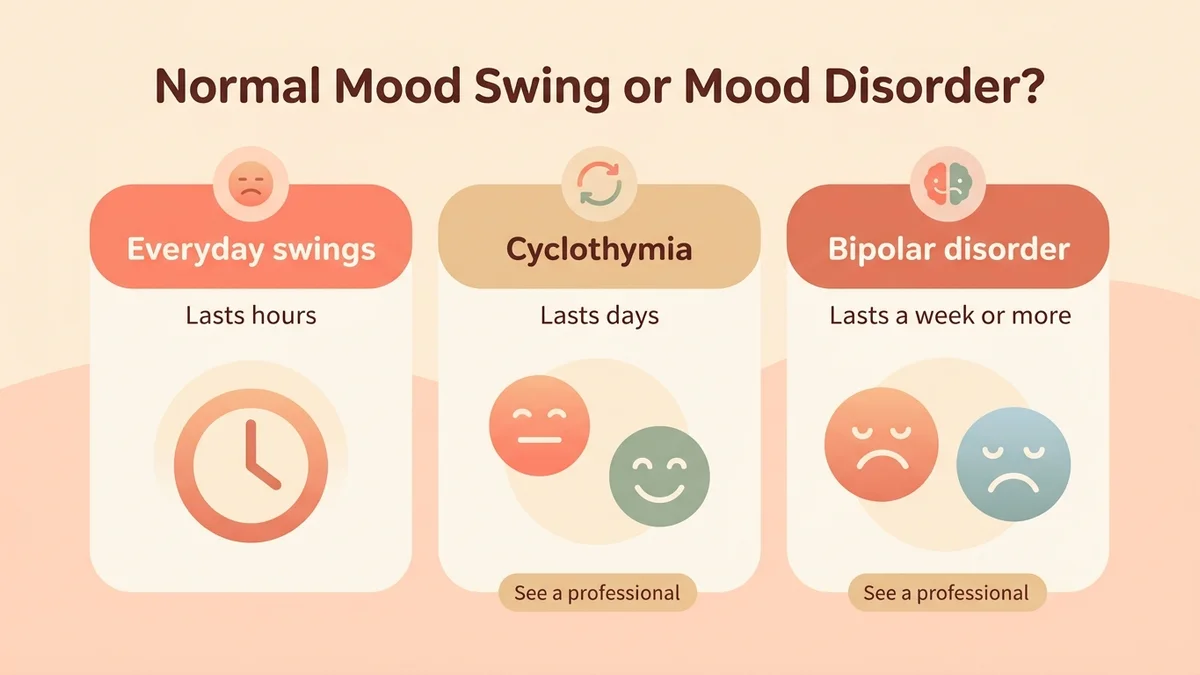
Normal mood swings last a few hours, stay proportional to events and don't stop you from functioning day to day. They're part of the human emotional range.
However, some signs should raise a flag:
- Cyclothymia: alternating periods of high mood (hypomania) and low mood lasting several days, without reaching the intensity of bipolar disorder
- Bipolar disorder: manic episodes (euphoria, little need for sleep, impulsivity) and depressive episodes lasting at least a week, with a major impact on social and work life
- Emotional dysregulation: intense, rapid emotional reactions, difficulty returning to calm, low frustration tolerance
The line between ordinary mood swings and a mood disorder lies in duration, intensity and impact on functioning. If your emotions disrupt your work or relationships for more than two weeks, it's time to see a professional.
Key point: Stigma still keeps many people from seeking help. Seeing a mental health professional isn't an admission of weakness — it's an act of courage.
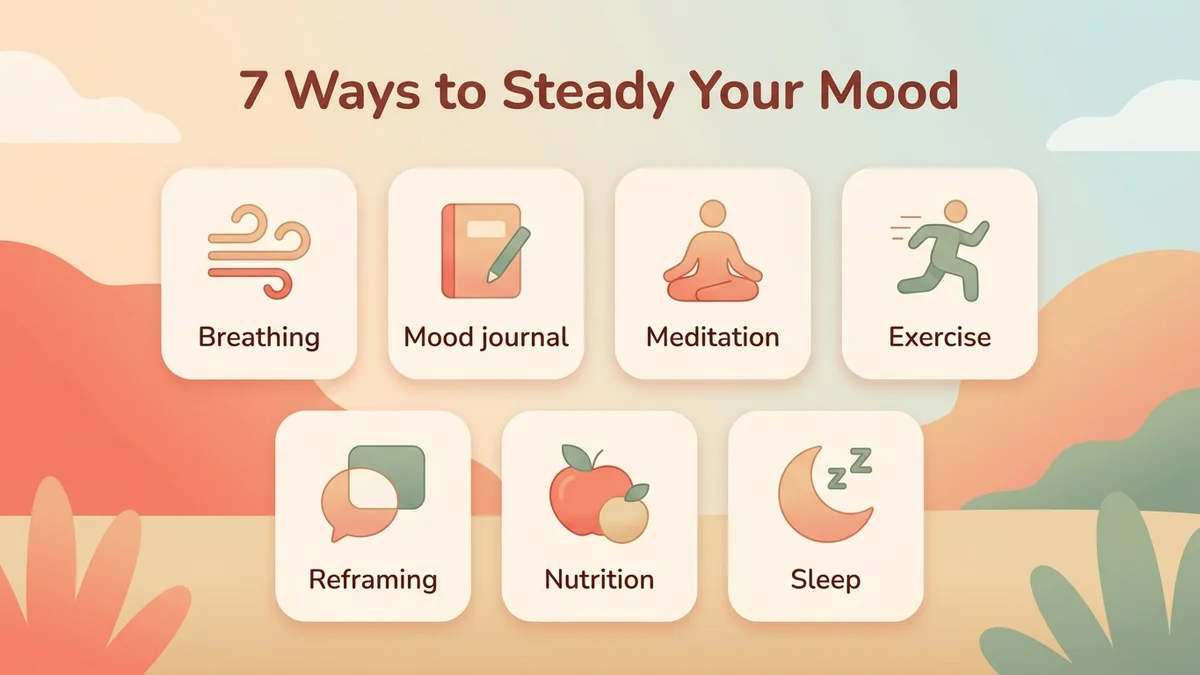
7 effective techniques to stabilize your mood swings
You don't need to overhaul your life overnight. Start with a single technique, practice it for two weeks, then gradually add another.
1. Conscious breathing (works in 3 minutes)
Cardiac coherence at 6 breaths per minute synchronizes heart and brain and, according to the HeartMath Institute, lowers cortisol by 23%. It's the fastest technique for breaking an emotional spiral.
Exercise: Breathe in for 5 seconds, breathe out for 5 seconds. Repeat for 5 minutes. Practice 3 times a day (morning, noon, evening). See our complete guide to cardiac coherence to go further, or use our free cardiac coherence timer.
2. The mood journal (understand your patterns)
Each day, rate your mood from 1 to 10 and note what you ate, how long you slept and the day's defining event. Within 2 weeks, patterns emerge: "I'm irritable when I sleep less than 7 hours" or "my mood drops after lunch."
3. Mindfulness meditation (10 min/day)
Eight-week mindfulness meditation programs have been shown to improve emotional regulation by strengthening the connections between the prefrontal cortex and the amygdala.
4. Regular physical activity
30 minutes of brisk walking, yoga or swimming releases endorphins and regulates cortisol. The effect on mood is immediate, and the effect on emotional stability builds over time.
5. Cognitive reappraisal (a CBT technique)
When facing an intense emotion, ask yourself three questions:
- What's the objective situation (facts, not interpretations)?
- What's my automatic interpretation?
- Is there another way to see things?
Research by Stanford psychologist James Gross has established this technique, rooted in cognitive behavioral therapy (CBT), as one of the most effective emotion regulation strategies. Practice it with our CBT thought record.
6. An anti-inflammatory diet
Favor foods rich in omega-3s (fatty fish, walnuts, flaxseed), tryptophan (legumes, dark chocolate, bananas) and magnesium (almonds, spinach). Limit refined sugar, caffeine and alcohol.
| Nutrient | Role in mood | Main sources |
|---|---|---|
| Omega-3s | Reduce brain inflammation | Salmon, sardines, walnuts |
| Tryptophan | Serotonin precursor | Legumes, dark chocolate |
| Magnesium | Muscle and nerve relaxation | Almonds, spinach, bananas |
| Vitamin D | Regulates serotonin | Sunlight, fatty fish, eggs |
| Iron | Brain oxygenation | Lentils, red meat, tofu |
7. A sleep routine
Go to bed and get up at the same time, even on weekends. Avoid screens for an hour before bed. If falling asleep is hard, try sophrology for sleep or an evening meditation.
Real-life scenarios
The morning that goes off the rails
Your alarm didn't go off. You're late, the kids are dawdling, and a coworker sends you an irritating message. Your mood turns dark in 10 minutes.
Express technique: Before replying to the message, take 6 deep breaths (5 seconds in, 5 seconds out). This simple cardiac coherence exercise is enough to switch off the stress response and restore your ability to think clearly.
The meeting that turns up the pressure
Your manager criticizes your project in front of the team. You feel anger rising, your cheeks flush, your hands tense.
In-the-moment technique: Apply cognitive reappraisal. Objective fact: "he pointed out two things to improve." Automatic thought: "he thinks I'm useless." Alternative: "he wants the project to succeed and is giving me the keys to improve it." This reframe defuses the emotional spiral.
When insomnia amplifies everything
You've slept badly three nights in a row. This morning, your partner makes a comment about the housework and you explode.
Repair technique: Recognize the trigger ("I'm reacting strongly because I'm exhausted"). Simply apologize. Then set up an evening routine to break the insomnia-irritability cycle.
Better understanding and regulating your emotions every day
Psychiatrist Dan Siegel, a clinical professor at UCLA, explains in this short video why putting words to your emotions — "name it to tame it" — helps calm the emotional brain.
As Dan Siegel explains, the goal isn't to suppress emotions but to recognize them so the reasoning brain can come back online. You can extend this practice with Serena, which guides you step by step with breathing and meditation exercises tailored to your current emotional state.
The Serena perspective
Anonymized Serena user data reveals a recurring pattern: people who track their mood daily for at least 3 weeks identify an average of 2.3 recurring triggers they had never consciously noticed before.
Academic theory emphasizes emotional regulation as a cognitive skill. In the field, Serena users show that the most transformative part isn't the technique itself, but becoming aware of the patterns. Once you clearly see that "every Monday morning, my mood drops after the team meeting," you can take targeted action.
Another observation: users who combine mood tracking with 5 minutes of daily cardiac coherence report a 40% reduction in episodes of irritability within 4 weeks — a better result than either practice on its own.
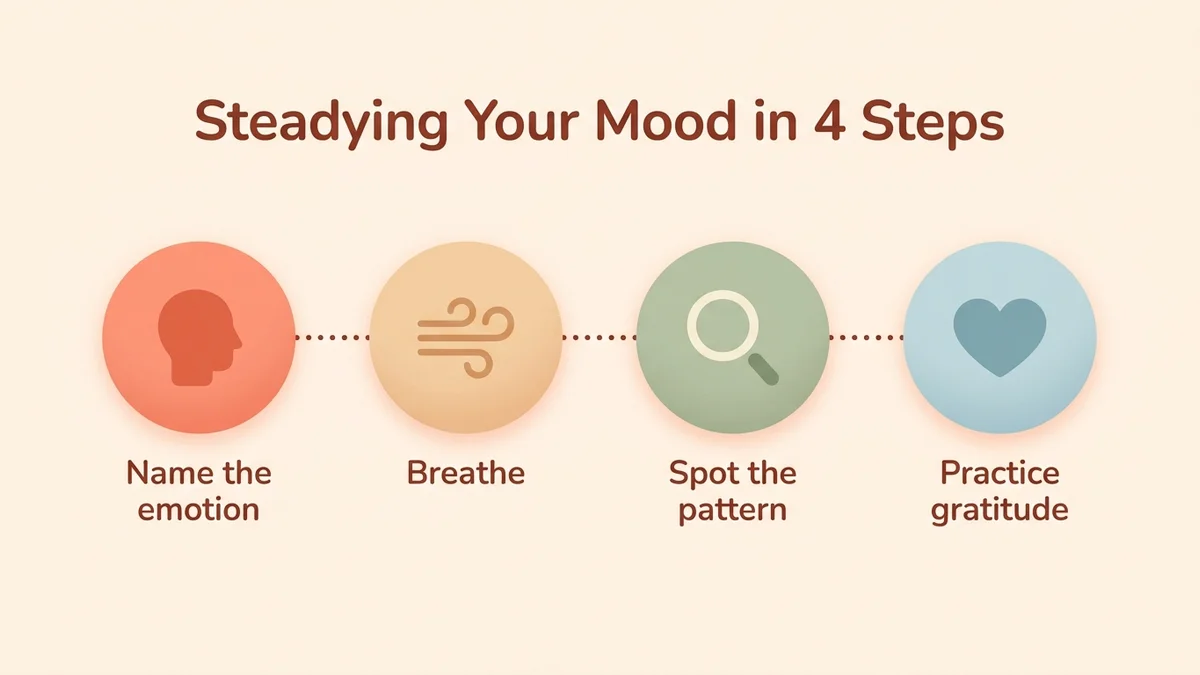
Serena Coach tip: Don't try to eliminate your mood swings. Try to understand them. Serena's Circumplex model helps you name exactly what you're feeling — and naming an emotion is already the start of regulating it. Psychologists call this "affect labeling."
Serena Coach tip: If your mood swings are linked to chronic stress, start with cardiac coherence 3 times a day for 2 weeks before adding other techniques. Consistency beats variety.
How Serena can help you stabilize your emotions
Serena is designed to support exactly this kind of emotional challenge:
- Mood tracking with the Circumplex model: pinpoint your emotions along two axes (energy and valence), more precisely than a simple 1-to-10 scale
- 6 guided breathing techniques: including cardiac coherence and 4-7-8 breathing to break emotional spirals in real time
- Gratitude journal: gradually rewire your brain toward positive emotions, a technique supported by research from the University of California
- Guided meditations: sessions adapted to your current emotional state
The Serena approach combines the three pillars of emotional stability: awareness (mood tracking), regulation (breathing) and positive reframing (gratitude).
Try Serena for free and start stabilizing your emotions today.
Frequently asked questions
Why do I have mood swings for no apparent reason?
Mood swings with no obvious cause are often linked to invisible factors: hormonal fluctuations, accumulated sleep debt, nutritional imbalance or underlying chronic stress. Your body reacts to these internal signals before you're aware of them. A mood journal helps reveal these hidden patterns within a few weeks.
How can I tell normal mood swings from bipolar disorder?
Normal mood swings last a few hours and stay proportional to events. Bipolar disorder stands out through manic episodes (extreme euphoria, little need for sleep, grandiose ideas) and depressive episodes lasting days to weeks. If your episodes disrupt your daily functioning for more than two weeks, see a psychiatrist.
Does diet really affect mood?
Yes, the effect is well documented. A meta-analysis published in Molecular Psychiatry (2019) found that a Mediterranean-style diet was linked to a 33% lower risk of depression. Omega-3s help regulate stress, tryptophan supports serotonin, and blood sugar spikes create emotional roller coasters. Choose low-glycemic foods to stabilize your mood.
How long does it take to stabilize emotions with meditation?
Most mindfulness programs studied in research last 8 weeks, and participants typically show significant improvements in emotional regulation by the end, even with about 10 minutes of daily practice. The first calming effects can be felt from the first sessions, but consistency is what lastingly transforms how you handle emotions.
Are mood swings more common in women?
Hormonal fluctuations related to the menstrual cycle, pregnancy and menopause make women more prone to mood swings, and women are nearly twice as likely to experience depression. But men aren't spared: work stress, lack of sleep and the somatization of anxiety also cause significant emotional swings in men.
When should I see a professional about mood swings?
See a professional if your mood swings last more than two weeks, disrupt your relationships or work, come with dark thoughts, or if you alternate between euphoria and deep emotional crashes. A psychologist or psychiatrist will assess the situation; therapy is often covered by health insurance or an Employee Assistance Program. If you're in crisis, call or text 988 at any time.
Does exercise really help stabilize mood?
Exercise is one of the most powerful mood regulators. According to The Lancet Psychiatry (2018), people who exercise have 43% fewer days of poor mental health, with the best results for 45-minute sessions 3 to 5 times a week. Physical activity releases endorphins, regulates cortisol and improves sleep — three key factors in emotional stability.
How can I help a loved one with mood swings?
Listen without judging and validate their emotions: "I understand this is hard for you." Avoid phrases like "calm down" or "it's no big deal," which minimize their experience. Offer concrete support: a walk, a shared quiet moment. If episodes are frequent and intense, gently encourage them to see a professional.
Conclusion
Mood swings aren't inevitable. They're a signal from your body and mind — a signal you can learn to decode and regulate.
Start with a single action today: keep a mood journal for two weeks, or practice 5 minutes of cardiac coherence three times a day. The first results will surprise you.
And if you'd like structured support that combines mood tracking, guided breathing and meditation, try Serena for free. Your emotional balance deserves daily attention — and Serena is here to guide you, step by step.