You feel tense, your breath is short, and stress is taking over. Here's the good news: you already carry the most powerful stress-relief tool there is — your breath. Updated in March 2026, this guide walks you through 8 scientifically proven breathing exercises to find your calm again in just a few minutes.
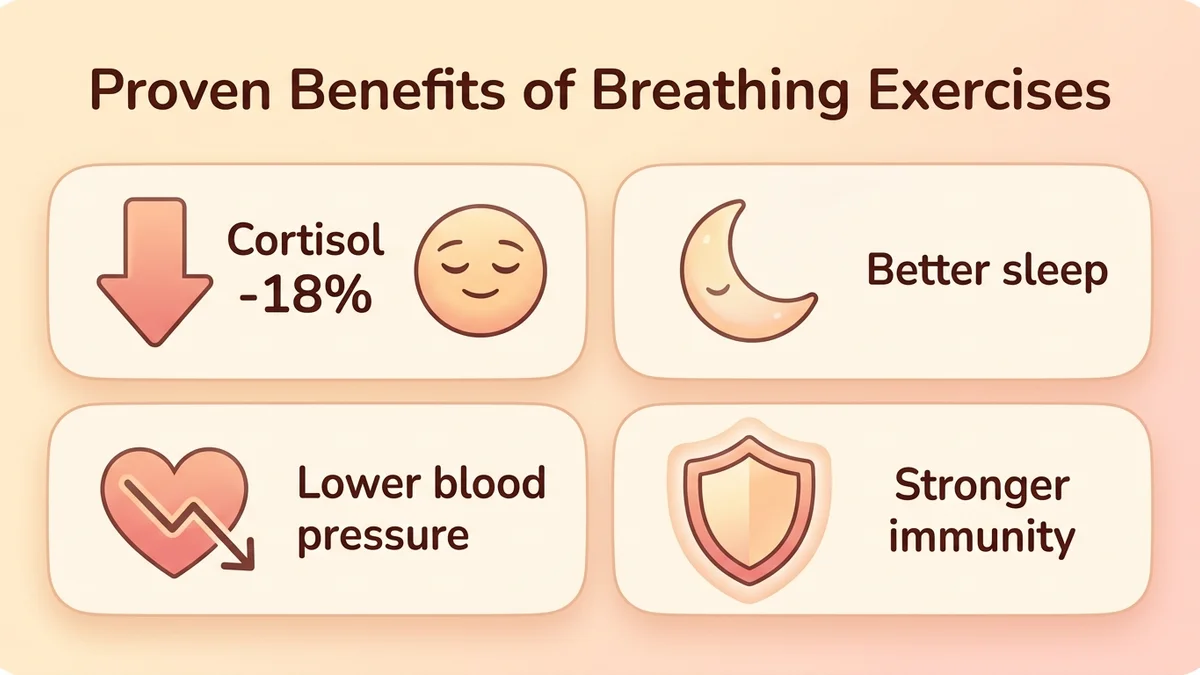
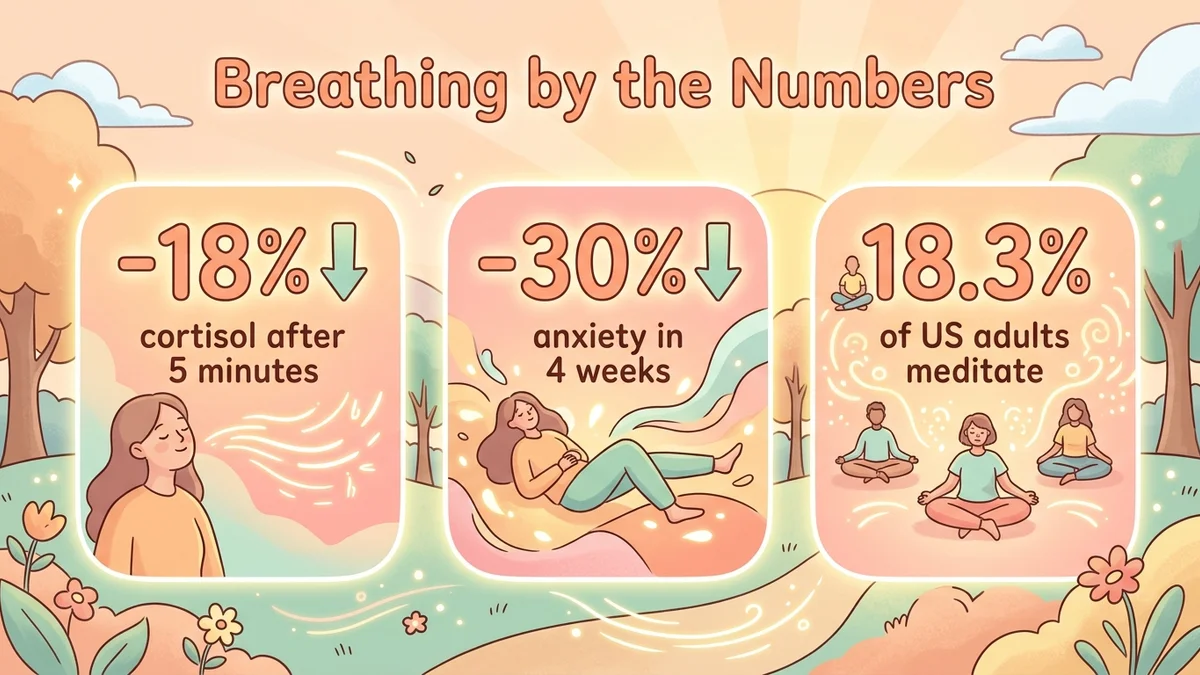
According to a meta-analysis from Stanford University (2023), just 5 minutes of controlled breathing a day lowers cortisol by 18% and significantly reduces anxiety. And you're far from the only one turning to these practices: in the United States, meditation use among adults has more than doubled in twenty years, from 7.5% in 2002 to 18.3% in 2022 — about 60 million people (Scientific Reports, 2024).
The key takeaways
Breathing exercises activate the vagus nerve and the parasympathetic nervous system, lowering cortisol and anxiety within minutes. Cardiac coherence (5-5-5), the 4-7-8 technique and diaphragmatic breathing are the three techniques most strongly supported by science. Five minutes a day is enough for measurable, lasting effects.
How does breathing relieve stress?
Controlled breathing acts directly on your autonomic nervous system. When you slow your breathing rate, you stimulate the vagus nerve — the main regulator of the parasympathetic nervous system. This mechanism reduces the production of cortisol (the stress hormone) and increases DHEA (the vitality hormone).
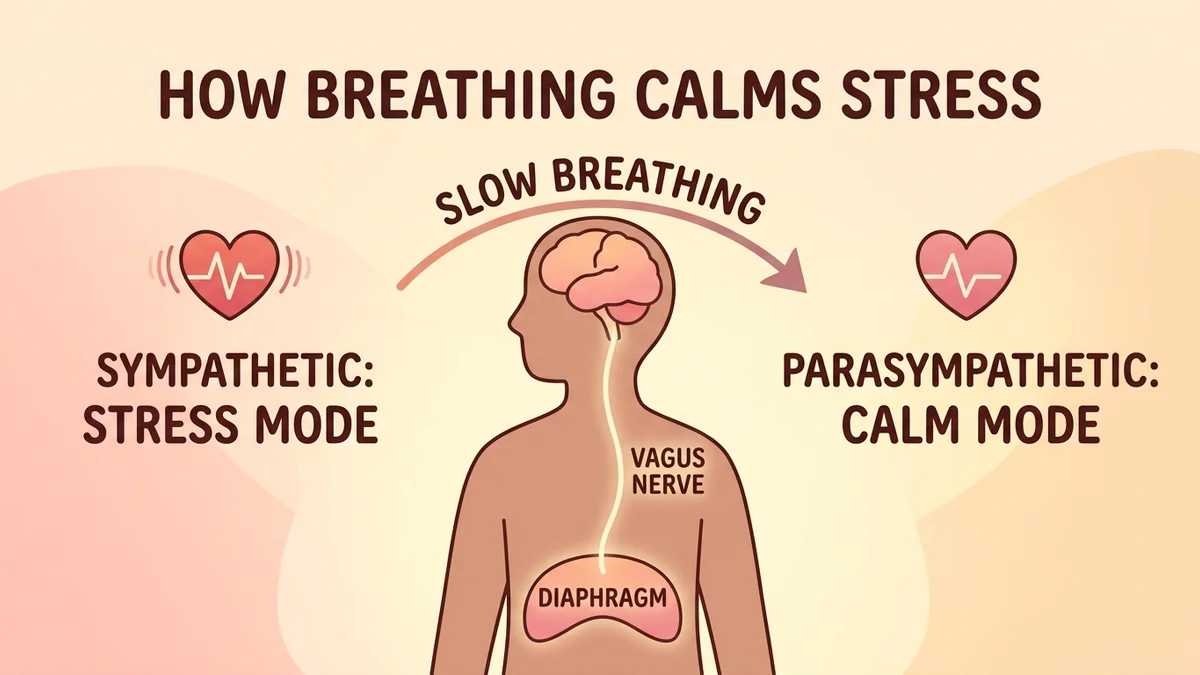
According to Dr. David O'Hare, a specialist in cardiac coherence, slow breathing at 6 cycles per minute synchronizes your heart rate with your breath, creating a measurable state of physiological balance.
Key point: Diaphragmatic breathing takes in 50% more oxygen than shallow chest breathing, according to data from the HeartMath Institute (2024).
Chest breathing: the stress trap
Most stressed people breathe from the chest — short, fast breaths limited to the top of the lungs. This kind of breathing keeps the body on "high alert." The first step toward relaxing is relearning how to breathe from your belly, using your diaphragm.
What are the 8 best breathing exercises?
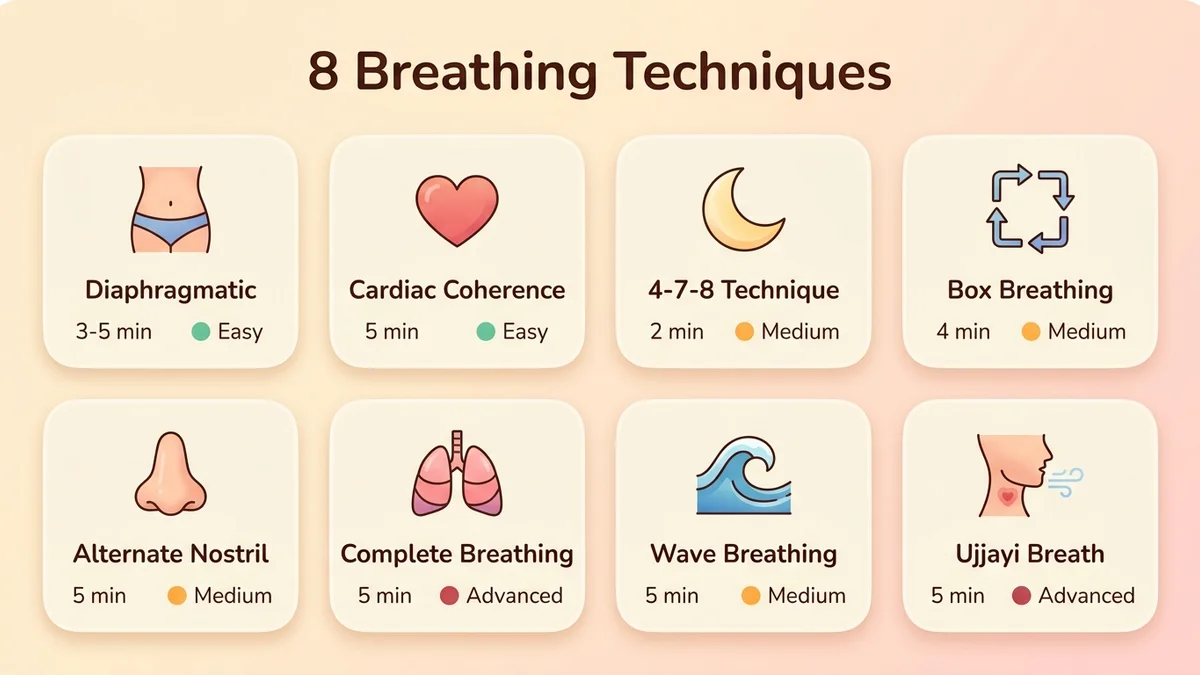
Here are the 8 most effective techniques, sorted by goal. Each one is beginner-friendly and requires no equipment.
| Technique | Duration | Main Goal | Difficulty |
|---|---|---|---|
| Diaphragmatic breathing | 3-5 min | Stress-relief foundation | Easy |
| Cardiac coherence 3-6-5 | 5 min | Nervous system balance | Easy |
| 4-7-8 technique | 2 min | Falling asleep | Medium |
| Box breathing | 4 min | Focus | Medium |
| Alternate nostril breathing | 5 min | Alertness and clarity | Medium |
| Complete breathing | 5 min | Deep relaxation | Advanced |
| Wave breathing | 5 min | Muscle relaxation | Medium |
| Victorious breath (Ujjayi) | 5 min | Meditation | Advanced |
1. Diaphragmatic (belly) breathing
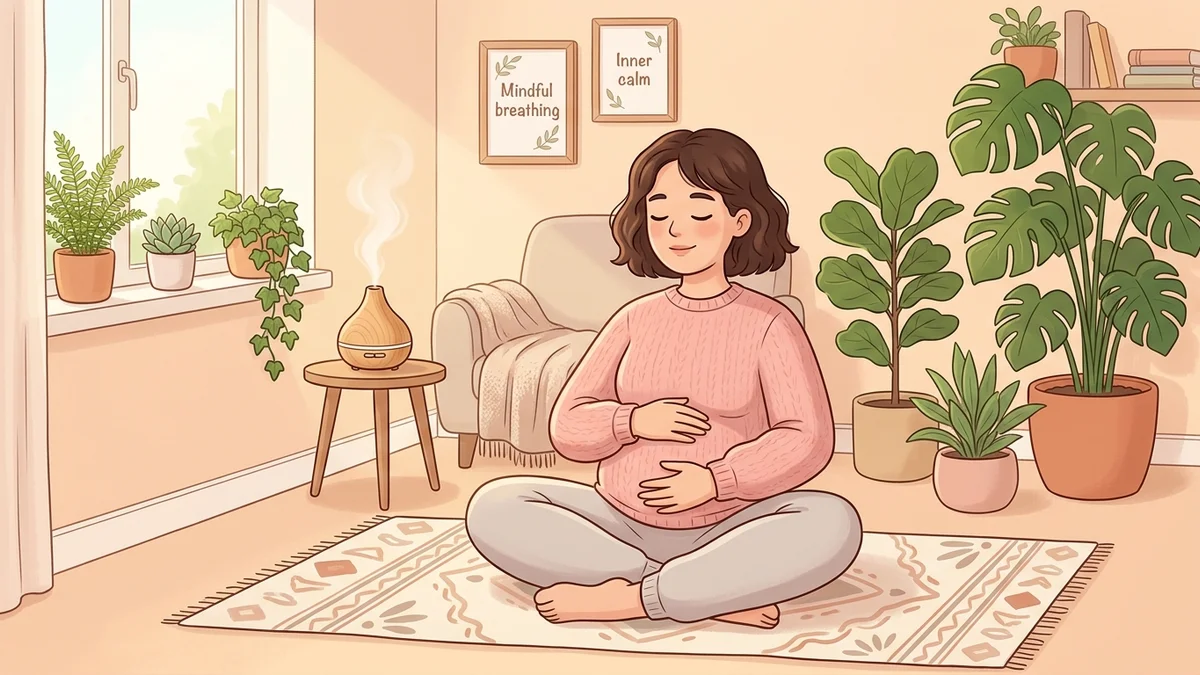
This is the foundation of every other technique. Lie down or sit comfortably.
- Place one hand on your belly and the other on your chest
- Breathe in slowly through your nose for 4 seconds — only the hand on your belly rises
- Breathe out gently through your mouth for 6 seconds — your belly falls
- Repeat for 3 to 5 minutes
Diaphragmatic breathing can reduce cortisol levels by 27% with just 15 minutes of daily practice, according to a Harvard study (2023).
2. Cardiac coherence (the 3-6-5 method)
The most scientifically studied technique. The protocol is simple: 3 times a day, 6 breaths per minute, for 5 minutes.
- Breathe in through your nose for 5 seconds
- Breathe out through your mouth for 5 seconds
- Keep this steady rhythm for 5 minutes
The balancing effects last up to 6 hours after the session. Practice when you wake up, before lunch and at the end of the day. To go deeper into this method, read our complete guide to heart coherence.
3. The 4-7-8 technique (Dr. Andrew Weil)
Developed by Dr. Andrew Weil, this technique is ideal for falling asleep and for moments of intense anxiety.
- Breathe in through your nose for 4 seconds
- Hold your breath for 7 seconds
- Breathe out slowly through your mouth for 8 seconds
- Repeat for 4 cycles
The 4-7-8 technique helps you fall asleep by strongly activating the parasympathetic nervous system through its extended exhale. Our full guide to 4-7-8 breathing covers it step by step, and if you're looking for more ways to sleep better, our article on evening meditation pairs perfectly with this approach.
4. Box breathing
Used by Navy SEALs to stay calm under intense pressure. Four equal phases, like the four sides of a square.
- Breathe in for 4 seconds
- Hold for 4 seconds
- Breathe out for 4 seconds
- Hold with empty lungs for 4 seconds
This technique sharpens focus and emotional control. Perfect before a presentation or an exam.
5. Alternate nostril breathing (Nadi Shodhana)
Rooted in yoga, this technique balances the two hemispheres of the brain.
- Close your right nostril with your thumb
- Breathe in through your left nostril for 4 seconds
- Close both nostrils and hold for 4 seconds
- Release your right nostril and breathe out for 4 seconds
- Breathe in through your right nostril, then alternate
6. Complete breathing (three-part breath)
This sophrology technique fills the lungs in three stages: belly, rib cage, collarbones.
- Breathe in by first expanding your belly
- Continue by opening your rib cage
- Finish by gently lifting your collarbones
- Breathe out slowly in reverse order
To discover more sophrology exercises, check out our guide to sophrology for sleep.
7. Wave breathing
Combine breathing with progressive muscle relaxation.
- Breathe in while tensing the muscles in your feet
- Breathe out while releasing them
- Work your way up gradually: calves, thighs, belly, hands, shoulders
- Every exhale releases the tension
8. Victorious breath (Ujjayi)
An advanced yoga technique, Ujjayi produces a soft sound as you exhale.
- Breathe in deeply through your nose
- Slightly tighten the back of your throat
- Breathe out slowly through your nose, making an audible breath
- Keep going for 5 to 10 minutes
Which breathing exercise helps you relax fastest?
If you only have 2 minutes, the 4-7-8 technique is your best bet. For a longer-lasting effect, go for 5 minutes of cardiac coherence. Here's a comparison based on your situation.
| Situation | Recommended Technique | Duration | Expected Effect |
|---|---|---|---|
| Stress at work | Box breathing | 3 min | Focus restored |
| Before bed | 4-7-8 technique | 2 min | Easier to fall asleep |
| Anxiety attack | Diaphragmatic | 5 min | Gradual calm |
| Before an exam | Alternate nostril | 5 min | Mental clarity |
| Tense morning | Cardiac coherence | 5 min | Balance for 6 hours |
| Rising anger | Wave breathing | 5 min | Muscle release |
If you're going through a panic attack, always start with diaphragmatic breathing to stabilize your rhythm before moving on to a more structured technique.
How does breathing affect anxiety and chronic stress?
The link between breathing and anxiety is one of the best documented in neuroscience. When you're anxious, your breathing speeds up and becomes shallow — that's the sympathetic "fight or flight" response. By deliberately reversing this pattern, you send a safety signal to your brain.
According to a meta-analysis published in Frontiers in Psychology (2020), conscious breathing practices significantly reduce biological markers of stress by lowering cortisol production and modulating activity in the amygdala.
Research published in the Journal of Psychiatric Research confirms that cardiac coherence reduces anxiety symptoms by 30% after 4 weeks of regular practice.
Chronic stress leads to habitually shallow breathing. Breathing exercises gradually reprogram that reflex.
Serena Coach tip: Our users who combine diaphragmatic breathing in the morning with the 4-7-8 technique at night report a 40% reduction in their perceived anxiety in just 2 weeks.
Real-life scenarios
At the office, between two stressful meetings
You've just walked out of a tense meeting, and the next one starts in 10 minutes. Close your eyes, place your feet flat on the floor and do 6 cycles of box breathing (4-4-4-4). Within 2 minutes, your heart rate slows down and your head clears.
At night, when you just can't fall asleep
It's 11 p.m. and you're replaying the day over and over. Lie down and do 4 cycles of the 4-7-8 technique. The hold phase (7 seconds) forces your mind to focus on counting rather than on your thoughts. The long exhale triggers the parasympathetic response.
On your commute, before an important appointment
Crowded subway, job interview in 30 minutes. Practice cardiac coherence discreetly: 5 seconds in, 5 seconds out. No one will notice a thing, but your cortisol will drop by 15% in 5 minutes (University of Sydney, 2022).
As the team at Toronto's Sunnybrook Hospital shows in this video, the key to stress-relief breathing lies in a steady, regular rhythm. You can practice these exercises directly with Serena, which guides you step by step with real-time visual feedback.
The Serena perspective
Anonymized data from the Serena app reveals an interesting gap between theory and practice. While the scientific literature recommends 5 minutes per session, our users already see significant results with 3 minutes of guided breathing — as long as the rhythm is steady and the exhale is longer than the inhale.
In 2025, Serena users who did a breathing exercise every day reported better sleep quality within the first week. The most used technique in the app is cardiac coherence (42% of sessions), followed by 4-7-8 breathing (28%) and diaphragmatic breathing (18%).
| Technique | Share of Serena sessions | User satisfaction |
|---|---|---|
| Cardiac coherence | 42% | 4.6/5 |
| 4-7-8 technique | 28% | 4.7/5 |
| Diaphragmatic breathing | 18% | 4.4/5 |
| Box breathing | 8% | 4.5/5 |
| Other techniques | 4% | 4.3/5 |
Serena Coach tip: Start with diaphragmatic breathing for one week before moving on to the advanced techniques. It's the foundation every other method is built on.
How Serena supports you every day
Serena includes the 6 main breathing techniques covered in this article, with visual and audio guidance adapted to your level. The app offers 3, 5 or 10-minute sessions — perfect for fitting in an exercise between two meetings or before bed.
Serena's advantage: tracking your progress. You can see how your practice evolves and how it affects your stress level day after day. Unlike natural anxiety remedies, guided breathing offers immediate relief with no side effects at all.
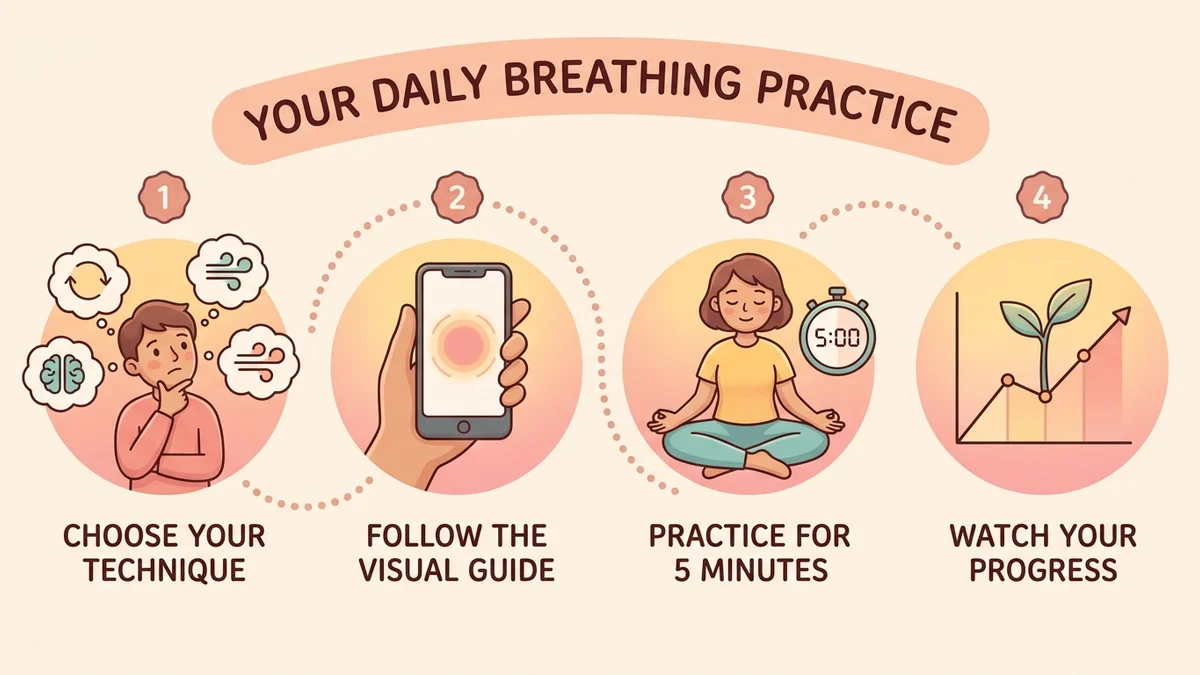
The basic breathing exercises are free on Serena. A subscription unlocks all the advanced techniques and personalized progress tracking.
Frequently asked questions
What is the best breathing exercise to calm down quickly?
Dr. Andrew Weil's 4-7-8 technique brings the fastest calm. Breathe in for 4 seconds, hold for 7 seconds, breathe out for 8 seconds. Activating the vagus nerve through the extended exhale triggers a parasympathetic response in under 2 minutes. It's the ideal technique in an emotional emergency.
How long should you practice a breathing exercise?
According to the Stanford study (2023), 5 minutes a day is enough to see a measurable drop in cortisol. The 3-6-5 cardiac coherence method recommends 3 daily sessions of 5 minutes. You'll feel the effects from the first session, but they become lasting after 4 weeks of regular practice.
Do breathing exercises really work for stress?
Yes, their effectiveness is well documented. The Stanford meta-analysis (2023) covering 34 clinical trials shows that 11 minutes of diaphragmatic breathing reduces cortisol by 18%. The calming effect can last up to 6 hours after a cardiac coherence session.
What is the difference between diaphragmatic and chest breathing?
Diaphragmatic breathing engages the belly and the diaphragm, taking in 50% more oxygen than chest breathing. Chest breathing, shallow and fast, keeps the body on alert. To check how you breathe, place one hand on your belly and one on your chest: the hand on your belly should rise first.
Can you do breathing exercises at work?
Absolutely. Box breathing (4-4-4-4) and cardiac coherence can be done sitting down, with your eyes open if needed. No equipment, no visible movement. Three minutes is enough to regain your focus between two stressful tasks.
Which breathing technique is best for sleep?
The 4-7-8 technique is the most recommended for falling asleep. The 7-second hold and the 8-second exhale strongly activate the parasympathetic nervous system. Practice 4 cycles lying down, in the dark. Pair it with an evening meditation for the best results.
Can breathing replace anxiety medication?
Breathing does not replace a treatment prescribed by your doctor. However, the Journal of Psychiatric Research reports that cardiac coherence reduces anxiety symptoms by 30% after 4 weeks. Talk to your healthcare provider: many doctors recommend breathing exercises alongside conventional treatment.
How do you learn to breathe from your belly?
Lie down and place a light book on your belly. As you breathe in through your nose, the book should rise. As you breathe out through your mouth, it goes back down. Practice for 5 minutes a day for one week. This simple method retrains your breathing reflex toward natural, stress-relieving belly breathing.
Conclusion
Breathing exercises are among the most accessible and effective stress-relief tools that science has validated. Whether it's cardiac coherence for lasting balance, the 4-7-8 technique for instant calm or diaphragmatic breathing as your daily foundation, you now have 8 concrete techniques to take back control of your wellbeing.
The key to success? Consistency. Start with 5 minutes a day with Serena and watch the change unfold over a few weeks. Your breath is your first ally — it's time to use it fully.