Does it feel like your brain is running in slow motion? Like brain fog keeps rolling in despite your best efforts? You're not alone. More and more people are actively investing time in their mental wellbeing — and looking for methods that go beyond vague advice. Biohacking for mental wellbeing offers a different approach: measure, test, adjust. No miracle recipes, just science-based protocols you can adapt to your daily life. Updated in May 2026.
The key takeaways
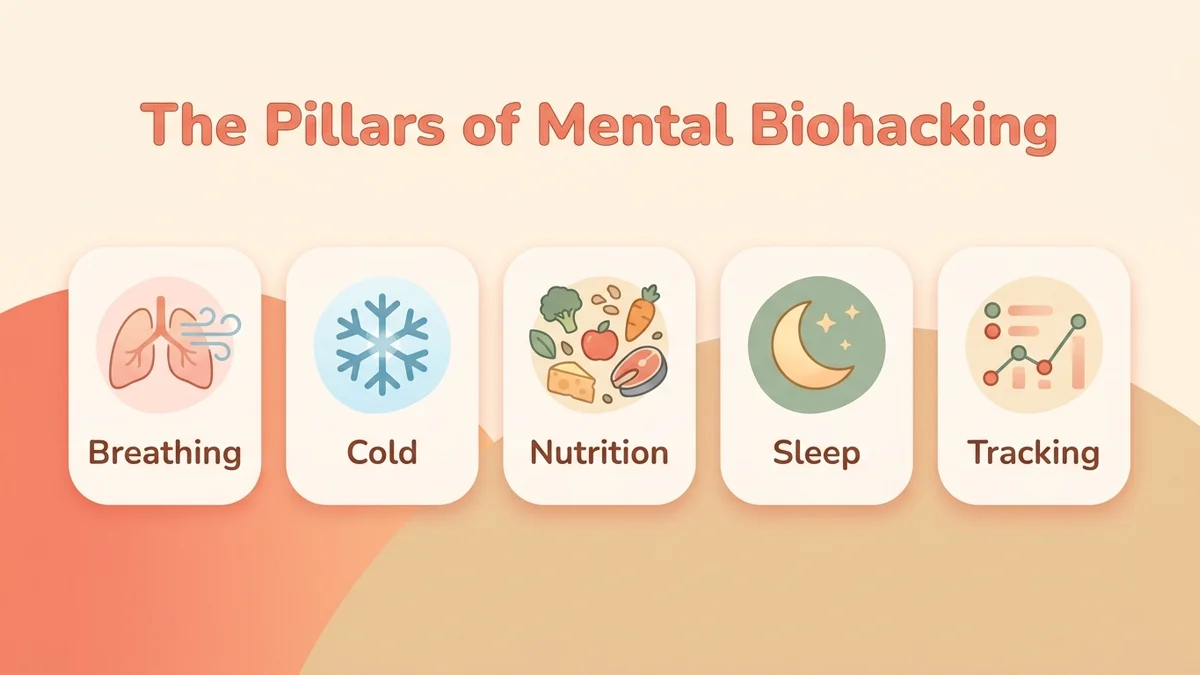
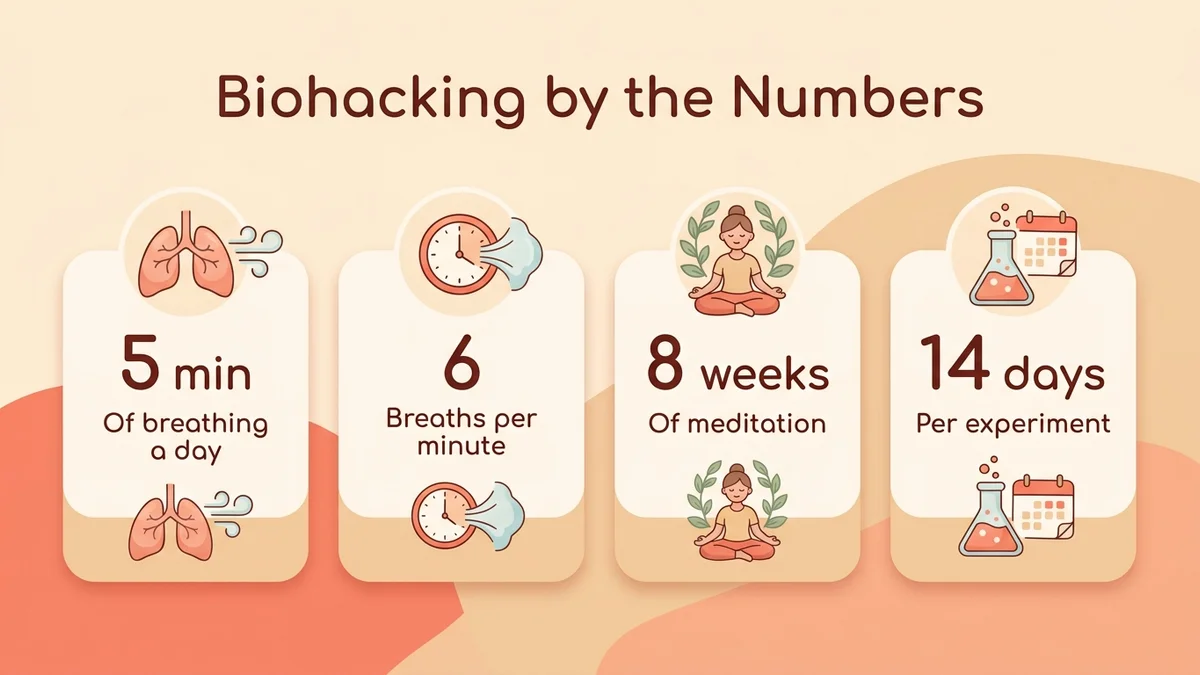
Mental biohacking combines science-backed techniques (cardiac coherence, cold exposure, light therapy, carefully chosen supplements) to optimize your mental state. You don't need expensive equipment: 5 minutes of guided breathing a day is enough to notice effects on stress and mental clarity. The approach is built on self-experimentation and tracking your personal data.
What is mental biohacking, and why should you care?
Mental biohacking is the practice of optimizing your brain with science-based tools that anyone can access. Contrary to popular belief, it isn't just for Silicon Valley tech enthusiasts. It's about testing techniques on yourself, measuring their effects and keeping what works. In short, becoming the scientist of your own mind.
Biohacking has grown into a fast-expanding, multibillion-dollar global market, according to industry analysts. That growth reflects a deeper trend: people want to take back control of their mental health with concrete methods.
Wearables, sleep trackers and breathing apps have made it easier than ever to see how daily habits affect mood, energy and focus.
Mental biohacking is for you if:
- You're dealing with persistent brain fog or emotional exhaustion
- You're looking for concrete solutions beyond "positive thinking"
- You like understanding how your body works
- You want measurable results, not vague promises
Mental biohacking turns each person into a researcher of their own wellbeing, with measurable, repeatable protocols.
What are the most effective biohacking techniques for mental wellbeing?
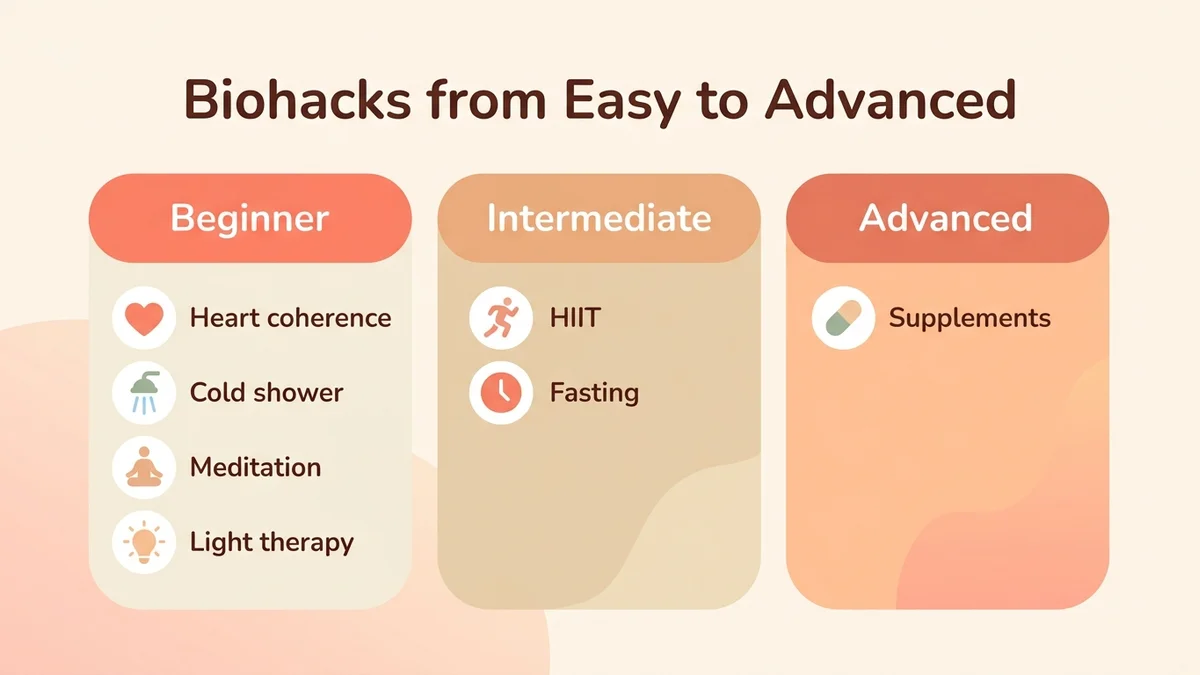
The most effective techniques combine accessibility with solid scientific evidence. Cardiac coherence, cold exposure and meditation top the list of well-supported practices. What they have in common: they act directly on the autonomic nervous system and produce noticeable effects within days.
Comparison table of mental biohacking techniques
| Technique | Time/day | Main effect | Time to results | Cost | Level |
|---|---|---|---|---|---|
| Cardiac coherence | 5-15 min | Lower cortisol, higher HRV | Immediate | Free | Beginner |
| Cold exposure | 1-5 min | Noradrenaline and dopamine boost | 1-2 weeks | Free | Beginner |
| Guided meditation | 10-20 min | Less anxiety | 3-4 weeks | Free | Beginner |
| Intermittent fasting | N/A | Possible effects on mood and inflammation (evidence mixed) | 4-6 weeks | Free | Intermediate |
| Light therapy | 20-30 min | Better mood and body clock | 1-2 weeks | $50-150 | Beginner |
| Natural nootropics | N/A | Modest focus and stress support | 2-4 weeks | $20-60/month | Advanced |
| HIIT | 15-25 min | Higher BDNF, better mood | 2-3 weeks | Free | Intermediate |
Cardiac coherence: the most accessible hack
Cardiac coherence — also called resonance breathing — is the ideal entry point to mental biohacking. In 5 minutes of rhythmic breathing (5 seconds in, 5 seconds out), you increase heart rate variability and, according to the HeartMath Institute, can lower your cortisol by 23%.
To go further with this technique, see our complete guide to cardiac coherence, or try our free cardiac coherence timer.
Cold exposure: the express boost
A common recommendation from breathwork and cold-exposure instructors is to start with 30 seconds of cold water at the end of your shower. In a classic study (Šrámek et al., European Journal of Applied Physiology, 2000), immersion in cool water (14°C / 57°F) raised noradrenaline by about 530% and dopamine by about 250%. A short cold shower is far less intense, but it taps into the same alertness-boosting response.
Natural nootropics
Some supplements may support cognition with few side effects — but always check with your doctor first, especially if you take medication:
- L-theanine (200 mg): calm focus, pairs well with coffee
- Rhodiola rosea: an adaptogen studied in several clinical trials for stress-related fatigue
- Magnesium L-threonate: a form of magnesium being studied for brain health
- Omega-3 DHA: supports brain structure and may reduce inflammation
Wearables like the Oura Ring or Whoop don't change your health on their own — but their real-time feedback can help you notice patterns and stick with healthier sleep and stress habits.
How does biohacking act on your brain? (the neuroscience)
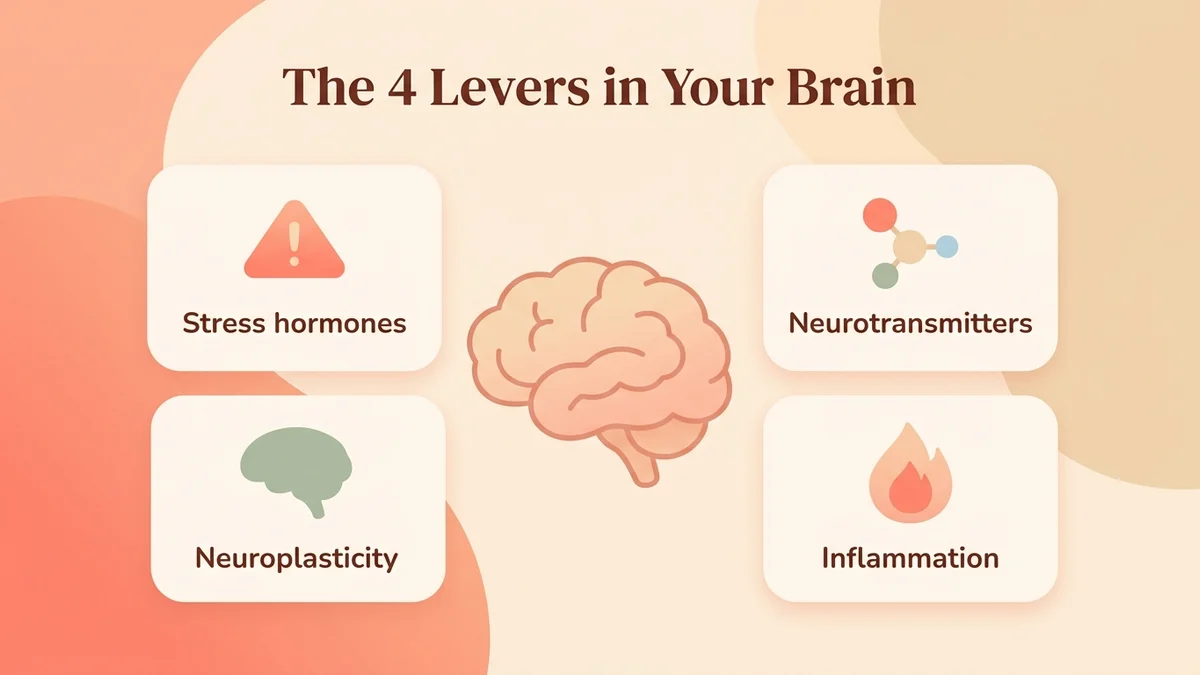
Mental biohacking works by activating specific neurobiological mechanisms. Each technique targets a particular lever: neurotransmitter production, regulation of the autonomic nervous system or stimulation of neuroplasticity. It isn't magic — it's applied biology.
Stanford neuroscientist Andrew Huberman has popularized many of these protocols on his podcast, always emphasizing the biological mechanism behind each one.
The 4 neurobiological levers of biohacking
| Lever | Mechanism | Associated techniques | Measurable marker |
|---|---|---|---|
| HPA axis (stress) | Cortisol regulation | Cardiac coherence, meditation | Salivary cortisol |
| Neurotransmitters | Dopamine/noradrenaline/serotonin | Cold, exercise, light | Heart rate variability (HRV) |
| Neuroplasticity | BDNF production | HIIT, learning, sleep | Cognitive tests |
| Inflammation | Lower inflammatory cytokines | Omega-3s, sleep, exercise | Blood CRP |
What actually happens in your brain:
- You practice cardiac coherence: the vagus nerve activates, a "rest and digest" signal reaches the brain, and stress hormones settle
- You expose yourself to cold: a thermal shock triggers a surge of noradrenaline and dopamine, creating alertness without anxiety
- You meditate: the prefrontal cortex strengthens, and an 8-week mindfulness study (Hölzel et al., 2010) found reduced gray matter density in the amygdala (the fear center) that tracked with lower stress
Mental biohacking works on some of the same biological systems targeted by conventional treatments — but it complements care rather than replacing it.
A core principle of the biohacking movement is simple: what gets measured gets improved. Track your mood, your sleep, your energy. That's exactly the principle behind a gratitude journal: measure to make progress.
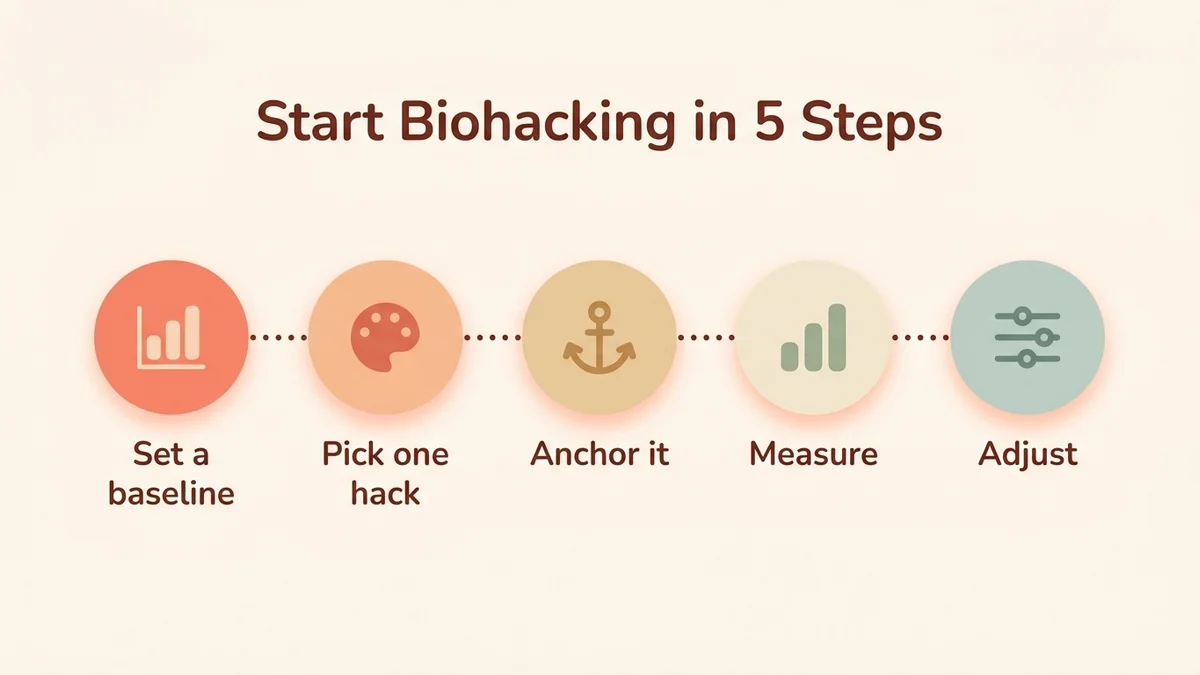
How to start mental biohacking in 5 simple steps
To begin, focus on a single technique for 2 weeks before adding another. The key is consistency, not intensity. A simple protocol followed every day beats a complex program abandoned after 3 days. Start small, measure everything, adjust often.
Step 1: Establish your baseline
Before changing anything, record your current state for 7 days:
- Mood (1-10), morning and evening
- Sleep quality
- Energy level
- Brain fog (yes/no)
That's your starting point. Without baseline data, you can't measure progress. For an extra reference point, take our free stress test.
Step 2: Choose your first technique
If you don't know where to start, cardiac coherence is the obvious choice. Free, risk-free, effects in 5 minutes. Browse our breathing exercises to find the variation that suits you.
Step 3: Build it into your existing routine
Anchor your new habit to an existing routine. Cardiac coherence right after brushing your teeth? A cold finish right after your usual hot shower? That's the micro-habits principle at work.
Step 4: Measure and record
Each day, note the impact on your mood and energy. A simple notebook works, or a mood-tracking app.
Step 5: Adjust after 14 days
Compare your data with your baseline. If you see improvement, keep going. If not, adjust the timing or duration, or try another technique.
Sample weekly plan (beginner)
| Day | Morning | Midday | Evening |
|---|---|---|---|
| Monday | Cardiac coherence 5 min | 15-min walk | Mood journal |
| Tuesday | Cold shower 30 sec | Box breathing 3 min | 3 gratitudes |
| Wednesday | Cardiac coherence 5 min | HIIT 15 min | Meditation 10 min |
| Thursday | Cold shower 30 sec | 15-min walk | Mood journal |
| Friday | Cardiac coherence 5 min | Box breathing 3 min | 3 gratitudes |
| Saturday | Cold shower 1 min | 30 min in nature | Meditation 10 min |
| Sunday | Active rest | Weekly review | Adjust protocol |
You can combine these techniques with your wellbeing morning routine for a cumulative effect.
Real-life scenarios
Scenario 1: Maria, 34, heading toward burnout
Maria is a manager at a startup. She goes from meeting to meeting, sleeps badly and feels burnout coming. Her biohacking protocol:
- Morning: 5 minutes of cardiac coherence before opening her email
- Lunch break: 2 minutes of 4-7-8 breathing to break the stress
- Evening: mood journal + 3 gratitudes
After 3 weeks, her self-rated stress score drops from 8/10 to 5/10. She sleeps 45 minutes more per night.
Scenario 2: Tyler, 28, chronic brain fog
Tyler is a software developer. For 6 months, he's felt like he's thinking "through cotton." His approach:
- Cutting sugar at breakfast (replaced with eggs + avocado)
- Gradual cold showers (30 sec → 2 min over 4 weeks)
- L-theanine 200 mg with his morning coffee, after checking with his doctor
Within 4 weeks, his focus (measured with a daily Stroop test app) improves by 35%.
Scenario 3: Susan, 45, anxious rumination
Susan can't "switch off" her brain. Her thoughts spin in circles, especially at night. See our advice on rumination. Her hack:
- A 10-minute body scan meditation before bed
- Dim, warm lighting in the evening instead of bright overhead lights
- Alternate nostril breathing when her thoughts start racing
After 5 weeks, her rumination episodes drop from daily to 2-3 times a week.
The Serena perspective
Mental biohacking isn't a passing fad. It's a logical evolution in how we relate to mental health. We've moved from "it's all in your head" to "it's measurable and changeable." And that's exactly Serena's philosophy: giving you concrete, science-based tools to take care of your mind every day.
What separates smart biohacking from "wellness gadgets" is consistency and measurement. A breathing exercise done once changes nothing. The same exercise practiced 5 minutes a day for 30 days can meaningfully change how your nervous system responds to stress.
Serena Coach tip: Track your mood for 7 days BEFORE launching a protocol. It's the foundation of any serious biohacking. Then add a single technique (cardiac coherence is ideal) and watch how your scores change. Seeing your progress on a chart is the best motivation there is. In Serena, daily mood tracking does exactly that: it shows you, with numbers, that your efforts are paying off.
Cardiac coherence: the most powerful (and free) biohacking tool
Cardiac coherence is arguably the mental hack with the best effort-to-results ratio. 5 minutes, no equipment, immediate effects. In this clip, Stanford neuroscientist Andrew Huberman explains a simple breathing tool to boost heart rate variability:
A popular protocol is "3-6-5": 3 times a day, 6 breaths per minute, for 5 minutes. This simple routine helps lower cortisol and improves heart rate variability (HRV), one of the best markers of stress resilience.
If chronic stress is part of your daily life, cardiac coherence should be your first reflex. Not in two weeks. Today.
Five minutes of cardiac coherence a day helps lower cortisol and builds measurable resilience to stress.
How Serena supports your biohacking journey
Serena was designed for people who want a structured approach to mental wellbeing. The app combines three pillars of accessible biohacking:
Smart mood tracking: log your state every day, visualize your trends and identify what works. It's your "personal lab" in your pocket.
A variety of breathing exercises: cardiac coherence, box breathing, 4-7-8, alternate nostril breathing. Not one generic exercise, but a complete program that adapts to what you need in the moment.
Guided gratitude journal: research links regular gratitude to greater wellbeing. Serena guides you with daily prompts to turn the practice into an automatic habit.
Where many wellness apps focus mainly on meditation content, Serena brings together a complete, accessible mental biohacking toolkit. Mood tracking, breathing, gratitude: all three pillars in one app. Comparing options? See our meditation app comparison.
Frequently asked questions
Is mental biohacking dangerous? The basic techniques (breathing, gradual cold exposure, meditation) are safe for most healthy people. Talk to a doctor before taking nootropics or supplements, or before making drastic changes to your diet.
How long before I see results? Cardiac coherence can have noticeable effects within 5 minutes. For lasting changes in mood and cognition, allow 3 to 6 weeks of regular practice.
Do I need to buy expensive equipment to biohack? No. The most effective techniques (breathing, meditation, journaling, cold exposure in the shower) cost nothing. Wearables like the Oura Ring are optional.
What's the difference between biohacking and personal development? Biohacking relies on measurable data and structured protocols. You test, measure and adjust. It's an iterative approach based on experimentation.
Can biohacking replace mental health care? No. Biohacking is a complement, not a substitute. If you're living with a diagnosed condition, professional support remains essential. If you're in crisis, call or text 988.
Does intermittent fasting really improve mental health? The evidence is mixed. Some studies suggest benefits for mood and inflammation, but results vary, and fasting isn't appropriate for everyone — particularly people with a history of eating disorders.
Is cold exposure suitable for beginners? Yes, starting with 30 seconds of cold water at the end of your shower. Add about 10 seconds a week. Check with your doctor first if you have a heart condition.
Which app can I use to track my mental biohacking? Serena combines mood tracking, a variety of breathing exercises and a gratitude journal. It's a complete tool for measuring the impact of your practices day to day.
Take control of your mind now
Mental biohacking isn't a passing trend. It's a quiet revolution in how we relate to mental health. The tools exist, science supports them, and they're accessible to everyone.
You don't need to change everything at once. Start with 5 minutes of cardiac coherence tomorrow morning. Note your mood before and after. That's it. That's already biohacking.
And if you'd like a companion to structure your approach, Serena is here. Mood tracking, guided breathing, gratitude. Your mental wellbeing lab, in your pocket, 24/7.