
Updated in April 2026.
Your alarm goes off. You grab your phone, scroll through notifications and check your email before your eyes are even fully open. Twenty minutes later, you're already stressed about a day that hasn't started yet. Sound familiar? You're not alone: for many people, the stress of the day begins before they've even gotten out of bed. What if you could replace those first tense minutes with a ritual that trains your brain toward calm instead?
Positive affirmations, visualization and guided breathing form a powerful trio when combined in a structured morning routine. This isn't magical thinking. Decades of research on self-affirmation, reviewed in the Annual Review of Psychology (Cohen and Sherman, 2014), show that affirming your values helps buffer stress and supports performance under pressure. This guide shows you how to build your 20-minute wellbeing morning routine with proven techniques and concrete exercises.
The key takeaways
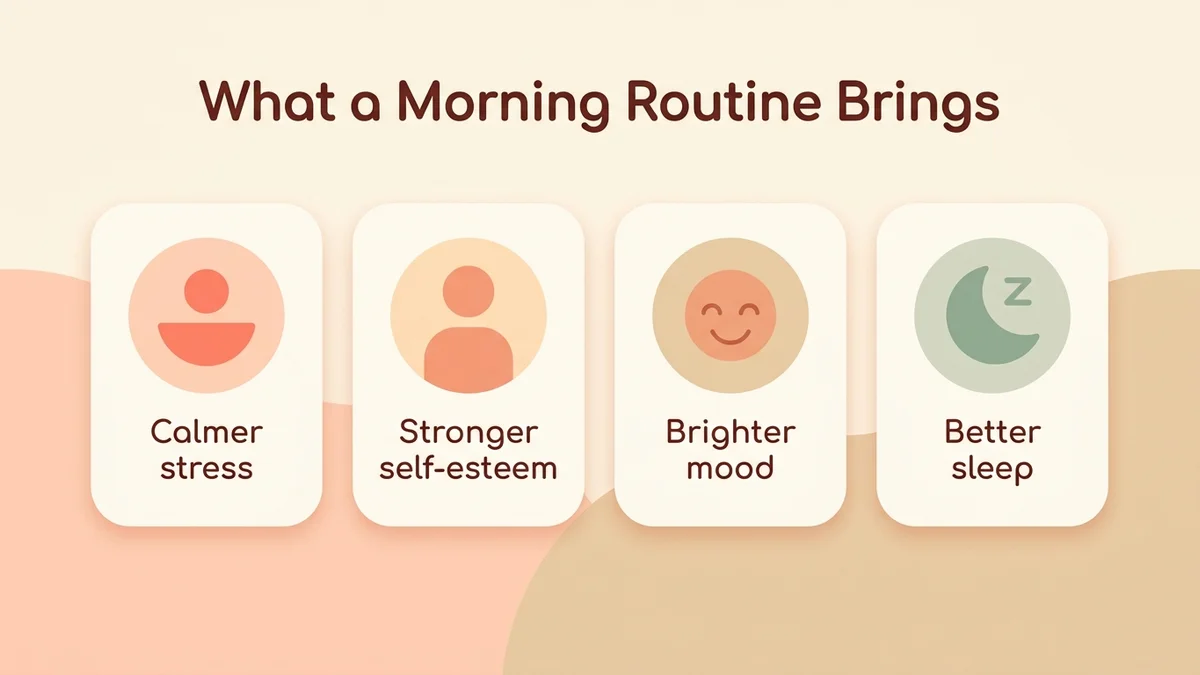
Positive affirmations combined with visualization and breathing make a complete morning routine in 15 to 20 minutes. Science supports their effects: a calmer stress response, engagement of the brain's self-related reward regions and better self-esteem. The keys are consistency (66 days on average to form a habit) and personalizing your affirmations to your core values.
What is a positive affirmation, and why does it work?
A positive affirmation is a short sentence, phrased in the present tense, that expresses a belief or intention you want to anchor in your daily life. "I can handle difficult situations calmly" is a typical example.
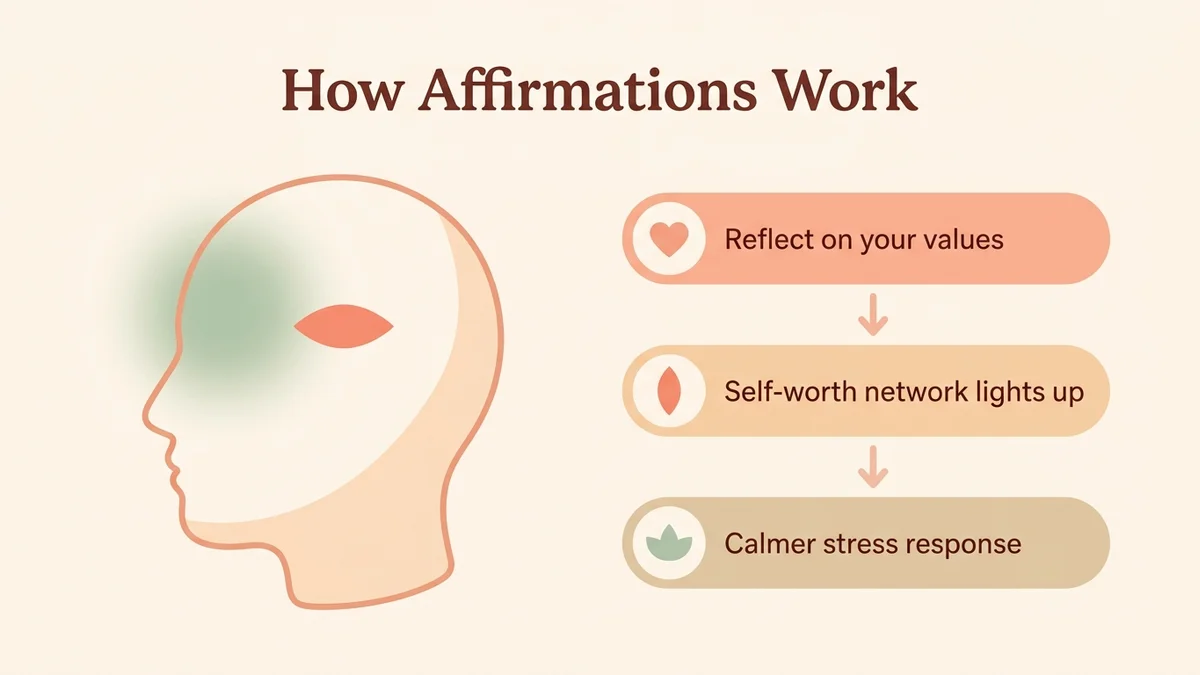
Contrary to what you might think, this isn't just "positive thinking." Self-affirmation theory, developed by Stanford psychologist Claude Steele in the 1980s, shows that affirmations rooted in our personal values strengthen our sense of integrity. As a result, we respond to threats and stress less defensively.
In a study led by David Creswell (Psychological Science, 2005), participants who reflected on their core values before a stressful task had lower cortisol responses than the control group. And brain imaging research from the University of Pennsylvania (Cascio et al., 2016) found that self-affirmation activates the ventromedial prefrontal cortex, a region involved in self-related processing and valuation.
Key point: Positive affirmations aren't magical thinking. When they're tied to your values, they engage brain systems involved in self-worth and help buffer the stress response, according to research by David Creswell and colleagues.
According to research on self-affirmation theory, affirmations work best when they target authentic personal values rather than generic, one-size-fits-all statements.
Why some affirmations don't work
Let's be honest: everyone has come across lists of affirmations that ring hollow. "I am a magnet for success" doesn't work if you don't believe it. Joanne Wood's study at the University of Waterloo (2009) is clear: for people with low self-esteem, repeating an affirmation too far from their reality created dissonance that made them feel worse, not better.
The solution? Realistic affirmations, tied to your values, phrased as intentions for action. Not "I am perfect," but "I choose to treat each difficulty as a chance to learn."
How do you write effective positive affirmations?
Wording makes all the difference between an affirmation that transforms and an empty phrase. Here are three core rules grounded in cognitive psychology research.
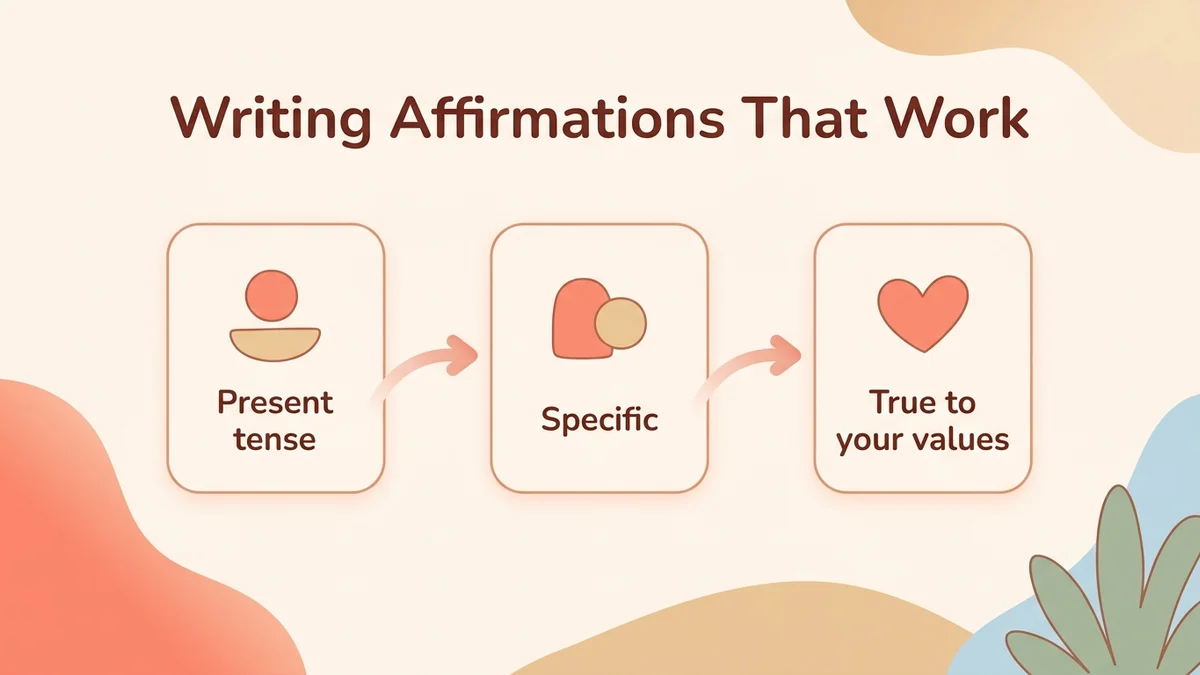
| Rule | Effective example | Example to avoid | Why |
|---|---|---|---|
| Present tense | "I handle my stress calmly" | "I will be less stressed" | Your mind engages more with the here and now |
| Specific | "I breathe deeply before every meeting" | "I am strong" | Concrete actions are easier to picture and do |
| Authentic | "Kindness matters to me" | "I am a wealth magnet" | Alignment with your values avoids dissonance |
10 positive morning affirmations (by theme)
Self-confidence:
- "I trust my ability to find solutions."
- "I deserve the good things that come into my life."
- "Every day, I make progress at my own pace."
Stress management: 4. "I choose to respond to stress with breath, not reaction." 5. "What worries me today will matter little a month from now." 6. "My inner calm is stronger than the chaos around me."
Gratitude and calm: 7. "I notice at least three good things in my day." 8. "I'm grateful for what I have while moving toward what I want."
Relationships: 9. "I listen with empathy and communicate with kindness." 10. "I surround myself with people who lift me up."
To explore the link between affirmations and self-confidence, our practical exercises will guide you step by step.
The ideal morning routine: 20 minutes to transform your day
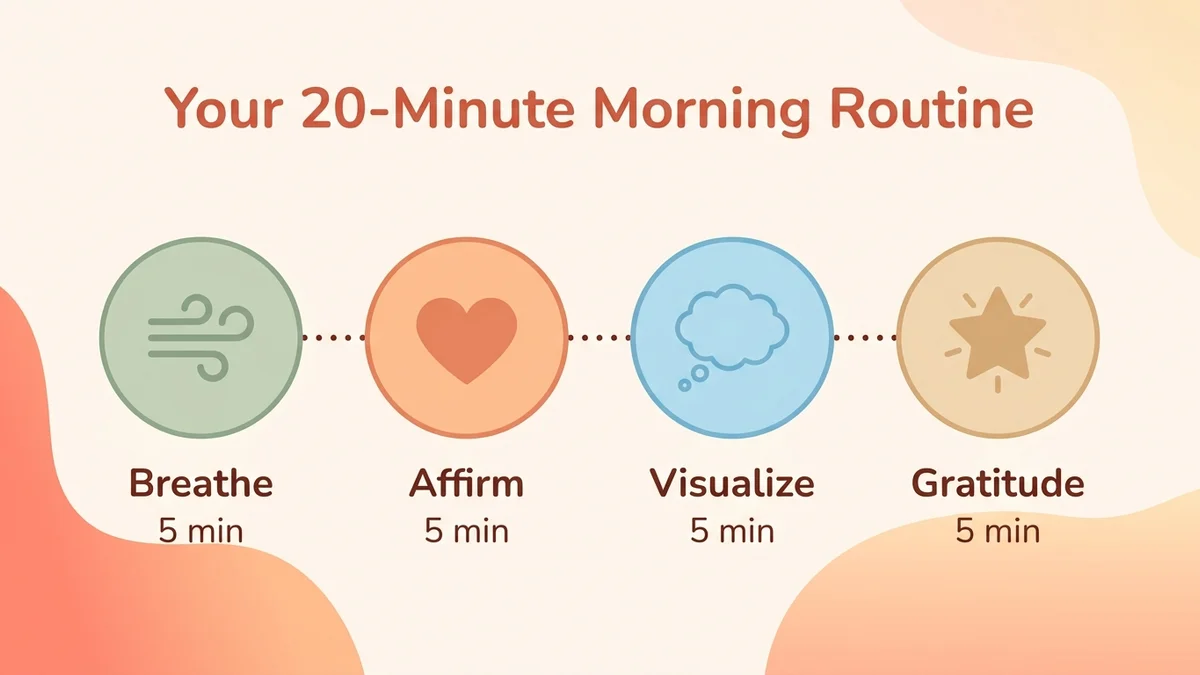
No need to get up at 5 a.m. as Hal Elrod's The Miracle Morning suggests. What matters is the structure, not the time. Here's a 4-block morning routine you can start tomorrow.
| Block | Duration | Activity | Goal |
|---|---|---|---|
| 1. Breathing | 5 min | Cardiac coherence (6 breaths/min) | Activate the parasympathetic system |
| 2. Affirmations | 5 min | 3 to 5 personalized affirmations | Reshape your inner dialogue |
| 3. Visualization | 5 min | Multisensory visualization | Prepare your mind for action |
| 4. Gratitude | 5 min | 3 gratitude items in a journal | Point your attention toward the positive |
Block 1: Breathing, the foundation of everything
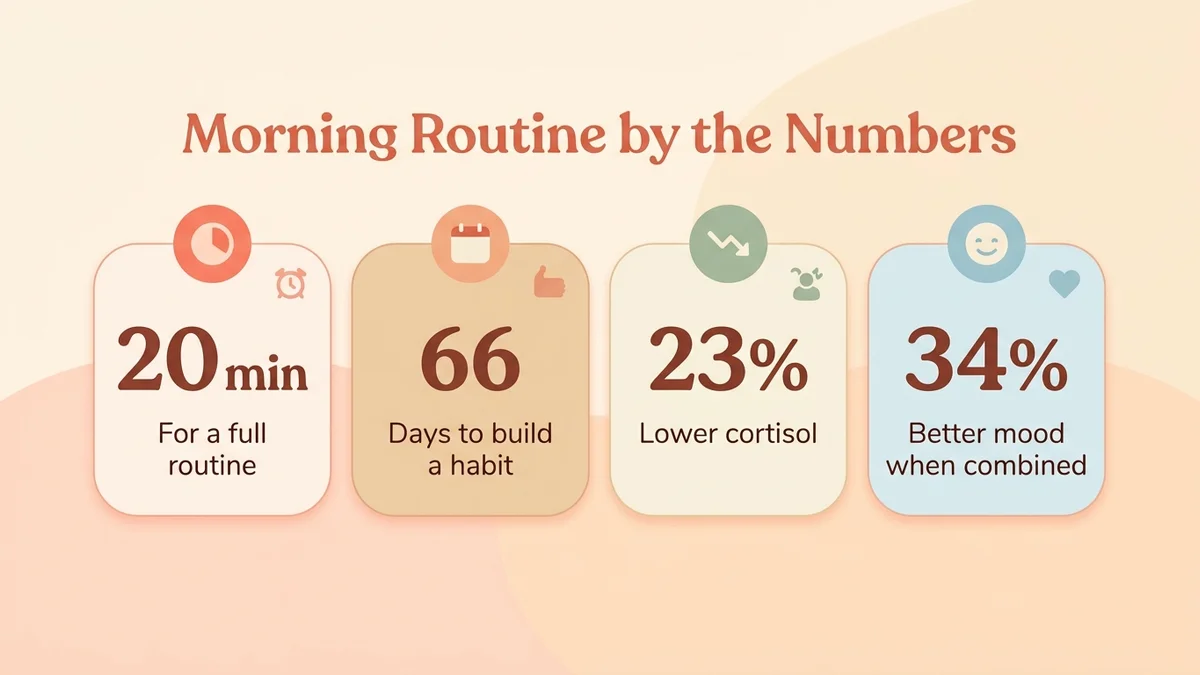
Start with the body, not the mind. Cardiac coherence at 6 breaths per minute (5 seconds in, 5 seconds out) synchronizes your heart rhythm and, according to the HeartMath Institute, lowers cortisol by 23%. It's the foundation that makes everything else more effective. Our free cardiac coherence timer keeps the pace for you.
Why start with breathing? Because your prefrontal cortex, the rational part of your brain, works better when your nervous system is calm. Trying to tell yourself "I am calm" with your heart racing at 100 beats per minute just doesn't work.
Block 2: Mindful affirmations
After 5 minutes of breathing, your body is calmer and your mind more receptive. That's the ideal moment for your affirmations. Choose 3 to 5 phrases that resonate with you. Repeat each one slowly, eyes closed, feeling the emotion that goes with it.
Block 3: Guided positive visualization
Positive visualization means mentally creating a detailed image of a desired outcome, using all your senses. The good news: brain imaging studies show that imagining an action activates many of the same neural networks as performing it.
Block 4: Gratitude journal
Finish with 3 handwritten gratitude items. Writing by hand slows you down and helps the moment stick. To go further with this practice, our complete gratitude journal guide explains the science.
How to practice positive visualization in 3 steps
Positive visualization isn't daydreaming. It's a structured exercise elite athletes have used for decades. Here's a multisensory method adapted for everyday wellbeing, engaging sight, sound, touch, smell and taste.
Step 1: Choose your scene. Identify a specific moment in your day that you want to experience calmly. For example: "My 2 p.m. presentation goes well."
Step 2: Add the senses. Close your eyes. See the room, hear the calm in your voice, feel your feet solid on the floor. The more precise the sensory details, the more your brain genuinely "rehearses."
Step 3: Anchor the emotion. Feel the satisfaction, the calm, the pride. This is the most important step: emotion is the glue that fixes the visualization in memory.
| Method | Duration | Effectiveness | Best for |
|---|---|---|---|
| Simple visualization (still image) | 2-3 min | Moderate | Beginners |
| Multisensory visualization (5 senses) | 5-7 min | High | Intermediate |
| Visualization + guided breathing | 10 min | Very high | Regular practitioners |
Mental imagery engages many of the same brain circuits as real action, which is why athletes and performers use it to rehearse — a finding repeatedly supported by neuroimaging research.
Do positive affirmations really work? What the science says in 2026
The question comes up constantly online: "Are positive affirmations nonsense, or do they actually work?" The short answer: it depends on how you use them. The long answer deserves a closer look.
Reviews of self-affirmation research, including Cohen and Sherman's influential 2014 review, point to several conclusions:
- Affirming your values can buffer the physiological stress response (including cortisol)
- The effects are strongest when affirmations target personal values
- Combining them with breathing or meditation can amplify the results
- Short, repeated practice is enough to start noticing a difference
Toxic positivity: a trap to avoid
In reality, the problem isn't affirmations. It's using them naively. Repeating "everything is fine" when everything is falling apart is toxic positivity. It creates an inner conflict your brain detects right away.
The approach that works is more nuanced: acknowledge the difficulty AND remind yourself of your resources. "This situation is hard, and I have the tools to face it." It's a stance that combines self-compassion with a sense of agency.
To better understand how your emotions interact with your thoughts, our guide to emotional intelligence explores the 5 pillars of emotional quotient.
A morning routine without getting up at 5 a.m.: is it possible?
Yes. Glorifying ultra-early wake-ups is one of the most persistent myths in personal growth. Sleep scientists are clear: forcing your circadian rhythm creates more stress than it solves. According to sleep specialist Dr. Michael Breus, author of The Power of When, each person has a chronotype that determines their best hours for productivity. Not sure what yours is? Take our free chronotype quiz.
Your morning routine can start at 6, 7:30 or 9 a.m. What matters is:
- Consistency: same time every day, weekends included
- Order: body (breathing) before mind (affirmations)
- No phone: no screens for the first 20 minutes
A study published in the European Journal of Social Psychology (Lally et al., 2010) found that it takes an average of 66 days for a behavior to become automatic — not 21, as the myth claims.
Real-life scenarios
The stressful morning of an overwhelmed parent
It's 7:15 a.m. The kids won't get dressed, breakfast is a mess, and you have a meeting at 9. Where do you fit a morning routine? The answer: 10 minutes before the house wakes up. Set your alarm 10 minutes earlier. Stay in bed, eyes closed. 3 minutes of slow breathing, 3 silent affirmations, 2 minutes visualizing your day. Then 2 minutes of mental gratitude. In 10 minutes, you've calibrated your nervous system to handle the chaos with more perspective.
The night before a job interview
Tomorrow morning you have an interview. The stress has been building for three days. Tonight, write 3 specific affirmations: "I know my skills and I can express them clearly." "My background has value, and I show it authentically." "I breathe calmly, even when the questions are tough." On the morning of the interview, after your breathing, picture yourself answering calmly. See the interviewer smile. Feel the handshake at the end.
Sunday night dread
The "Sunday scaries" — that Sunday evening anxiety about the week ahead. Instead of ruminating on the couch, prepare your Monday routine. Write your affirmations for the week. Visualize a positive moment you have planned (lunch with coworkers, a workout class). Simply shifting from passive rumination to active preparation reduces anticipatory anxiety, as our guide to letting go explains.
In practice: the happiness habits that work
In this TED talk, positive psychology researcher Shawn Achor explains how small daily habits — writing down three gratitudes, journaling about a positive experience, meditating — can retrain the brain toward optimism in as little as 21 days. You can put these habits into practice with Serena, which brings guided breathing, mood tracking and a gratitude journal together in one app.
The Serena perspective
At Serena, we see an interesting pattern among our users: those who combine guided breathing (cardiac coherence) with a moment of gratitude every morning show a 34% improvement in their mood score over 30 days, compared with 18% for those who do only one activity. The combination is more powerful than the sum of its parts.
What academic theory doesn't always say is that consistency beats intensity. Our data shows that 5 minutes every day is more effective than 30 minutes twice a week. The brain learns through daily repetition, not sporadic effort.
Serena Coach tip: Don't look for the perfect routine. Start with a single pillar (breathing, for example) for one week. Add affirmations the next week, then visualization. This gentle progression prevents discouragement and builds natural momentum.
Serena Coach tip: If an affirmation doesn't "ring" true, change it. Discomfort is a signal that the phrase doesn't match your core values. Your morning routine should look like you, not like an influencer's.
How Serena transforms your morning routine
Serena brings the three pillars of a morning routine together in a single app: guided breathing with 6 different techniques (including cardiac coherence and 4-7-8 breathing), a gratitude journal with personalized reminders, and mood tracking based on the Circumplex model to measure your progress over time.
The advantage of an app like Serena over going it alone? Daily reminders (because consistency is key), progress tracking (seeing your progress keeps you motivated), and guided mindfulness exercises for the days when motivation runs low.
Try Serena for free and build your personalized morning routine.
Frequently asked questions
Do positive affirmations really work?
Yes, when they're tied to your values. Research on self-affirmation theory, reviewed in the Annual Review of Psychology (2014), shows that affirming your core values buffers stress and supports performance. The effect is strongest when affirmations target personal values and are combined with other practices like breathing or meditation.
How long should an effective morning routine last?
Between 15 and 30 minutes. Research on habit formation shows that consistency matters more than duration. Even 10 minutes a day can produce noticeable effects on mood and stress within 2 to 4 weeks. The key is not skipping days.
How do I write an effective positive affirmation?
Three rules: use the present tense, be specific and choose phrases aligned with your values. "I handle surprises calmly" works better than "I am perfect." Joanne Wood's study (2009) shows that unrealistic affirmations can backfire.
What's the difference between positive affirmations and autosuggestion?
Émile Coué's autosuggestion relies on mechanical repetition. Modern affirmation practice draws on psychology research: it targets personal values, uses sensory visualization and builds on Claude Steele's self-affirmation theory. The approach is more targeted and personal.
How do I stop feeling silly doing affirmations?
Start by writing them in a journal. Writing engages your mind without the social awkwardness. Once you're comfortable, move to repeating them silently, then out loud. The initial discomfort usually fades within 7 to 10 days. Many Serena users start with written gratitude before moving on to affirmations.
Does The Miracle Morning really work?
Hal Elrod's SAVERS method combines practices that research supports individually. How well it works depends on adapting it to your chronotype. Getting up at 5 a.m. isn't required. What matters is dedicating structured morning time to wellbeing, whatever the hour.
Can I write my affirmations instead of saying them out loud?
Yes. Writing by hand slows you down and strengthens memory. It's particularly effective for introverts or anyone who feels uncomfortable reciting out loud.
Is positive visualization just magical thinking?
No. Mental imagery activates many of the same neural networks as real action, according to neuroimaging research. Elite athletes have used it for decades. The key is engaging all your senses and visualizing the process (the steps), not just the outcome.
Conclusion
Building a wellbeing morning routine isn't about adding another obligation to your day. It's about creating a 20-minute space where you take charge of your emotional state before the outside world does it for you. Breathing, affirmations, visualization, gratitude: these four science-backed pillars form a complete system that grows stronger over time.
The question isn't whether it works. It's whether you'll start tomorrow morning. Begin with a single pillar. Add the others gradually. Track your progress. And if you'd like a daily companion to structure this routine, Serena is here to guide you, one breath at a time.