You're lying in bed. The clock says 2 a.m. And your brain is replaying yesterday's conversation on a loop. You analyze every word, every look, every silence. You search for what you could have said differently. But nothing gets resolved. That's what rumination is: a scratched record spinning in your head without ever finding an answer. How do you break this vicious circle? That's exactly what this guide is about. Updated in April 2026.
According to the National Institute of Mental Health (NIMH), 21 million American adults — 8.3% of the adult population — experienced a major depressive episode in a single year, and rumination is one of its main drivers. The good news: simple, proven techniques exist to break the cycle. You're not doomed to ruminate.
The key takeaways
Rumination is a process of repetitive negative thoughts that loop without reaching a solution. It activates the brain's default mode network and wears out the prefrontal cortex. To stop ruminating, you need to interrupt the cycle with concrete actions: mindfulness, breathing, physical movement or writing. 8 weeks of regular practice reduce rumination by 40%.
What exactly is rumination?
Rumination is a repetitive way of thinking that focuses on the causes, consequences and meaning of past negative events or current problems. Unlike constructive reflection, it leads to no solution. It spins, over and over, like a washing machine stuck on the same cycle.
The term comes from the Latin ruminare, meaning "to chew again." That's exactly what your brain does: it chews on the same thoughts without ever digesting them. According to psychologist Susan Nolen-Hoeksema, a pioneer of research on the subject, rumination differs from reflection in being passive and unproductive.
What neuroscience tells us
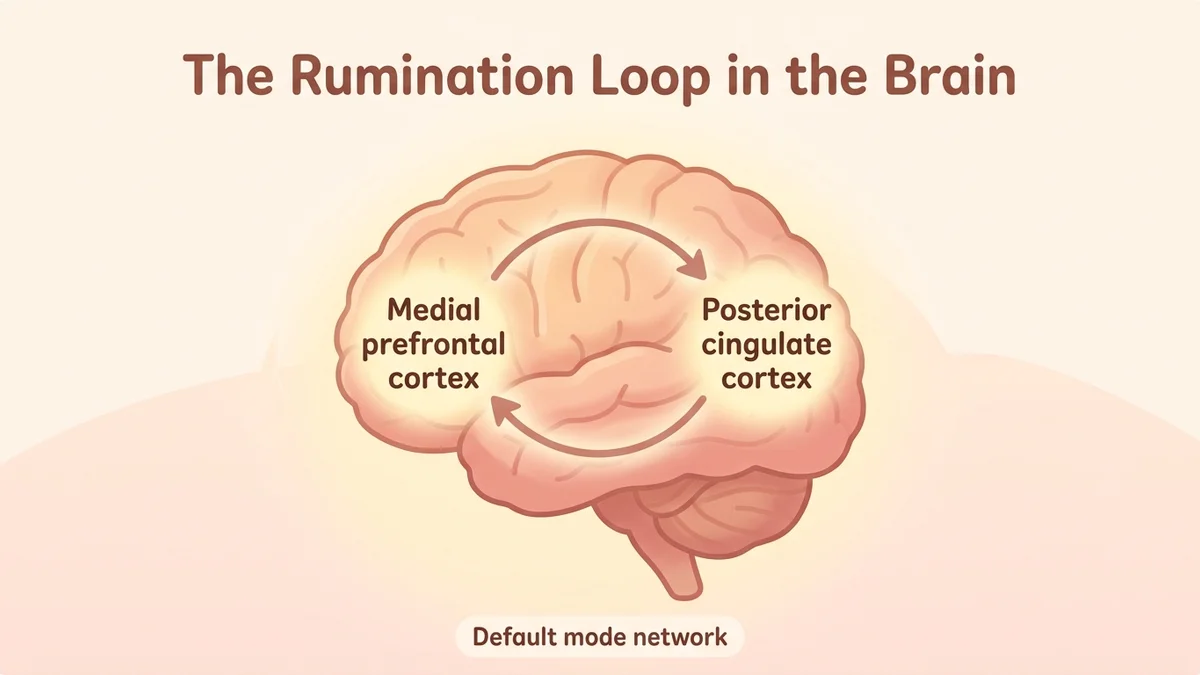
Rumination is linked to overactivity in the default mode network. This brain network switches on when you're not doing anything in particular. It's useful for creativity and planning. But in chronic ruminators, it runs out of control.
The medial prefrontal cortex plays a central role. It processes self-referential thoughts (thoughts about yourself). When it's overactivated, your brain stays stuck on your own problems instead of moving on.
According to a study published in Biological Psychiatry (2023), people prone to rumination show increased connectivity between the medial prefrontal cortex and the amygdala, which amplifies negative emotions.
Let's be honest: everyone ruminates from time to time. It's human. The problem starts when this way of thinking becomes your default mode of operating.
What are the 3 types of rumination?
There are three forms of rumination, and identifying them helps you tackle them better. Reflective rumination is about the past, worry rumination is about the future, and abstract rumination keeps you from taking concrete action.
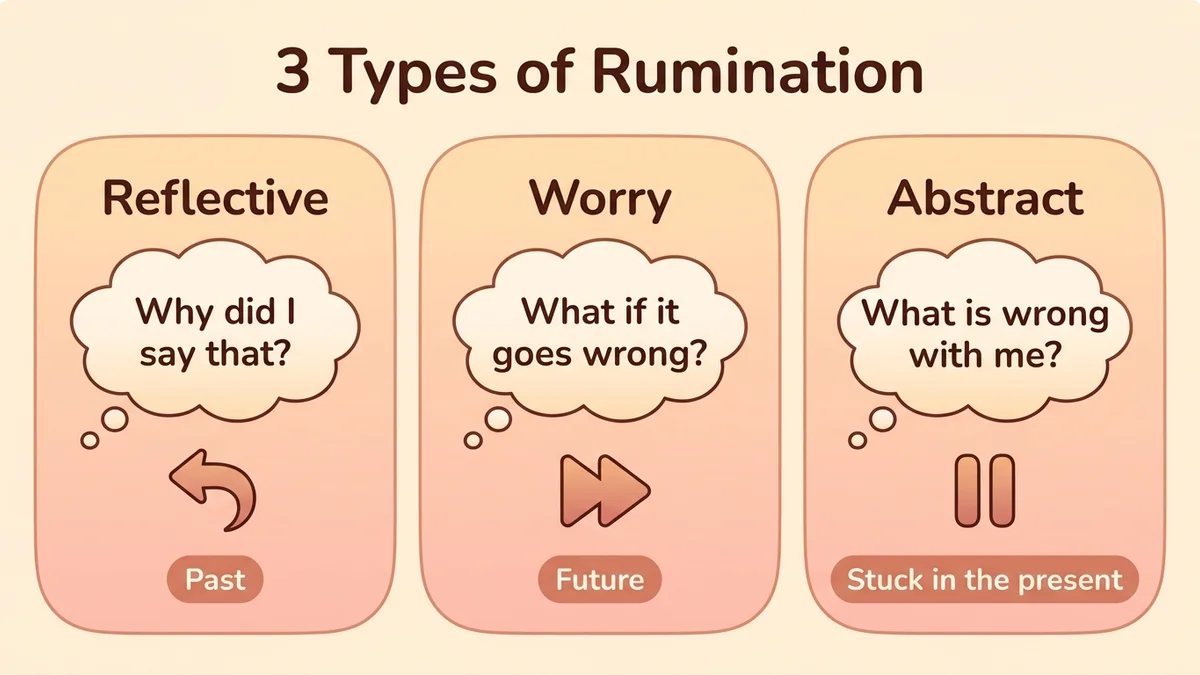
| Type of rumination | Time focus | Typical thought | Main risk |
|---|---|---|---|
| Reflective (regret) | Past | "Why did I say that? I should have kept quiet." | Depression |
| Worry | Future | "What if it goes wrong? What if I lose my job?" | Generalized anxiety |
| Abstract | Frozen present | "Why am I like this? What's wrong with me?" | Paralysis and mental exhaustion |
Reflective rumination
This is the most common kind. You mentally replay past scenes. You look for what you could have done differently. This form is strongly linked to depressive episodes.
Worry rumination
It closely resembles anticipatory anxiety. Your brain builds worst-case scenarios about the future. "What if my contract isn't renewed? What if my relationship doesn't last?" This type of rumination fuels chronic stress.
Abstract vs. concrete rumination
This is an important distinction highlighted by psychologist Edward Watkins. Abstract rumination asks "why" ("Why me?"), while concrete thinking asks "how" ("How can I move forward?"). Shifting from "why" to "how" is one of the keys to stopping rumination.
How do you know if you're ruminating? The telltale signs
If you're ruminating, your brain has been looping on the same thoughts for more than 30 minutes without moving toward a solution. You feel growing fatigue, tightness in your chest and an inability to focus on anything else.
Here are the warning signs:
| Sign | What you feel | Worrying frequency |
|---|---|---|
| Looping thoughts | The same idea keeps coming back, unchanged | Several times a day |
| Can't switch off | You can't think about anything else | More than 30 min at a stretch |
| Fatigue without effort | You're exhausted without doing anything physical | Daily |
| Sleep problems | Can't fall asleep, your brain keeps spinning | 3+ nights a week |
| Irritability | Small things set you off | Recent change |
| Loss of pleasure | Activities you love no longer interest you | For 2+ weeks |
| Physical tension | Clenched jaw, tight shoulders, headaches | Daily |
In reality, many people ruminate without realizing it. They think they're "thinking through" their situation. The difference? After real reflection, you have a plan. After rumination, you just have a headache.
According to the American Psychological Association (2023), chronic rumination (daily, for more than 4 weeks) quadruples the risk of developing a major depressive episode.
If you recognize yourself in these signs, the intrusive thoughts that often come with rumination deserve your attention too. You can also gauge where you stand with our rumination test.
Why is rumination so hard to stop?
The brain interprets rumination as an attempt at problem-solving, which makes it self-reinforcing. Your mind believes it's "working" on the problem when it's actually going in circles. It's a neurological trap that's hard to escape without a conscious strategy.
Three mechanisms explain why it's so difficult:
1. The illusion of control. Your brain thinks that ruminating is doing something. By analyzing the problem from every angle, you feel like you're on top of it. But it's an illusion. Rumination produces no concrete action.
2. Emotional confirmation bias. When you ruminate, you (unconsciously) look for evidence that your negative thought is true. Your brain filters information to confirm that "yes, it really was my fault" or "yes, this is going to go badly."
3. Neural habit. According to Dr. Judson Brewer (2022), rumination creates neural pathways. The more you ruminate, the stronger those pathways get. It's like a trail in the woods: the more often you take it, the easier it is to follow.
| Mechanism | What happens in the brain | Why it traps you |
|---|---|---|
| Illusion of control | The prefrontal cortex stays active | Feels like "working" on the problem |
| Confirmation bias | The amygdala amplifies negative emotions | Dark thoughts seem "true" |
| Neural habit | Circuits strengthen with repetition | The more you ruminate, the more automatic it gets |
How do you stop ruminating? 8 proven techniques
To stop ruminating, you need to interrupt the automatic cycle with a conscious, concrete action. No single technique works for everyone. The idea is to try these 8 approaches and find the ones that suit you.
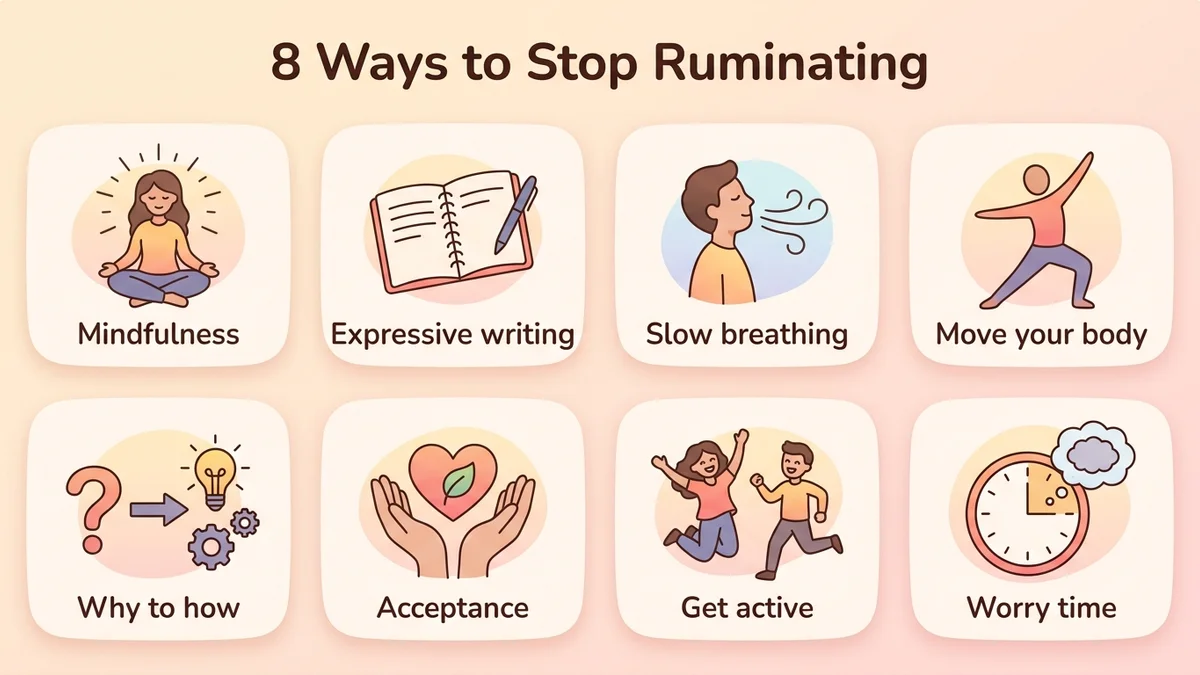
1. Mindfulness
This is the most studied and most effective technique against rumination. The principle: observe your thoughts without judging them or clinging to them. Like clouds drifting across the sky.
According to a meta-analysis of 209 studies published in Clinical Psychology Review (2024), mindfulness meditation reduces rumination by 40% after 8 weeks of regular practice.
Start with 5 minutes a day. Sit down, close your eyes, focus on your breathing. When a thought comes (and it will), note it mentally ("oh, a thought") and come back to your breath. No need to empty your mind. Just observe. Our mindfulness meditation guide walks you through it step by step.
2. Expressive writing (journaling)
Writing your thoughts down gets them out of your head. Literally. When you put your ruminations on paper, your brain considers them "processed" and can move on.
The method: take 15 minutes in the evening. Write down everything that comes to mind, with no filter and no structure. Don't reread it. The goal isn't to produce a piece of writing — it's to empty your mind.
An effective variation: the "worry time" technique. Postpone all your ruminations to a fixed 20-minute slot. The rest of the day, when a ruminative thought comes up, tell yourself, "I'll deal with this at 6 p.m." That defuses the urgency.
3. Mindful breathing
Breathing slowly activates the parasympathetic nervous system — the one that calms you down. In 3 to 5 minutes, cardiac coherence lowers cortisol by 20% and interrupts the rumination cycle.
The 3-6-5 technique: breathe in for 3 seconds, breathe out for 6 seconds, for 5 minutes. The long exhale sends a safety signal to your brain. It's physiological. Your amygdala calms down, and the looping thoughts lose their intensity.
4. Physical movement
When you move, your brain focuses on your body's sensations. It can't ruminate and coordinate physical effort at the same time. It's mechanical.
According to a University of California study (2024), 30 minutes of brisk walking reduce rumination by 25% in the following hours, and the effects are still measurable the next day.
No need to run a marathon. A 20-minute walk outdoors is enough. Ideally, in nature if you can. Contact with trees, sky and fresh air adds an extra anti-rumination effect (this is what's known as forest bathing).
5. Shift from "why" to "how"
This is Edward Watkins's technique, and it's remarkably simple. When you catch yourself thinking "why is this happening to me?", turn the question into "how can I handle this situation?"
| Ruminative thought (why) | Constructive thought (how) |
|---|---|
| Why did I blow that interview? | How can I prepare better next time? |
| Why doesn't anyone understand me? | How can I express my needs more clearly? |
| Why am I always anxious? | How can I fit a breathing routine into my day? |
This simple change in wording switches your brain from passive mode (rumination) to active mode (problem-solving).
6. Acceptance and cognitive defusion
Stop fighting your thoughts. It sounds paradoxical, but the harder you try "not to think about something," the more you think about it (that's the white bear effect, demonstrated by Daniel Wegner in 1987).
ACT (Acceptance and Commitment Therapy) offers an alternative: welcome the thought without believing it. Tell yourself "I'm having the thought that I'm worthless" instead of "I'm worthless." That distance changes everything. The thought loses its emotional power.
To go further, our guide to letting go gives you concrete exercises.
7. Behavioral activation
It's simple and powerful: do something. Anything that requires your attention. Cooking, tidying up, calling a friend, drawing, playing music. The idea is to give your brain a concrete task to replace rumination.
Dr. Christopher Martell, a pioneer of behavioral activation, showed that action comes before motivation. You don't need to feel like doing something. Do it, and the desire will follow (or not — but at least you'll have stopped ruminating).
8. The "rumination time" technique
Give yourself permission to ruminate, but within a strict frame. Pick a 20-minute slot each day (not in the evening). During that slot, ruminate as much as you want. Outside of it, postpone every ruminative thought to that slot.
The result? According to a University of Groningen study (2023), this technique reduces total rumination time by 50% in 4 weeks. By putting rumination in a box, you take back control.
What is the link between rumination and psychological disorders?
Rumination is a transdiagnostic factor, meaning it plays a role in several psychological disorders. It doesn't directly cause depression or anxiety, but it feeds and prolongs them. It's an amplifier of suffering.
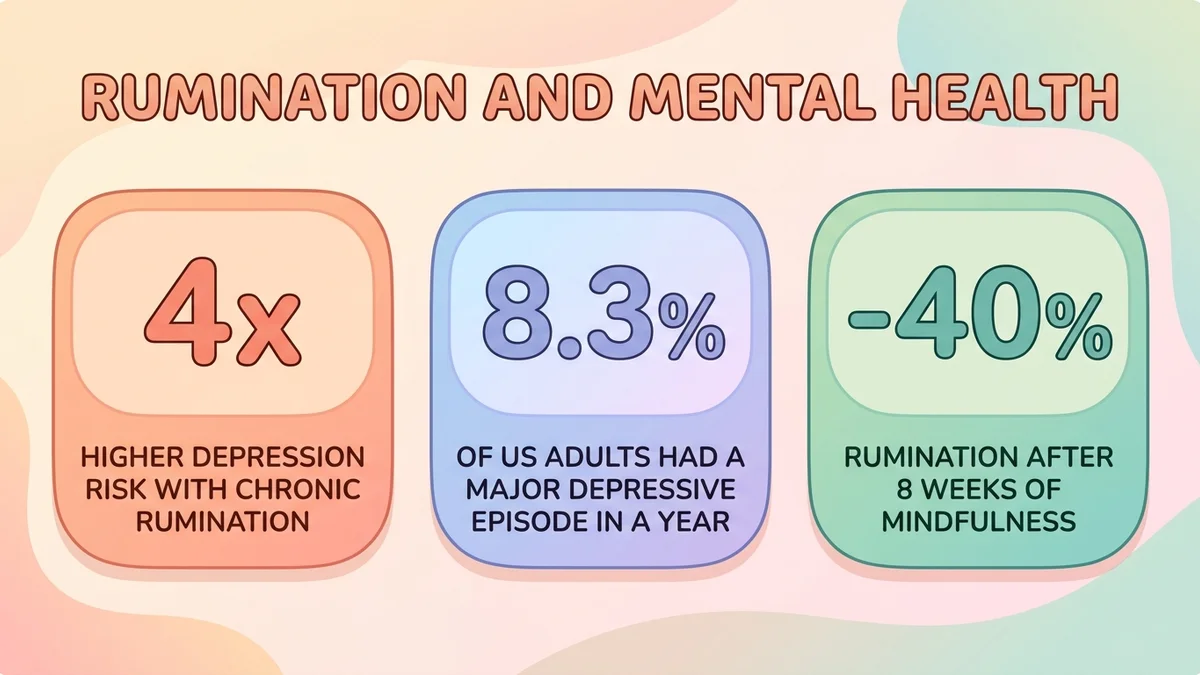
According to NIMH, 8.3% of American adults experienced a major depressive episode in a single year, with rates reaching 18.6% among young adults aged 18 to 25. Rumination is recognized as one of the main factors that keeps these episodes going.
| Disorder | Role of rumination | Key point |
|---|---|---|
| Depression | Keeps mood low, blocks recovery | 4x risk with chronic rumination (APA, 2023) |
| Generalized anxiety | Fuels worst-case scenarios | Worry is the core feature of the disorder |
| Insomnia | Prevents falling asleep | One of the most cited reasons for lying awake |
| Burnout | Prevents disconnecting from work | Evening rumination about work blocks recovery |
The loop is vicious. Rumination worsens anxiety, which worsens sleep problems, which worsen fatigue, which reduces the prefrontal cortex's ability to stop rumination. To break this spiral, you need to act on several levers at once.
In this TED talk, psychologist Guy Winch explains clearly and compassionately why rumination is so damaging and how a simple two-minute distraction can break the habit. His approach blends research and everyday practice.
Real-life scenarios
Sarah, 34, marketing manager
Sarah ruminates every evening when she gets home from work. She replays her meetings on a loop, analyzes her coworkers' reactions, convinces herself she said something wrong. The result: it takes her 2 hours to fall asleep and she wakes up tired.
What worked for her: "worry time." Sarah set aside 6:00 to 6:20 p.m. to write her ruminations in a notebook. After that slot, she does 5 minutes of cardiac coherence and starts her evening. In 3 weeks, the time it took her to fall asleep dropped from 2 hours to 30 minutes.
Mark, 28, looking for work
After 6 months without a job, Mark ruminates nonstop. "Why did I quit my old job? Why isn't anyone calling me back? What's wrong with me?" Every rejection restarts the machine. He started avoiding opening his emails.
What worked for him: the "why to how" technique. Instead of "why isn't anyone calling me back?", he asked himself "how can I improve my résumé and cover letter?" He also started a 30-minute walk every morning before checking job listings. His rumination decreased, and above all, he found the energy to apply again.
Lisa, 42, mother of two
Lisa ruminates about her mental load. "Am I doing enough for the kids? Am I a good mother?" These thoughts loop while she makes dinner, on her commute, in the shower.
What worked for her: mindfulness meditation, 10 minutes in the morning before the kids wake up. And above all, the ACT technique: "I'm having the thought that I'm not present enough" instead of "I'm not present enough." That small verbal distance cut the emotional intensity of her ruminations in half within a few weeks.
How do you build your anti-rumination routine?
The key isn't a miracle technique, but a set of daily micro-habits that gradually reduce rumination. By combining 2 to 3 techniques suited to your profile, you can see significant results within 3 to 6 weeks.
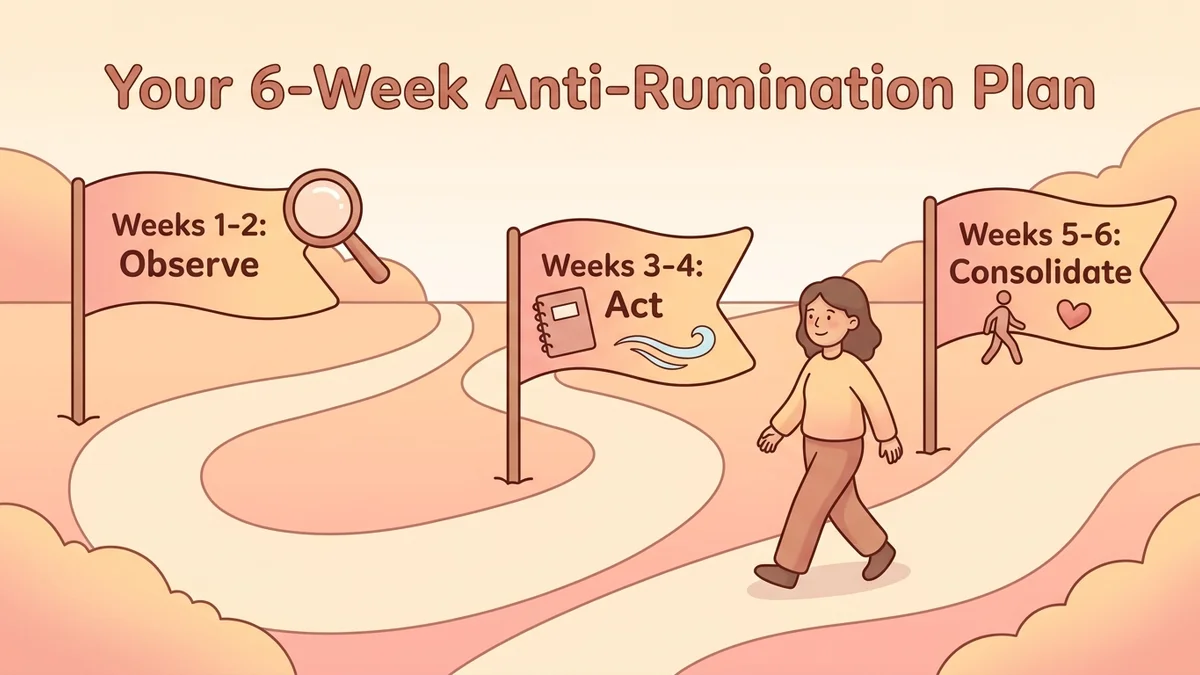
Here's a 3-phase plan:
Weeks 1-2: Observe. Note when you ruminate during the day (morning, midday, evening). Identify the triggers. Start 5 minutes of mindful breathing a day.
Weeks 3-4: Act. Set up a 20-minute "worry time." Add 10 minutes of mindfulness. Practice switching from "why" to "how" every time you ruminate.
Weeks 5-6: Consolidate. Add 20-30 minutes of daily physical movement. Keep a gratitude journal in the evening (3 positive things from your day). Our gratitude journal guide explains how to get the most out of it.
The Serena perspective
As a team of developers and people passionate about mental health, we hear from Serena users every day: "I can't stop thinking." Rumination is one of the first problems our app sets out to address.
Serena's daily mood tracking helps you detect your rumination patterns. By logging your emotional state every day, you spot the moments, situations and triggers that set the cycle in motion. That's the first step: becoming aware of the pattern.
The guided breathing exercises built into Serena are designed to interrupt rumination in real time. When you feel your thoughts starting to spin, open the app and start a 3-minute session. Your breathing slows, your amygdala calms down, and your brain steps out of the loop.
What we recommend to our users:
- Track your mood every day, even when you're "fine." It's in the trends that you'll see your rumination patterns.
- Use the breathing exercises as a "stop" button when your thoughts start racing.
- Don't judge yourself. Ruminating doesn't make you weak. Your brain is trying to protect you. It's just doing it the wrong way.
If rumination has lasted more than 4 weeks and is affecting your sleep, your work or your relationships, see a mental health professional. Serena is a support tool, not a substitute for therapy.
In summary
Rumination isn't a life sentence. It's a brain mechanism that can be reprogrammed. The default mode network runs out of control, the medial prefrontal cortex loops on your problems, and the amygdala amplifies every negative emotion. But your brain is plastic. With practice, you can build new neural pathways.
Remember these 3 points:
- Identify: spot your rumination moments and triggers (mood tracking helps).
- Interrupt: use a physical technique (breathing, movement) to break the cycle.
- Replace: shift from "why" to "how," from passive to active.
Start today. 5 minutes of mindful breathing. That's all. And if you're looking for a daily companion to track your mood and quiet your thoughts, download Serena for free. Your brain deserves some rest.