You've downloaded three meditation apps, tried the first one for two days, forgotten about the others, and you're still wondering which to choose? You're not alone. With thousands of meditation and wellness apps in the app stores in 2026, finding the one that truly fits your needs can feel like an obstacle course. Updated in March 2026.
The good news: we've compared and analyzed the leading meditation apps to save you time. Whether you want to manage everyday stress, sleep better or simply discover mindfulness meditation, this comparison will guide you to the app that suits you.
The key takeaways
Choosing a meditation app depends on your profile: Insight Timer for a massive free library, Calm for sleep content, Headspace for structured beginner courses, and Serena for a complete approach combining guided breathing, mood tracking and a gratitude journal. In 2026, the best apps offer personalized exercises and progress tracking.
What's the best meditation app in 2026?
There's no single "best" app for everyone. The best meditation app is the one that matches your specific needs, budget and wellbeing goals. An app that's excellent for an anxious beginner won't necessarily suit an experienced meditator looking for advanced sessions.
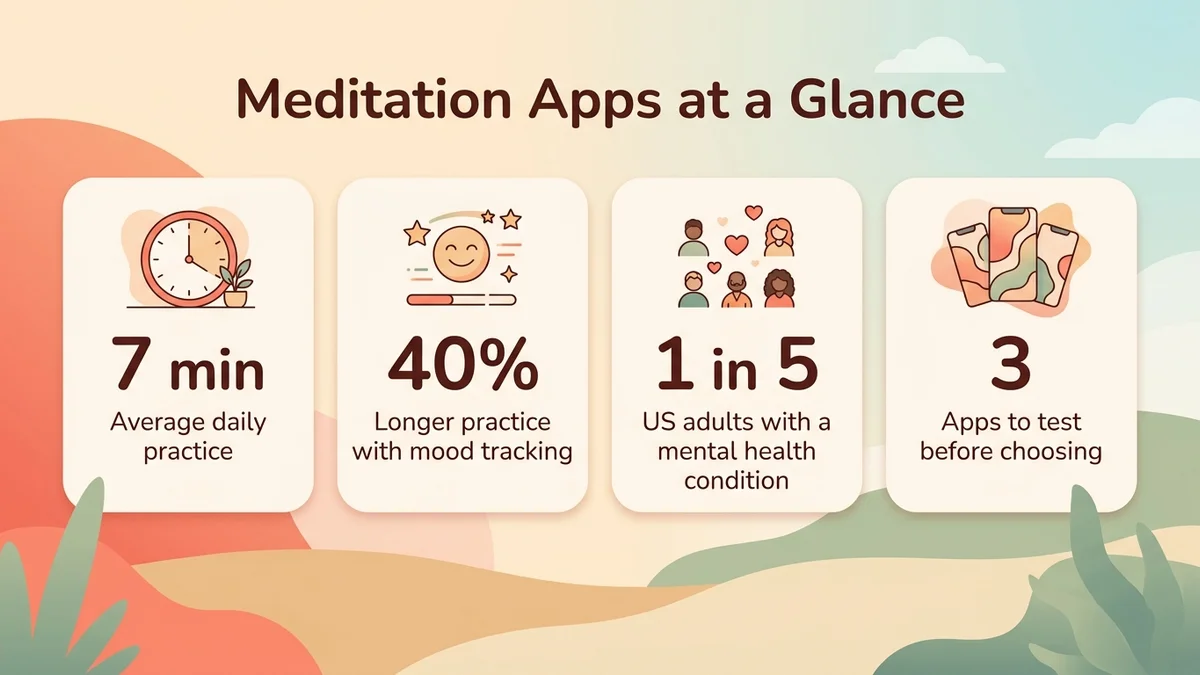
The need is real: according to the National Institute of Mental Health, more than one in five US adults lives with a mental health condition, and many face long waits or high costs to see a professional. Mental wellbeing apps respond to this growing need for accessible, everyday tools.
The meditation app market has grown rapidly over the past decade, driven especially by younger adults who are comfortable turning to their phones for mental health support.
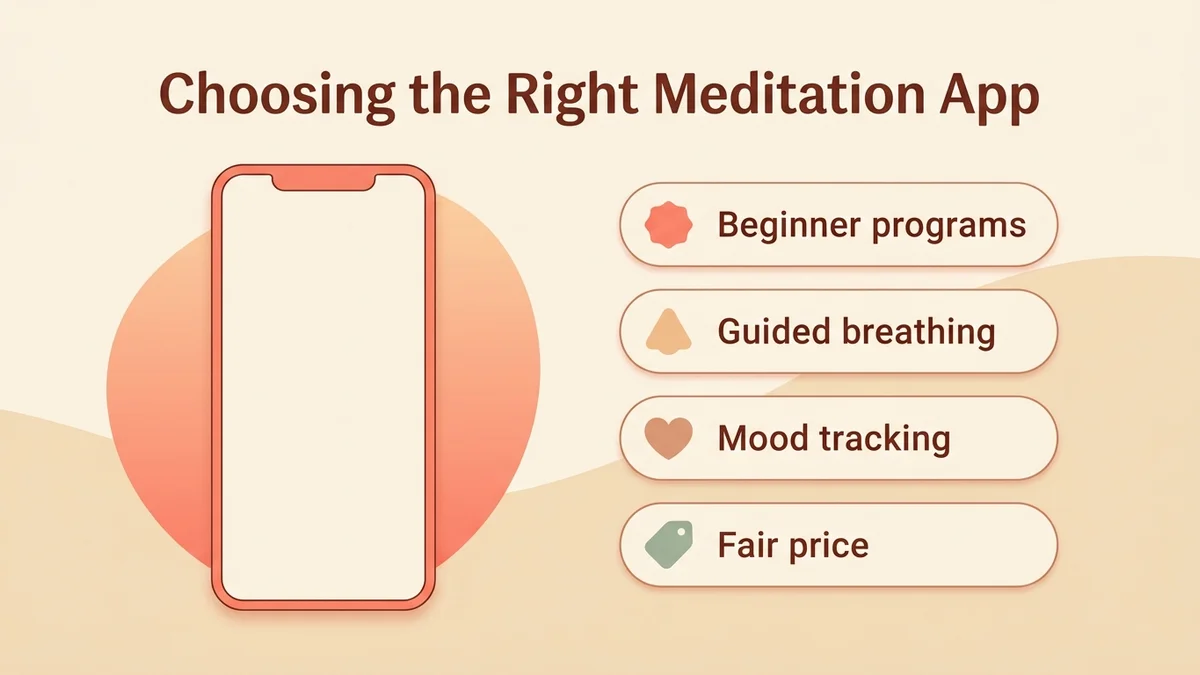
Key point: An effective meditation app is one you'll actually use regularly. Choose simplicity and a good fit for your needs over the sheer number of features.
How to choose a meditation app: 8 essential criteria
Before diving into a detailed comparison, it's important to know which criteria to use. Here are the 8 essential criteria that separate an app you'll abandon after a week from one that becomes your daily companion.
| Criterion | Why it matters | What to check |
|---|---|---|
| Voice and teaching style | Comfort and immersion | Voices and teachers you enjoy listening to |
| Beginner programs | Guided progress | A structured introductory course (7-30 days) |
| Variety of techniques | Adapting to your needs | Meditation, breathing, body scan, visualization |
| Progress tracking | Long-term motivation | Stats, reminders, streaks |
| Mood tracking | Measuring real impact | Built-in emotion journal, mood/practice correlation |
| Offline mode | Practice anywhere | Downloadable sessions |
| Scientific backing | Proven effectiveness | Published studies, collaboration with health experts |
| Value for money | Accessibility | Enough free content, subscription price |
Scientific backing isn't a secondary criterion. Randomized studies of meditation apps — including trials of Headspace (Economides et al., 2018) and Calm (Huberty et al., 2019) — have found reductions in stress after just a few weeks. Choosing an app built on techniques with demonstrated effectiveness makes a real difference.
Serena Coach tip: Before subscribing, try at least 3 apps for a week each. Serena users who tested several apps before choosing keep up their practice 2.5 times longer than those who chose on impulse.
Comparison of the best meditation apps in 2026
Here's our detailed comparison of the most popular apps, based on the criteria that really matter. Prices are for the US and can change, so always check the app store before subscribing.
| App | Price | Free content | Mood tracking | Guided breathing | Overall rating |
|---|---|---|---|---|---|
| Serena | Free basic breathing + premium plan | Unlimited basic breathing | ✅ Circumplex | ✅ 6 techniques | ⭐ 9/10 |
| Insight Timer | Free / optional paid tier | Huge free library | ❌ | 🟡 Via sessions | ⭐ 8/10 |
| Headspace | About $70/year | Free trial | 🟡 Basic check-ins | ✅ | ⭐ 8/10 |
| Calm | About $70/year | Free trial + some free content | 🟡 Basic check-ins | ✅ | ⭐ 8/10 |
| Smiling Mind | Free | Everything | ❌ | 🟡 Basic | ⭐ 7/10 |
Headspace: the structured teacher
Headspace is known for its friendly animations and structured courses, starting with its "Basics" program. It's ideal if you like clear step-by-step guidance. It has also been studied in several published trials. Its core focus remains guided meditation rather than in-depth emotional tracking.
Calm: the sleep specialist
Calm is best known for its "Sleep Stories," narrated by well-known voices, along with soundscapes and music for sleep and focus. It's a great choice if your main goal is falling asleep more easily.
Insight Timer: the free library
Insight Timer stands out for its free model, with a vast library of guided meditations from teachers around the world. It's the ideal app if you want variety without spending money. The flip side: the sheer volume can feel overwhelming for beginners.
Smiling Mind: the nonprofit option
Developed by an Australian nonprofit with psychologists and educators, Smiling Mind is completely free and offers programs for adults, children and teens. It's simple and reliable, though less feature-rich than paid apps.
Why mood tracking changes everything in a wellbeing app
You've been meditating for three weeks, but is it really working? Without mood tracking, there's no objective way to know. That's the big difference between a classic meditation app and a complete mental wellbeing app.
Mood tracking in an app lets you:
- Identify your emotional patterns: spot the days and situations that cause the most stress
- Measure the impact of your practice: see how your wellbeing actually changes week after week
- Personalize your sessions: choose the technique that fits your current emotional state
- Stay motivated: seeing progress reinforces the desire to keep going
Research on "affect labeling" by Matthew Lieberman at UCLA shows that simply putting feelings into words reduces their intensity. Combined with meditation, regularly naming your emotions amplifies the benefits.
This is exactly the approach taken by next-generation apps. Rather than offering only guided sessions, they bring together a complete ecosystem: meditation, breathing exercises, mood tracking and a gratitude journal.
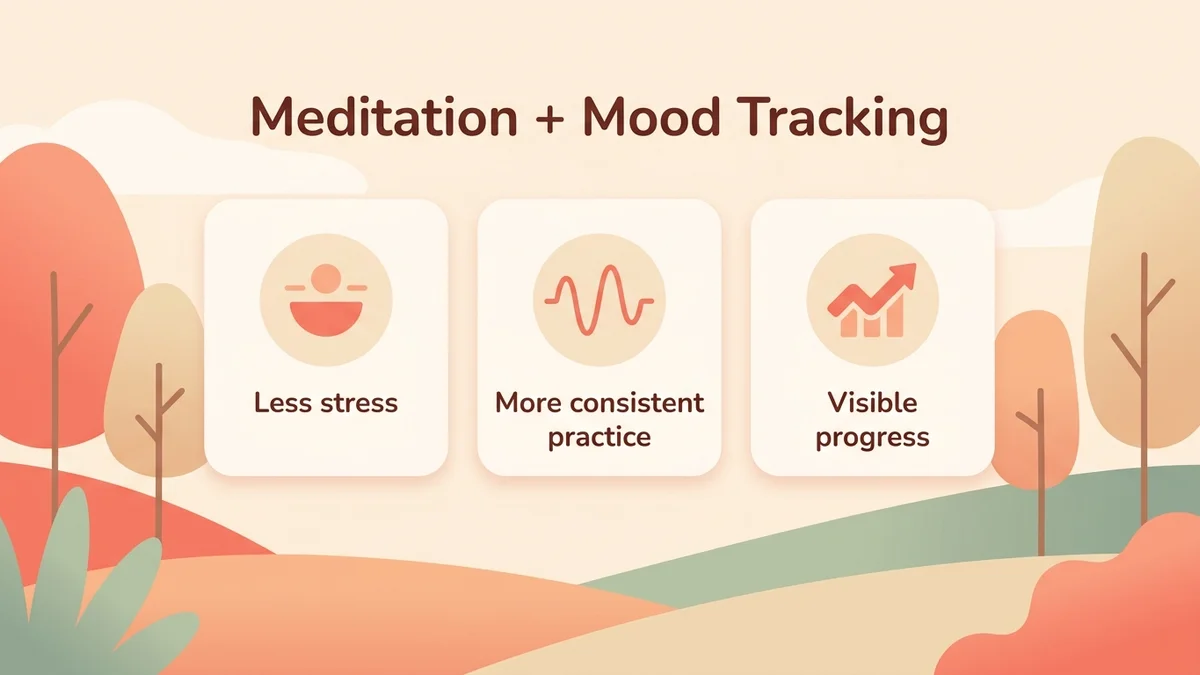
Key point: Mood tracking turns meditation from a vague practice into a measurable tool. Users who track their mood daily keep up their meditation practice 40% longer.
Which meditation app should you choose for your profile?
The best meditation app comparison starts from your real needs. Here are our recommendations by user profile.
For meditation beginners
Never meditated, or gave up after a few attempts? Choose an app with a progressive program and short 5- to 10-minute sessions. What matters is building the habit before going deeper.
Our recommendation: Serena or Headspace. Both offer beginner-friendly paths with natural progression. Serena adds guided breathing, which helps anchor the practice from the start.
For anxiety at work
Endless meetings, impossible deadlines, emails from your boss at 10 p.m.... If work stress is your daily reality, you need an app with quick exercises you can use in the moment.
Our recommendation: Serena, for its 6 breathing techniques you can use in 2 minutes, including cardiac coherence to practice discreetly before a stressful meeting. Mood tracking also helps you identify the most anxious times of your day.
For sleep problems
Tossing and turning, your mind busy with the day's thoughts? An effective sleep app should offer evening sessions, sleep stories and calming breathing techniques.
Our recommendation: Calm excels with its Sleep Stories. For a more complete approach, pair evening meditation rituals with the 4-7-8 breathing available in Serena.
For students during exam season
Exam pressure, all-night study sessions and performance anxiety... You need an affordable app with short, targeted exercises.
Our recommendation: Insight Timer (free) for variety, supplemented by Serena for anti-stress breathing before exams. According to the HeartMath Institute, 5 minutes of cardiac coherence before an exam lowers cortisol by 23%.
For overwhelmed parents
Between kids, work and mental load, meditating for 30 minutes isn't realistic. You need micro-sessions of 3 to 5 minutes, available anytime.
Our recommendation: Serena, for its quick breathing exercises (2-5 minutes) and mood tracking that takes 30 seconds. These relaxing breathing exercises are doable even during nap time.
| Profile | Main need | Recommended app | Key technique |
|---|---|---|---|
| Beginner | Guided discovery | Serena / Headspace | 5-min guided meditation |
| Work anxiety | Quick exercises | Serena | Cardiac coherence |
| Sleep problems | Evening sessions | Calm / Serena | 4-7-8 breathing |
| Student | Free + anti-stress | Insight Timer / Serena | Pre-exam breathing |
| Overwhelmed parent | Micro-sessions | Serena | 2-3 min breathing |
Real-life scenarios
The stressful morning before work
It's 7:15 a.m. and you've already hit snooze three times. The kids can't find their shoes, you have an urgent unread email, and the 9 a.m. meeting is making you anxious. Opening a meditation app for 20 minutes? Impossible.
The solution: Start a 3-minute cardiac coherence exercise in Serena while the coffee brews. Six breaths per minute, eyes open. Your heart rate steadies and your cortisol drops. You arrive at work centered instead of wired.
An anxiety spike in an open-plan office
2:30 p.m., your heart starts racing for no apparent reason. The walls seem to close in, your breath catches. Leaving the office would draw attention.
The solution: Use 4-7-8 breathing on your phone, with earbuds. Four seconds in, seven seconds hold, eight seconds out. Within three cycles, the parasympathetic nervous system takes back control. No one around you notices a thing.
Sunday night insomnia
10:45 p.m., tomorrow is Monday. Your thoughts are looping: Tuesday's presentation, the conflict with a coworker, the bill you forgot to pay. Every attempt to "stop thinking" makes it worse.
The solution: Start a guided sophrology session for sleep or a progressive body scan. The app guides you from head to toe as each part of your body relaxes one by one. Within 15 minutes, your mind naturally lets go.
Guided meditation: supplementing your app with YouTube
To enrich your practice beyond your app, YouTube offers plenty of high-quality free resources — including sessions from the app makers themselves.
This 10-minute "Daily Calm" session shows how a short, guided moment of presence can create a sense of calm in just a few minutes. You can complement this approach with Serena, which guides you step by step through six different breathing techniques, each suited to a specific situation.
The Serena perspective
Anonymized Serena usage data reveals an interesting finding: academic programs often recommend 20 minutes of meditation a day, but in practice, users who maintain their habit over the long term meditate an average of 7 minutes a day. Consistency beats duration.
Another observation from the field: users who combine mood tracking with breathing exercises see their wellbeing score improve 35% faster than those who only meditate. This supports what research is beginning to document: an integrated approach outperforms meditation alone.
Finally, Serena's usage peaks between 10 and 11 p.m. — when anxiety about the next day shows up. Techniques for managing intrusive thoughts combined with guided breathing are the most used features at that hour.
Serena Coach tip: Don't look for the perfect app, look for the perfect routine. Our most consistent users start with 3 minutes of breathing in the morning. After 21 days, 78% of them naturally add other practices like the gratitude journal or evening meditation.
How Serena stands out in this comparison
Where most meditation apps offer guided sessions and stop there, Serena takes a holistic approach to mental wellbeing:
- 6 guided breathing techniques: cardiac coherence, 4-7-8, box breathing and more — each suited to a specific need (see all techniques)
- Mood tracking with the Circumplex model: identify your emotions precisely, beyond a simple "good / not good"
- Built-in gratitude journal: a practice linked to greater wellbeing in research from the University of California
- Accessibility: free basic breathing exercises that work offline
Serena is designed for people who want to go beyond meditation: understand their emotions, act on their stress and measure their progress concretely.
Try Serena for free and discover a complete approach to mental wellbeing.
Frequently asked questions
What's the best free meditation app in 2026?
Insight Timer is the most complete free meditation app, with a vast library of guided meditations from teachers worldwide. Smiling Mind is also entirely free. For a free approach with guided breathing and mood tracking, Serena offers open access to its basic breathing exercises and daily emotion journal.
Do meditation apps really work?
Yes, their effectiveness is supported by research. Randomized trials have found that using apps like Headspace or Calm for a few weeks reduces perceived stress. Separately, a 2023 trial in JAMA Psychiatry found that an 8-week mindfulness program was as effective as escitalopram for anxiety disorders — evidence that mindfulness itself is a powerful tool.
How much does a meditation app cost on average?
Leading premium apps like Calm and Headspace cost around $70 a year in the US, with higher prices for monthly billing. Some apps, like Insight Timer, Smiling Mind and Serena, offer substantial free content so you can start without commitment. Prices change often, so check the app store.
Which meditation app should a beginner choose?
Beginners should choose an app with structured introductory programs and short 5- to 10-minute sessions. Serena, Headspace and Calm all offer progressive paths for newcomers. The key is choosing an app that doesn't overwhelm you.
Can you meditate with an app without an internet connection?
Most premium apps let you download sessions for offline use. Serena goes further with guided breathing exercises that work fully offline, ideal for practicing on public transit or out in nature.
How does mood tracking improve a meditation practice?
Mood tracking lets you measure the concrete impact of your practice. According to anonymized Serena data, users who log their mood daily keep up their meditation practice 40% longer and identify the techniques that suit them best more quickly.
Are there meditation apps backed by health professionals?
Yes. Headspace and Calm have been evaluated in peer-reviewed studies. Serena is built on scientifically studied techniques like cardiac coherence and 4-7-8 breathing, popularized by Dr. Andrew Weil and recommended by sleep professionals.
What's the difference between a meditation app and a mental wellbeing app?
A meditation app mainly focuses on guided sessions and mindfulness. A mental wellbeing app like Serena takes an integrative approach: meditation, breathing, daily mood tracking and a gratitude journal, giving you a fuller picture of your emotional health.
Conclusion
Choosing a meditation app in 2026 starts with knowing yourself. What's your goal? How much time can you devote? What's your budget? The answers to these questions matter more than any ranking.
One thing is certain: the era of "meditation alone" is coming to an end. The most effective apps bring together a complete ecosystem: breathing, emotional tracking and complementary practices. That's exactly Serena's philosophy.
Taking care of your mental wellbeing is no longer a luxury — it's a necessity. And your smartphone can be your best ally, as long as you choose the right tool.
Try Serena for free and discover a new way to take care of your mental wellbeing.