You sleep 8 hours and wake up exhausted. You read the same paragraph three times without taking it in. Making even the smallest decision feels impossible. This isn't laziness. It's mental exhaustion — and you're far from alone: according to the American Psychological Association's 2023 Work in America survey, 77% of US workers reported work-related stress in the past month, and 31% reported emotional exhaustion. Updated in April 2026.
The good news: mental exhaustion isn't a life sentence. It's an alarm signal from your brain telling you "stop, I'm maxed out." In this guide, you'll understand what's really happening in your head, identify your warning signs and discover concrete solutions to get your mental clarity back.
The key takeaways
Mental exhaustion is cognitive depletion caused by prolonged overload of the prefrontal cortex. It shows up as trouble concentrating, unusual irritability and persistent brain fog. Unlike physical fatigue, rest alone isn't enough. Daily breathing micro-routines, tracking your emotional state and lightening your cognitive load help you regain your mental energy within 3 to 6 weeks.
What exactly is mental exhaustion?
Mental exhaustion is a state of cognitive and emotional depletion that happens when your brain runs beyond its capacity for too long. It affects your concentration, your working memory and your ability to make decisions. It's neither a whim nor a lack of willpower.
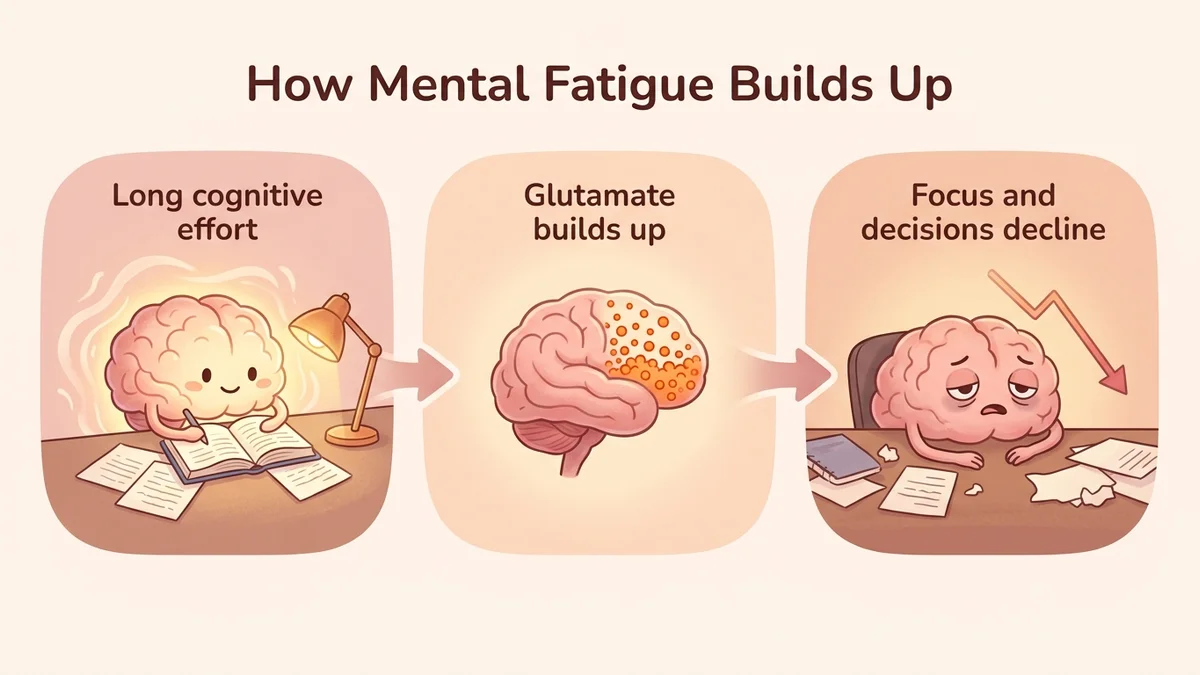
In 2022, Professor Mathias Pessiglione's team at the Paris Brain Institute made a major discovery. Their study, published in Current Biology, shows that prolonged cognitive effort causes glutamate to build up in the prefrontal cortex. Glutamate is an excitatory neurotransmitter. In excess, it becomes toxic to neurons and reduces your ability to focus and make choices.
In practical terms, your brain works like a muscle. After a day of intense work, it needs to recover. But unlike a muscle, a single night's sleep isn't always enough to clear that excess glutamate — especially if you string together days of cognitive overload.
Key point: Mental exhaustion is a measurable neurobiological phenomenon. It's not "all in your head" in the figurative sense. It's literally in your brain, in the prefrontal cortex.
What are the 9 signs of mental exhaustion?
Mental exhaustion shows up through a set of cognitive, emotional and behavioral signs. If you check 4 or more of these signs and they've lasted more than two weeks, your brain is sending you a clear message: it's time to slow down.
Cognitive signs
- Constant brain fog: you search for words, forget why you walked into a room, reread without understanding.
- Trouble concentrating: you can't stay focused for more than 10 minutes. Your mind jumps all over the place.
- Decision paralysis: choosing what to order at a restaurant becomes an ordeal. Simple decisions wear you out.
Emotional signs
- Disproportionate irritability: a harmless comment makes you snap. Your tolerance is at rock bottom.
- Apathy and disengagement: what used to excite you leaves you indifferent. You go through the motions on autopilot.
- Diffuse anxiety: a constant sense of unease with no identifiable reason. Stress becomes chronic with no specific trigger.
Behavioral signs
- Unusual procrastination: you put off tasks you used to handle easily.
- Social withdrawal: seeing friends takes superhuman effort. You cancel plans regularly.
- Physical fatigue without effort: your body feels heavy even though you haven't moved all day. That's your mental exhaustion showing up as physical symptoms.
| Type of fatigue | Main cause | Typical duration | Main solution |
|---|---|---|---|
| Physical fatigue | Muscle effort | 1-2 days of rest | Sleep and recovery |
| Mental fatigue | Cognitive overload | 3-6 weeks | Micro-routines + cognitive rest |
| Emotional fatigue | Relational overload | 2-4 weeks | Boundaries + social support |
| Burnout | Chronic mental + emotional fatigue | 3-12 months | Professional support |
77% of US workers report work-related stress, and 57% report negative impacts such as emotional exhaustion, lack of motivation or fatigue. (American Psychological Association, Work in America Survey, 2023)
Mental fatigue, emotional exhaustion or mental load: what's the difference?
These three terms often get mixed up. Yet telling them apart helps you target the right solution. Here's what concretely separates them.
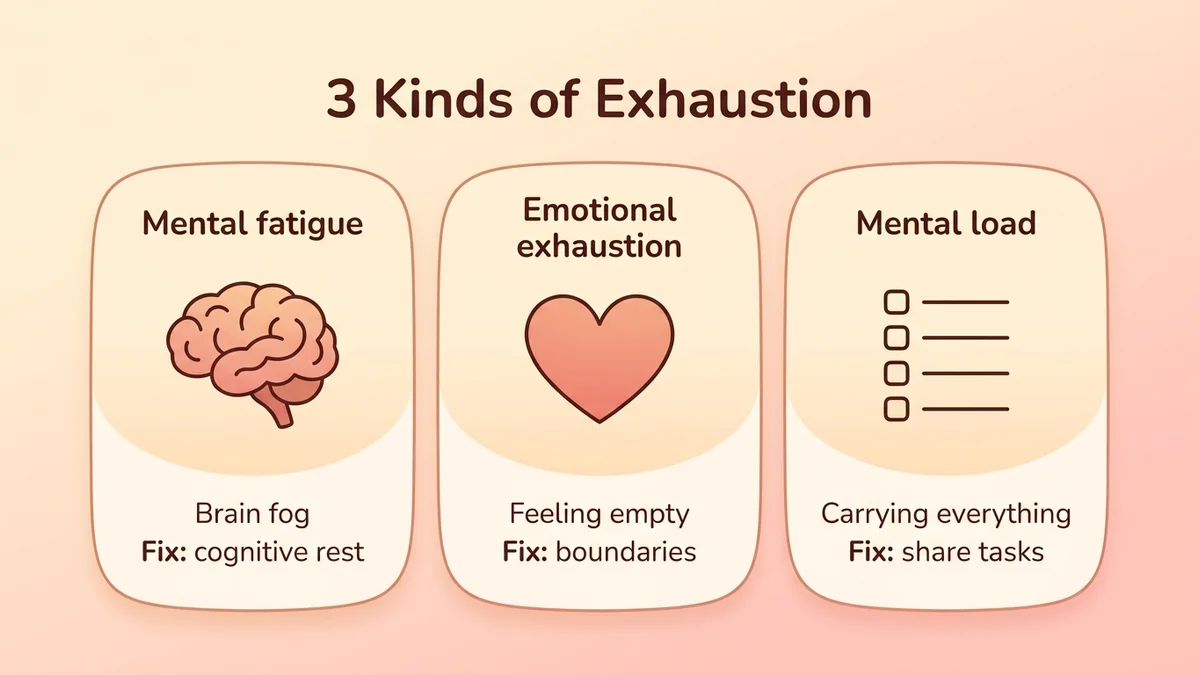
Mental fatigue is cognitive depletion. Your brain can no longer process information. It's like an overheating processor.
Emotional exhaustion comes from relational and emotional overload. Caregivers, parents and healthcare workers are particularly exposed. You give too much without getting enough back. Your emotional intelligence is stretched beyond its limits.
Mental load refers to that invisible list of things to think about, organize and anticipate all the time. Groceries, the kids' doctor appointments, birthdays, day-to-day logistics. Research consistently shows that women still carry the bulk of this invisible household work. Our guide on how to reduce your mental load goes into detail.
Let's be honest: in real life, these three forms often pile up. You're managing a complex project at work (mental fatigue), supporting a loved one through a hard time (emotional exhaustion) and handling all the family logistics (mental load). The result? Overall exhaustion that a weekend can't erase.
| Criterion | Mental fatigue | Emotional exhaustion | Mental load |
|---|---|---|---|
| Origin | Cognitive overload | Emotional overload | Organizational overload |
| Who's affected | Knowledge workers, students | Caregivers, healthcare workers, parents | Mostly women |
| Main sign | Brain fog | Emotional emptiness | Feeling like you "carry everything" |
| Key solution | Cognitive rest, breathing | Boundaries, support | Delegating, sharing tasks |
Key point: Identifying your dominant type of exhaustion is the first step to acting effectively. Tracking your mood every day helps you spot patterns.
Why your brain "crashes": the science of glutamate
Wondering why you can't think straight by the end of the day? The answer lies in your brain's biochemistry.
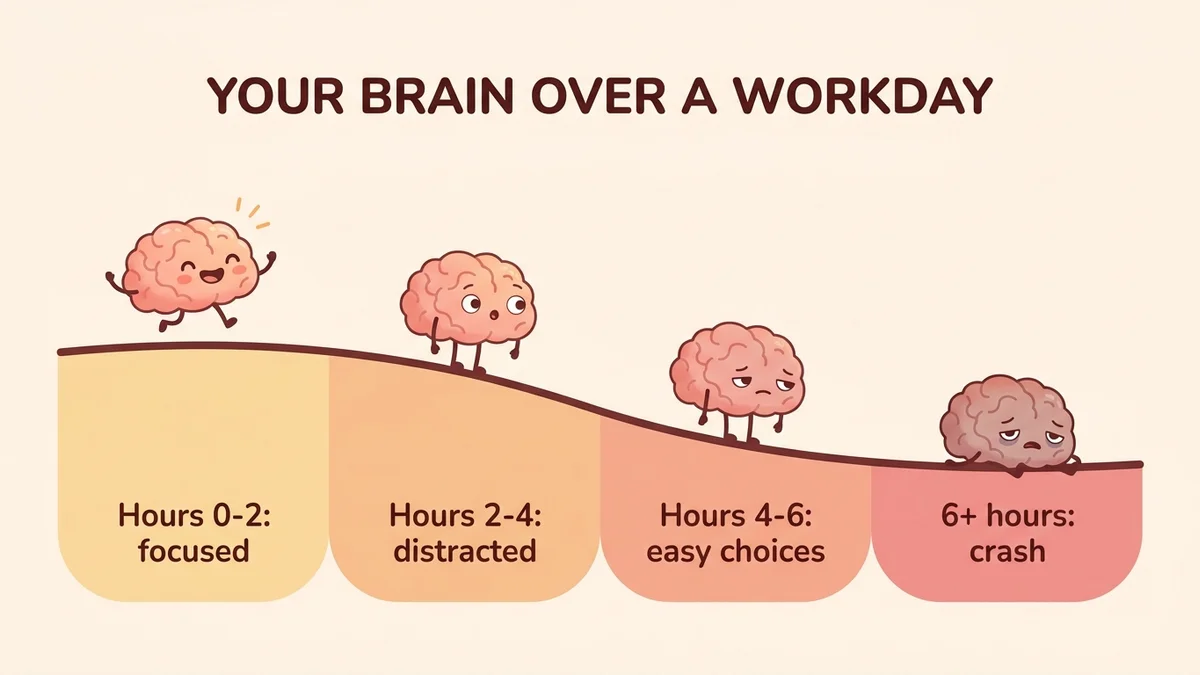
According to the study by Wiehler, Pessiglione and Mochel published in Current Biology (2022), here's what happens when you push your brain too long:
- Hours 0-2: your prefrontal cortex works normally. You're focused and productive.
- Hours 2-4: glutamate starts building up. You feel the first signs of distraction.
- Hours 4-6: the excess glutamate becomes toxic. Your brain triggers a protective mechanism: it pushes you toward easy options and immediate rewards.
- Beyond 6 hours: your decisions become impulsive. Your working memory gives out. That's the "cognitive crash."
Neurologist Fanny Mochel explains that this mechanism is a safety system. Your brain forces you to disengage in order to protect itself. Ignoring these signals is like driving on an empty tank.
And what if you string together 8-10 hour days of intense cognitive work without real recovery? The glutamate doesn't clear fast enough. The fatigue accumulates. You enter a vicious circle where every day starts with a deficit. It's exactly like sleep debt, except it's cognitive debt.
Mental fatigue isn't a lack of motivation. It's a measurable buildup of glutamate in the prefrontal cortex that reduces your capacity for decision-making and concentration. (Wiehler et al., Current Biology, 2022)
How do I know if I'm mentally exhausted? The 2-minute test
Answer these 10 questions honestly. Count your "yes" answers.
| # | Question | Yes / No |
|---|---|---|
| 1 | I wake up tired despite a full night's sleep | |
| 2 | I reread a text several times without understanding it | |
| 3 | I've been snapping over little things for 2+ weeks | |
| 4 | Choosing what to eat takes effort | |
| 5 | I cancel plans because "I don't have the energy" | |
| 6 | I procrastinate on tasks I used to handle easily | |
| 7 | I have near-constant brain fog | |
| 8 | I feel emotionally drained by the end of the day | |
| 9 | I drift from one screen to another for hours with no purpose | |
| 10 | I struggle to picture the future or plan anything |
Results:
- 0-3 yes: normal fatigue. A few adjustments will do.
- 4-6 yes: established mental exhaustion. Act now with the solutions below.
- 7-10 yes: severe exhaustion. See a professional and put a recovery plan in place.
This test isn't a medical diagnostic tool. If your symptoms persist, see your primary care doctor.
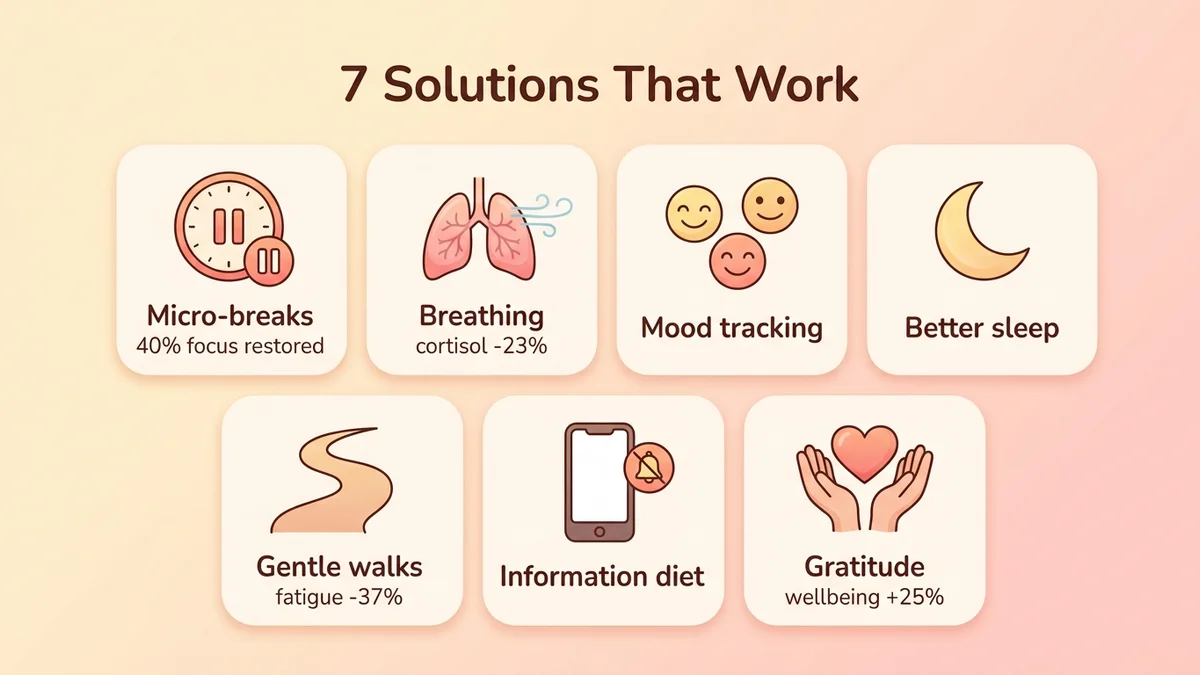
7 proven solutions to fight mental exhaustion
No vague advice here. Each solution is backed by research and something you can apply today.
1. The cognitive micro-break (an upgraded Pomodoro technique)
Work for 25 minutes, then take a 5-minute screen-free break. No phone. Look out the window, walk, breathe. Every 2 hours, take a real 15-20 minute break.
According to a University of Illinois study (2024), these micro-breaks restore 40% of your ability to concentrate. The secret: the break has to be a real cognitive "unplug," not an Instagram scroll.
2. Anti-fatigue breathing (5 minutes, 3 times a day)
Breathing is the fastest tool for reducing prefrontal overload. Cardiac coherence at 6 breaths per minute activates your parasympathetic nervous system and lowers cortisol by 23% according to the HeartMath Institute.
The anti-mental-fatigue protocol:
- Morning (7 a.m.): 5 minutes of cardiac coherence to start the day right
- Midday (1 p.m.): 5 minutes of 4-7-8 breathing to recharge
- Evening (7 p.m.): 5 minutes of belly breathing to unwind
Apps like Serena guide you step by step with real-time visual feedback. No need to count: just follow the breathing guide.
3. Daily mood tracking (2 minutes a day)
You can't improve what you don't measure. Logging your emotional state every day, even in a single word, lets you spot patterns before they become a problem.
On Monday you write "foggy." Tuesday, "irritable." Wednesday, "empty." Thursday, "better." In one week, you see that your Mondays and Tuesdays are consistently hard. Then you can act: lighten your Monday schedule, or fit a breathing session in before the day starts.
4. Strategic sleep (not just "sleeping more")
Sleeping more isn't enough if the quality is poor. What matters for cognitive recovery:
- Regular hours: go to bed and get up at the same time, weekends included (give or take 30 minutes)
- No screens 1 hour before bed: blue light suppresses melatonin by 55% according to a Harvard study (2024)
- Strategic nap: 20 minutes between 1 and 3 p.m. No longer, or you'll slip into deep sleep and wake up groggy.
- Bedroom temperature: 64-66°F (18-19°C), ideal for brain recovery
5. Gentle movement (not HIIT)
Forget grueling workouts when you're mentally exhausted. Your body needs gentle movement, not extra stress.
According to the British Journal of Sports Medicine (2024), 30 minutes of walking outdoors reduces cognitive fatigue by 37%. Yoga and tai chi are especially effective because they combine movement with conscious breathing.
6. An information diet
Your brain processes around 6,000 thoughts a day according to Queen's University (2020). Every notification, every scroll, every news story eats up cognitive bandwidth.
Concrete actions:
- Turn off non-essential notifications
- Limit social media to 30 minutes a day
- Set screen-free windows: meals, the first hour of the morning, the last hour of the evening
- Practice single-tasking: one task at a time, no multitasking
7. Gratitude as a mental recharger
It may sound simplistic. Yet according to a University of California study (2024), writing down 3 positive things every evening for 3 weeks increases subjective wellbeing by 25% and reduces emotional fatigue by 19%.
Why does it work? Gratitude activates the medial prefrontal cortex, the brain area linked to emotional regulation. It's like stretching a tight muscle. To learn more, read our complete guide to the gratitude journal.
Real-life scenarios
A single parent's Monday morning
It's 7:15 a.m. Your alarm has gone off three times. Your kid can't find their math notebook, the cat knocked over its bowl, and you have an important meeting at 9. Before your workday has even started, your prefrontal cortex has already made 50 micro-decisions.
The 3-minute solution: before you leave the house, close your eyes and take 6 slow breaths (5 seconds in, 5 seconds out). Just one minute. Your heart rate slows, your brain settles, and you arrive at work with a mind that functions.
A caregiver's Wednesday evening
You get home from work. Your mother calls for the third time today. Your partner asks what's for dinner. Your son needs help with homework. You feel tears welling up for no reason. That's emotional exhaustion.
The solution: give yourself permission to say, "I need 15 minutes for myself." Go to a quiet room. Open your mood tracker and simply write down what you're feeling. This simple act of naming your emotion reduces the intensity of the feeling by 43% according to a UCLA study (2024).
Friday afternoon in an open-plan office
4:30 p.m. You've been staring at your screen for 20 minutes without producing anything. Coworkers are chatting, emails keep coming, the fluorescent lights feel harsh. Your brain has "crashed." That's the glutamate cognitive crash.
The solution: don't fight it. Step outside for 10 minutes. Walk with no destination. Let your mind wander. This "default mode" is exactly what your prefrontal cortex needs to clear out the excess glutamate.
The Serena perspective
At Serena, we see that users who combine guided breathing with daily mood tracking report improved mental clarity by their second week. What's interesting is the gap between theory and practice.
Theory says: "meditate for 20 minutes a day." In reality, our anonymized data shows that 5 minutes of guided breathing 3 times a day works better than a single long session. Why? Because the micro-sessions happen at the moments of overload, not after the damage is done.
We also see that users who log their mood daily identify their fatigue triggers 3 weeks earlier than those who don't. Mood tracking isn't a gimmick. It's a prevention tool.
Serena Coach tip: If you only remember one thing from this article, make it this: mental exhaustion is easier to prevent than to cure. 5 minutes of breathing in the morning and 2 minutes of mood tracking in the evening. 7 minutes a day to protect your brain. A tiny investment for a considerable return.
On video: why you feel mentally fatigued
In this video, psychologist Dr. Thomas Smithyman explains why mental fatigue happens and what actually helps you recover. Practical, accessible advice grounded in psychology.
As the video explains, mental fatigue isn't a question of willpower but of managing your cognitive energy. You can put this advice into practice every day with Serena, which guides you step by step through breathing exercises and tracking your wellbeing.
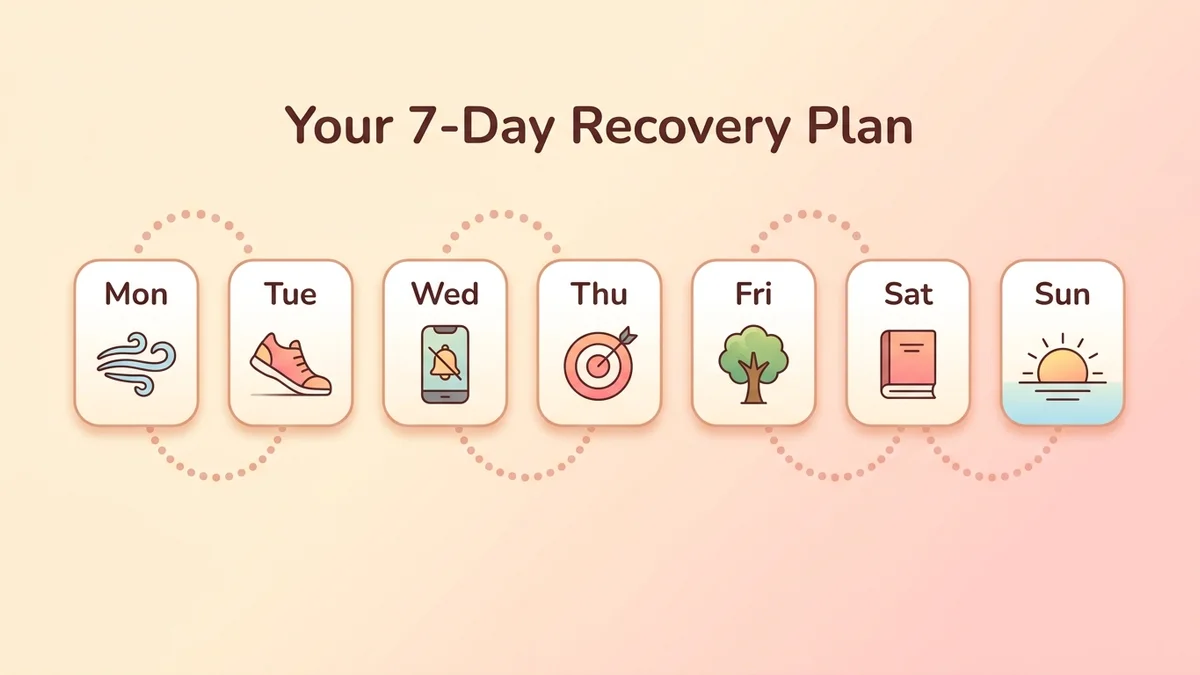
A 7-day anti-exhaustion plan with Serena
No need to change everything at once. Here's a gradual plan to get your mental energy back.
| Day | Morning (5 min) | During the day | Evening (5 min) |
|---|---|---|---|
| Monday | Cardiac coherence | 2 screen-free micro-breaks | Write 3 gratitudes |
| Tuesday | 4-7-8 breathing | 15-min walk at lunch | Mood tracking |
| Wednesday | Cardiac coherence | Notifications off for 2 hours | 3 gratitudes + mood |
| Thursday | Belly breathing | Single-tasking on your main project | Evening breathing |
| Friday | Cardiac coherence | 20-min nature break | Weekly review |
| Saturday | Sleep in (max +1 hour) | Screen-free fun activity | 20 min of reading |
| Sunday | Breathing on waking | 30 min of gentle movement | Calmly plan the week |
Serena brings all these tools together in one app: guided breathing with 6 different techniques, mood tracking with the Circumplex model and a gratitude journal. Download it for free and start your plan today.
Mental exhaustion at work: when the environment is the problem
What if the problem isn't you? In many cases, mental exhaustion is an organizational symptom, not an individual one.
According to the APA's 2023 Work in America survey, workers in psychologically unsafe workplaces are far more likely to report stress and burnout — a sign that the environment matters as much as personal coping skills.
Risk factors at work:
- Noisy open-plan offices: background noise reduces concentration by 66% (Cornell University, 2023)
- Back-to-back meetings: every meeting costs about 25 minutes of refocusing (Microsoft study, 2024)
- Forced multitasking: the brain doesn't multitask, it rapidly switches between tasks, which drains your cognitive resources
- An "always available" culture: emails after 8 p.m. increase the risk of burnout by 44%
Serena Coach tip: You can't always change your work environment. But you can create micro-bubbles of recovery. 3 deep breaths before every meeting. A midday mood check-in to take your temperature. These small rituals make a real difference.
When should you see a professional?
Mental exhaustion isn't always something you can manage alone. See a professional if:
- Your symptoms last more than 4 weeks despite changes
- You can no longer function day to day (work, hygiene, relationships)
- You have recurring intrusive thoughts
- You feel persistently down
- Sleep no longer rests you at all
Resources in the United States (2026):
- 988 Suicide & Crisis Lifeline: call or text 988 (free, 24/7)
- Crisis Text Line: text HOME to 741741 (free, 24/7)
- NAMI HelpLine: 1-800-950-6264 (information and referrals)
- Your primary care doctor is your first point of contact
Frequently asked questions
What is the difference between mental fatigue and physical fatigue?
Physical fatigue goes away with rest. Mental fatigue persists even after a full night's sleep. It affects your cognitive functions: concentration, memory, decision-making. According to the Paris Brain Institute (2022), it's linked to a buildup of glutamate in the prefrontal cortex, not to a lack of muscular energy.
Can mental exhaustion turn into burnout?
Yes. Burnout is the advanced stage of untreated mental exhaustion. The World Health Organization describes it as energy depletion, cynicism toward work and reduced professional efficacy. If your mental fatigue lasts more than 4 weeks and rest no longer helps, see a professional. Learn more in our guide to burnout symptoms.
How long does mental exhaustion last?
Mild mental fatigue clears up after a few days of cognitive rest. Fatigue that has built up over weeks requires 3 to 6 weeks of active changes: breathing micro-routines, regular sleep and a lighter cognitive load. The key is to act early.
Do screens make mental fatigue worse?
Yes. Being constantly connected keeps the prefrontal cortex in overdrive. According to a University of Gothenburg study (2025), more than 4 hours of non-work screen time a day raises the risk of cognitive fatigue by 53%. Set screen-free windows, especially in the morning and evening.
Does meditation help with mental fatigue?
Yes. According to a meta-analysis published in Psychological Bulletin (2024), mindfulness meditation reduces mental fatigue by 31% in 8 weeks. It lowers resting activity in the prefrontal cortex, allowing the brain to recover. 10 minutes a day is enough. To get started, read our mindfulness meditation guide.
How do you explain mental exhaustion to the people around you?
Use concrete comparisons: "My brain is like a computer with 50 tabs open — it's lagging and overheating." Explain that it's not laziness but real neurological exhaustion. Share the numbers: 77% of US workers report work-related stress.
Are mental exhaustion and depression the same thing?
No. Mental exhaustion is a reversible state of cognitive depletion. Depression is a clinical disorder with persistent sadness, loss of interest and symptoms lasting more than 2 weeks. However, ignored mental exhaustion can develop into a depressive episode. Watch your signs and see a professional if needed.
Which foods help with mental fatigue?
Omega-3s (salmon, walnuts) protect neurons. Magnesium (dark chocolate, almonds) reduces nervous fatigue. B vitamins (eggs, legumes) support neurotransmitter production. Avoid refined sugar, which causes spikes and then crashes in cognitive energy.
Conclusion
Mental exhaustion isn't a sign of weakness. It's a biological signal your brain sends when it needs to recover. By understanding the glutamate mechanism and setting up daily micro-routines, you can get your mental clarity back within a few weeks.
Start small: 5 minutes of breathing in the morning, 2 minutes of mood tracking in the evening. That's all. Serena supports you with guided exercises and personalized tracking. Download the app for free and start your anti-exhaustion plan today.