You typed "cortisol detox" or "how to lower cortisol" into your search engine. Maybe you've been sleeping badly for weeks, your belly feels bloated for no obvious reason, and this fatigue won't let go no matter how much you rest. You sense something is off in your body — and you're right to look for answers.
Updated in April 2026 — The "cortisol detox" is all over social media, but what does the science actually say? In this guide, you'll learn what cortisol really is, why the "detox" idea is misleading, and above all the 7 research-backed natural methods to effectively regulate this stress hormone.
The key takeaways
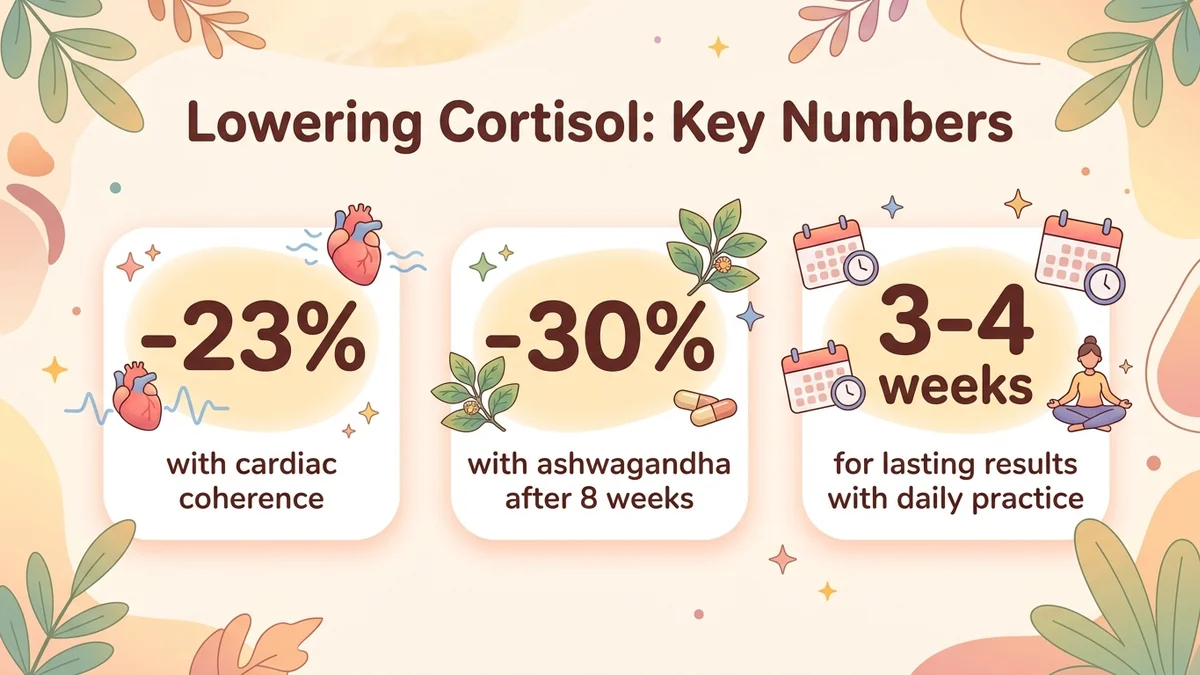
Cortisol is a vital hormone that doesn't get "detoxed" — it gets regulated. Chronically high levels cause fatigue, belly weight gain and insomnia. Cardiac coherence (5 min, 3 times a day) lowers cortisol by 23% according to the HeartMath Institute. Combined with regular sleep, anti-inflammatory nutrition and adaptogenic herbs, lasting regulation takes hold within 3 to 4 weeks.
What is cortisol and why is everyone talking about it?
Cortisol is a hormone produced by your adrenal glands, often nicknamed the "stress hormone." In reality, its role goes far beyond that: it regulates your blood sugar, blood pressure, immune system and sleep-wake cycle. Without cortisol, your body couldn't function.
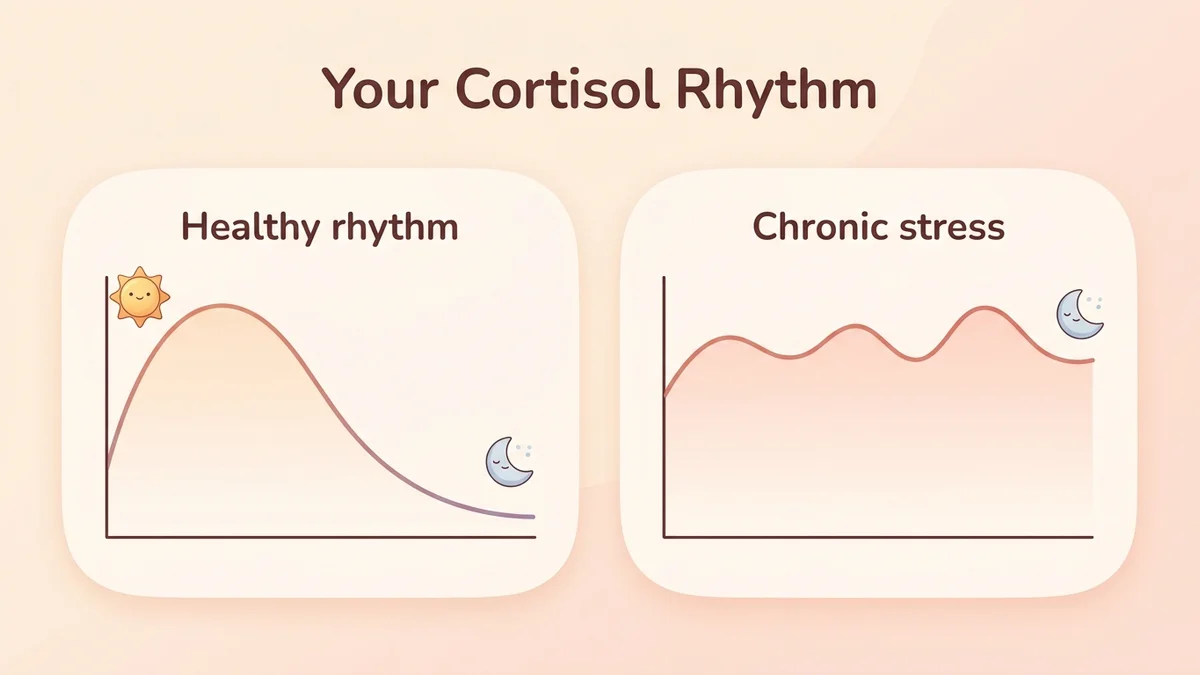
Cortisol follows a natural circadian rhythm, peaking between 6 and 8 a.m. and dipping around midnight, regulating your energy throughout the day.
The problem arises when that rhythm gets disrupted. Under chronic stress, your hypothalamic-pituitary-adrenal axis (HPA axis) stays switched on. The result: your cortisol no longer comes down in the evening. And that's when the trouble starts.
The vicious cycle of chronically high cortisol
Here's how the vicious circle sets in:
- Prolonged stress → The HPA axis stays activated
- High cortisol in the evening → Melatonin production is blocked
- Disrupted sleep → The body doesn't recover
- Waking up tired → More stress to compensate
- Back to step 1 → The cycle feeds itself
If you recognize yourself in this pattern, know that it's neither rare nor irreversible.
Key point: Cortisol isn't your enemy. It's the chronic disruption of its rhythm that causes problems — and the good news is that you can do something about it.
How do you know if your cortisol is too high?
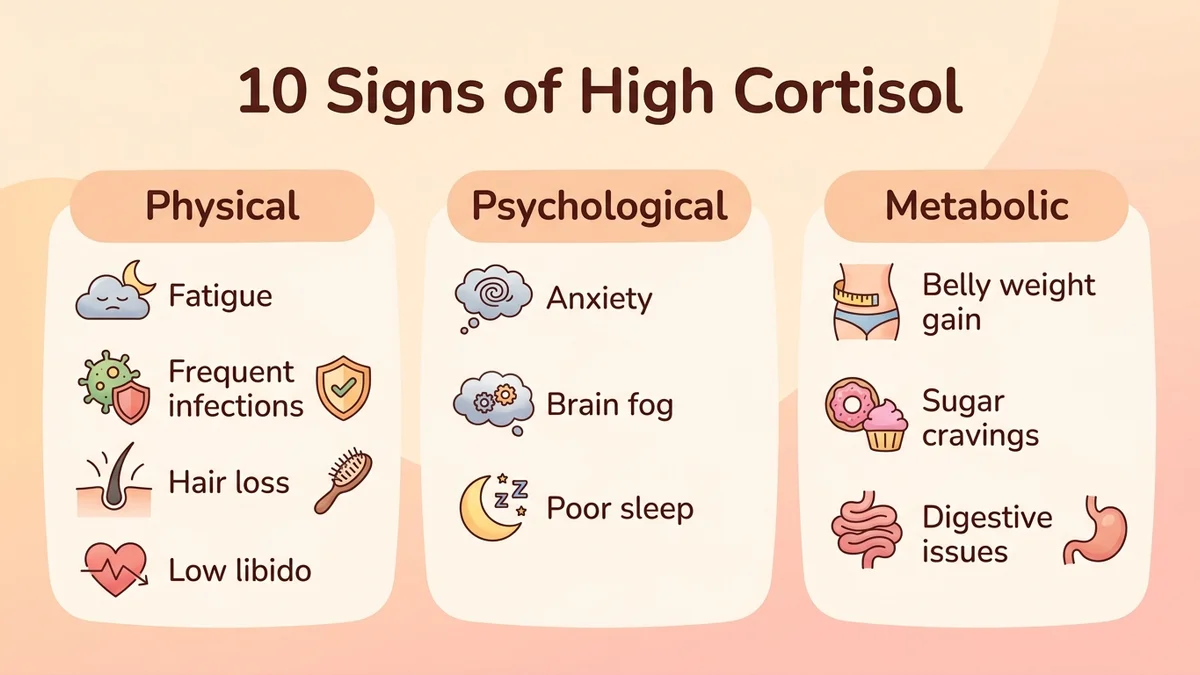
Your body sends clear signals when your cortisol stays high for too long. Here are the 10 most common signs. If you recognize at least 4, it's time to act.
| # | Sign | What's happening in your body |
|---|---|---|
| 1 | Persistent fatigue despite rest | Your stress system is running nonstop |
| 2 | Belly weight gain | Cortisol promotes visceral fat storage |
| 3 | Sleep problems | High evening cortisol blocks melatonin |
| 4 | Anxiety and irritability | The brain's amygdala is overactivated |
| 5 | Intense sugar cravings | Cortisol increases appetite and cravings |
| 6 | Brain fog | The hippocampus (memory) is inhibited by cortisol |
| 7 | Frequent infections | Chronic cortisol suppresses the immune response |
| 8 | Digestive problems | The gut-brain axis is disrupted |
| 9 | Hair loss | Stress diverts nutrients away from hair follicles |
| 10 | Low libido | Cortisol inhibits sex hormones |
If these symptoms sound familiar, you may also recognize the 13 signs of chronic stress or the physical manifestations of anxiety somatization. These three issues — high cortisol, chronic stress and somatization — are closely linked.
Serena Coach tip: Before you self-diagnose, log your symptoms for a week along with the time and intensity. An emotional tracking journal, like the one in Serena, helps you spot patterns — the signs often get worse in the evening between 6 and 10 p.m., right when cortisol should normally be dropping.
Does the "cortisol detox" really exist?
It's THE question everyone is asking — and the answer is nuanced. The term "cortisol detox" is scientifically inaccurate, but the intention behind the search is legitimate.
What the science says
France's national health research institute, Inserm (2025), addressed the trend in its Canal Détox fact-checking series, explaining that cortisol is an essential hormone that doesn't need to be "regulated" in the absence of a medical condition. Cortisol isn't a toxin your liver has to eliminate. Your body produces and breaks it down continuously.
Cortisol doesn't get detoxified — it gets regulated by addressing what disrupts the hypothalamic-pituitary-adrenal axis, according to Inserm (2025).
The "adrenal fatigue" myth
The Endocrine Society, the world's largest organization of endocrinologists, states that there is no scientific proof that adrenal fatigue is a real medical condition. Your adrenal glands don't "burn out" — they keep producing cortisol, but its rhythm is thrown off.
What actually works
Instead of "detoxing," the goal is to restore your cortisol's natural circadian rhythm:
| Popular approach | Scientific reality | Verdict |
|---|---|---|
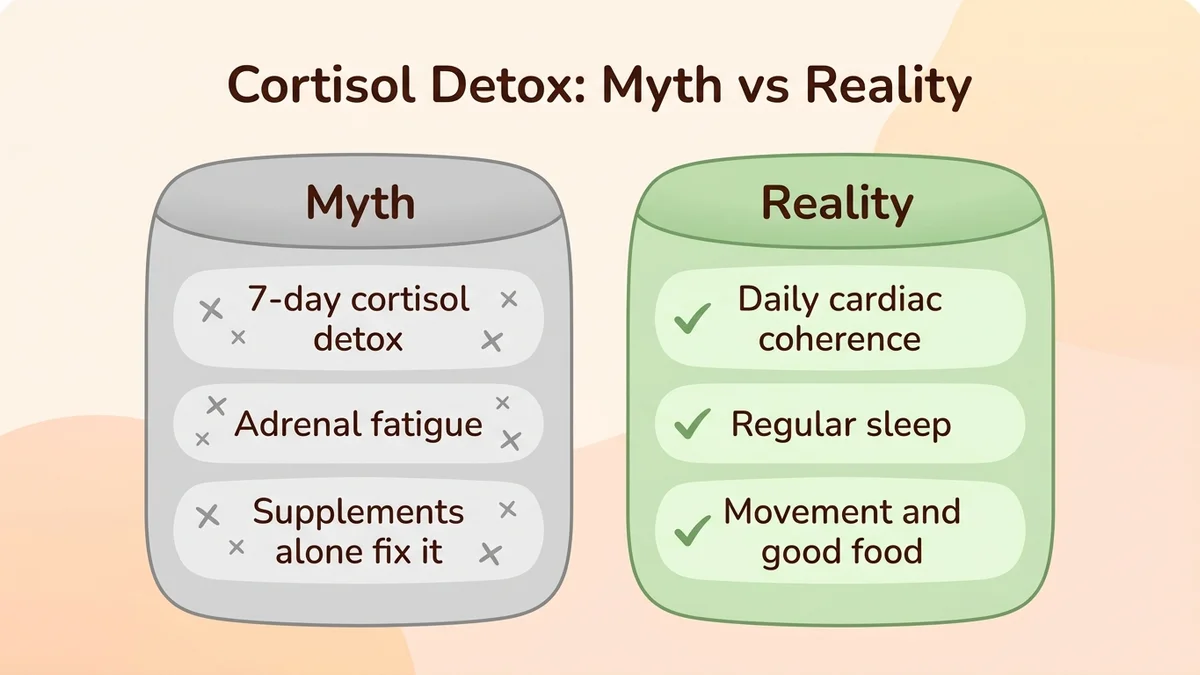
| "7-day cortisol detox" | No study validates a detox protocol | Marketing myth |
| Daily cardiac coherence | Lowers cortisol by 23% (HeartMath) | Proven |
| "Anti-cortisol" supplements alone | Helpful as support, not a standalone fix | Partly true |
| Overall lifestyle (sleep + nutrition + movement) | The approach most supported by research | Proven |
Inserm notes that exercise, sleep and relaxation techniques improve wellbeing — not by "regulating cortisol" as such, but by supporting overall health.
Key point: Forget the "detox." Focus on the habits that restore your cortisol's natural rhythm — it's more effective and more lasting.
How do you lower cortisol naturally? 7 proven methods
Let's get practical. Here are the 7 most effective levers for regulating your cortisol, ranked by how quickly they work.
1. Cardiac coherence — results in 5 minutes
Five minutes of guided breathing activate the parasympathetic nervous system and lower cortisol for 4 to 6 hours.
The 365 method, developed by Dr. David O'Hare, is the fastest and best-documented technique:
- 3 times a day (morning, midday, late afternoon)
- 6 breaths per minute (breathe in for 5 seconds, breathe out for 5 seconds)
- 5 minutes per session
Why does it work? By breathing at 6 cycles per minute, you reach the "resonance frequency" of your cardiovascular system. Your heart rate variability improves, your vagus nerve switches on and your cortisol drops. According to the HeartMath Institute, this practice lowers cortisol by 23% on average while increasing DHEA (the vitality hormone) by 100%.
The cumulative effects — lasting improvement in vagal tone and a structural drop in cortisol — appear after 3 to 4 weeks of regular practice.
To explore cardiac coherence in depth, read our complete guide to heart coherence, which explains the physiology and offers progressive exercises. You can also practice right now with our free cardiac coherence timer.
2. Optimize your sleep — the foundation of everything
Sleep is the most powerful lever for restoring your cortisol's circadian rhythm. When you sleep badly, your morning cortisol peak shifts, and your nighttime dip doesn't go low enough.
Anti-cortisol sleep protocol:
- Fixed wake-up time: even on weekends (± 30 min max)
- Natural light in the morning: 10 to 15 minutes within the first 30 minutes after waking
- No screens after 9 p.m.: blue light blocks melatonin
- Bedroom temperature: 64-66°F (18-19°C)
- Wind-down rituals: evening meditation or reading 30 minutes before bed
Sleep problems are among the most common complaints of people living with chronic stress, which is why our guide to sleep problems and natural remedies is a useful companion. It's a vicious circle: high cortisol keeps you awake, and lack of sleep keeps cortisol high.
3. Anti-cortisol nutrition
Some nutrients directly help your body regulate cortisol:
| Nutrient | Food sources | Effect on cortisol |
|---|---|---|
| Magnesium | Dark chocolate, almonds, spinach | Modulates the stress response (-24% cortisol) |
| Omega-3s | Salmon, sardines, flaxseed | Reduce cortisol-related inflammation |
| Vitamin C | Kiwi, bell peppers, citrus | 1,000 mg/day lowers cortisol after exertion |
| B vitamins (B6, B9, B12) | Whole grains, legumes | Support the nervous system |
| Antioxidants | Berries, matcha green tea | Protect against oxidative stress |
What to limit: refined sugar (causes cortisol spikes), caffeine after 2 p.m. (delays cortisol's evening decline), alcohol (disrupts sleep and recovery).
4. The right kind of exercise — not too much, not too little
Moderate exercise lowers cortisol. Excessive exercise raises it. The distinction matters.
According to a meta-analysis published in the British Journal of Sports Medicine (2024), 30 minutes of moderate exercise 3 times a week reduce stress markers by 40%.
Activities that lower cortisol:
- Brisk walking outdoors (bonus: light exposure)
- Gentle yoga (Hatha or Yin yoga, not intense hot yoga)
- Swimming
- Tai chi and qigong
- Moderate-intensity cycling
Activities to dose carefully:
- Intense HIIT (temporarily raises cortisol by 50-80%)
- Long-distance running without proper recovery
- Very heavy strength training with no rest days
The secret? Move at an intensity where you can still talk comfortably. If you're so out of breath you can't hold a conversation, you've crossed into your body's stress zone.
5. Adaptogenic herbs — complementary support
Adaptogenic herbs help your body better withstand stress by modulating the cortisol response. They don't replace a healthy lifestyle, but they complement it effectively.
Ashwagandha lowers cortisol by 30% on average after 8 weeks of supplementation, according to a study in the Indian Journal of Psychological Medicine (2012).
| Herb | Main effect | Recommended dose | Time to effect |
|---|---|---|---|
| Ashwagandha | Lowers cortisol (-30%) | 300-600 mg/day | 6-8 weeks |
| Rhodiola rosea | Increases stress resilience | 200-400 mg/day | 1-3 weeks |
| Tulsi (holy basil) | Overall hormonal balance | As tea, 2-3 cups/day | 2-4 weeks |
Always check with your doctor before starting a supplement, especially if you take medication. For a complete guide to natural anxiety solutions, read our article on natural anxiety remedies, which covers 10 science-backed options.
Serena Coach tip: Start with one change at a time. The Serena users who get the best results start with cardiac coherence, then gradually add the other pillars week after week.
6. Meditation and mindfulness — rewiring your stress response
Mindfulness meditation doesn't just calm you down in the moment. It structurally changes your brain. According to a study in Psychoneuroendocrinology (2023), 8 weeks of MBSR (Mindfulness-Based Stress Reduction) practice significantly reduce salivary cortisol.
15 minutes of daily meditation lower cortisol by 25% over eight weeks, according to research in contemplative neuroscience.
You don't need to meditate for an hour: 10 to 15 minutes is enough. What matters is consistency. Start with short 5-minute sessions and build up gradually. If you're a beginner, check out our mindfulness meditation guide.
7. Social connection and laughter — the forgotten cortisol reducers
It may sound trivial, but laughter and positive social interactions are powerful hormonal regulators. Laughter lowers cortisol while releasing endorphins and oxytocin — the bonding hormone.
According to a Mayo Clinic study (2025), people with strong social ties have baseline cortisol levels 20% lower than those living in isolation.
Concrete actions:
- Call someone who makes you laugh (even for 10 minutes)
- Join a group activity (choir, team sport, dance)
- Limit social media that fuels comparison
- Cuddle a pet (20 minutes lower cortisol by 15%)
How long does it take to lower cortisol?
It depends on the method and your situation. Here's a realistic timeline:
| Timeframe | What changes | Method |
|---|---|---|
| 5 minutes | Immediate cortisol drop (-23%) | Cardiac coherence |
| 1 week | Better sleep | Sleep hygiene |
| 2-3 weeks | Less day-to-day anxiety | Daily meditation |
| 3-4 weeks | Improved vagal tone | Cardiac coherence 3x/day |
| 6-8 weeks | Structural cortisol drop (-30%) | Ashwagandha + healthy lifestyle |
| 3 months | A new, stable hormonal "set point" | Combined approach |
The key is consistency. Five minutes of cardiac coherence every day beats an hour of meditation once a week.
Lowering cortisol when you're swamped: real-life scenarios
Scenario 1 — Waking up in emergency mode
Your alarm goes off and your first thought is the list of everything you have to do today. Your heart speeds up before your feet even touch the floor.
Your protocol: Stay lying down for 2 minutes. Place a hand on your belly. Breathe in through your nose for 5 seconds (your belly rises), breathe out through your mouth for 5 seconds (your belly falls). Do 6 cycles. Then get up and spend 10 minutes in natural light before touching your phone. This simple ritual recalibrates your morning cortisol peak.
Scenario 2 — A conflict at work at 3 p.m.
A coworker has just criticized your work in front of the whole team. Your jaw clenches, your shoulders rise. Cortisol and adrenaline flood your system.
Your protocol: Excuse yourself for 5 minutes. Head to the restroom or a quiet stairwell. Start a cardiac coherence session in Serena. After 3 minutes, your parasympathetic nervous system takes back over. You return to the room with a steady heart rate and your ability to think clearly restored. To handle these situations better, our article on work stress management offers complementary strategies.
Scenario 3 — Rumination insomnia at 11 p.m.
You've been in bed for an hour. Your mind keeps looping on a difficult conversation. The harder you try to sleep, the more awake you feel.
Your protocol: Get out of bed (staying in bed awake teaches your brain to associate your bed with wakefulness). Settle into an armchair with dim lighting. Practice 4-7-8 breathing: breathe in for 4 seconds, hold for 7 seconds, breathe out for 8 seconds. The extended exhale strongly activates your vagus nerve and brings cortisol down. Go back to bed when you feel sleepy again.
The Serena perspective
Anonymized data from Serena users reveals an interesting pattern: people who practice cardiac coherence 3 times a day for at least 3 weeks report an average 40% improvement in their subjective stress score. What's striking is the "click" effect that usually happens between the second and third week — as if the nervous system needed that long to "understand" it can release the pressure.
Academic theory predicts a gradual, linear drop in cortisol. In practice, our real-world observations show more of a "plateau, then click" effect: few noticeable changes in the first 10 days, then a clear, rapid improvement between day 14 and day 21. This gap between theory and lived experience explains why many people give up too early — right before the benefits appear.
Serena Coach tip: Don't judge whether cardiac coherence works before 21 days of daily practice. Use Serena's mood tracking to measure your progress — the numbers don't lie, even when the feeling takes longer to change.
Understanding stress regulation on video: the vagus nerve
To go deeper into the link between breathing, the vagus nerve and your stress response, this short video from Cleveland Clinic explains simple, everyday ways to strengthen your vagus nerve — the body's main "brake" on stress.
As the video shows, slow breathing acts directly on the autonomic nervous system to rebalance the sympathetic/parasympathetic scale. You can practice this every day with Serena, which offers 6 guided breathing exercises, including cardiac coherence.
How Serena helps you regulate your cortisol
Regulating your cortisol takes consistency — and that's exactly where Serena comes in. The app combines the three most effective pillars against high cortisol:
- Guided cardiac coherence: 6 breathing techniques with visual and audio guidance, including the 365 method
- Daily mood tracking: based on the Circumplex model of emotions to identify your stress patterns
- Anti-anxiety exercises: meditation, progressive muscle relaxation and visualization
The basic breathing exercises are free. A subscription unlocks full access with personalized tracking.
Frequently asked questions
Is a "cortisol detox" really possible?
No, cortisol isn't a toxin but an essential hormone that your body produces and breaks down continuously. According to Inserm (2025), "cortisol detox" is a marketing shortcut. What really works is restoring cortisol's natural circadian rhythm through sleep, guided breathing, a suitable diet and moderate physical activity.
How long does it take to lower cortisol?
Cardiac coherence works in 5 minutes, with an effect lasting 4 to 6 hours. For lasting cortisol regulation, allow 3 to 4 weeks of daily practice according to the HeartMath Institute. Ashwagandha shows significant results after 8 weeks of regular supplementation. The most effective approach combines several methods over 3 months.
Which foods lower cortisol naturally?
Foods rich in omega-3s (salmon, sardines, flaxseed), magnesium (70% dark chocolate, almonds, spinach), vitamin C (kiwi, red bell peppers, citrus) and antioxidants (berries, leafy greens) help regulate cortisol. Avoid refined sugar, which causes cortisol spikes, and limit caffeine after 2 p.m.
Does high cortisol cause weight gain?
Yes, chronically high cortisol promotes visceral fat storage, especially around the belly — what's often called "cortisol belly." Cortisol increases appetite and sugar cravings and promotes insulin resistance. Regulating your cortisol through cardiac coherence and moderate physical activity helps stabilize your weight over time.
How do you measure your cortisol level?
There are three methods: a morning blood test between 7 and 9 a.m. for a snapshot, a saliva test with 4 samples over 24 hours to observe the full circadian rhythm, and a 24-hour urine cortisol test for an overall picture. Ask your doctor which test best suits your situation.
Does cardiac coherence really lower cortisol?
Yes, it's one of the fastest and best-documented methods. According to the HeartMath Institute, cardiac coherence at 6 breaths per minute lowers cortisol by 23% on average and increases DHEA by 100%. Dr. David O'Hare's 365 method recommends 3 sessions of 5 minutes a day for a lasting cumulative effect.
Does exercise raise or lower cortisol?
Both, depending on intensity. Intense, prolonged exercise (HIIT, marathons) temporarily raises cortisol. Moderate physical activity (walking, yoga, swimming) lowers it over time. According to a meta-analysis in the British Journal of Sports Medicine (2024), 30 minutes of moderate exercise 3 times a week is optimal for reducing stress markers.
When should you see a doctor about high cortisol?
See a doctor if you have rapid, unexplained weight gain (especially in the face and abdomen), purple stretch marks, persistent fatigue despite rest, muscle weakness, or if your symptoms last more than 4 weeks without improvement. Cushing's syndrome, though rare, needs to be ruled out with an endocrine workup.
Conclusion
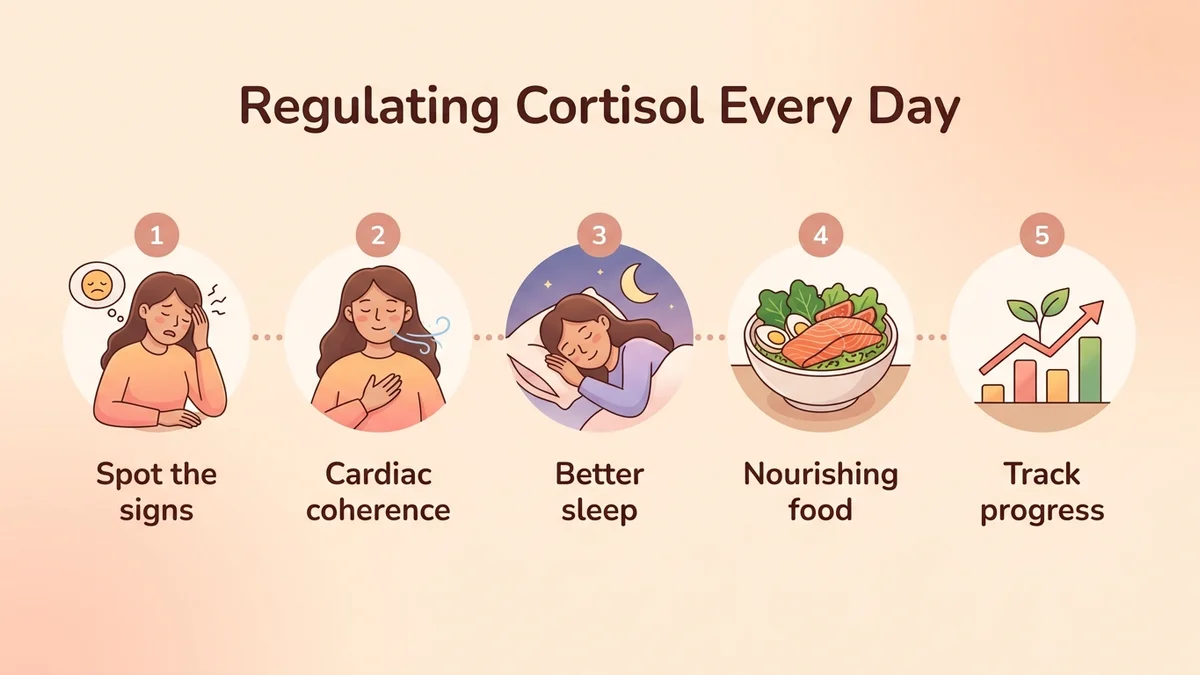
Cortisol isn't your enemy — it's the messenger of a body that needs to find its balance again. Forget miracle 7-day "detoxes" and focus on what really works: daily cardiac coherence, regular sleep, anti-inflammatory nutrition and moderate physical activity.
The most important thing? Start small. Five minutes of guided breathing tonight is already a first step toward better-regulated cortisol. And in 3 weeks, you'll feel the difference.
Get started with Serena — free breathing exercises