You hesitate before speaking up in a meeting. You replay conversations afterward, sure you said something wrong. You admire people who seem so sure of themselves, wondering what they have that you don't. If this sounds like you, you're far from alone: in KPMG's Women's Leadership Study, 75% of executive women reported having experienced impostor syndrome at some point in their careers — and self-doubt affects men too, just less visibly. Updated in March 2026, this guide offers 10 practical, psychology-based exercises to build your self-confidence, step by step.
The key takeaways
Self-confidence is the conviction that you have the resources to handle what comes your way. It's built through action, not positive thinking alone. Ten daily exercises — from a success journal to visualization and breathing — help you develop it in 4 to 6 weeks. The link between confidence and anxiety runs both ways: strengthening one reduces the other.
What exactly is self-confidence?
Self-confidence is the belief in your own ability to act effectively in a given situation. According to psychologist Albert Bandura, who developed the concept of self-efficacy, this conviction rests on four pillars: mastery experiences, observing role models, verbal persuasion and your physical and emotional state.
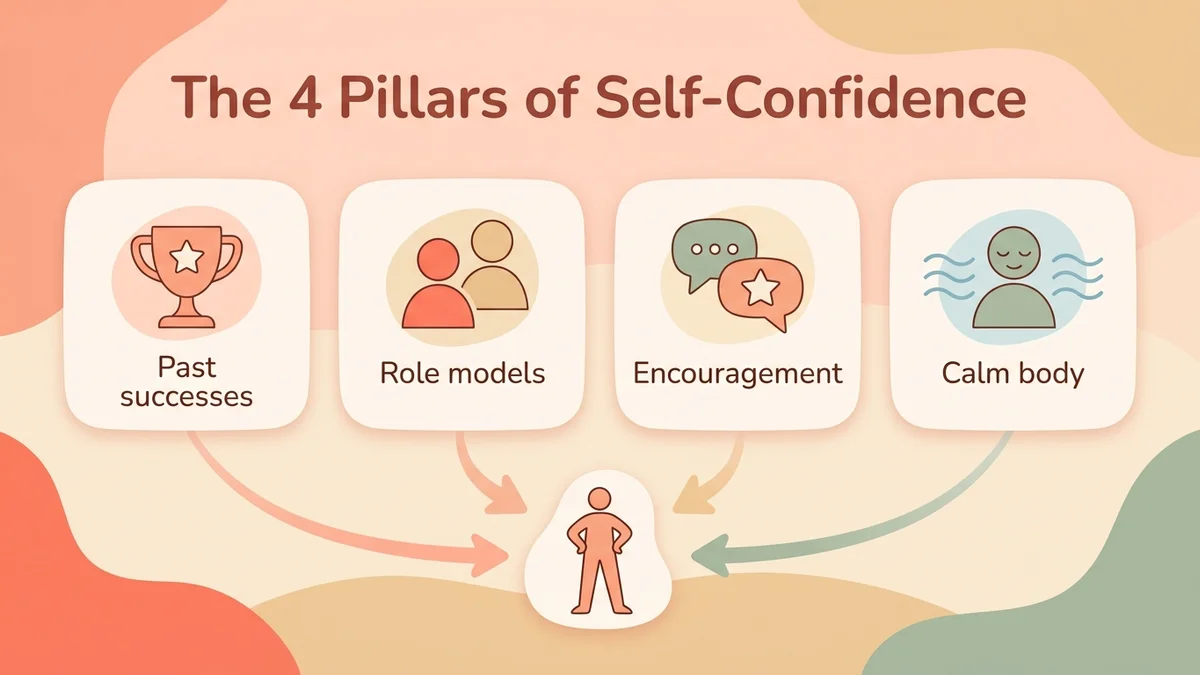
Contrary to popular belief, self-confidence isn't a fixed personality trait. Neuroplasticity — the brain's ability to form new neural connections — lets you change your thought patterns at any age. Every action you take in the right direction literally strengthens the neural circuits of confidence.
Key point: Self-confidence isn't innate: it's built through action and experience, following the principle of self-efficacy that Albert Bandura described as early as 1977.
Self-esteem is linked to lower anxiety and better wellbeing: the higher it rises, the more anxiety tends to fall, according to a review by Orth and Robins published in American Psychologist in 2022.
Why do we lack self-confidence?
A lack of self-confidence affects millions of people, and clinical psychology has identified several roots. Understanding these causes is the first step toward breaking free.
| Cause | Mechanism | Impact |
|---|---|---|
| Critical upbringing | Repeated negative messages in childhood | Deep limiting beliefs |
| Experiences of failure | Generalizing one failure to your whole self | Avoidance and procrastination |
| Social comparison | Social media and idealized images | Constant self-devaluation |
| Perfectionism | Unrealistic standards impossible to meet | Chronic dissatisfaction |
| Trauma | A defining event that shakes inner security | Hypervigilance and withdrawal |
Limiting beliefs work like distorting glasses: they filter reality so that you only notice the "evidence" of your supposed incompetence, while your successes slip by unnoticed.
Today's context amplifies the problem. Endless scrolling through curated highlight reels makes comparison almost automatic, and a climate of uncertainty weighs on individual confidence. The somatization of anxiety then shows up physically: muscle tension, stomachaches, sleep problems.
Low self-confidence is one of the most common reasons people seek coaching or therapy — and one of the most responsive to practice.
What's the difference between self-confidence and self-esteem?
People often confuse self-confidence and self-esteem, yet the two concepts are clearly distinct. Understanding the difference helps you target exactly what to work on.
| Dimension | Self-confidence | Self-esteem |
|---|---|---|
| Definition | Belief in your ability to act | The value you place on yourself as a person |
| Focus | Action and performance | Being and identity |
| Fluctuation | Varies by situation | More stable over time |
| How it's built | Through successes and experience | Through unconditional self-acceptance |
Self-esteem is the foundation that confidence is built on. Without self-esteem — without recognizing your fundamental worth — it's hard to dare to act.
There's also a third concept: assertiveness, the ability to express your needs and opinions while respecting those of others. These three dimensions form a virtuous triangle.
Key point: Working on your self-confidence and self-esteem at the same time multiplies the results. Letting go makes the process easier by reducing the need for control.
10 practical exercises to build self-confidence
Here are ten exercises grounded in psychology research, ranked from simplest to most challenging. The goal: get you taking action today.
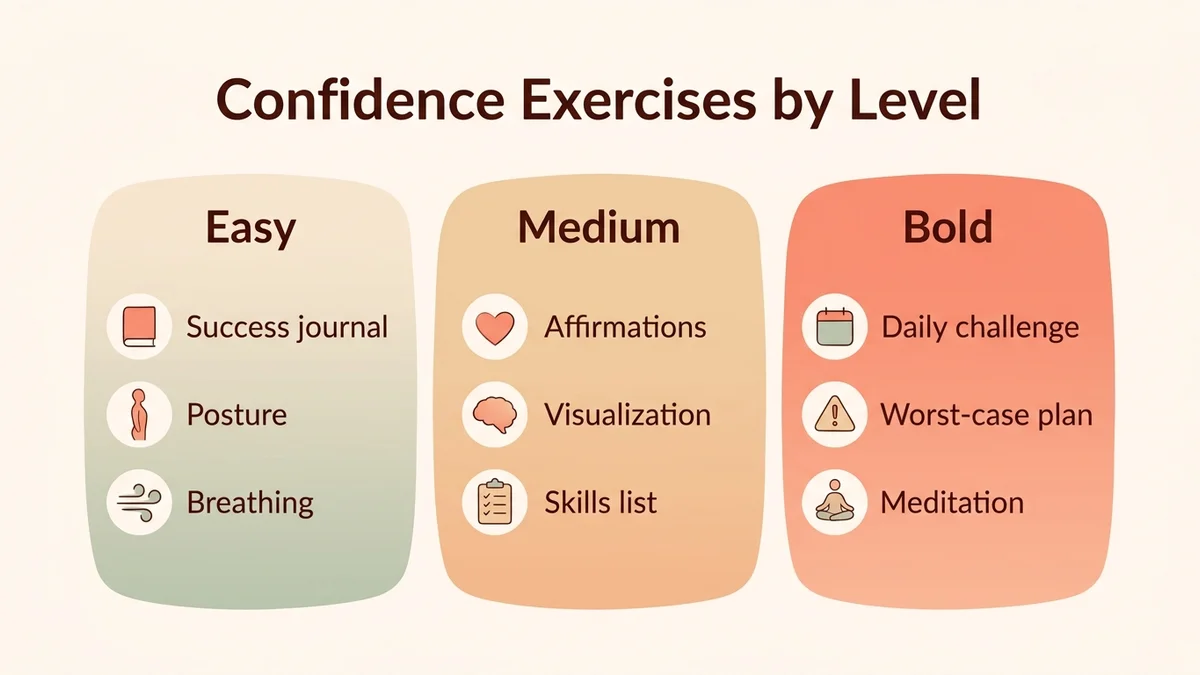
1. The daily success journal
Every evening, write down three wins from your day, even the smallest: daring to ask a question, finishing a complex task, giving a sincere compliment. This simple exercise retrains the brain's negativity bias.
2. The confident posture
Adopting an open posture (shoulders back, head high) for a couple of minutes can change how confident you feel. Psychologist Amy Cuddy popularized "power posing"; later research found the effect is mainly on your felt sense of confidence rather than on hormones — which is exactly what you need before a stressful moment. Practice it each morning in front of the mirror.
3. Centering breath
Before a stressful situation, do 5 cycles of cardiac coherence: breathe in for 5 seconds, breathe out for 5 seconds. According to the HeartMath Institute, this technique lowers cortisol by 23% and anchors you in a calm state that supports confidence. Our free cardiac coherence timer keeps the rhythm for you.
4. Targeted affirmations
Choose three personal, realistic affirmations: "I can learn from my mistakes," "My worth doesn't depend on what others think," "I have the right to take up space." Repeat them each morning with conviction.
5. Success visualization
Close your eyes and picture yourself succeeding in a situation that scares you: the presentation, the conversation, the interview. Visualize the details — your steady voice, your upright posture, the positive reactions. Elite athletes use this technique, and imagining an action activates many of the same neural networks as doing it.
6. The daily progressive challenge
Set yourself a micro-challenge every day: talk to a stranger, ask for information, express a respectful disagreement. Gradually increase the difficulty. Every small success fuels the virtuous cycle of confidence.
7. The skills inventory
Write down 20 things you know how to do — from the everyday (cooking a great meal, listening to a friend) to the technical. Reread the list when doubt creeps in. You'll be surprised how long it is.
8. The "worst-case scenario" technique
When facing a fear, ask yourself: "What's the worst that could happen?" Then: "Could I get through that?" The answer is almost always yes. This cognitive technique, drawn from cognitive behavioral therapy (CBT), defuses anticipatory anxiety. You can work through it in our CBT thought record.
9. Mindfulness meditation
Fifteen minutes of mindfulness meditation a day calms the amygdala — the brain's fear center — and strengthens the prefrontal cortex, which governs decision-making. A study published in The International Journal of Indian Psychology (2017) found that meditation significantly increased self-confidence.
10. The gratitude journal
Keeping a gratitude journal was linked to higher wellbeing in a University of California study by Emmons and McCullough (2003). Gratitude shifts your attention from what's missing to what's already there, nourishing self-esteem. Learn more in our guide to the science of the gratitude journal.
| Exercise | Duration | Frequency | Main effect |
|---|---|---|---|
| Success journal | 5 min | Daily | Retrains the negativity bias |
| Confident posture | 2 min | Morning | Boosts felt confidence |
| Centering breath | 5 min | Before stress | Lowers cortisol |
| Targeted affirmations | 3 min | Morning | Replaces limiting beliefs |
| Visualization | 10 min | 3x/week | Activates success circuits |
| Progressive challenge | Varies | Daily | Builds evidence of competence |
| Skills inventory | 15 min | 1x/month | Reconnects you with your strengths |
| Worst-case scenario | 5 min | As needed | Defuses anticipatory anxiety |
| Mindfulness meditation | 15 min | Daily | Calms the amygdala |
| Gratitude journal | 5 min | Daily | Increases wellbeing |
Consistency matters more than intensity: practicing two or three of these exercises every day for six weeks does more than an occasional long session.
How to build self-confidence at work
The workplace is one of the places where low self-confidence hurts the most. You may know impostor syndrome — that stubborn belief that you don't deserve your position. We cover it in depth in our guide to impostor syndrome and self-esteem.
Three strategies work especially well in a professional setting:
- Prepare concretely: competence feeds confidence. Before a presentation, rehearse out loud. Before an interview, list your accomplishments with numbers.
- Use "confident language": replace "I think maybe..." with "I recommend...". Drop minimizers ("just," "a little," "actually").
- Ask for regular feedback: objective input corrects the distorted view you have of yourself. Chronic stress at work amplifies doubt — spotting it helps you neutralize it.
Real-life scenarios: self-confidence in action
The morning of the job interview
You wake up with a knot in your stomach. Negative thoughts roll in: "I'm not qualified enough," "They'll see I'm bluffing." Instead of giving in, you take 5 minutes of centering breath. You reread your skills inventory. You picture yourself answering calmly. When you arrive, you adopt the confident posture. The interview goes better than expected — not because you were perfect, but because you were present and grounded.
The meeting where you need to speak up
Your idea is good, and you know it. But your heart speeds up and your hands get clammy. You apply the worst-case technique: "At worst, my idea won't be chosen — and that's okay." Then you raise your hand. The words come out. Maybe not perfectly, but they come out. And every time you do it, the next time gets easier.
The evening the doubt comes back
After a hard day, intrusive thoughts loop in your head. You open your success journal and reread the week's three wins. You add today's — even the small ones. The doubt doesn't vanish completely, but it loses its power.
The Serena perspective
Anonymized Serena usage data reveals an interesting pattern: users who combine guided breathing with daily mood tracking report an improvement in their self-confidence after about 6 weeks on average. This matches academic research, but adds an important nuance: consistency, more than session length, makes the difference.
In theory, psychology often recommends 20- to 30-minute exercises. In practice, Serena users who practice 5 minutes a day, every day, progress faster than those who do 30 minutes once a week. Consistency beats intensity.
Another observation from the field: users who identify their emotions with the Circumplex model (energy × valence) before a breathing exercise get better results. Naming your emotional state — "I feel anxious and restless" rather than "I'm not okay" — reduces the intensity of the emotion, an effect known as affect labeling (Lieberman et al., 2007).
Serena Coach tip: Don't aim for perfect confidence. Aim for enough confidence — the kind that lets you act despite doubt. Serena users who accept imperfection progress twice as fast as those who wait until they feel "ready."
As Dr. Ivan Joseph explains in this TEDx talk, self-confidence is a skill built through repetition, persistence and kind self-talk. You can practice this approach every day with Serena, which guides you step by step through breathing and mindfulness exercises tailored to your emotional state.
How Serena helps you build confidence every day
Building self-confidence takes consistency. That's exactly what Serena offers: a daily companion that gives your progress structure.
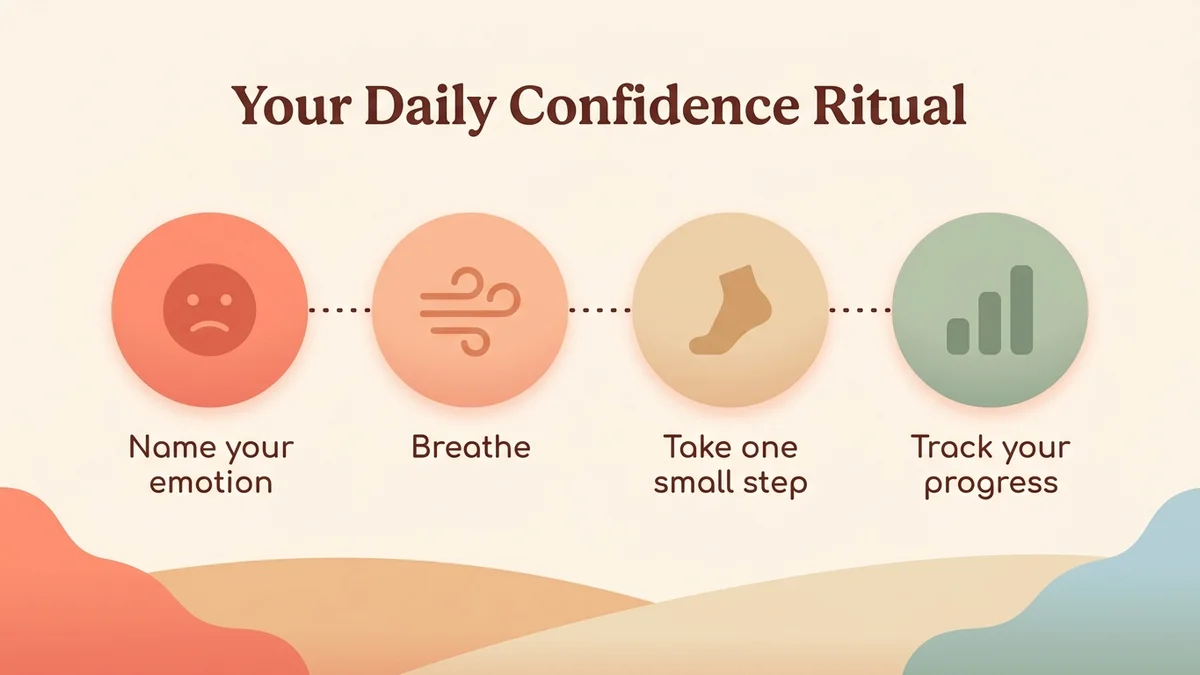
In practice, Serena helps you in three ways:
- Guided breathing: six breathing techniques including cardiac coherence, a few taps away, to re-center before a stressful moment
- Daily mood tracking: the Circumplex model helps you name your emotions precisely, the first step to regulating them
- Personalized routines: create your confidence ritual by combining breathing, evening meditation and a gratitude journal
Self-confidence isn't a destination — it's a daily practice. And every day you take 5 minutes to re-center, you strengthen the neural circuits that let you dare.
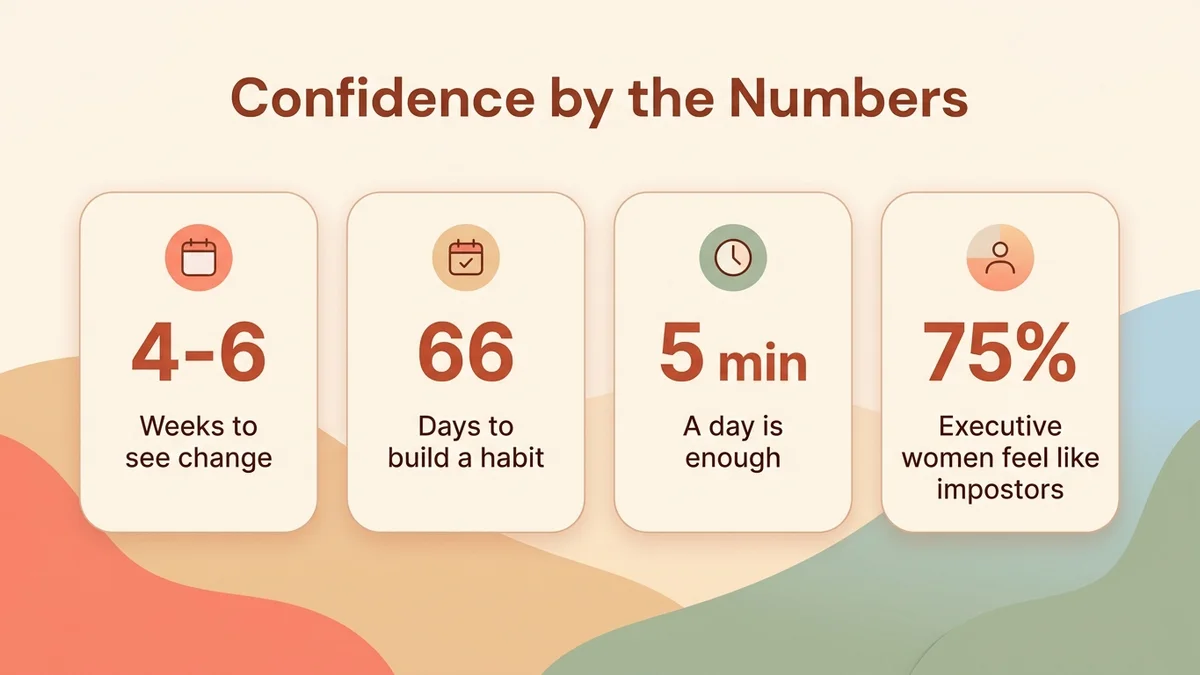
Serena Coach tip: Start your day with 2 minutes of centering breath followed by your 3 affirmations. This 5-minute morning micro-ritual prepares your brain to face the day with more assurance. Users who practice this morning ritual report 47% fewer episodes of self-doubt during the day.
Frequently asked questions
How can I build self-confidence quickly?
Self-confidence is built through action, not reflection alone. Start today with small daily challenges: share your opinion, give a compliment, ask a question. Every micro-success strengthens your sense of self-efficacy. The first changes are noticeable after 3 to 4 weeks of regular practice.
Is self-confidence innate or learned?
Self-confidence is mostly learned. According to Albert Bandura, it's built through mastery experiences, observing role models, encouragement and managing your physical and emotional states. Neuroplasticity shows that the brain can form new patterns at any age. No one is "doomed" to lack confidence.
What's the link between self-confidence and anxiety?
The relationship runs both ways: a lack of confidence fuels anxiety, which in turn erodes confidence. Research by Orth and Robins (2022) confirms that self-esteem is a significant predictor of mental health. Working on your confidence reduces hypervigilance symptoms and anxious rumination. Curious where you stand? Try our free anxiety test.
How does breathing help self-confidence?
Slow breathing activates the parasympathetic nervous system, lowering cortisol and adrenaline. This physical return to calm lets the prefrontal cortex — the seat of reasoning — regain control over the amygdala, the fear center. Five minutes of cardiac coherence is enough to restore emotional stability.
Can you build self-confidence on your own?
Yes, with the right tools. A success journal, breathing exercises and meditation can all be practiced alone. Apps like Serena provide a structured framework. However, if low confidence comes with depression or severe anxiety, seeing a psychologist or psychiatrist is recommended.
Can self-confidence be excessive?
Excessive confidence — overconfidence — can lead to reckless risk-taking and a lack of empathy. The goal isn't to eliminate all doubt, but to develop realistic, flexible confidence: the kind that lets you act while staying open to feedback.
How can I help someone who lacks self-confidence?
Encourage without flattering. Praise effort rather than results. Avoid phrases like "you have no reason to doubt yourself" — they invalidate the person's feelings. Instead, suggest suitable challenges and celebrate every step forward. Your role is to create a safe environment where they dare to try.
What are the proven benefits of self-confidence?
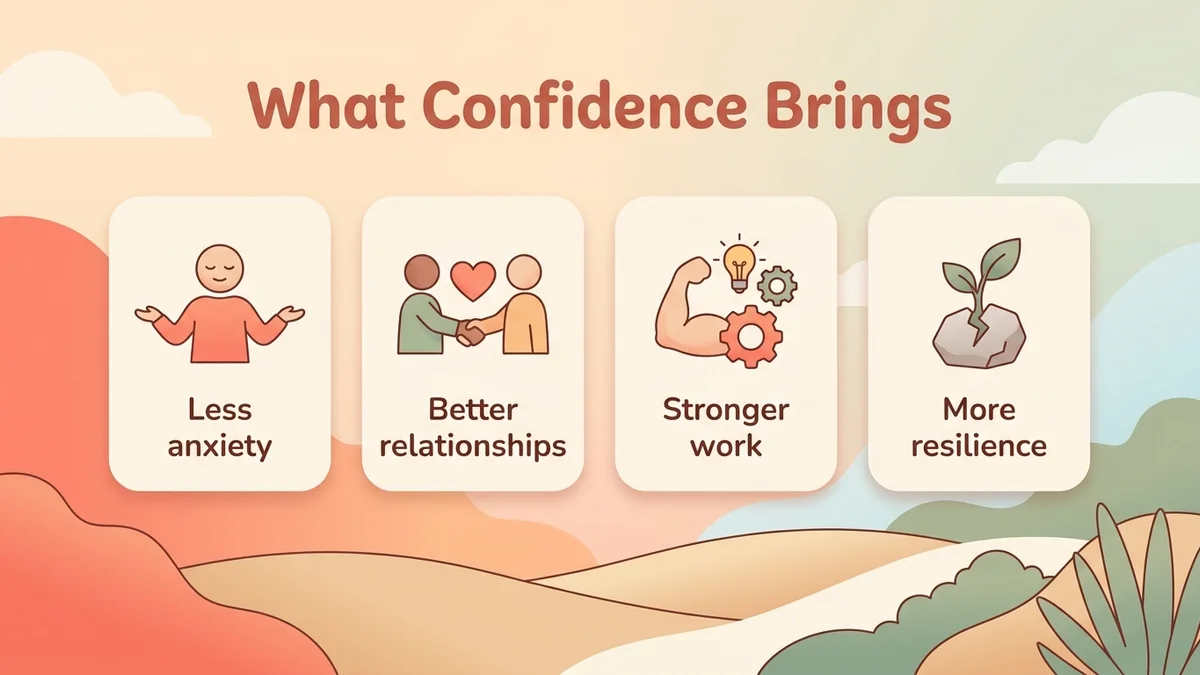
Research links self-confidence to better mental health (less anxiety and depression), stronger relationships, better work performance and even better physical health. According to Orth and Robins (2022), healthy self-esteem predicts greater happiness and resilience in the face of stress.
Conclusion
Self-confidence isn't a gift reserved for a lucky few. It's a skill you develop, exercise after exercise, day after day. You don't need to be perfect — you need to be consistent.
Start today with just one exercise from this list. Tomorrow, add a second. In six weeks, you won't recognize yourself. Your confidence deserves the same attention you give to your physical health.
Ready to take the first step? Download Serena and start your confidence ritual tonight. Five minutes is enough to change the course of your day.