
You haven't forgotten anything. Not yet. But your brain is running at full speed to make sure of it. Tuesday's dentist appointment, tomorrow's meeting, the birthday gift to buy, the laundry that's waiting. Mental load is that endless list written nowhere that takes up all the space in your head. And it's wearing you out.
In 2026, mental health is France's National Cause for the second year running. 22% of working adults report deteriorating psychological health, and 7 in 10 employees have experienced a work-related psychological disorder. Mental load is no longer just a discomfort: it's a public health issue. The good news is that concrete exercises exist to reduce it. Updated May 2026.
The key takeaways
Mental load is the sum of the invisible concerns tied to managing daily life. It constantly draws on the prefrontal cortex and causes fatigue, irritability, and sleep problems. To lighten it, you need to offload tasks (write them down), prioritize, delegate, and build in cognitive decompression exercises: breathing, gratitude, and mood tracking. Five minutes of cardiac coherence reduces cortisol by 23%.
What is mental load?
Mental load refers to the invisible work of planning, anticipating, and coordinating that we carry out constantly to manage daily life. This concept, popularized by sociologist Monique Haicault in 1984, was brought back into the spotlight by Emma's comic "You Should've Asked" in 2017.
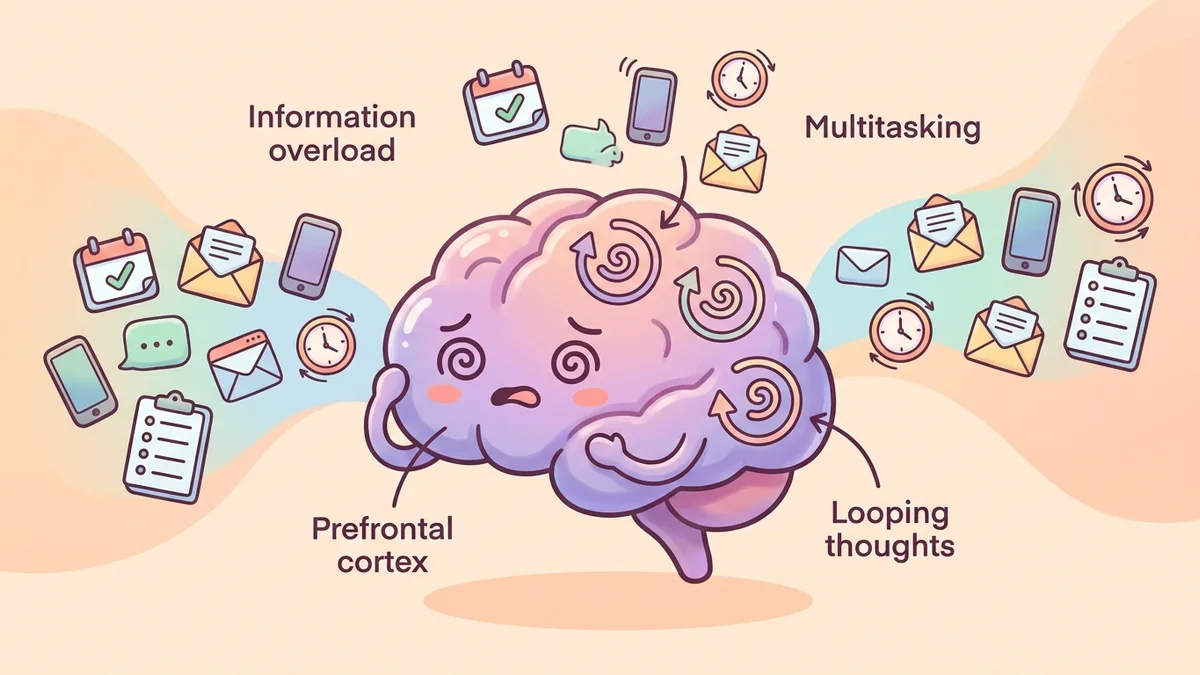
In practical terms, mental load is thinking about the groceries in a meeting, planning the week's meals in the shower, remembering you need to book a pediatrician appointment in the middle of a film. It's your brain working like a 24/7 project manager, with no break and no recognition.
Neurologically, this overload draws on the prefrontal cortex, the brain region responsible for planning and decision-making. When this region is saturated, it loses efficiency. This is what neuroscientists call decision fatigue.
71% of French women say they suffer from mental load, and 60% of working people report significant daily stress (DARES 2023).
Key point: Mental load isn't a lack of organization. It's a cognitive overload that affects everyone, regardless of how organized they are.
What are the symptoms of mental overload?
Mental load can't be seen. But it can be felt. Here are the signals that should get your attention.
| Symptom | What's happening | When to worry |
|---|---|---|
| Persistent fatigue | The prefrontal cortex is exhausted | Despite 7-8 hours of sleep |
| Irritability | Lowered stress tolerance threshold | Disproportionate reactions |
| Frequent forgetfulness | Saturated working memory | Missed appointments |
| Insomnia | A brain that won't switch off | Looping thoughts in bed |
| Difficulty concentrating | Zeigarnik effect (unfinished tasks) | Inability to finish a task |
| Physical tension | Somatization of stress | Headaches, back pain, stomach aches |
| Feeling overwhelmed | More tasks than capacity | A constant sensation |
The Zeigarnik effect, discovered by psychologist Bluma Zeigarnik, explains why unfinished tasks keep coming back into our minds. Your brain keeps an "open window" for each task in progress. The more open windows you have, the more your mental load increases.
Key point: If you check off 4 symptoms or more for over 2 weeks, it's time to act. Not tomorrow, now.
Mental load in numbers: a massive reality
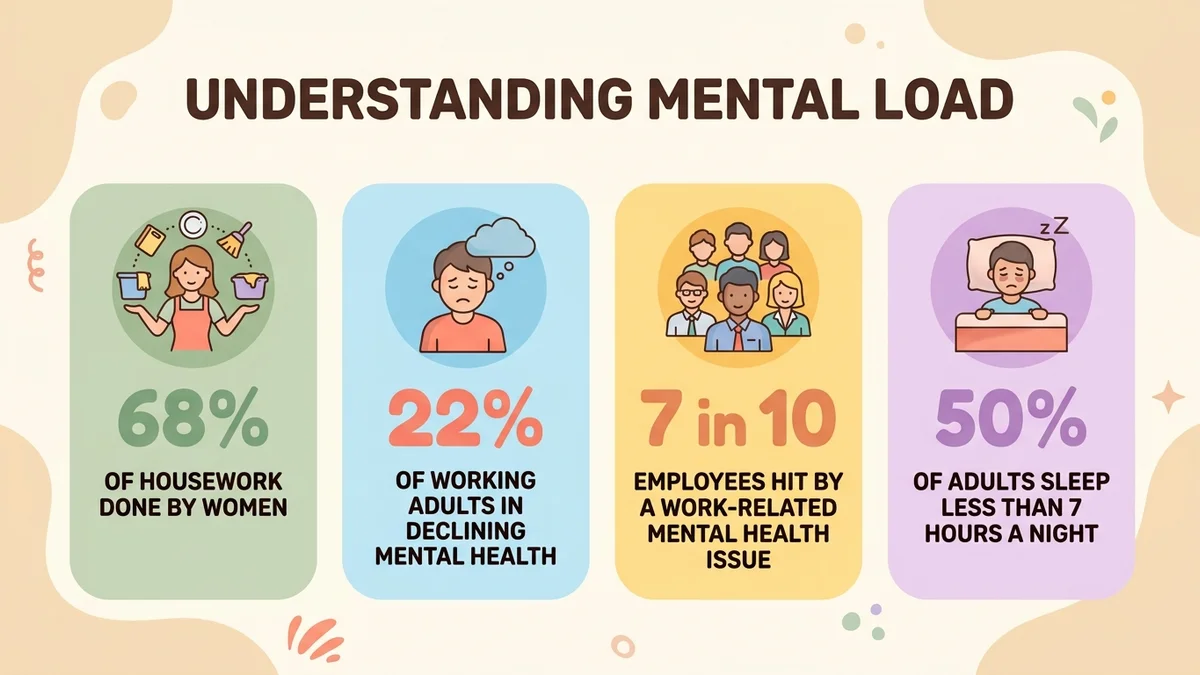
The data leaves no room for doubt:
| Statistic | Source |
|---|---|
| 68% of domestic work handled by women | EIGE 2022 |
| 22% of working adults in deteriorating psychological health | Qualisocial/Ipsos 2026 |
| 7 in 10 employees have experienced a work-related psychological disorder | Éditions Tissot 2026 |
| 50% of adults sleep less than 7 hours a night | INSV 2025 |
| 31% of 18-24 year-olds show anxiety symptoms | SPF 2024 |
| 73% of women vs 62% of men affected at work | Mental Health Barometer 2026 |
| 4 hours/day of domestic tasks for women vs 2 hours for men | INSEE |
Honestly, these numbers strike me every time I reread them. This isn't a fad or a whim. It's a structural problem affecting millions of people.
How do you reduce your mental load? 8 concrete exercises
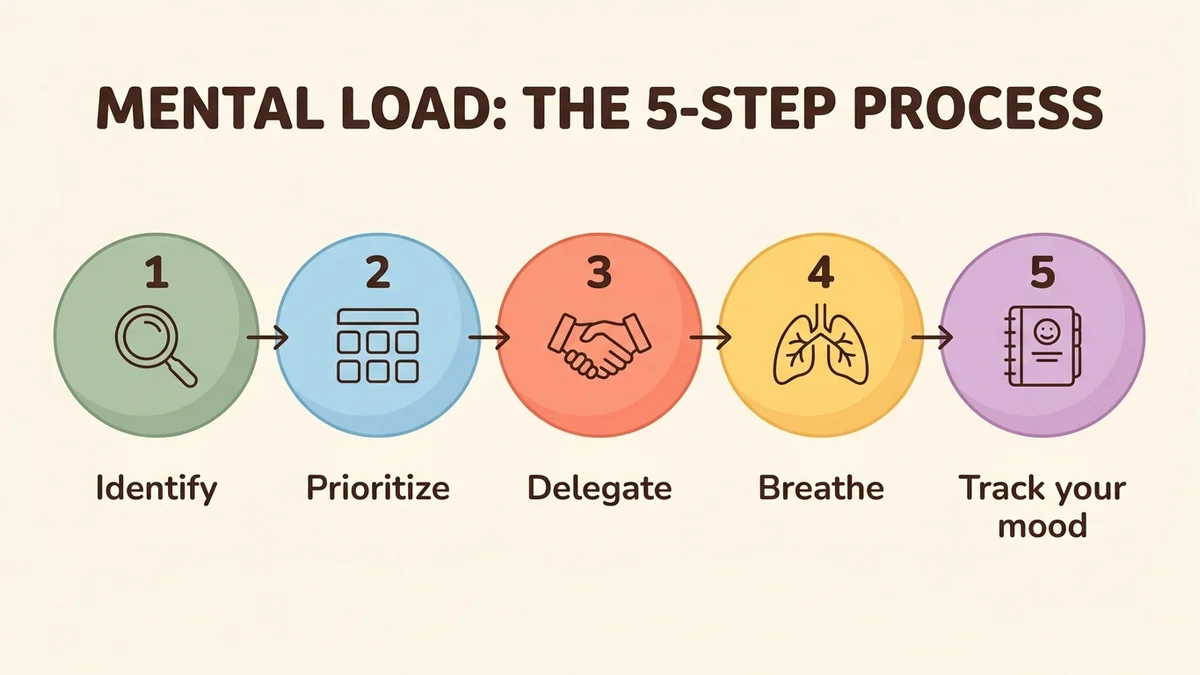
1. The written brain dump (5 minutes)
Grab a notebook. Write down everything cluttering your head. Absolutely everything: groceries, calls to make, ideas, worries. Don't sort, don't prioritize. Just empty it out.
This move turns the Zeigarnik effect to your advantage. By offloading tasks, you close the "windows" in your brain. A study from Baylor University (Scullin et al., 2018) shows that people who write their to-do list before sleeping fall asleep 9 minutes faster.
2. The priority matrix (10 minutes)
Take your list and sort each task into 4 categories:
| Urgent | Not urgent | |
|---|---|---|
| Important | Do now | Schedule |
| Not important | Delegate | Delete |
This is the Eisenhower matrix. The key: the "delete" category is the most freeing. You don't have to do everything. Really.
3. Cardiac coherence breathing (5 minutes)
Inhale for 5 seconds. Exhale for 5 seconds. For 5 minutes. That's it. This exercise, validated by the HeartMath Institute, synchronizes your heart rhythm and reduces cortisol by 23% in a single session.
Practice it 3 times a day: on waking, after lunch, before bed. It's the exercise with the best effort-to-result ratio against mental overload. You can use an app like Serena that guides your breathing with visual animations.
4. The gratitude journal (3 minutes)
Every evening, write down 3 positive things from your day. Not extraordinary events. Little things: a good coffee, a smile you received, a task completed.
Robert Emmons and Michael McCullough (2003) showed that this practice increases wellbeing by 25% over 10 weeks. It recalibrates your brain's attention: instead of scanning for problems, it starts spotting the positive. It's a direct antidote to mental rumination.
5. Daily mood tracking (1 minute)
Each day, rate your mood on a scale of 1 to 10. It's quick, but it's powerful. Within 2 weeks, you'll see patterns emerge: which days are the heaviest? Which situations trigger overload?
This tracking turns a vague feeling ("I'm exhausted") into concrete data. That's exactly what Serena's mood tracking offers: a daily check-in that helps you understand your mental load cycles.
6. The 2-minute rule
If a task takes less than 2 minutes, do it right away. Reply to that message, put away that document, send that email. Every micro-task you put off takes up a disproportionate amount of mental space.
David Allen, creator of the GTD (Getting Things Done) method, demonstrated that these small accumulated tasks are the leading cause of cognitive overload.
7. Transition rituals (2 minutes)
Between two activities (work and home, meeting and break), mark a moment of transition. Close your eyes, take 3 deep breaths, then start the next activity.
Without a transition, your brain blends the contexts. You're physically at home but mentally still at the office. Those 2 minutes of mindful breathing create a clear boundary.
8. Intentional disconnection (30 minutes/day)
Put down your phone. Not on silent. Put it in another room. For at least 30 minutes.
Notifications are interruptions that restart your mental load with every buzz. According to a University of California study (Mark et al., 2023), it takes 23 minutes to refocus after an interruption. 30 minutes without a screen is 30 minutes of pure cognitive decompression.
How do you lighten the mental load in a relationship?
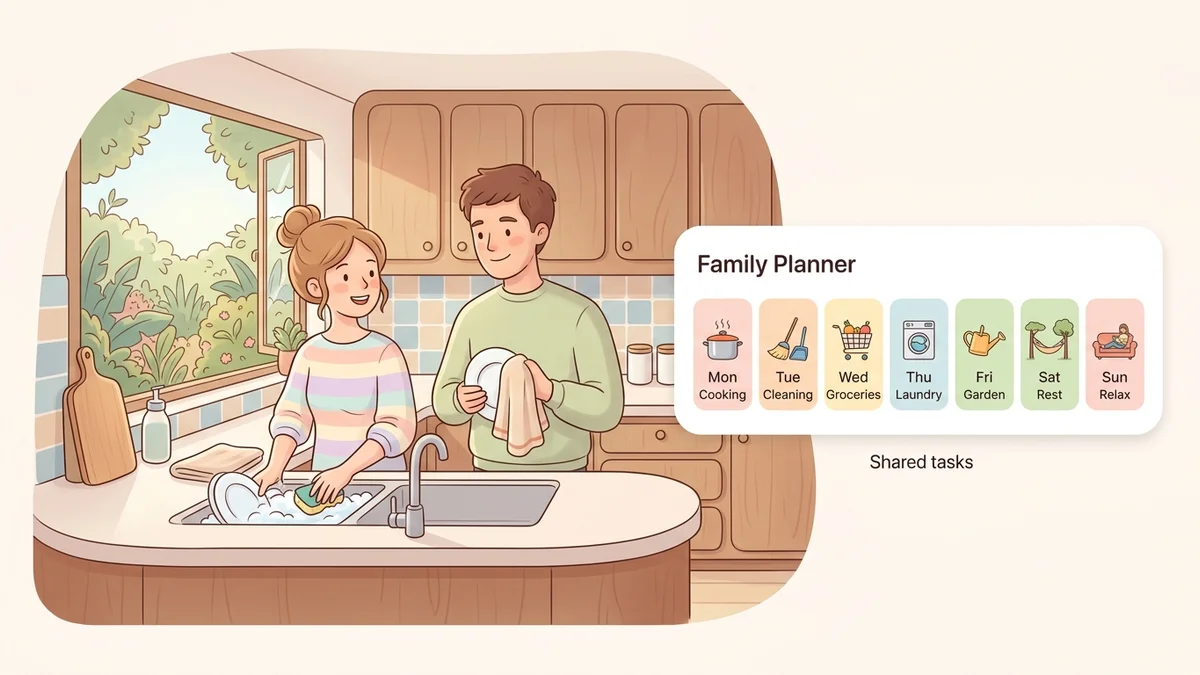
Mental load in a relationship is often asymmetrical. According to INSEE, women handle 64% of household tasks and 71% of parenting tasks. But the problem isn't just execution: it's the planning.
Saying "I would've done the dishes, you just had to ask" illustrates exactly the problem. The person who has to ask carries the load of thinking, planning, and checking. Three steps the person who "helps" doesn't see.
Here are 3 concrete actions to rebalance things:
- The responsibility board. List every household task (not just the visible ones). Divide them up. Each person is responsible from A to Z for their tasks, not just the execution.
- The weekly check-in. 15 minutes on Sunday evening to adjust, anticipate the week ahead, and resolve friction. It's a time investment that saves hours.
- The non-control principle. If you delegate, accept that it will be done differently. The dishwasher isn't loaded the way you would have done it? It doesn't matter. Letting go of control means letting go of mental load.
Mental load at work: when the office invades your head
Work is the leading source of mental load for 59% of employees. The mix of demands (emails, meetings, messaging apps, notifications) fragments attention and stops the brain from focusing on one task at a time.
| Workplace load factor | Impact | Solution |
|---|---|---|
| Constant multitasking | Exhaustion of the prefrontal cortex | Pomodoro technique (25 min focus) |
| Emails and notifications | 23 min to refocus | Fixed check-in slots |
| Excessive meetings | Decision fatigue | "No Meeting Wednesday" policy |
| Remote work without boundaries | Work/life confusion | End-of-day ritual |
| Emotional load | Empathy burnout | Breathing exercises |
France's "Mon soutien psy" program, renewed in 2026, lets you see a psychologist with 60% reimbursement. If your workplace stress becomes unmanageable, it's a resource worth knowing about.
The Serena perspective: mood tracking as a mental load radar

Most articles on mental load give you organizational tips. That's useful, but not enough. Because mental load isn't just a logistical problem. It's an emotional one.
That's why mood tracking is an underrated tool. By noting your emotional state each day, you build a map of your mental load. You see when it rises, why, and what brings it down.
Serena combines three complementary tools: guided breathing (to calm the nervous system when the load rises), the gratitude journal (to recalibrate attention toward the positive), and mood tracking (to understand your patterns). It's a trio backed by research.
Real-life scenarios
Marie, 34, mother of two. She wakes up at 6 a.m. with a mental list of 15 tasks. Since she started doing the written brain dump every morning and cardiac coherence at midday, she sleeps better and snaps at her kids less. "I'm not doing fewer things. But my brain isn't looping anymore."
Thomas, 41, manager at an IT services firm. 87 emails a day, 6 meetings on average. He introduced the Pomodoro technique and two fixed email slots (10 a.m. and 4 p.m.). His mental load at work dropped within 3 weeks. "The hardest part was resisting the urge to check my email every 5 minutes."
Camille, 28, freelancer. With no imposed structure, her mental load explodes. Daily mood tracking helped her spot that Mondays were consistently her worst days. She reorganized her week to start Mondays with creative tasks, not administrative ones. "Seeing the data in black and white changes everything."
When should you consult a professional?
Mental load on its own isn't an illness. But when it lasts, it can lead to burnout or depression.
Consult if:
- Fatigue persists despite rest for more than 4 weeks
- You cry for no apparent reason
- You can no longer make simple decisions
- The people around you say you've changed
- You have "what's the point" kinds of thoughts
France's Mon soutien psy program (2026) and helplines like 3114 (the national suicide prevention number) are accessible first steps.
Frequently asked questions
What exactly is mental load?
Mental load refers to all the invisible concerns tied to managing daily life: planning meals, keeping track of medical appointments, anticipating the grocery shopping, organizing vacations. It's a constant cognitive workload, often unrecognized, that weighs on the prefrontal cortex and generates mental fatigue.
What are the symptoms of mental overload?
The main signs are persistent fatigue despite rest, unusual irritability, sleep problems, frequent forgetfulness, difficulty concentrating, and a constant feeling of being overwhelmed. According to INSERM (2025), chronic mental overload raises cortisol levels by an average of 30%.
Does mental load affect women more than men?
Yes, studies confirm it. According to INSEE, women handle 64% of household tasks and 71% of parenting tasks. EIGE (2022) shows that women perform 68% of unpaid domestic work. That said, mental load at work also affects men, with 62% of them reporting a work-related psychological disorder.
What's the difference between mental load and burnout?
Mental load is a state of daily cognitive overload. Burnout is the next stage: total exhaustion that prevents you from functioning. Untreated mental load can lead to burnout within a few months. If you feel emotional detachment, unusual cynicism, or an inability to work, consult a professional.
How do you measure your mental load?
The NASA-TLX test assesses cognitive load across 6 dimensions. Day to day, ask yourself 3 questions: how many tasks are occupying my mind right now? Am I able to be present in what I'm doing? Am I sleeping well? A daily mood tracker also helps you spot overload peaks.
Which apps help reduce mental load?
There are two categories: organization apps (Todoist, Notion) that offload tasks, and mental wellbeing apps (Serena, Calm) that address the stress caused by overload. Serena combines guided breathing, a gratitude journal, and mood tracking, three tools scientifically validated against mental load.
How do you lighten the mental load in a relationship?
Start by making the invisible visible: list every household management task on a shared board. Then divide them fairly, assigning full responsibility (not just execution, but planning too). Schedule a weekly 15-minute check-in to adjust.
Can breathing really reduce mental load?
Yes, it's proven. Cardiac coherence (5 seconds inhaling, 5 seconds exhaling) reduces cortisol by 23% in 5 minutes according to the HeartMath Institute. This exercise calms the sympathetic nervous system and frees up mental space. Three 5-minute sessions a day are enough to see a significant effect within 2 weeks.
Conclusion
Mental load isn't inevitable. It's a state that can be measured, understood, and reduced. The 8 exercises in this guide require neither a budget nor an upheaval of your life. Just 5 to 15 minutes a day of regular practice.
Start with a single exercise this week. The written brain dump in the morning, or breathing at midday. Notice what changes. Then gradually add more.
If you're looking for a tool to structure this process, Serena brings together guided breathing, a gratitude journal, and mood tracking in a single app. It's a quiet companion that helps you lighten the load, one day at a time.