
Updated in April 2026.
You feel anger rising during a tense meeting, but instead of exploding, you take a breath and calmly rephrase your thought. Your coworker bursts into tears and you find exactly the right words to comfort her. You manage to motivate your team on a rainy Monday morning. It isn't magic. It's emotional intelligence in action.
Emotional intelligence (EI) is the ability to perceive, understand, manage and use your own emotions and those of others to guide your thoughts and actions. Popularized by psychologist Daniel Goleman in 1995, it's now widely seen as a key predictor of success alongside IQ. Best of all, it can be developed at any age.
The key takeaways
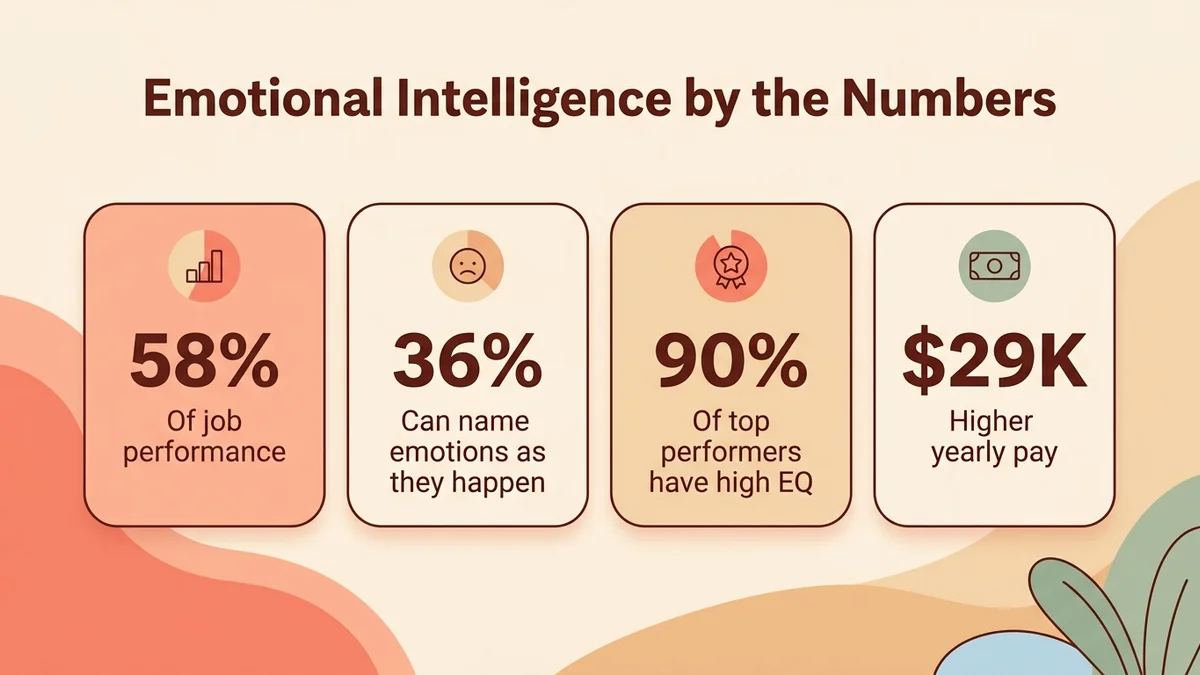
Emotional intelligence rests on 5 pillars: self-awareness, self-regulation, motivation, empathy and social skills. According to TalentSmart, it accounts for 58% of job performance. The good news: unlike IQ, EQ can be trained every day through simple practices like mood tracking, guided breathing and a gratitude journal.
What exactly is emotional intelligence?
Emotional intelligence is the ability to recognize your own emotions and those of others, understand them, and use them as a source of information to guide your thinking and behavior. The concept was formalized in 1990 by psychologists Peter Salovey and John Mayer, then popularized by Daniel Goleman in his 1995 bestseller.
In practice, a person with high EQ knows why they feel irritated (self-awareness), chooses not to send that cutting email (self-regulation), understands that a coworker is stressed rather than hostile (empathy), and adapts their communication accordingly (social skills).
Interest in emotional skills has grown alongside the broader conversation about mental health, both at work and at home. Emotional intelligence sits at the crossroads of personal growth and wellbeing.
Key point: Emotional intelligence isn't the opposite of rationality. Affective neuroscience shows that emotions are essential to decision-making. Neurologist Antonio Damasio found that patients with damage to the brain areas that integrate emotion paradoxically make worse decisions.
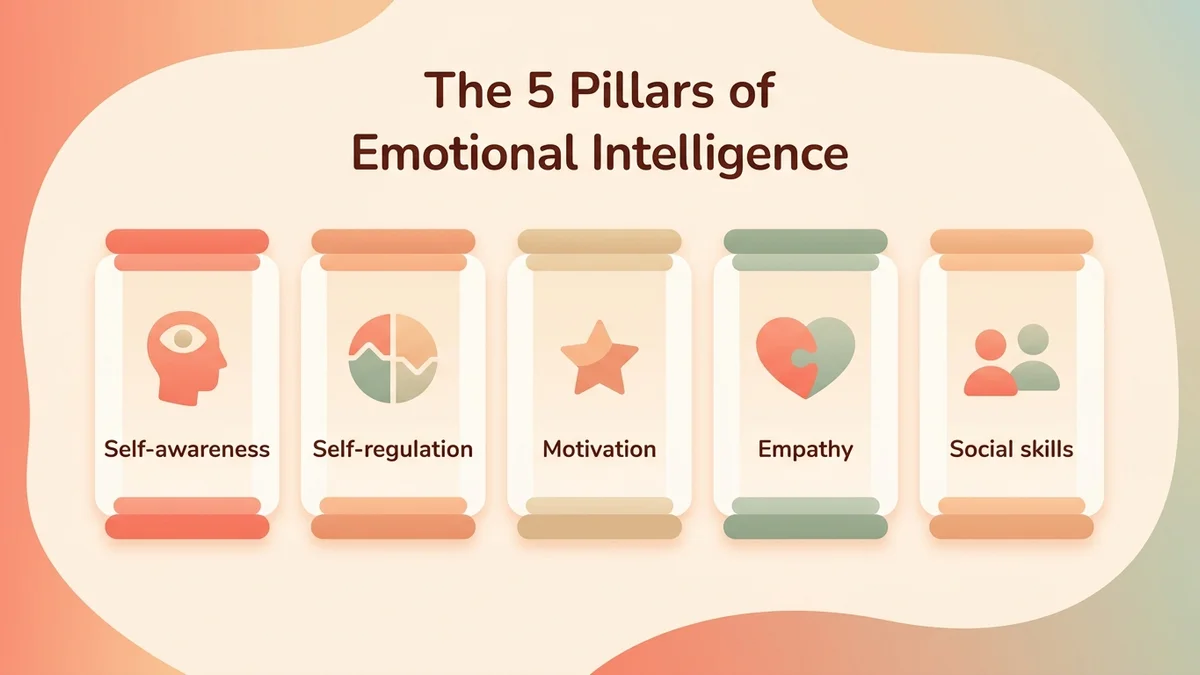
What are Goleman's 5 pillars of emotional intelligence?
Daniel Goleman structured emotional intelligence around 5 interdependent pillars. Each one is a skill you can train on its own, and each strengthens the others.
1. Self-awareness
This is the ability to identify your emotions in real time and understand their impact on your thoughts and actions. Have you ever caught yourself being irritable all day without knowing why? That's a lack of self-awareness.
How to develop it: Keep an emotion journal. Each evening, write down 3 emotions you felt during the day and what triggered them. Within 3 weeks, patterns emerge. Daily mood tracking is an excellent starting point.
2. Self-regulation
This isn't suppressing emotions. It's choosing how to respond to them. It's the difference between "I'm angry and I yell" and "I'm angry, I take 90 seconds to let the wave pass, then I speak calmly."
How to develop it: Use the 90-second technique popularized by neuroscientist Jill Bolte Taylor: the chemical wave of an emotion passes through the body in about 90 seconds if you don't feed it with thoughts. During those 90 seconds, breathe with cardiac coherence. Our cardiac coherence guide explains the method.
3. Motivation
People with high EQ are driven by intrinsic motivation, not just salary or status. They find meaning in what they do and persevere in the face of obstacles.
How to develop it: Practicing gratitude strengthens motivation and resilience. In Robert Emmons' research at the University of California, people who kept a gratitude journal felt more optimistic and even exercised more.
4. Empathy
Empathy goes beyond "putting yourself in someone else's shoes." It's perceiving unspoken emotions: a tone of voice, a forced micro-smile, a silence that says a lot. Psychologist Paul Ekman's research on facial expressions showed how much emotional information passes through nonverbal cues.
How to develop it: Practice active listening. In your next conversation, focus only on what the other person is saying without preparing your reply. Rephrase what you understood before responding.
5. Social skills
This is the ability to manage relationships, inspire others, resolve conflicts and collaborate effectively. Leaders with strong social skills create a climate of trust.
How to develop it: Practice assertive communication: express your needs clearly without aggression or passivity. The DESC model (Describe, Express, Specify, Consequences) is a practical framework.
| Pillar | Key question | Daily exercise | Duration |
|---|---|---|---|
| Self-awareness | "What am I feeling right now?" | Emotion journal (3 emotions/day) | 5 min |
| Self-regulation | "How do I want to respond?" | 90-second breathing before reacting | 2 min |
| Motivation | "Why does this matter to me?" | Gratitude journal (3 things/day) | 5 min |
| Empathy | "What is the other person feeling?" | Active listening without interrupting | 10 min |
| Social skills | "How am I communicating?" | Constructive feedback (DESC model) | 5 min |
How do you know if you have high emotional intelligence? Self-assessment
Before working on your EI, it helps to know where you stand. Here's a quick self-assessment based on criteria used in research. For a more structured score, take our free emotional intelligence test.
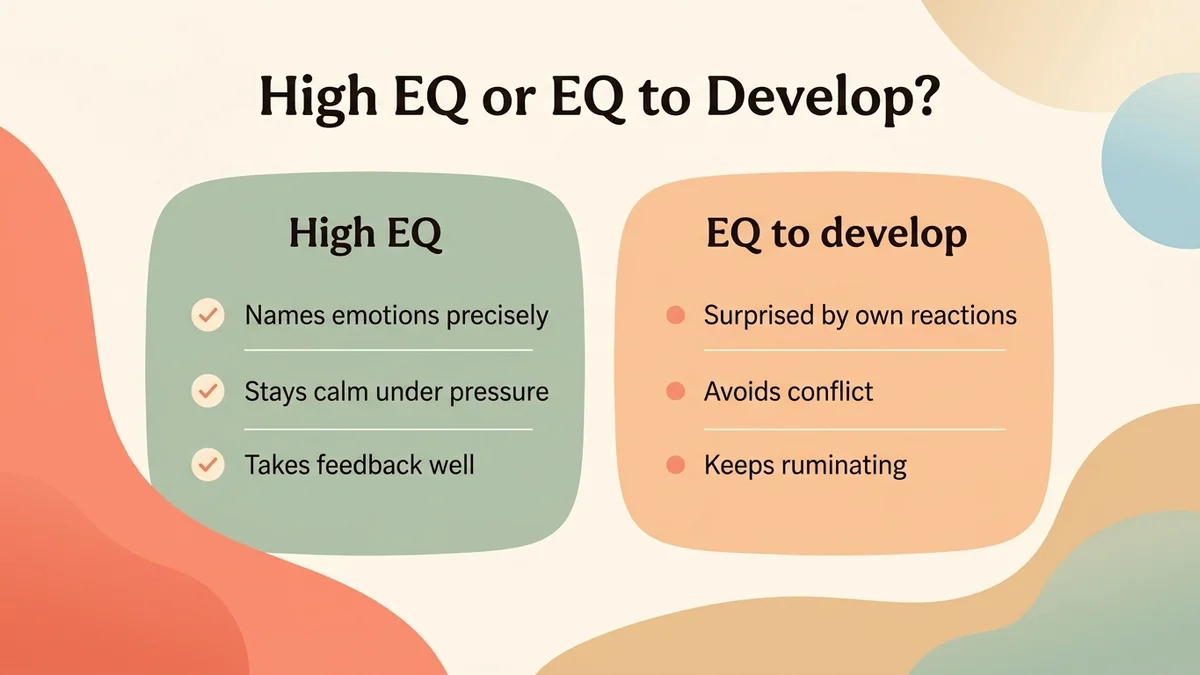
Signs of high EQ:
- You can name exactly what you're feeling (not just "fine" or "stressed")
- You stay calm under pressure and step back before reacting
- You accept criticism without feeling personally attacked
- People confide in you easily
- You adapt your communication to the person you're talking to
- You recognize when you're wrong and apologize sincerely
- You sense tension in a group before it erupts
Signs your EQ could use work:
- You're often surprised by the intensity of your emotional reactions
- Conflicts overwhelm you, or you systematically avoid them
- You struggle to understand why people react the way they do
- You ruminate over past situations without being able to let go
- People tell you that you lack tact or are "too blunt"
According to Travis Bradberry and Jean Greaves, authors of Emotional Intelligence 2.0, only 36% of people they tested could accurately identify their emotions as they happened. That's not a life sentence: emotional skills improve with consistent practice.
Scientific tests to go further
| Test | Type | Items | Access | Scientific validity |
|---|---|---|---|---|
| EQ-i 2.0 (Bar-On model) | Professional | 133 | Certified practitioner | High (widely studied) |
| MSCEIT (Mayer-Salovey-Caruso) | Ability | 141 | Professional | High (academic reference) |
| Schutte Self-Report EI Test | Self-report | 33 | Free (research use) | Moderate (validated in research) |
| Serena EQ test | Self-reflection | Short | Free online | Indicative only (not a clinical tool) |
IQ vs. EQ: why emotional intelligence matters more than you think
For a long time, people believed IQ determined success. More recent data tells a more nuanced story.
| Criterion | IQ | EQ (emotional quotient) |
|---|---|---|
| Measures | Logic, memory, reasoning | Perceiving, managing and using emotions |
| Stability | Relatively fixed after adolescence | Evolves throughout life |
| Impact on job performance | Important for technical tasks | 58% of performance (TalentSmart) |
| Impact on salary | Moderate correlation | +$29,000/year on average (TalentSmart) |
| Trainable | Only slightly | Strongly |
TalentSmart's testing also found that 90% of top performers score high in emotional intelligence. And the trend is accelerating with the rise of AI: cognitive tasks are increasingly automated, while empathy, relational creativity and conflict management remain distinctly human.
Emotional intelligence accounts for 58% of performance across job types, making it one of the strongest predictors of workplace success, according to TalentSmart.
7 practical exercises to develop your emotional intelligence every day
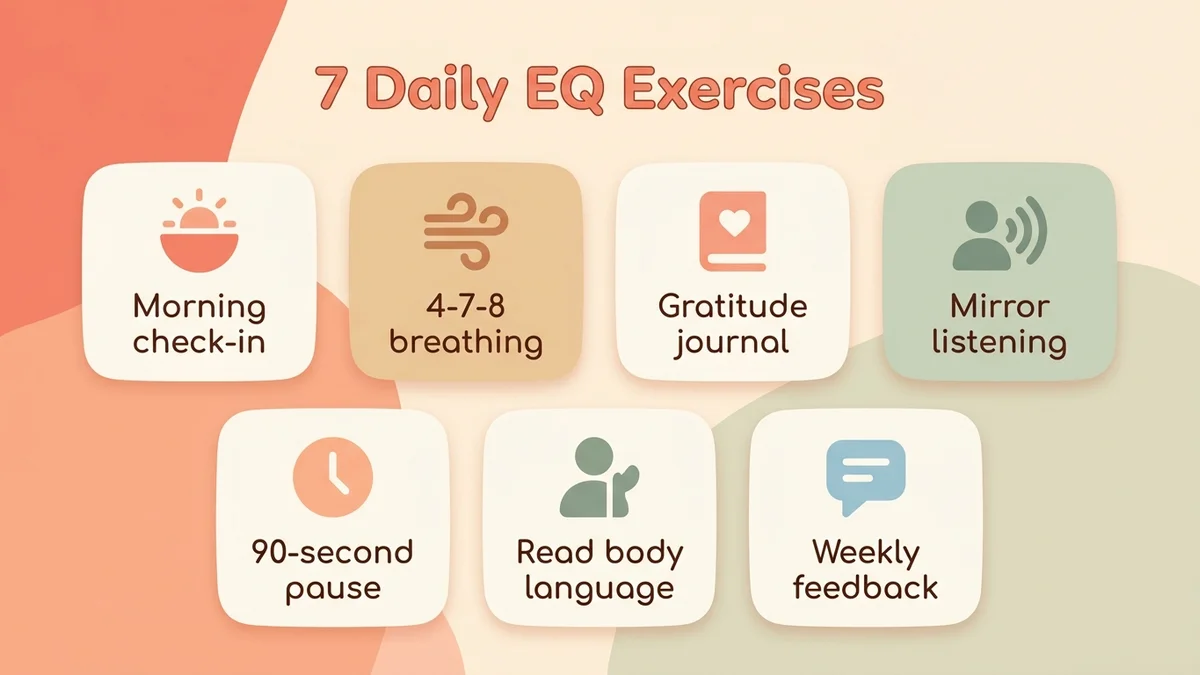
Let's move from theory to action. These 7 exercises draw on affective neuroscience research and feedback from Serena users.
1. The morning emotional check-in (3 min)
When you wake up, ask yourself: "How am I feeling this morning, on a scale of 1 to 10?" Then name the precise emotion. Not "good" or "bad," but "excited," "apprehensive," "calm," "annoyed." Emotional vocabulary is the gateway to self-awareness.
2. 4-7-8 breathing before stressful situations (2 min)
Before a difficult meeting, an interview or a potential conflict, practice 4-7-8 breathing: breathe in for 4 seconds, hold for 7, breathe out for 8. This technique activates the parasympathetic nervous system and calms the stress response in under 2 minutes. Our guided 4-7-8 breathing tool counts for you.
3. The targeted gratitude journal (5 min)
Each evening, write down 3 moments when you felt a positive emotion AND identify why. "Grateful because Mark helped me with the project" = you're training self-awareness AND empathy. Our gratitude journal guide explains the science.
4. Mirror listening (10 min per conversation)
In a conversation, listen without preparing your reply. Then rephrase: "If I understand correctly, you feel emotion because situation." This practice develops empathy and social skills at the same time.
5. The 90-second pause (in conflict)
When a strong emotion rises, count to 90 in your head. According to neuroscientist Jill Bolte Taylor, that's about how long the chemical reaction of an emotion takes to move through the body. After 90 seconds, you respond with your prefrontal cortex, not your amygdala.
6. The micro-expression scan (daily)
During your interactions, notice nonverbal signals: jaw tension, averted eyes, crossed arms, micro-smiles. This attention trains your cognitive empathy. Start by observing one person a day.
7. Weekly constructive feedback
Each week, give one person sincere positive feedback and ask for feedback on yourself. Use the DESC model: Describe the situation, Express how you feel, Specify your request, and share the positive Consequences.
Emotional intelligence in the age of AI: why EQ is the skill of 2026
Automatable tasks (data analysis, writing, coding) are increasingly handed off to machines. What remains irreplaceable: the ability to build trust, read a room and support someone through a difficult moment. The World Economic Forum's Future of Jobs reports consistently rank skills like resilience, empathy and active listening among the most in-demand capabilities.
Organizations that invest in emotional skills also invest in prevention: people who can recognize and regulate stress early are better protected against burnout.
For people changing careers (like many Serena readers), EQ is a differentiating asset. A developer who can communicate with non-technical colleagues, a manager who notices when their team is struggling, a salesperson who truly listens: that's what AI can't do.
Real-life scenarios
Scenario 1: The email that raises the tension
Sarah, 38, project manager. She receives a curt email from her director: "The numbers aren't good. We'll talk tomorrow." In the past, she would have ruminated all night. Now she does an emotional check-in: "I feel threatened and defensive." She names the emotion, practices 5 minutes of cardiac coherence, then calmly prepares her response with facts. The next day, the meeting goes well. Her director was just in a hurry, not upset.
Scenario 2: The friend who isn't okay
Tom, 27, developer. His friend says "I'm fine" in a tone that says the opposite. Before, he would have taken the answer at face value. Now he practices mirror listening: "You don't sound so sure. What's going on?" His friend ends up opening up about early signs of burnout. Tom listens without giving advice and suggests he talk to a professional.
Scenario 3: The job interview
Nadia, 31, changing careers. In an interview, the recruiter asks a destabilizing question. Instead of panicking, she takes 3 seconds of silence (self-regulation), honestly acknowledges she doesn't know the topic in depth, and explains how she would learn it. The recruiter is impressed by her emotional maturity. She gets a callback.
The Serena perspective
At Serena, we see that users who track their mood daily develop a noticeably richer emotional vocabulary within 4 to 6 weeks. Instead of "I'm fine" or "I'm stressed," they identify nuances: "I feel under pressure but not unmotivated," "I'm emotionally tired but not sad."
This emotional granularity is exactly what Daniel Goleman describes as self-awareness, the first pillar of EI. Theory says emotional vocabulary is the key. What we observe in the field is that simply naming an emotion 3 times a day in the app reduces perceived stress intensity by 20 to 30% within a month.
Serena Coach tip: Don't try to develop all 5 pillars at once. Start with self-awareness (check-in + mood tracking) for 3 weeks. When it becomes automatic, add self-regulation (breathing). Then empathy. Stack your habits one by one.
How Serena helps you develop your emotional intelligence
Serena was designed as a daily emotional development tool. Each feature maps to a pillar of EI:
| EI pillar | Serena feature | How it helps |
|---|---|---|
| Self-awareness | Mood tracking (Circumplex model) | Identify your emotions precisely and spot your patterns |
| Self-regulation | 6 guided breathing techniques | Calm your nervous system in 2-5 minutes |
| Motivation | Daily gratitude journal | Strengthen your intrinsic motivation and resilience |
| Empathy | Personalized emotional insights | Better understand your triggers and those of others |
| Social skills | Reminders and progress tracking | Build lasting regulation habits |
5 minutes a day is enough. Download Serena for free and start with the morning emotional check-in.
Daniel Goleman explains emotional intelligence
To understand the foundations of the concept, this Big Think video featuring Daniel Goleman sums up the key principles of emotional intelligence and why it matters so much for success.
As Goleman explains, emotional intelligence isn't a luxury but a necessity for navigating a complex world. You can put his principles into practice every day with Serena, which guides you in developing each pillar.
Frequently asked questions
Is emotional intelligence innate or learned?
Both. Genetic factors influence baseline emotional reactivity, but EI develops considerably with experience and practice. According to Daniel Goleman, EQ tends to increase with age. Programs combining mindfulness with emotional skills training show that it's far more trainable than IQ.
What's the difference between IQ and emotional quotient?
IQ measures analytical cognitive abilities. EQ assesses the ability to perceive, understand and manage emotions. Both are useful, but in different areas. IQ helps you solve a technical problem. EQ helps you convince your team to implement the solution. According to TalentSmart, EQ accounts for 58% of performance across job types.
How can I develop emotional intelligence quickly?
"Quickly" is relative, but progress is measurable within 3 to 4 weeks. Start with a daily emotional check-in (name 3 emotions a day). Add cardiac coherence (5 minutes, 3 times a day). Keep a gratitude journal in the evening. These 3 habits target Goleman's pillars 1, 2 and 3 at the same time.
What's the link between emotional intelligence and empathy?
Empathy is the 4th pillar of emotional intelligence. It has two dimensions: cognitive empathy (intellectually understanding what someone feels) and affective empathy (physically feeling the other person's emotion). EI includes empathy but goes further: it adds managing your own emotions and social skills.
What is a highly sensitive person, and how does it relate to EQ?
A highly sensitive person (HSP), a trait described by psychologist Elaine Aron, processes emotions and sensory information more deeply than average. High sensitivity isn't the same as high emotional intelligence: sensitive people feel more intensely, and EI skills help them manage that intensity. Learn more in our highly sensitive person guide or take the HSP test.
Can children develop their emotional intelligence?
Yes, and it's even easier in childhood. Psychologist John Gottman showed that "emotion coaching" — naming emotions with children from age 2 or 3 ("you're frustrated because...") — builds the foundations of EQ. A landmark meta-analysis of more than 200 school-based social and emotional learning programs (Durlak et al., 2011) found improved social skills, fewer conduct problems and better academic performance.
What's the difference between empathy and emotional intelligence?
Empathy is a component of emotional intelligence, not a synonym. EI spans 5 pillars: self-awareness, self-regulation, motivation, empathy and social skills. A very empathetic person who can't manage their own emotions has only partial EQ. Full EI means perceiving emotions AND knowing what to do with them.
Does emotional intelligence help manage stress and anxiety?
Directly. Self-awareness lets you detect stress before it becomes chronic. Self-regulation gives you tools to manage it (breathing, cognitive reframing). Our article on the signs of chronic stress details the signals to watch for. Research consistently links higher emotional intelligence to lower stress and better psychological wellbeing.
Conclusion
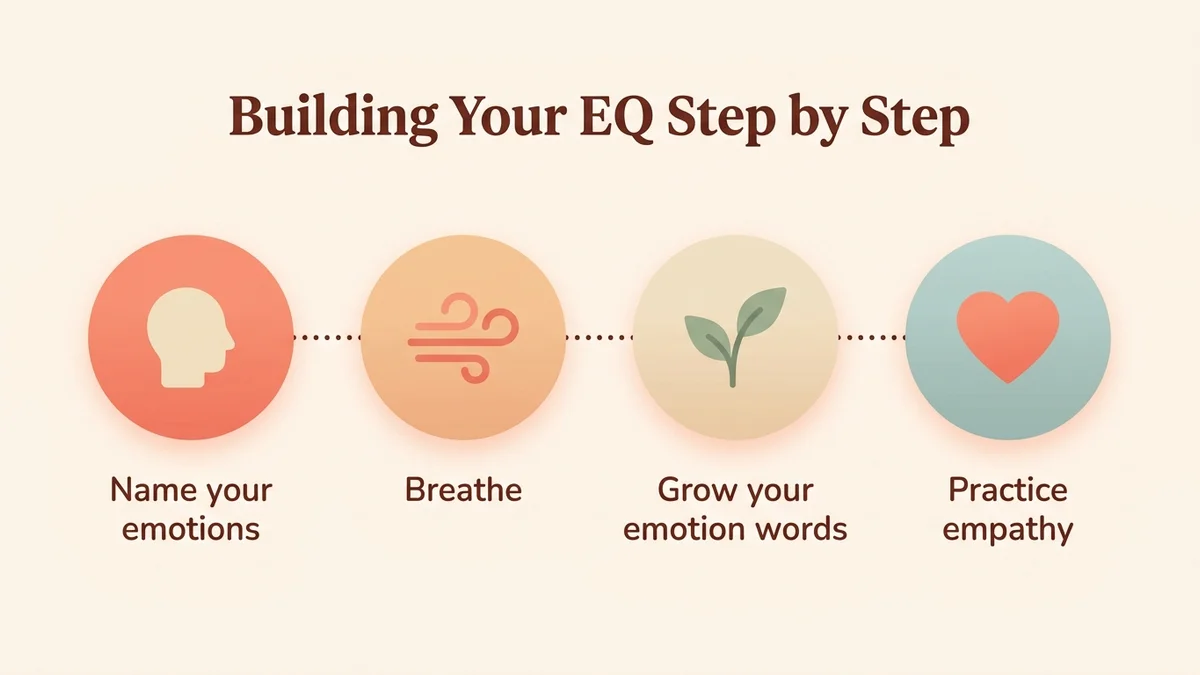
Emotional intelligence isn't a talent reserved for a chosen few. It's a set of skills you can train, measure and develop throughout your life. Goleman's 5 pillars offer a clear framework, and the 7 exercises in this guide give you a concrete action plan.
Start small: a morning emotional check-in, guided breathing when stress rises, three lines of gratitude in the evening. Within 4 weeks, you'll notice the difference in your relationships, your decision-making and your wellbeing.
Serena supports you along the way with mood tracking, guided breathing and a gratitude journal. Develop your emotional intelligence in 5 minutes a day. Try it for free.