You cry at a movie no one else in the theater seems to find moving. A piece of music goes right through you. An offhand comment from your boss stays in your head for three days. You feel like you experience everything at full volume, while the people around you just say "you're too sensitive."
Updated in April 2026, this guide helps you understand what high sensitivity tests actually measure, recognize the concrete signs of the trait, and above all, know what to do with that information. Because yes, there's a clear way to approach the question "am I a highly sensitive person?" — and it's grounded in 30 years of scientific research.
The key takeaways
High sensitivity, or Sensory Processing Sensitivity (SPS), is a temperament trait found in roughly 15 to 30% of people. It's neither a weakness nor a disorder. Identified by psychologist Elaine N. Aron in the 1990s, it's characterized by deeper processing of information, high emotional reactivity and sensitivity to subtle details in the environment. Learning to recognize it is the first step toward living well with it.
What exactly is high sensitivity?
Let's be honest: "highly sensitive" gets used loosely, often imprecisely. So let's lay the groundwork.
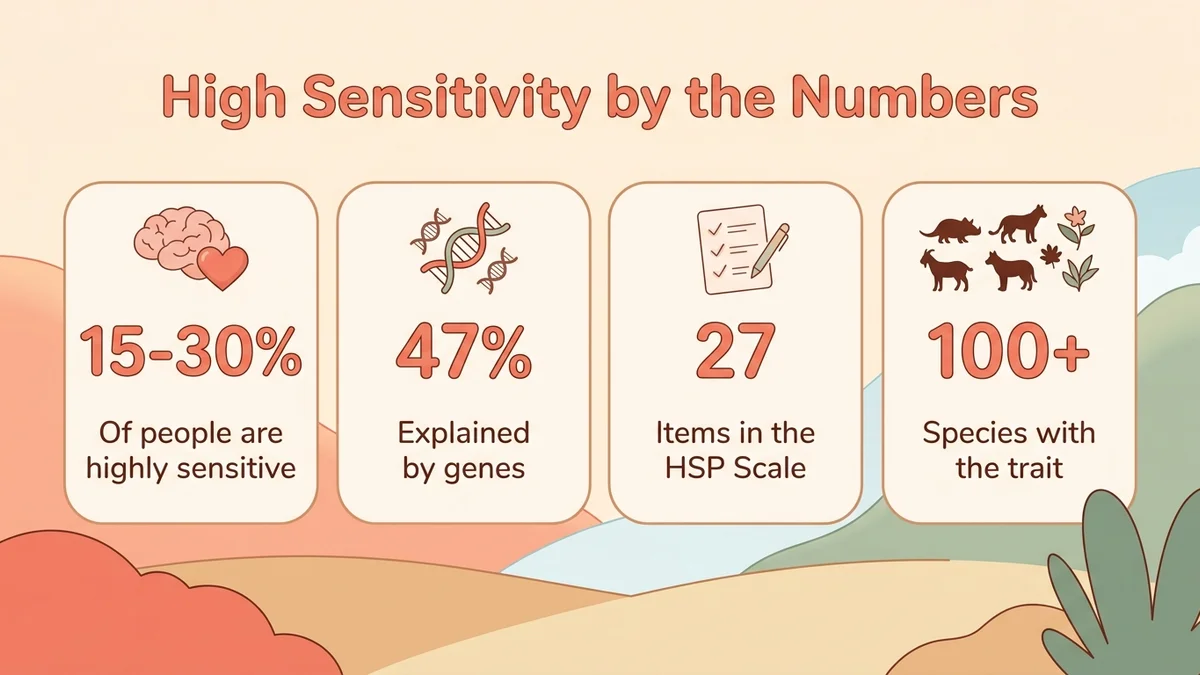
American psychologist Elaine N. Aron formalized the concept in the 1990s under the name Highly Sensitive Person (HSP). Her work led to a standard measurement tool, the HSP Scale, made up of 27 scientifically validated items (Aron and Aron, 1997).
High sensitivity, also called Sensory Processing Sensitivity (SPS), is found in roughly 15 to 20% of people according to Aron — and up to about 30% in later research that identified "orchids" among adults (Lionetti et al., 2018). Aron reports similar traits in more than 100 animal species, which suggests an evolutionary strategy rather than an anomaly. A large twin study estimated heritability at about 47% (Assary et al., 2021).
Her bestselling book The Highly Sensitive Person (1996) brought the concept to the general public, and her website remains a reference for people exploring the trait.
The DOES model: the 4 pillars of high sensitivity
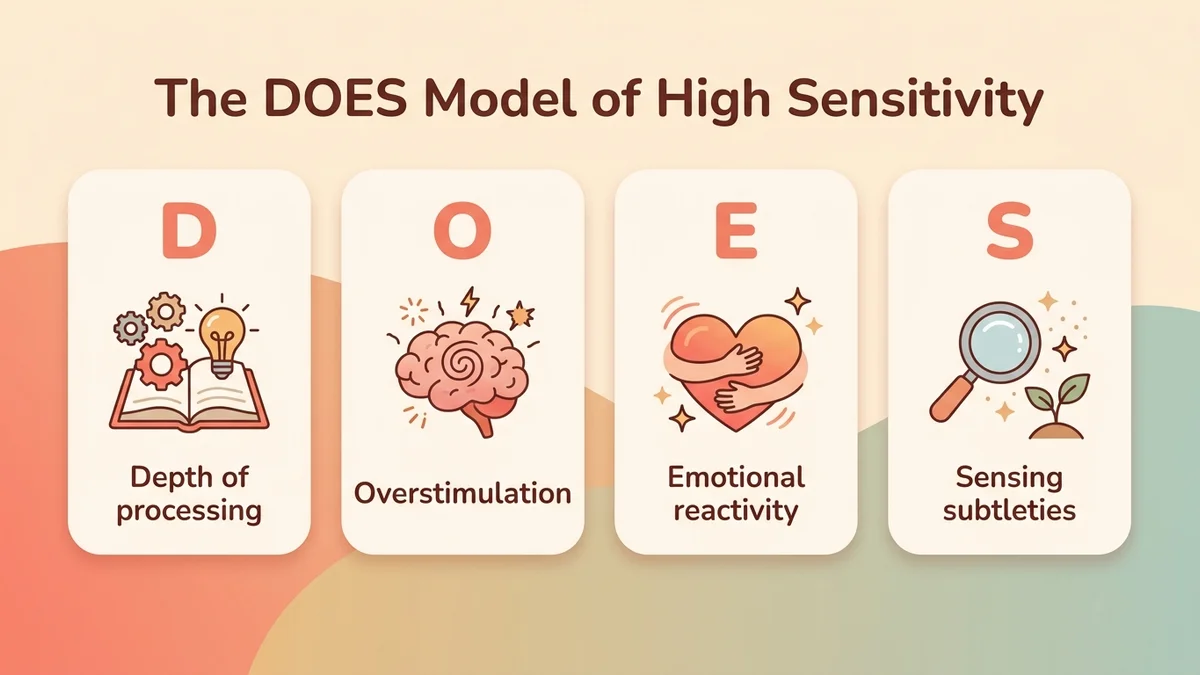
Elaine Aron described high sensitivity through four dimensions, grouped under the acronym DOES:
| Letter | Dimension | What it means in practice |
|---|---|---|
| D | Depth of processing | You analyze every situation deeply. You think about consequences, nuances and details others don't notice. |
| O | Overstimulation | After a busy day, you're exhausted even if you haven't done anything physical. Noisy environments, crowds and multitasking overwhelm you quickly. |
| E | Emotional reactivity & Empathy | Your emotions are intense. You also feel other people's emotions, sometimes before they express them. Strong empathy is often at the heart of this pillar. |
| S | Sensitivity to Subtleties | You notice fine details: a change of mood in someone's voice, a slight shift in lighting, a false note in a conversation. |
On a neurobiological level, brain imaging studies (Acevedo et al., 2014) found that highly sensitive people show stronger activation in areas linked to awareness, empathy and action planning — including the insula and regions associated with the mirror neuron system. Their nervous systems respond more strongly to stimuli, which explains the fatigue that follows overstimulation.
High sensitivity isn't a manufacturing defect. It's a finer-grained information processing system, with real advantages in the right contexts — the central message of Elaine Aron's work.
"I feel everything at full volume": 12 telltale signs
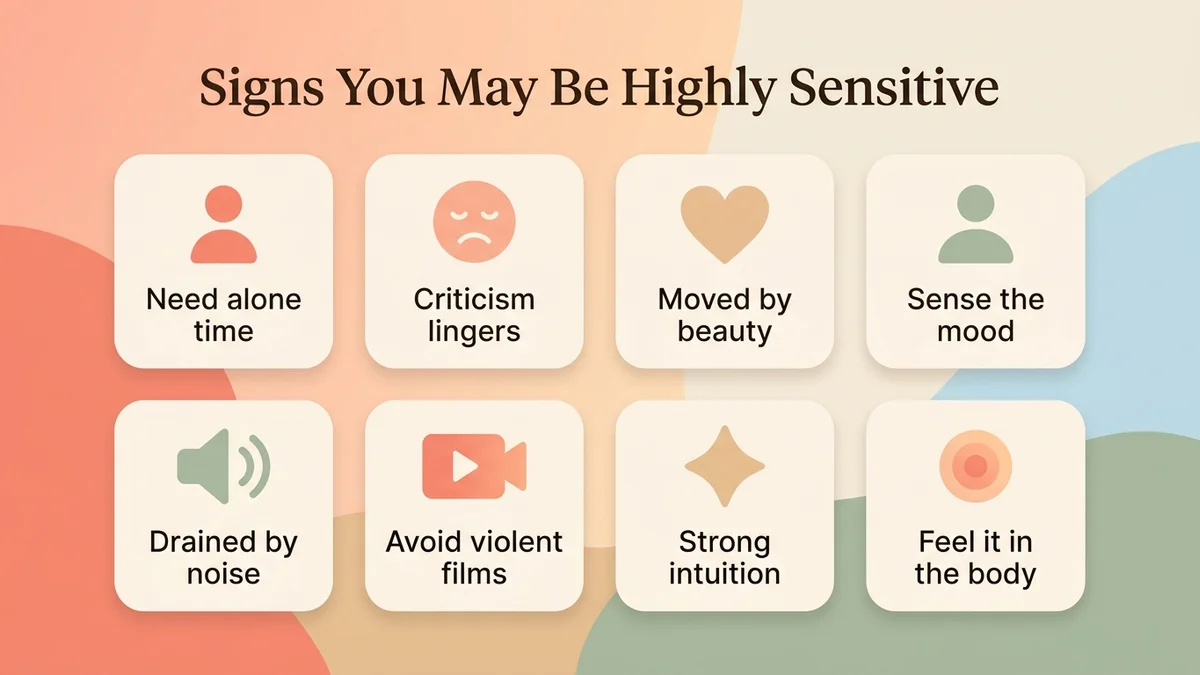
How do you know if you're highly sensitive? Not by checking boxes at random, but by noticing recurring patterns in your life. Here are the 12 most documented signs.
1. You need time alone to "decompress"
After any social interaction, even a pleasant one, you feel the need to be alone. Not because you don't like people, but because your nervous system has absorbed too many stimuli. An hour of quiet isn't a luxury: it's a necessity.
2. Criticism affects you for a long time
A comment, even a kindly worded one, can stay in your head for hours or even days. Rumination is a classic feature of high sensitivity. You replay the scene, analyze every word, and search for what you could have done differently.
3. You're deeply moved by beauty
A melody, a sunset, a well-written sentence: these things truly move you, sometimes physically. Chills, tears, a sense of fullness. Deep processing applies to art and beauty too.
4. You absorb the emotional atmosphere of places
You walk into a room where an argument just happened and you sense it immediately, without anyone saying a word. This sensitivity to emotional atmosphere is linked to heightened activity in empathy-related brain networks.
5. Noise, light and crowds drain you
A noisy open-plan office, a grocery store on a Saturday afternoon, harsh fluorescent lights: what feels "normal" to others is physically exhausting for you. Overstimulation isn't in your head — it's in your nervous system.
6. You avoid violent movies or shows
Violence, scenes of animal suffering, horror films: you struggle to watch them, not because you're fearful, but because you experience them from the inside with an intensity others may not feel.
7. You've often been called "too sensitive"
The people around you have used that phrase since childhood. Parents, teachers, coworkers: "you take things too much to heart." This experience of being misunderstood is one of the most common markers of highly sensitive people.
8. You have strong intuition
You sense when something's wrong, when someone isn't being honest, when a situation is about to go badly. This intuition isn't magic: it's the product of finely processing hundreds of micro-signals that your brain integrates in real time.
9. You get overwhelmed by decisions
Not just major life decisions: even choosing a restaurant when you're tired can become a puzzle. The deep processing that comes with high sensitivity consumes a lot of mental resources.
10. You react physically to emotions
A tight throat, a knotted stomach, tension in your chest: your emotions show up in your body. This link is well documented in research on the somatization of anxiety and is common among HSPs.
11. You need meaning in what you do
Working "just for a paycheck" weighs on you. You look for meaning, coherence and alignment between your values and your actions. This isn't a whim: it's built into how highly sensitive people function.
12. Hunger, pain or fatigue strongly affect your state
When you're hungry, you're not yourself. When you're short on sleep, your sensitivity multiplies. Some HSPs describe it as a "cascade": one unmet physical need amplifies every other sensation.
Comparison table: HSP vs. non-HSP
| Situation | Typical HSP reaction | Typical non-HSP reaction |
|---|---|---|
| A noisy 3-hour meeting | Exhaustion, need for complete quiet afterward | Normal fatigue, quick recovery |
| Criticism from a manager | Replaying it for 24-48 hours | Taking it on board and moving on |
| A sad movie | Tears, emotional resonance for hours | Passing emotion, forgotten within the hour |
| Open-plan office | Trouble focusing, sensory overload | Gradual adaptation possible |
| Unexpected change | Intense stress, need time to adjust | Mild irritation, quick adjustment |
| Tense atmosphere | Immediate, intense perception, even without explanation | Noticed only if the signals are clear |
How to know if you're highly sensitive: the validated test
The good news: there's a scientifically validated tool to answer this question. Elaine Aron's HSP Scale includes 27 statements. You rate each one on a scale from 1 to 7 (from "not at all" to "extremely").
Key statements from the HSP Scale (representative selection)
| Statement | Score (1-7) |
|---|---|
| I am easily overwhelmed by strong sensory input (bright lights, strong smells, coarse fabrics, sirens) | ... |
| I get rattled when I have a lot to do in a short amount of time | ... |
| I am deeply moved by the arts or music | ... |
| I am bothered when there are many things going on at once | ... |
| I make a point of avoiding mistakes and not forgetting things | ... |
| I am easily bothered by unpleasant stimuli | ... |
| Other people's moods affect me | ... |
| I am particularly sensitive to the effects of caffeine | ... |
Rough interpretation: if many of the 27 statements feel strongly true for you, you probably have the HSP trait. But remember, this is a self-assessment tool, not a diagnosis.
Take the test online for free
Rather than calculating your score by hand, you can take our free highly sensitive person test: 24 questions, 3 minutes, no sign-up. It has one advantage over most online tests: instead of a simple "yes or no," it gives you a detailed profile across the 4 dimensions of the DOES model. You can see which one dominates for you, and therefore what to work on first.
When should you see a professional?
A high sensitivity test is a starting point. It doesn't replace a psychological evaluation. See a therapist if:
- Your sensitivity significantly affects your work or relationships
- You have persistent symptoms of social anxiety
- You experience chronic emotional distress
- You struggle to distinguish your emotions from other people's
A psychologist familiar with the HSP concept (increasingly common) can help you understand your profile in depth.
Quotable: Highly sensitive people process information more deeply than average, which makes them both more vulnerable to overload and more able to perceive nuances others miss.
Emotional vs. sensory sensitivity: what's the difference?
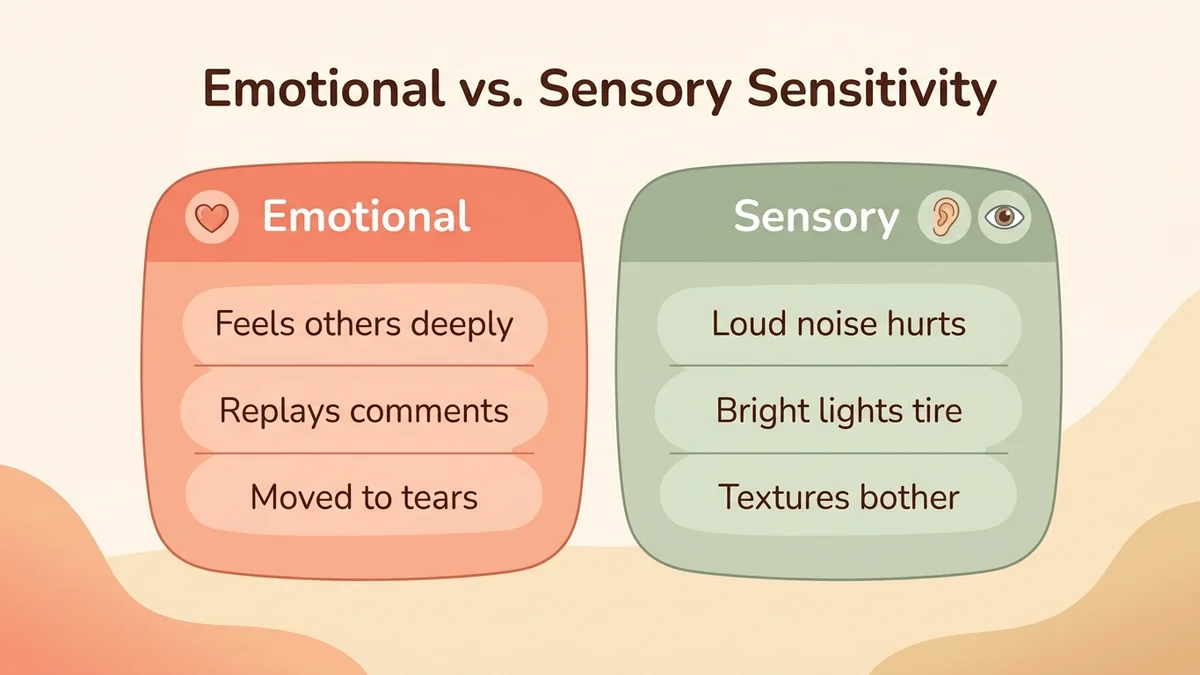
High sensitivity is often discussed as one uniform block. In reality, it takes two main forms that can coexist.
| Dimension | Emotional sensitivity | Sensory sensitivity |
|---|---|---|
| Definition | Intense emotional reactions to events, words or other people's emotions | Heightened reactivity of the five senses (hearing, sight, smell, touch, taste) |
| Examples | Crying at a documentary, feeling a loved one's anxiety, replaying a comment | Discomfort with loud noises, trouble with fluorescent lights, sensitivity to textures |
| Mechanism | Strong emotional reactivity, highly active empathy networks | Low sensory threshold, reactive autonomic nervous system |
| Associated risk | Emotional exhaustion, mood swings, relational burnout | Physical fatigue, social avoidance, difficulties at work |
| Strength | Deep empathy, well-developed emotional intelligence | Fine perception, creativity, artistic sensitivity |
According to Elaine Aron, both forms are often present at the same time in HSPs. A "sensory-dominant" profile is mostly drained by the physical environment. An "emotional-dominant" profile is mostly affected by relationship dynamics.
HSP, giftedness, introversion, autism: understanding the differences
This is one of the most common areas of confusion. These four profiles are often mixed up or wrongly linked.
| Characteristic | HSP (high sensitivity) | Intellectual giftedness | Introversion | Autism (ASD) |
|---|---|---|---|---|
| Definition | Temperament trait linked to deep processing | High cognitive ability (IQ above ~130) | Preference for less social stimulation | Neurodevelopmental condition |
| Prevalence | About 15-30% of people | About 2% of people | Roughly a third to half of people | About 1 in 31 US children (CDC) |
| Origin | Neurobiological, about 47% heritable | Neurobiological, heritable | Personality trait, partly heritable | Genetic/neurological |
| How it's measured | HSP Scale (27 items, Aron) | Standardized IQ tests | Personality questionnaires | DSM-5 criteria, clinical evaluation |
| Key feature | Overstimulation, deep processing | Fast, complex reasoning | Recharges through solitude | Social communication differences, restricted or repetitive behaviors |
| Can they coexist? | Yes, with the others | Yes, with HSP | Yes — though Aron notes about 30% of HSPs are extroverts | Yes, with HSP (but distinct mechanisms) |
The key point: high sensitivity isn't autism. There's some symptom overlap (sensory sensitivity, difficulty in noisy environments), but the mechanisms are distinct. If you're seriously wondering, a professional evaluation is the only reliable path.
"How do I stop being an emotional sponge?": real-life scenarios
Theory is useful. But here's what it looks like in practice.
Scenario 1: The noisy open-plan office
Jason, 34, is a developer at an 80-person company. His open-plan office holds 30 coworkers, constant phone calls and clattering keyboards. By 3 p.m., he feels a fatigue his coworkers don't. His focus has collapsed. He goes home feeling like he's spent the day on a construction site.
What he learns: it's not a lack of willpower. It's sensory reactivity. He wears noise-canceling headphones, negotiates two remote days a week and gives himself 20 minutes of total silence at lunch. His productivity rebounds.
Scenario 2: The evening with friends
Sara, 29, is part of a close group of eight friends. Every get-together is fun, but after two hours she feels "drained." She smiles and joins in, but inside she has nothing left. She leaves early and her friends don't understand.
What she realizes: she needs to "recharge" after every social stimulation. She learns to leave without guilt, to explain her needs to her friends, and to plan quiet time after each social event.
Scenario 3: The moving film
Tom, 41, has avoided group movie nights for years. Not because he doesn't like movies, but because he feels embarrassed crying in front of everyone at scenes his friends find "not that sad." He sometimes needs an hour after the film to "come back down."
What he integrates: his deep processing gives him an unusually rich artistic experience. It's the same thing that gives him his ability to create, perceive and innovate. He learns to value what his friends sometimes secretly envy.
The Serena perspective: what we see in the field
At Serena, we notice that users who identify as highly sensitive show specific usage patterns. Their mood journals show more emotional variability during the day than the average user. In the evening, they more often select states like "overwhelmed," "restless" or "exhausted for no clear reason."
We also see that they're among the most consistent users of breathing exercises. In particular, cardiac coherence stands out as their number-one tool for returning to calm after a period of overstimulation.
Research on "differential susceptibility" helps explain this. In a study of adults, Francesca Lionetti and colleagues (2018) found that highly sensitive people are more affected by negative environments — but also benefit more from positive, supportive ones. Sensitivity works in both directions.
Quotable: High sensitivity isn't a vulnerability in itself. It's a temperament trait whose expression depends largely on the quality of the environment.
Serena Coach tip
If you recognize yourself in several of the signs described here, start by keeping a mood journal for two weeks. Note not only your emotions but also your sensory context: noise level, number of interactions, sleep quality. Patterns will appear quickly. You'll end up with a map of your overstimulation triggers — far more useful than a simple online test.
How to live better with high sensitivity every day
It's the question almost everyone asks after recognizing the trait: "Okay, I'm highly sensitive. Now what?"
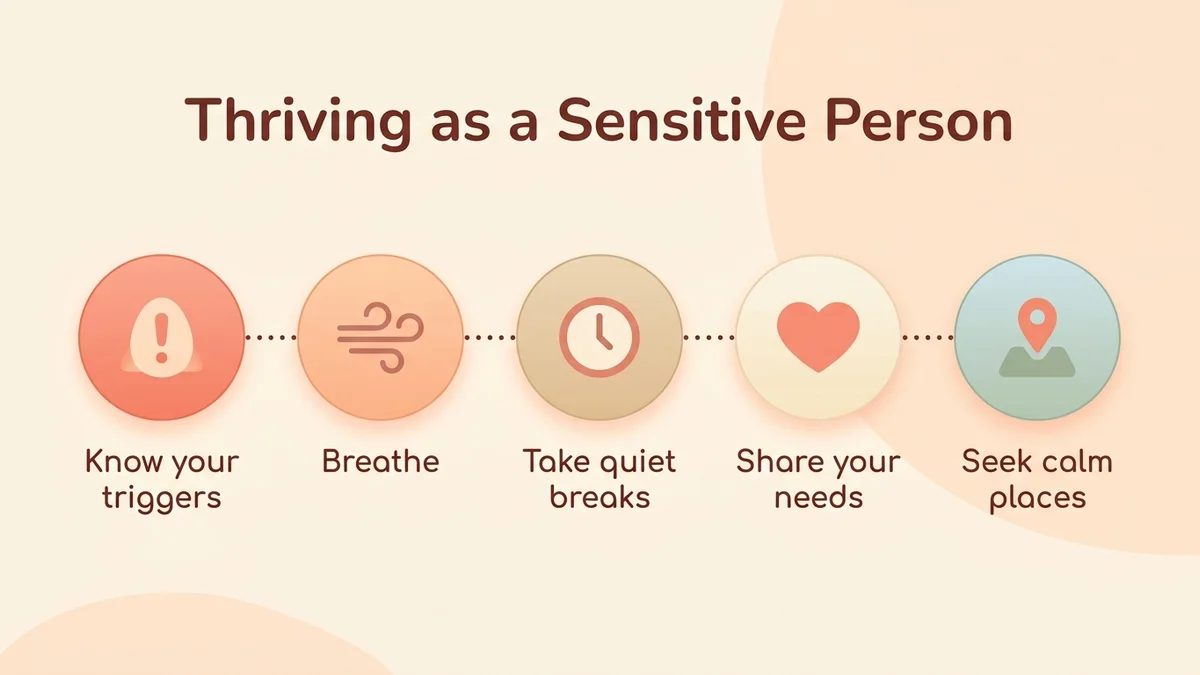
1. Identify your overstimulation triggers
Start by mapping what overloads you. Noise, crowds, conflict, lights, smells, emotionally charged conversations? Sensory reactivity is personal. Your list will be different from another HSP's.
A practical tool: the mood journal in Serena lets you note the context of each emotional state. After a few weeks, the patterns become obvious. You can also locate where stress shows up in your body with our stress body map.
2. Practice cardiac coherence regularly
Cardiac coherence is one of the best-documented emotional regulation tools for highly sensitive people. Three times a day, five minutes each. It acts directly on the autonomic nervous system, which sits at the heart of HSPs' sensory reactivity. Our free cardiac coherence timer guides each breath.
3. Create "decompression zones"
This isn't weakness. It's smart resource management. Plan 20 to 30 minutes of silence after a busy day, before starting another social or mental activity. Anxiety-related hypervigilance persists when the nervous system is never given time to return to baseline.
4. Work on emotional regulation, not suppression
Wanting to "stop feeling" backfires. The goal is emotional regulation: recognizing the emotion, naming it, and choosing how to respond rather than simply reacting. Mindfulness techniques are especially well suited.
5. Communicate your needs to the people around you
"I'm not running away from the party, I need to recharge." That sentence changes everything. Misunderstood sensitivity creates unnecessary conflict. A simple explanation, without apologizing, often opens the door to real understanding.
6. Seek out nourishing environments
Nature, silence, art, quality relationships: highly sensitive people thrive in environments that match their deep processing. It's not withdrawal — it's common sense.
7. Explore a gratitude practice
Highly sensitive people who regularly keep a gratitude journal report better emotional resilience. Gratitude directs attention toward what nourishes rather than what drains, without denying real difficulties.
Serena supports highly sensitive people with emotional regulation every day. Mood tracking, guided breathing exercises, short meditations: the app is designed for the moments when you feel yourself approaching overload. Download Serena for free and start your mood journal today.
Go further: an illuminating video
In this short video, Elaine Aron herself explains what it means to be a highly sensitive person and why the trait is so often misunderstood.
Frequently asked questions about high sensitivity
Is being highly sensitive a disorder?
No, high sensitivity isn't an illness or a psychiatric disorder. It's a temperament trait identified by psychologist Elaine Aron in the 1990s, found in roughly 15 to 30% of people. The trait involves deeper processing of sensory and emotional information. It can create difficulties in some environments and strengths in others.
Is high sensitivity hereditary?
Partly, yes. A large twin study (Assary et al., 2021) estimated that about 47% of differences in sensitivity are explained by genetics. The environment, especially early experiences, also plays a decisive role in how the trait shows up.
Can high sensitivity be cured?
High sensitivity isn't something to cure because it isn't an illness. However, you can learn to manage it better. Tools like cardiac coherence, meditation and mood tracking help regulate the intense emotions linked to this personality trait.
What's the difference between emotional and sensory sensitivity?
Emotional sensitivity refers to intense reactions to your own emotions and those of others. Sensory sensitivity affects the five senses: loud noises, bright lights, uncomfortable textures. According to Elaine Aron, both forms often coexist in highly sensitive people.
Are giftedness and high sensitivity the same thing?
No. Intellectual giftedness refers to high cognitive ability (typically an IQ above 130). High sensitivity is a temperament trait linked to deep processing. The two can coexist, but they're distinct characteristics with different mechanisms.
How do you live with a highly sensitive partner?
Respect their need for quiet time after a stimulating day. Avoid comments like "you're too sensitive." Favor gentle, direct communication. Highly sensitive people need to feel that their experience is validated, not minimized.
Does high sensitivity increase with age?
The trait stays fairly stable throughout life. However, awareness of your sensitivity often grows with age. Chronic stress, fatigue or hormonal changes can temporarily intensify reactions. Getting to know yourself helps you manage these variations better.
My child is highly sensitive. How can I support them?
Validate their emotions without minimizing them. Create a calm, predictable environment. Warn them about upcoming changes. Teach them age-appropriate breathing techniques. High sensitivity in children is a strength when it's met with kindness and support.
Conclusion
High sensitivity isn't a flaw to fix. It's a temperament trait found in a large minority of people, observed across many animal species and supported by 30 years of scientific research. The question "am I highly sensitive?" doesn't call for a medical answer but for self-knowledge.
If you recognize yourself in this guide, the next step isn't to "feel less." It's to learn to navigate with your sensitivity: know your triggers, protect your resources, communicate your needs and value what this trait brings you.
In fact, high sensitivity is often associated with richer creativity, more developed emotional intelligence and a capacity for empathy that can become your most precious asset, in your personal and professional life alike.
Serena is designed to support you on this path of self-knowledge. Mood journal, breathing exercises, guided meditations: tools built for people who feel intensely and want to live better with it. Discover the Serena app, available for free on the App Store.
Sources:
- Aron, E.N. (1996). The Highly Sensitive Person. Broadway Books.
- Aron, E.N., & Aron, A. (1997). Sensory-processing sensitivity and its relation to introversion and emotionality. Journal of Personality and Social Psychology.
- Acevedo, B.P. et al. (2014). The highly sensitive brain: an fMRI study of sensory processing sensitivity and response to others' emotions. Brain and Behavior.
- Lionetti, F. et al. (2018). Dandelions, tulips and orchids: evidence for the existence of low-sensitive, medium-sensitive and high-sensitive individuals. Translational Psychiatry.
- Assary, E. et al. (2021). Genetic architecture of environmental sensitivity reflects multiple heritable components: a twin study with adolescents. Molecular Psychiatry.