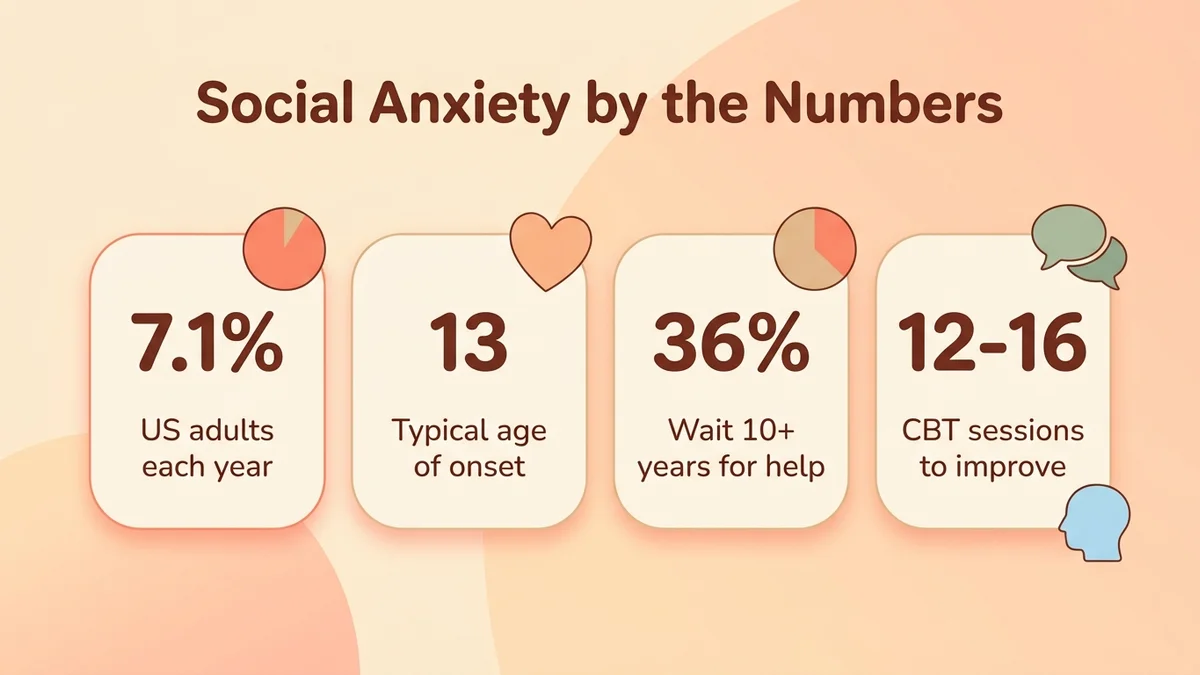
Your palms are sweaty, your heart is racing and your mind keeps spinning before a simple team meeting. You rehearse every word you might say, and yet, when your turn comes, your throat tightens. If this sounds familiar, you're not alone: according to the National Institute of Mental Health (NIMH), about 7.1% of US adults experience social anxiety disorder in any given year — roughly 15 million people, per the Anxiety and Depression Association of America (ADAA). Updated in March 2026.
The good news? This condition responds well to treatment. In this complete guide, you'll learn how to recognize social anxiety, understand how it works and, above all, how to overcome it with concrete, science-backed techniques.
The key takeaways
Social anxiety is a recognized anxiety disorder that goes far beyond ordinary shyness. It's defined by an intense fear of being judged in social situations and affects about 7% of American adults each year. Cognitive behavioral therapy (CBT) produces solid results in 12 to 16 sessions. Techniques like breathing, gradual exposure and cognitive restructuring help you rebuild confidence and calm in everyday life.
What exactly is social anxiety?
Social anxiety, also called social phobia or social anxiety disorder (SAD), is an excessive and persistent fear of being watched, judged or humiliated in social situations. Unlike passing shyness, this DSM-5 condition causes distress that deeply affects daily life.
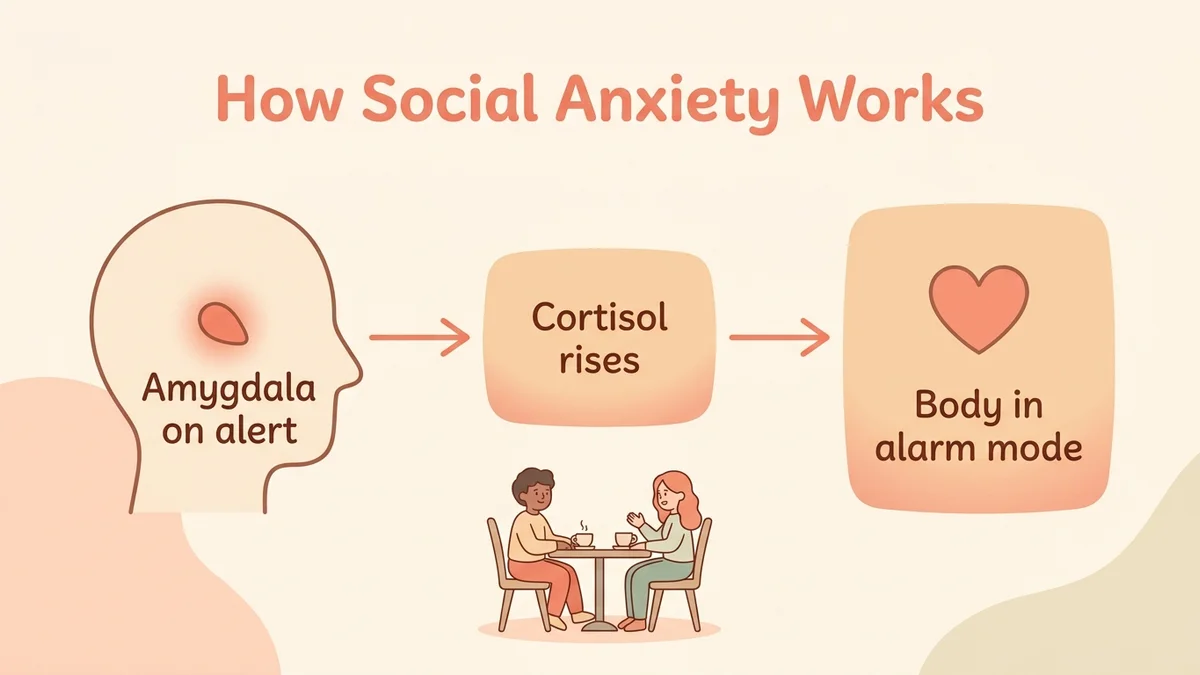
In practical terms, your amygdala — the brain's fear center — fires disproportionately in response to perfectly ordinary social situations. It sends alarm signals as if you were in danger, when you're simply having lunch with coworkers or making a phone call.
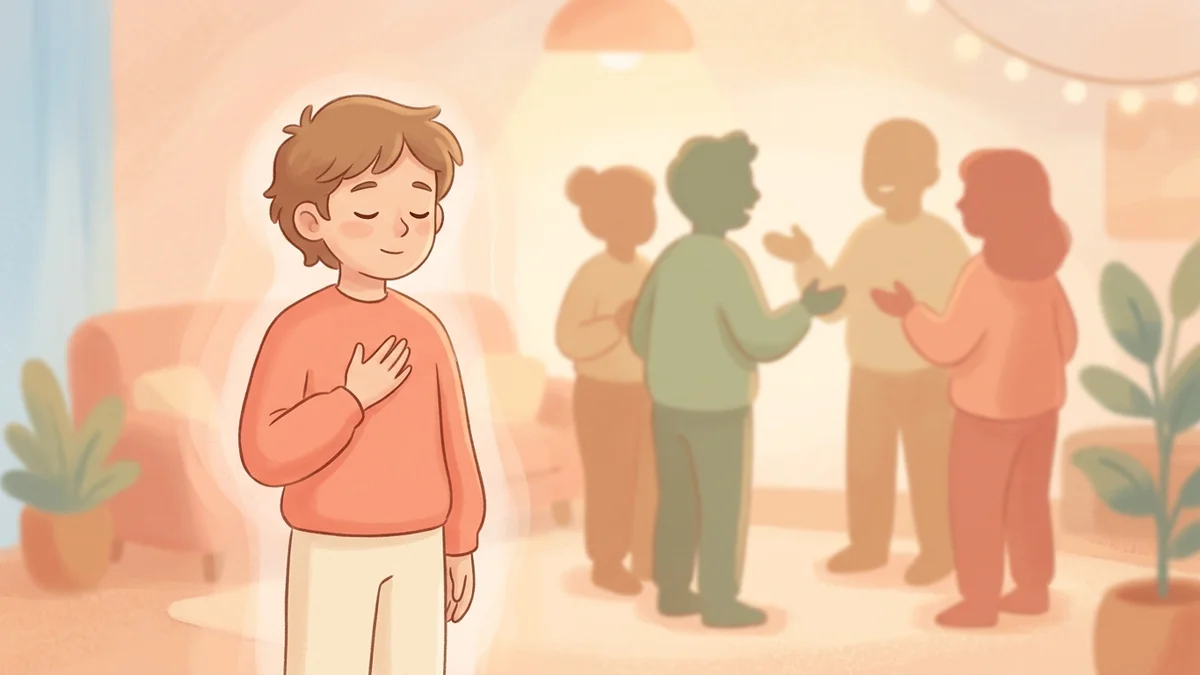
Key point: Social anxiety isn't a lack of willpower or a character flaw. It's a well-identified neurobiological pattern that responds to scientifically validated approaches.
Social anxiety, social phobia or shyness: what's the difference?
These three terms are often confused. Here's how to tell them apart:
| Characteristic | Shyness | Social anxiety | Severe social phobia |
|---|---|---|---|
| Intensity | Mild discomfort | Marked fear | Intense panic |
| Daily impact | Minimal | Moderate to significant | Disabling |
| Avoidance | Rare | Frequent | Systematic |
| Duration | Passing | Persistent (>6 months) | Chronic |
| Need for treatment | No | Recommended | Necessary |
The line between them lies in the intensity of the suffering and the degree of avoidance. Shyness makes a party uncomfortable; social anxiety makes you skip it — and the next ten.
What are the symptoms of social anxiety?
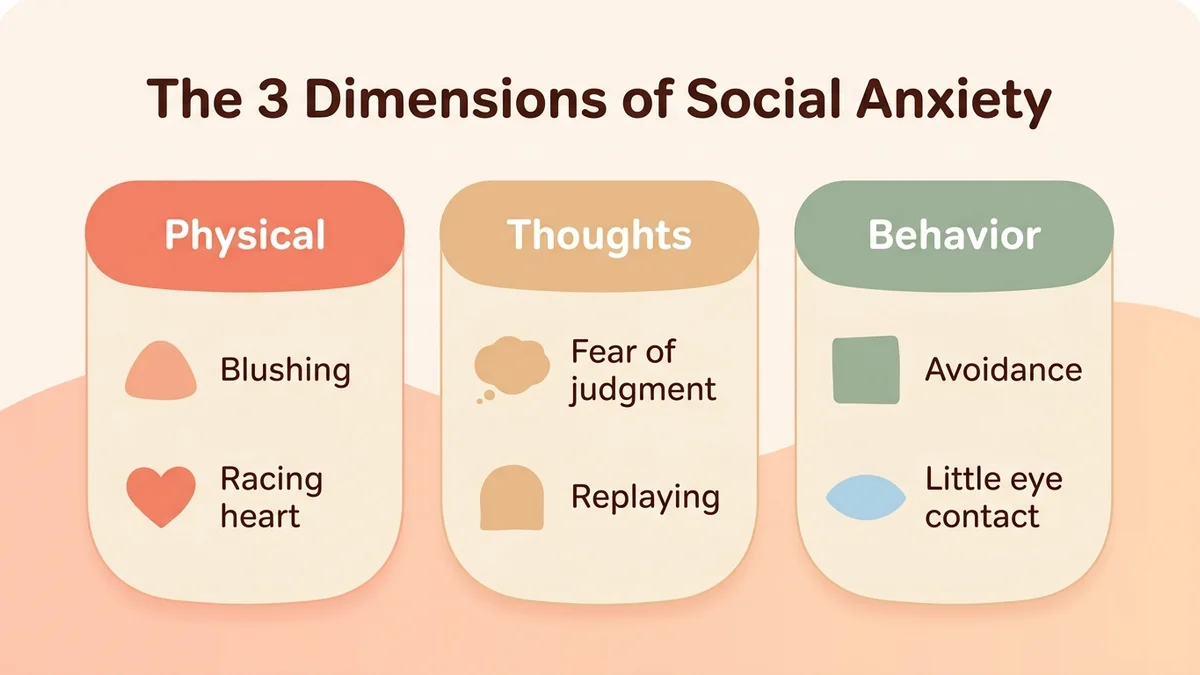
Social anxiety symptoms show up on three levels — physical, cognitive and behavioral — and usually appear in adolescence. Recognizing them is the first step toward doing something about them.
Physical symptoms
Your body reacts as if facing a real threat:
- Uncontrollable blushing (erythrophobia)
- Trembling hands or voice
- Excessive sweating, especially the palms
- Heart palpitations and chest tightness
- Nausea or stomachaches
- Dry mouth and a lump in the throat
Cognitive symptoms
Your mind switches into "social hypervigilance" mode:
- Constant fear of being judged negatively
- Conviction that others notice your discomfort
- Rumination before and after every interaction
- Negative automatic thoughts ("I'm going to say something stupid")
- Overestimating social danger
Behavioral symptoms
Avoidance becomes your survival strategy:
- Turning down invitations or career opportunities
- Avoiding eye contact
- Speaking softly or not at all
- Staying on the edges of groups
- Using alcohol or other substances to "loosen up"
Social anxiety rarely travels alone: it frequently co-occurs with depression, other anxiety disorders and alcohol use problems. According to the ADAA, 36% of people with social anxiety report living with symptoms for 10 years or more before seeking help.
What causes social anxiety?
Social anxiety results from a complex interplay of biological, psychological and environmental factors. Understanding these causes helps defuse guilt — you didn't "choose" to be anxious.
Neurobiological factors
Neuroscience research has identified several mechanisms:
- Amygdala hyperactivity: brain imaging studies consistently show that the amygdala of socially anxious people reacts more strongly to social cues such as critical or angry faces
- Serotonin dysregulation: this neurotransmitter plays a key role in regulating anxiety
- Genetic predisposition: twin studies suggest a moderate heritability, often estimated around 30 to 40%
Environmental factors
Your personal history shapes how you relate to others:
- Harsh or overprotective parenting: highly critical parents reinforce the fear of judgment
- Bullying: a public humiliation can anchor a lasting fear of interactions
- Anxious role models: watching a parent avoid social situations teaches avoidance
- Traumatic events: a memorable experience of humiliation or rejection
Clark and Wells' cognitive model
Clark and Wells' model (1995), still a reference in CBT, explains the vicious cycle of social anxiety:
- Social situation → negative beliefs are activated
- Self-focused attention → excessive monitoring of your own reactions
- Safety behaviors → subtle avoidance strategies (avoiding eye contact, speaking little)
- Post-event processing → replaying the situation afterward ("I should have said...")
The cycle feeds itself: the more you watch yourself, the more you notice your symptoms, which strengthens your anxiety.
How do I know if I really have social anxiety?
If you recognize yourself in at least 3 of the following situations, talking to a professional could help. The Liebowitz Social Anxiety Scale (LSAS) is the reference tool clinicians use to assess severity. For a quick first check, you can also take our free anxiety test.
The most feared situations
| Situation | Mild anxiety | Moderate anxiety | Severe anxiety |
|---|---|---|---|
| Speaking up in a meeting | Manageable discomfort | Racing heart, shaky voice | Unable to speak at all |
| Eating in public | Brief embarrassment | Fear of trembling while eating | Systematic avoidance |
| Calling a stranger | Slight hesitation | Putting off the call for days | Never calling |
| Being the center of attention | Brief blushing | Panic, urge to flee | Refusing any such situation |
| Dealing with authority | Normal respect | Stammering, losing your footing | Avoiding any supervisor |
Key point: Social anxiety disorder isn't something to self-diagnose. If these situations have been paralyzing you for more than 6 months, see a psychologist or psychiatrist.
How to overcome social anxiety: 7 concrete techniques
Overcoming social anxiety is a gradual process, not an instant breakthrough. Here are the most effective techniques, validated by research and clinical practice.
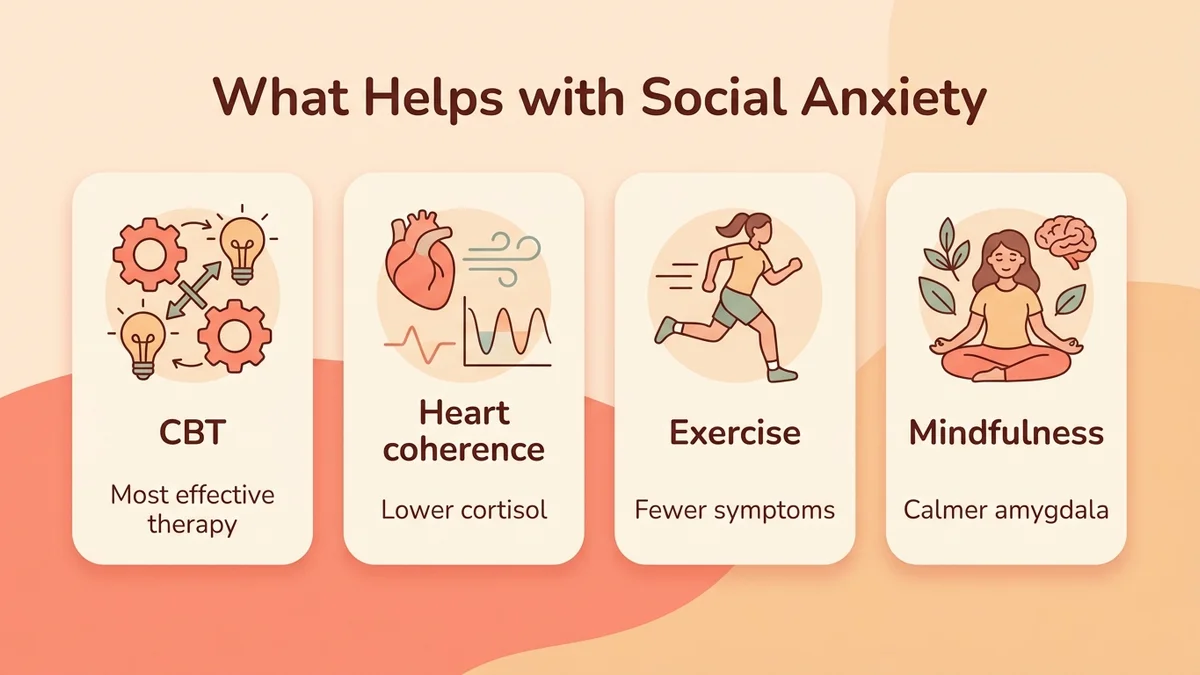
1. Cognitive behavioral therapy (CBT)
CBT is the first-line treatment recommended by clinical guidelines such as those of the UK's NICE. It combines three components:
- Cognitive restructuring: identifying and changing negative automatic thoughts ("everyone is judging me" → "people are mostly focused on themselves")
- Gradual exposure: facing feared situations step by step, from least to most anxiety-provoking
- Social skills training: role-plays and practice scenarios to build ease in relationships
A network meta-analysis of more than 100 trials published in The Lancet Psychiatry (Mayo-Wilson et al., 2014) found individual CBT to be the most effective psychological treatment for social anxiety, with results that hold over time.
2. Gradual exposure
Exposure is the heart of treatment. The principle: face your fears in stages.
Example exposure ladder:
- Smile at a stranger on the street
- Ask someone for the time
- Start a short conversation with a cashier
- Join a group activity (sports, a class)
- Speak up in a meeting in front of 5 people
- Give a presentation to a larger group
Stay in each exposure long enough for your anxiety to start going down on its own — often 20 to 30 minutes. This natural decrease is called habituation, and it teaches your brain that the situation is safe.
3. Breathing and cardiac coherence
When anxiety rises, your breathing speeds up and your sympathetic nervous system revs up. Cardiac coherence reverses this mechanism:
- Breathe in for 5 seconds through your nose
- Breathe out for 5 seconds through your mouth
- Repeat for 5 minutes (6 breaths per minute)
According to the HeartMath Institute, cardiac coherence at 6 breaths per minute lowers cortisol by an average of 23%. It's a powerful tool to use right before a stressful social situation — our free cardiac coherence timer guides you through it.
4. Cognitive restructuring
Learn to spot your cognitive distortions:
| Distortion | Example | Realistic alternative |
|---|---|---|
| Mind reading | "They think I'm incompetent" | "I can't know what they're thinking" |
| Catastrophizing | "If I blush, it'll be humiliating" | "Blushing is human, most people won't notice" |
| Personalization | "They're laughing, it must be at me" | "They're probably laughing about something else" |
| Emotional reasoning | "I feel useless, so I am useless" | "My emotion isn't an objective fact" |
To practice, write down one situation, the automatic thought and a balanced alternative in our CBT thought record.
5. Mindfulness and meditation
Mindfulness meditation helps you step out of "hypervigilance" mode by bringing attention back to the present moment rather than worst-case scenarios.
In a study at Stanford University (Goldin and Gross, Emotion, 2010), people with social anxiety disorder who completed an 8-week mindfulness-based stress reduction program showed reduced amygdala activity in response to negative self-beliefs, along with fewer anxiety symptoms.
6. Assertiveness
Assertiveness means expressing your needs and opinions without aggression or submission. Group workshops let you practice in a safe setting:
- Disagreeing politely
- Giving or receiving a compliment
- Saying no without guilt
- Holding eye contact during a conversation
7. Regular physical activity
Exercise and yoga reduce stress and improve self-esteem. Meta-analyses consistently show that regular aerobic exercise reduces anxiety symptoms, and even 30 minutes of moderate activity three times a week makes a noticeable difference.
Yoga is especially helpful because it combines movement, breathing and attention to the body — three levers that directly counter the physical alarm of social anxiety.
Why you feel anxious socializing: video guide
To better understand where social anxiety comes from and what actually helps, this TED talk by clinical psychologist Fallon Goodman offers a clear, compassionate perspective:
As the talk shows, overcoming social anxiety is a structured, gradual process. You can complement this approach with Serena, which guides you every day through breathing practice and emotion tracking.
Real-life scenarios
Social anxiety isn't lived in textbooks. Here are three concrete situations and how to get through them.
Scenario 1: The Monday morning team meeting
The context: You know your manager will ask everyone for an update. Since Sunday evening, you've been dreading it. Your stomach is in knots and you slept badly.
The technique: 10 minutes before the meeting, do 5 minutes of cardiac coherence. Prepare one simple sentence in advance ("This week, I'm moving forward on project X"). Focus on the content of your message, not on the image you project.
The expected result: The anxiety doesn't disappear completely, but it drops from 8/10 to 5/10. Enough to speak up. Every time you do it, the next round of updates gets a little easier.
Scenario 2: After-work drinks with coworkers
The context: You're invited for a drink after work. Your reflex: find an excuse. But this time, you decide to go.
The technique: Set a modest goal — stay 30 minutes and have a conversation with just one person. Use open questions ("What are you working on these days?"). If anxiety rises, step away for 2 minutes to practice box breathing.
The expected result: You discover that a one-on-one conversation is far more comfortable than the whole group. You leave with a small sense of victory.
Scenario 3: The dreaded phone call
The context: You need to call your landlord to report a problem. You've been putting it off for three days.
The technique: Write the key points on a piece of paper. Take 3 deep breaths. Remind yourself that the discomfort will last 5 minutes at most. Tell yourself: "The discomfort of calling is temporary; the discomfort of not calling lasts indefinitely."
The expected result: The call lasts 3 minutes. The relief afterward is immediate and builds your confidence for the next call.
The Serena perspective
What Serena usage data reveals about social anxiety:
Serena users who report social anxiety show a distinct emotional profile: their check-ins show a predominance of high-energy negative emotions (stress, nervousness) before social situations, followed by a drop into low-energy negative emotions (exhaustion, sadness) afterward.
What academic theory doesn't always mention is that post-social fatigue can be as disabling as pre-social anxiety. Our users report needing 1 to 3 hours of "recovery" after an intense social interaction, even when it went well.
Cardiac coherence practiced right before a social situation (and not only in the morning, as most guides recommend) shows the best results in Serena mood tracking: an average 35% drop in perceived anxiety over the 15 minutes following the practice.
Serena Coach tip: Don't underestimate the "social hangover." After a difficult interaction, give yourself recovery time without guilt. Use Serena's mood tracking to spot your patterns: which situations cost you the most energy? That self-awareness is the first step toward managing them better.
How Serena supports you with social anxiety
Social anxiety is worked on every day, not just during therapy sessions. That's where Serena becomes a valuable ally:
- Guided breathing before stressful situations: 6 breathing techniques, including cardiac coherence and 4-7-8 breathing, available in seconds
- Mood tracking with the Circumplex model: identify your emotions precisely to spot the patterns behind your social anxiety
- Gratitude journal: refocus your attention on positive interactions rather than negative rumination, a practice with scientifically proven benefits
- Daily exercises: 5-minute micro-practices to reinforce what you learn in therapy
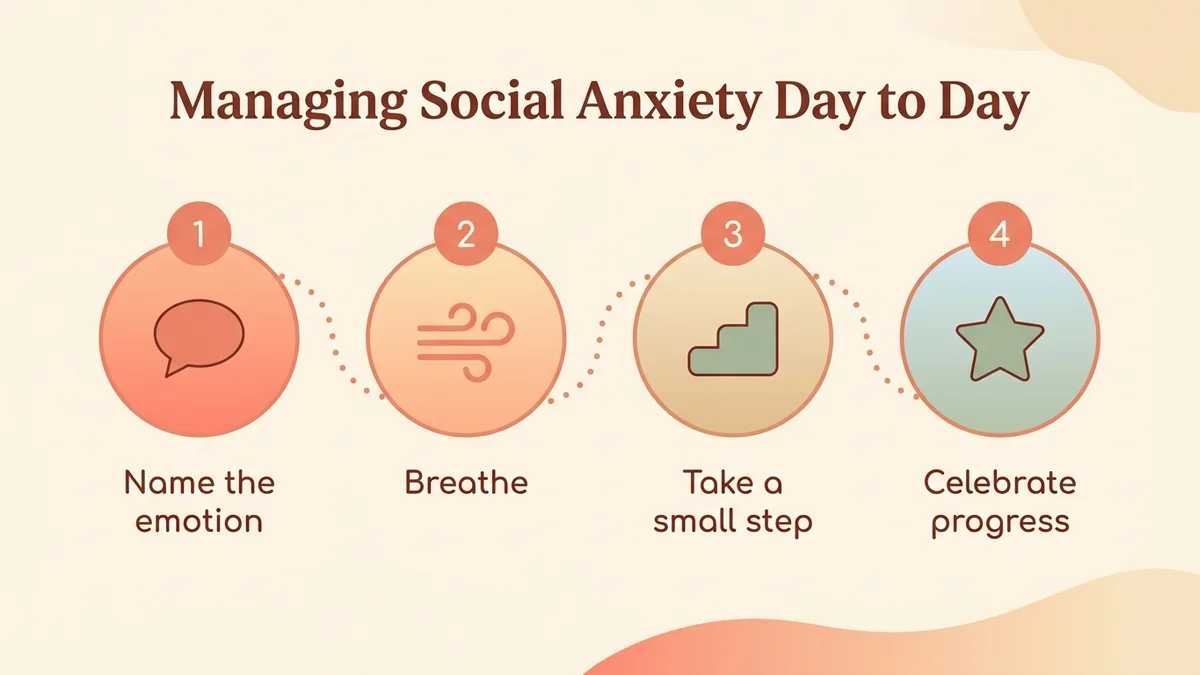
According to the ADAA, more than a third of people with social anxiety wait a decade or longer before getting help. Serena can be a first step toward care, alongside or while waiting for therapy.
Social anxiety at work: a particular challenge
The workplace concentrates many anxiety-provoking situations for people with social anxiety — and the stakes feel higher because your career is involved.
The most feared situations at work
- Speaking up in meetings
- Performance reviews
- Team lunches and social events
- Phone calls
- Dealing with senior leadership
Strategies for the workplace
Before a meeting: write down what you want to say, and practice cardiac coherence for 5 minutes beforehand. If you have Serena, start a guided breathing session discreetly.
During: focus on the content, not on your image. Take notes — it keeps your hands busy and gives you something to anchor to.
After: resist the post-event replay. Instead, write down one thing that went well in your gratitude journal.
Serena Coach tip: Many US employers offer an Employee Assistance Program (EAP) with free, confidential counseling sessions. And if social anxiety disorder significantly limits your work, the Americans with Disabilities Act (ADA) may entitle you to reasonable accommodations. Check with HR — you might be surprised by the resources available.
When and how to see a professional
Seeking help isn't a sign of weakness — it's an act of courage. Here are the markers that tell you it's time.
Warning signs
- Your anxiety has lasted more than 6 months
- You avoid situations that affect your life (work, relationships, hobbies)
- You use alcohol or other substances to cope
- You also have symptoms of depression
- Your sleep quality is deteriorating
Which professional should you see?
| Professional | Specialty | Coverage |
|---|---|---|
| CBT therapist (psychologist, LCSW, LPC) | Cognitive behavioral therapy | Often covered by health insurance or an EAP |
| Psychiatrist | Diagnosis + medication if needed | Usually covered by health insurance |
| Primary care doctor | First assessment and referral | Covered by most plans |
Medication
In moderate to severe cases, a doctor may prescribe SSRIs (selective serotonin reuptake inhibitors); sertraline and paroxetine are FDA-approved for social anxiety disorder. Medication is generally most effective when combined with CBT rather than used alone.
If you ever feel overwhelmed or have thoughts of harming yourself, call or text 988 (Suicide & Crisis Lifeline) at any time.
Frequently asked questions
What's the difference between shyness and social anxiety?
Shyness is a personality trait that doesn't stop you from functioning day to day. Social anxiety disorder, on the other hand, is an anxiety disorder recognized by the DSM-5 that causes significant distress and systematic avoidance of social situations. The key difference lies in the intensity of the suffering and its impact on daily, professional and relationship life.
Can social anxiety be cured completely?
Many people recover fully or improve dramatically. Cognitive behavioral therapy is the best-studied treatment, and a large network meta-analysis in The Lancet Psychiatry found individual CBT to be the most effective psychological approach. Most people notice meaningful improvement within 12 to 16 sessions. The skills learned in therapy tend to last, unlike medication, whose effect often stops when treatment ends.
What are the first signs of social anxiety?
Early signs include uncontrollable blushing in social situations, a shaky voice, growing avoidance of interactions, anxious anticipation of social events and replaying every exchange afterward. According to the ADAA, symptoms typically begin around age 13 and tend to worsen without support.
How can I help someone with social anxiety?
Avoid minimizing their experience with phrases like "it's all in your head" or "just try harder." Show that you understand how hard it is. Encourage without pushing, offer to go with them into difficult situations, and suggest seeing a psychologist trained in CBT. Your patience and kindness are their best allies.
Can breathing calm a social anxiety attack?
Absolutely. Diaphragmatic breathing activates the parasympathetic nervous system and calms the body within minutes. Cardiac coherence at 6 breaths per minute is particularly effective for regaining calm before a social situation. Practice it with Serena for step-by-step guidance.
Does social anxiety affect women more than men?
According to the National Institute of Mental Health, past-year social anxiety disorder affects about 8.0% of US women and 6.1% of US men. Women are diagnosed more often, but men seek help less frequently, which probably underestimates their true prevalence. The disorder can affect anyone, regardless of age, gender or background.
Can you work normally with social anxiety?
It's possible but often draining. Meetings, presentations and interactions with coworkers become sources of intense stress. Adapted strategies — preparation, breathing, letting go — and, when needed, workplace accommodations help people function much better day to day.
Do wellness apps help with social anxiety?
Apps like Serena are an effective complement to therapy. Guided breathing, mood tracking and daily 5-minute exercises let you practice CBT techniques between sessions. They don't replace a therapist, but they reinforce progress and offer support that's available anytime.
Conclusion
Social anxiety isn't a life sentence. With the right techniques and appropriate support, you can transform how you relate to others and rediscover a fulfilling social life.
Start small: one mindful breath before your next interaction, a smile at a stranger, one more sentence in a meeting. Every micro-victory counts and gradually rewires your brain.
You're not alone — millions of people live with social anxiety, and asking for help has never been more accessible. Try Serena for free to start your journey toward more social ease, or see a professional if your anxiety significantly affects your daily life.
Your next step: download Serena and start with 5 minutes of cardiac coherence before your next social situation. You might be surprised by the result.