You're lying in bed, eyes wide open. It's 11:47 p.m. Your body is exhausted, but your mind refuses to cooperate. Thoughts keep scrolling by — tomorrow's meeting, that unfinished conversation, the grocery list you forgot. Sound familiar? You're not alone. Sleep meditation is now one of the most effective natural ways to get back to restful nights, without medication or side effects. Updated in August 2026, this guide gives you the keys to fall asleep faster, starting tonight.
The key takeaways
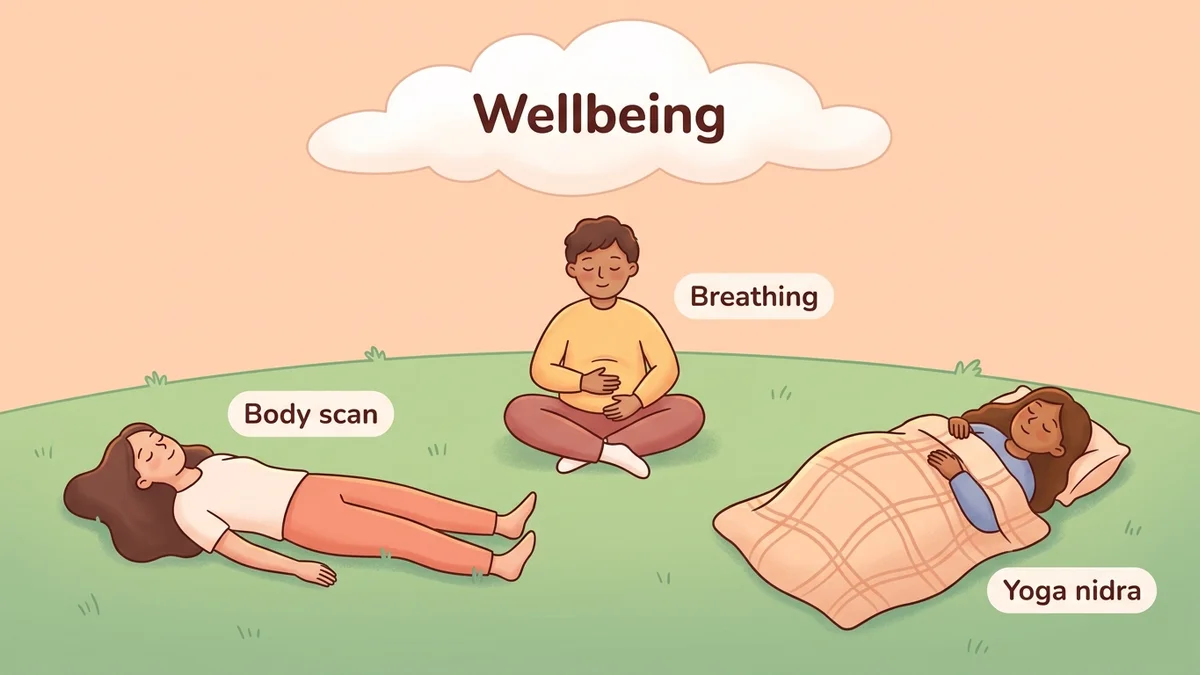
Sleep meditation reduces stress and activates the parasympathetic nervous system, helping you fall asleep naturally. The most effective techniques: body scan, 4-7-8 breathing and yoga nidra. According to a Vanderbilt study published in PNAS (2025), meditation stimulates brain "cleaning" in a way similar to deep sleep. Expect visible results within 6 weeks at 10-20 minutes a night.
How does meditation actually help you sleep better?
Meditation improves sleep by activating the parasympathetic nervous system, which is responsible for deep relaxation. This activation reduces the production of cortisol (the stress hormone) and supports the release of serotonin, a precursor of melatonin — the body's natural sleep hormone.
In practical terms, when you meditate before bed, three mechanisms kick in:
- Your heart rate gradually slows, signaling to your body that it's time to rest
- Your anxious thoughts subside as your attention focuses on your breath or bodily sensations
- Your muscle tension releases, clearing the physical blocks that keep you from falling asleep
According to a study published in JAMA Internal Medicine, people who practiced mindfulness meditation 20 minutes a day slept significantly better and felt less daytime fatigue than the control group.
Key point: Mindfulness meditation increases the production of serotonin, a precursor of melatonin, the body's natural sleep hormone.
More recently, a Vanderbilt University study published in PNAS in December 2025 showed that meditation stimulates the flow of cerebrospinal fluid in a way similar to deep sleep. According to lead author Professor Manus Donahue, meditation could serve as a non-invasive way to boost the clearance of harmful proteins from the brain. This finding confirms that meditating gives your brain a head start on its nightly cleanup before you even fall asleep.
What are the 7 best meditation techniques to fall asleep?
Not all meditations are equal when it comes to sleep. Here are the 7 most effective techniques, sorted by profile and needs.
| Technique | Ideal duration | Difficulty | Best for |
|---|---|---|---|
| Body scan | 15-20 min | Easy | Physical tension |
| 4-7-8 breathing | 2-5 min | Very easy | Falling asleep quickly |
| Mindfulness | 10-20 min | Medium | Racing thoughts |
| Yoga nidra | 20-45 min | Easy | Chronic insomnia |
| Guided meditation | 10-30 min | Very easy | Beginners |
| Visualization | 10-15 min | Medium | Evening anxiety |
| Cardiac coherence | 5 min | Very easy | Intense stress |
The body scan
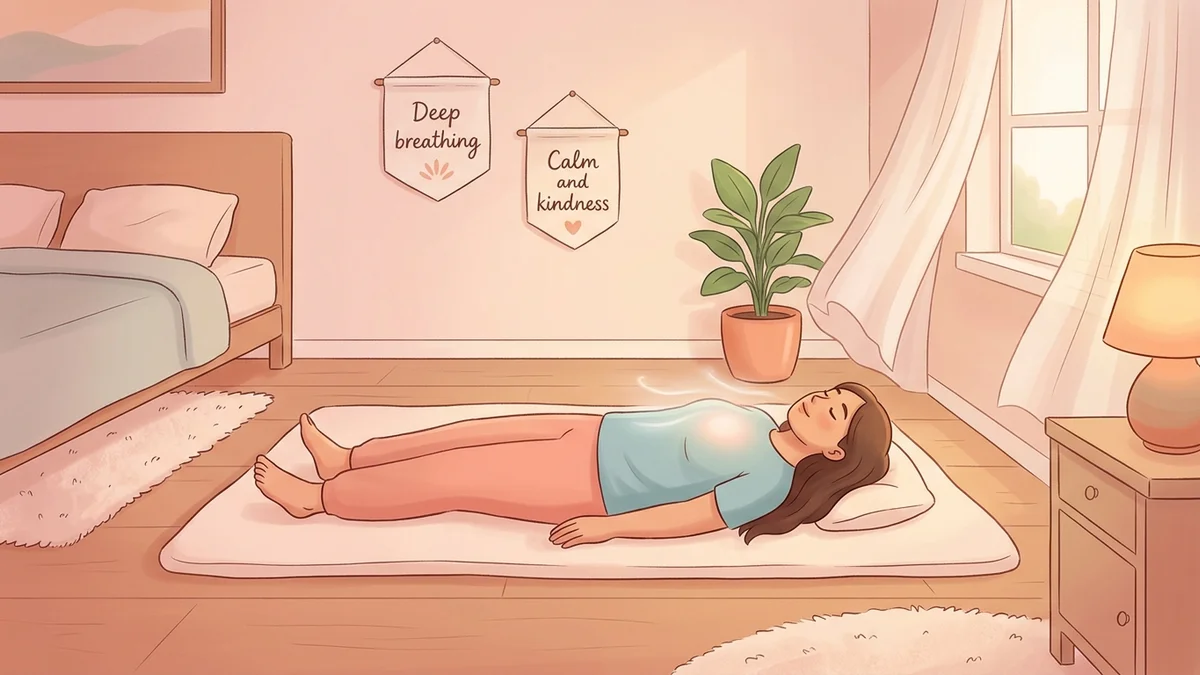
The body scan involves bringing your attention to each part of your body in turn, from your toes to the top of your head. At each area, you notice the sensations there — tension, warmth, tingling — then consciously relax the muscles.
How to practice:
- Lie down in Savasana (on your back, arms along your sides, palms facing up)
- Close your eyes and take 3 deep breaths
- Bring your attention to your toes. Notice, then release
- Work your way up gradually: feet, calves, knees, thighs, pelvis, belly, chest, shoulders, arms, hands, neck, face
- Finish with an overall awareness of your whole body
Serena Coach tip: Most of our users report falling asleep before they reach their shoulders during a body scan. If that happens to you, it's perfectly normal — and it's exactly the point.
4-7-8 breathing
Developed by Dr. Andrew Weil, this technique is nicknamed the "natural tranquilizer for the nervous system." The principle is simple: breathe in for 4 seconds, hold for 7 seconds, breathe out for 8 seconds.
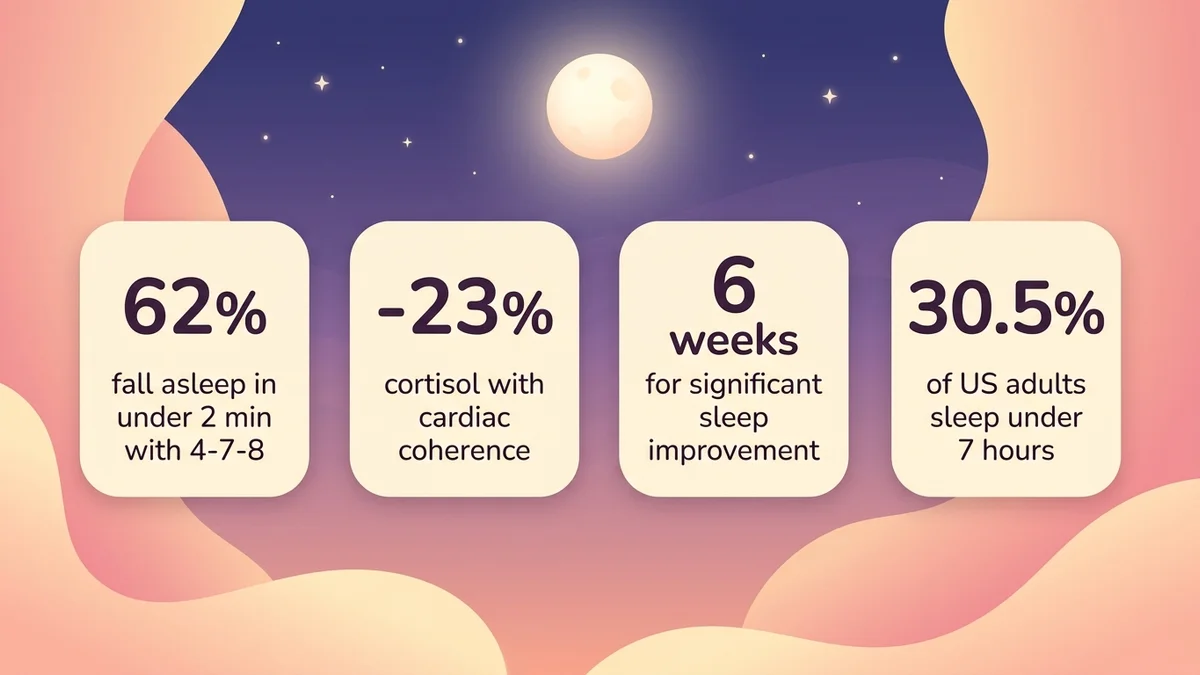
The 4-7-8 breathing technique developed by Dr. Andrew Weil helps 62% of regular practitioners fall asleep in under 2 minutes. We've dedicated a detailed guide to it: 4-7-8 breathing for sleep.
How to practice:
- Place the tip of your tongue against the roof of your mouth, just behind your upper teeth
- Breathe out completely through your mouth with a gentle whoosh
- Breathe in silently through your nose for 4 seconds
- Hold your breath for 7 seconds
- Breathe out slowly through your mouth for 8 seconds
- Repeat for 4 cycles
Mindfulness meditation
Mindfulness, popularized in the West by Professor Jon Kabat-Zinn, involves observing your thoughts without judging or following them. You watch them drift by like clouds in the sky.
For sleep, this technique is especially effective against nighttime rumination — those loops of thought that keep going around in your head.
How to practice:
- Get comfortable in bed
- Focus your attention on your natural breathing
- When a thought comes up, notice it without judgment ("oh, a thought about work"), then gently return to your breath
- Don't fight your thoughts — let them pass
Yoga nidra (yogic sleep)
Yoga nidra is a guided deep relaxation practice that brings you into a state between wakefulness and sleep. According to early research on this ancient technique, a 45-minute yoga nidra session may be equivalent to 2 hours of sleep in terms of nervous system recovery. Learn more in our guide to yoga nidra and sleep hypnosis.
How to practice:
- Lie down comfortably under a blanket
- Follow a guided session (audio or app)
- Let yourself be guided through rotations of awareness, visualizations and intentions
Guided bedtime meditation
If you're a beginner, guided meditation is your best ally. A voice walks you through it step by step — there's nothing you need to "do" or "know." You simply follow the instructions.
Platforms like YouTube, Spotify and dedicated apps offer thousands of guided meditations designed specifically for sleep. Sessions usually last between 10 and 30 minutes. If you're torn between several options, our comparison of meditation apps breaks down how to choose based on your profile.
Soothing visualization
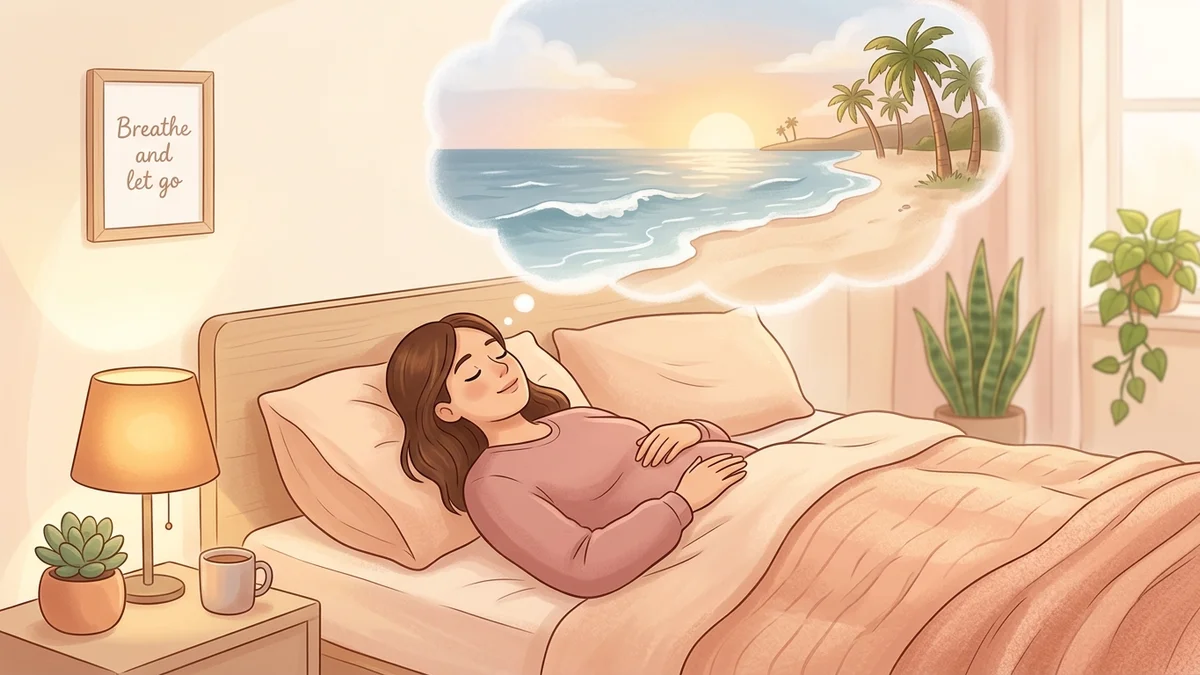
Visualization means imagining a safe, calming place: a deserted beach at sunset, a silent forest, a snowy cabin by the fire. The goal is to engage all your senses — sounds, smells, textures — to pull your mind away from anxious thoughts.
Cardiac coherence
Cardiac coherence is a rhythmic breathing technique at 6 breaths per minute (5 seconds in, 5 seconds out) for 5 minutes. It synchronizes your heart rhythm with your breath and balances the autonomic nervous system.
Practicing cardiac coherence for 5 minutes before bed lowers cortisol by 23% on average, according to the HeartMath Institute (2024).
How long should you meditate before bed to see results?
To improve your sleep quality, it's recommended to meditate for 10 to 20 minutes every evening. Beginners can start with 5 minutes and build up gradually.
| Practice time | Expected effects | Time to results |
|---|---|---|
| 5 min/night | Immediate relaxation | From the 1st session |
| 10 min/night | Easier to fall asleep | 2-3 weeks |
| 15-20 min/night | Better deep sleep | 4-6 weeks |
| 20+ min/night | Lasting reduction in insomnia | 6-8 weeks |
According to the scientific literature, sleep improves significantly after 6 weeks of daily practice, at 10 to 20 minutes per session. What matters isn't duration, but consistency. Better 5 minutes every night than 30 minutes once a week.

Key point: Consistency beats duration. Five minutes of meditation every night produces better results than an occasional long session.
"My brain never switches off at night": meditation as a solution
You may have already tried everything — herbal teas, melatonin pills, screens off at 9 p.m. — and nothing really works. This scenario is extremely common: your body is tired, but your mind is running at full speed.
That's exactly where meditation makes the difference. Unlike external solutions (pills, teas), meditation works on the root cause: an overactive sympathetic nervous system, the one that keeps you in "alert" mode.
The scale of the problem is significant: according to the CDC (2024), 30.5% of American adults sleep less than 7 hours a night, and stress is one of the leading culprits.
Here's why meditation succeeds where other solutions fail:
- Herbal teas act on the body but not on the mind
- Melatonin regulates the body clock but doesn't calm your thoughts
- Turning off screens reduces stimulation but doesn't switch off "alert" mode
- Meditation acts directly on the nervous system, the source of the problem
As mindfulness researchers have shown, meditation acts directly on stress by changing the way the brain processes emotional stimuli.
Real-life scenarios
Anxious Sunday nights
You're in bed, and the week ahead is flooding your mind. Meetings, deadlines, family logistics... Your jaw clenches, your shoulders tighten.
The solution: Do a 10-minute body scan starting from your feet. Focus on releasing each area of tension. Before you even reach your face, your body will have sent the sleep signal to your brain.
Post-screen insomnia
It's 11 p.m. and you've just put down your phone. Your mind is still buzzing — notifications, news, social media.
The solution: 3 cycles of 4-7-8 breathing, followed by a 5-minute visualization. Imagine yourself walking barefoot on warm sand, listening to the sound of the waves. In 8 minutes, you'll have made the transition from the digital world to your inner world.
Waking up at 3 a.m.
You wake up in the middle of the night. You can't fall back asleep, and the thoughts start up again.
The solution: 5 minutes of cardiac coherence (breathing at 6 cycles per minute), then a mindfulness meditation lying down. Whatever you do, don't check the time. Focus only on the ebb and flow of your breath.
The Serena perspective
Anonymized data from Serena users reveals interesting patterns. Among users who practice guided breathing in the evening, most start a session between 10:30 and 11:15 p.m. — confirming that the need shows up at the transition to sleep, not before.
Notably, the most used technique in the evening isn't classic meditation, but 4-7-8 breathing, followed by the body scan. Users who combine the two report the best results on their perceived sleep quality.
What theory doesn't tell you: scientific studies recommend 15-20 minutes of meditation. In real life, our data shows that 8 to 12-minute sessions deliver the best balance between effectiveness and sticking with it. Why? Because a shorter session is easier to maintain over time — and it's consistency, not duration, that makes the difference.
Serena Coach tip: If you're just starting out, begin with 5 minutes of 4-7-8 breathing right in bed, with the lights off. Add one minute each week. After a month, you'll have a solid 9-minute ritual — enough to transform your nights.
How to create your bedtime meditation ritual
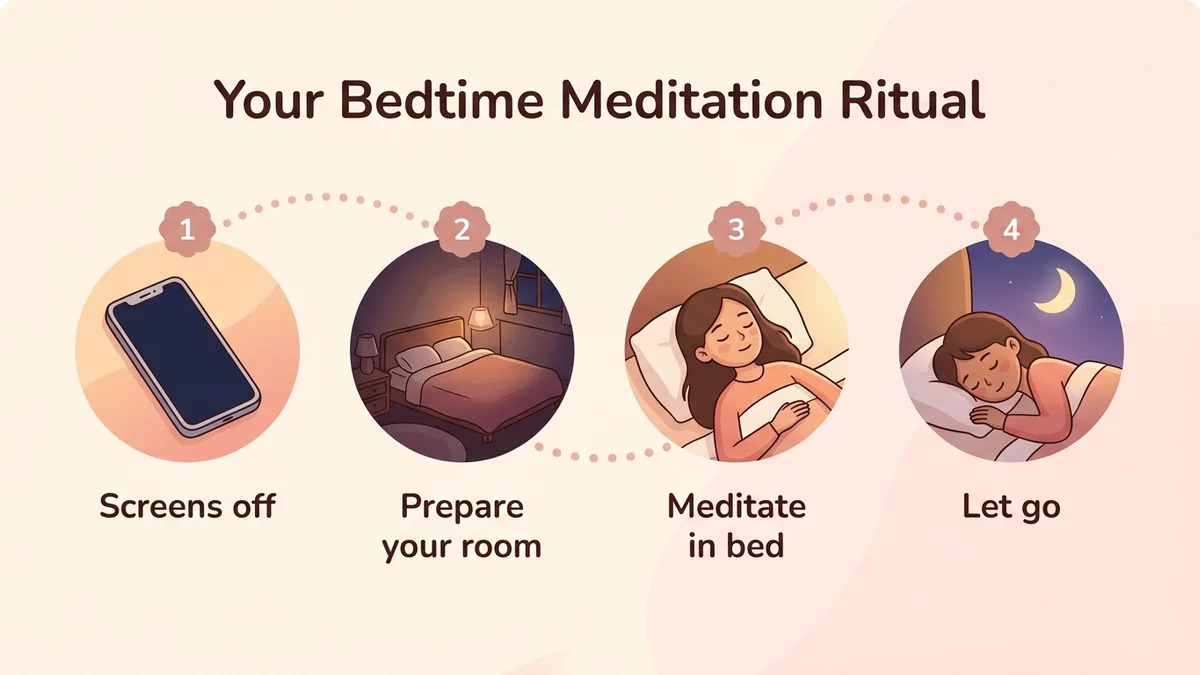
An effective bedtime ritual isn't just about meditating. It's a sequence of actions that tells your body: "it's time to sleep." Here's a 4-step ritual you can start tonight:
| Step | Action | Duration | Goal |
|---|---|---|---|
| 1 | Turn off screens | 30 min before | Reduce blue light |
| 2 | Set up your space | 5 min | 64-66°F, darkness |
| 3 | Meditate in bed | 10-15 min | Calm the nervous system |
| 4 | Let go | Naturally | Fall asleep effortlessly |
Step 1 — Disconnect (30 min before bed) Put your phone out of reach. Blue light from screens blocks melatonin production for up to 90 minutes.
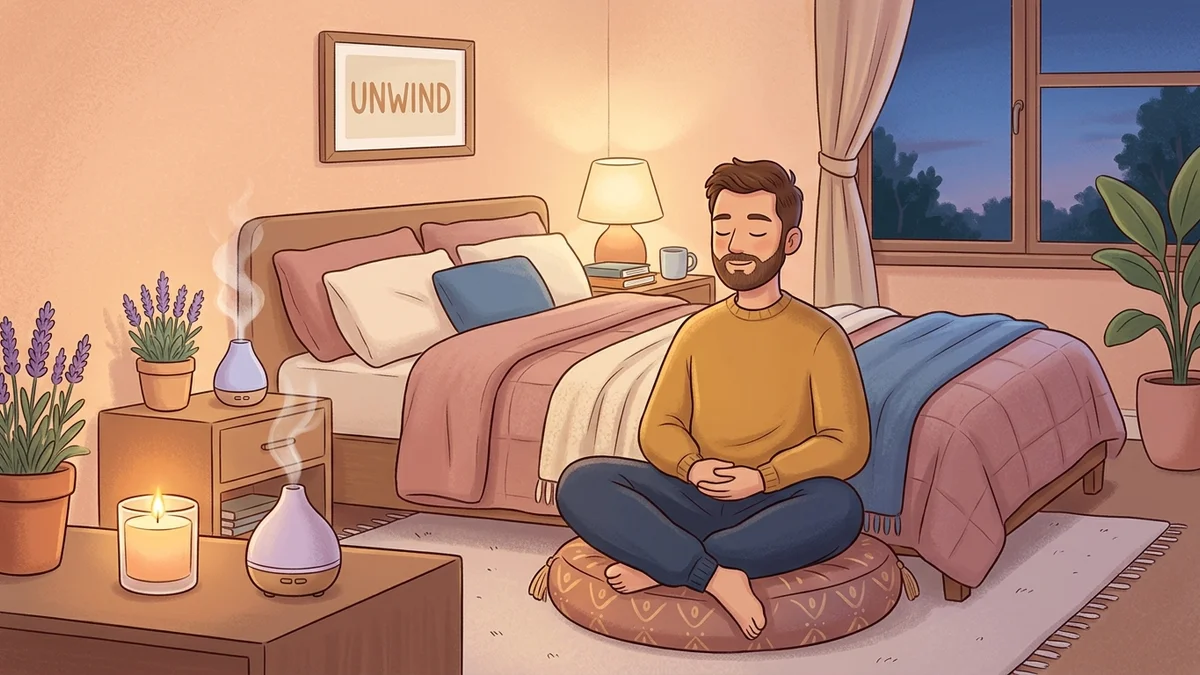
Step 2 — Prepare your cocoon Ideal temperature: 64-66°F (18-19°C). As dark as possible. You can diffuse some lavender essential oil or light a candle (blow it out before you meditate).
Step 3 — Your bedtime meditation Choose your technique based on how you feel:
- Lots of physical tension → Body scan
- Restless mind → 4-7-8 breathing + mindfulness
- General anxiety → Yoga nidra
- First time → Guided meditation (app or YouTube)
The Honest Guys, one of YouTube's best-known meditation channels, offer guided talk-downs designed specifically for falling asleep. Here's one of their most popular sessions:
As this guided meditation shows, sleep comes naturally when body and mind are gently guided. You'll find this kind of guidance directly in Serena, with breathing sessions adapted to how you feel in the moment.
Step 4 — Let go Don't try to fall asleep. Let sleep come to you. If you're still awake after 20 minutes, get up for 10 minutes, then try again.
Can meditation replace sleeping pills?
Meditation doesn't replace a prescribed medical treatment, but it's a powerful natural alternative for mild to moderate sleep problems. Several studies, including the one published in JAMA Internal Medicine, confirm that mindfulness meditation is as effective as classic behavioral therapies for insomnia.
What the science says:
- Meditation reduces insomnia symptoms comparably to mild sleep aids, without side effects or dependence (JAMA Internal Medicine)
- CBT-I (cognitive behavioral therapy for insomnia) now includes meditation as a component of treatment
- Stress is the number-one factor behind sleep problems, and meditation acts on it directly
Important: If you take sleeping pills, never stop them abruptly. Talk to your doctor about tapering off gradually, bringing in meditation as a complement and then potentially as a replacement.
How Serena helps you sleep better
Serena brings the most effective meditation techniques for sleep together in a simple, supportive app:
- 6 guided breathing techniques, including 4-7-8 breathing and cardiac coherence, with visual and audio guidance
- Daily mood tracking based on the Circumplex model, to identify patterns between your emotions and your sleep quality
- A built-in gratitude journal, a practice that, according to the University of California, improves sleep by 25% when combined with meditation
Serena doesn't replace a health professional, but it gives you the tools to build your bedtime ritual, night after night, at your own pace.
Frequently asked questions
Is guided meditation effective for insomnia?
Yes, guided meditation is particularly effective for insomnia. According to a study published in JAMA Internal Medicine, participants who followed a 6-week mindfulness meditation program saw a significant improvement in their sleep, comparable to the results of classic behavioral therapies.
Can you meditate right in bed?
Absolutely. For bedtime meditation, lying down in bed is actually recommended. Use the Savasana posture: on your back, arms along your sides, palms facing up. If you fall asleep during the session, that's a sign the technique is working perfectly.
What is the best meditation technique for beginners?
For beginners, guided meditation and 4-7-8 breathing are the most accessible. Guided meditation requires no prior knowledge: a voice walks you through it step by step. 4-7-8 breathing is easy to remember and produces calming effects from the very first cycles.
Do you need to meditate every night to sleep better?
Consistency is the key to effectiveness. Ideally, meditate every evening at the same time to condition your body. However, even 3 to 4 sessions a week produce measurable results. What matters is building a lasting habit rather than aiming for perfection.
Can meditation make insomnia worse?
In rare cases, beginners may feel frustrated if they "try too hard" to meditate. The classic mistake: trying to force an empty mind. Meditation isn't the absence of thoughts, but the kind observation of them. If anxiety persists, see a health professional.
Yoga nidra or classic meditation: which is better for sleep?
Yoga nidra is better suited to people with chronic insomnia or deep fatigue, because it induces a very deep state of relaxation without conscious effort. Mindfulness meditation works better for racing thoughts and everyday stress. You can alternate between the two depending on your needs.
Does 4-7-8 breathing really help you sleep?
Yes. Developed by Dr. Andrew Weil of the University of Arizona, this technique acts as a "natural tranquilizer" for the nervous system. Holding your breath for 7 seconds forces your body to slow down, while the extended 8-second exhale activates the parasympathetic nervous system.
How long before bedtime meditation shows results?
Most people feel a relaxing effect from the very first session. For a lasting improvement in sleep quality, allow 4 to 6 weeks of daily practice for 10 to 20 minutes. According to studies, results build over time and become significant after 8 weeks.
Conclusion
Sleep meditation is neither a fad nor a placebo. It's a practice validated by science — from JAMA Internal Medicine to Vanderbilt University — that acts directly on the mechanisms of sleep. Whether you choose the body scan, 4-7-8 breathing or yoga nidra, what matters is getting started. Tonight. 5 minutes is enough.
Your sleep deserves this attention. And you deserve nights that truly restore you.