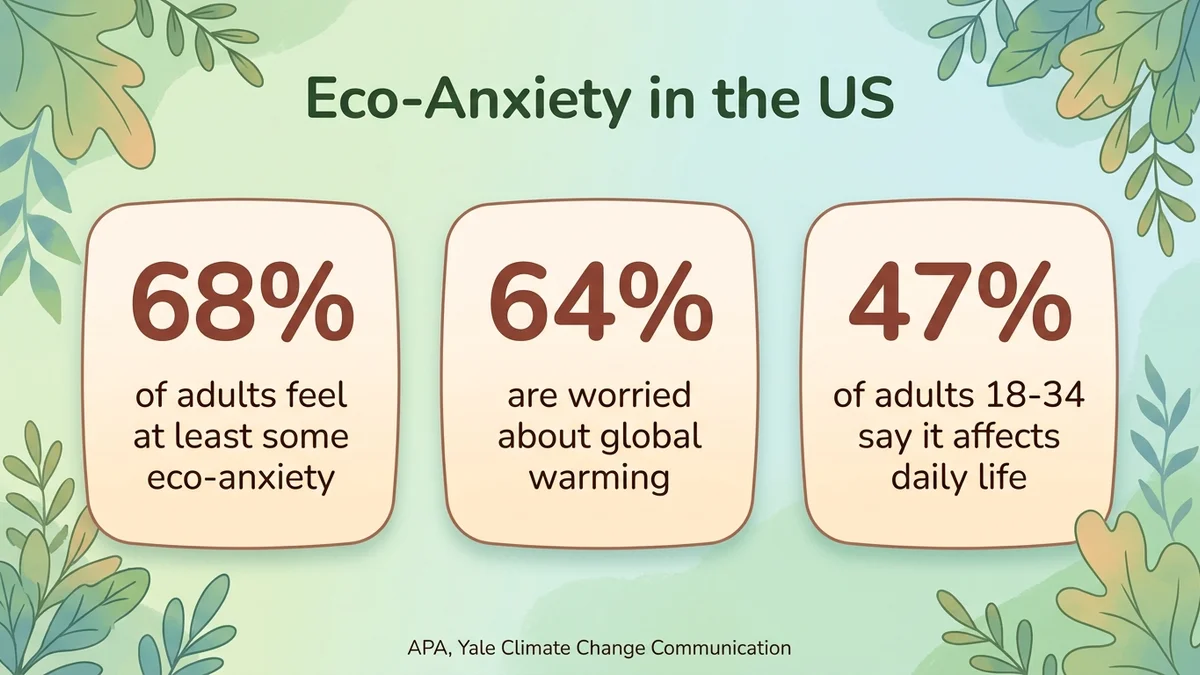
You're scrolling through your news feed. Floods in Spain, heat records in Asia, glaciers melting faster than ever. Your stomach tightens. You close the app, but the anxiety lingers. This unease has a name: eco-anxiety. And you're not alone. According to the American Psychological Association, 68% of US adults report feeling at least a little eco-anxiety. Updated in May 2026.
The good news: eco-anxiety isn't a life sentence. Concrete solutions exist to find a balance between ecological awareness and mental wellbeing. In this guide, you'll understand what you're feeling and why — and above all, how to act so you feel better.
The key takeaways
Eco-anxiety is psychological distress in the face of environmental threats, and more than two-thirds of American adults feel at least some of it (APA). It isn't a mental illness but an adaptive response that can become overwhelming. Guided breathing, journaling, reconnecting with nature and collective engagement are the most effective ways to turn that anxiety into a force for action.
What exactly is eco-anxiety?
Eco-anxiety is psychological distress caused by anticipating the consequences of climate change and environmental destruction. It shows up as persistent worry, a sense of powerlessness and sometimes difficulty living normally.
The term was coined by Belgian-Canadian physician and researcher Véronique Lapaige in 1997 and has since entered everyday language. The American Psychological Association (APA) describes it as "a chronic fear of environmental doom."
According to psychiatrist Laelia Benoit, a researcher at Inserm and the Yale Child Study Center, eco-anxiety isn't a psychiatric disorder. It isn't listed in the DSM-5. It's a legitimate emotional response to very real threats. But when it takes over daily life, it deserves particular attention.
According to the Yale Program on Climate Change Communication (Fall 2025), 64% of Americans are at least somewhat worried about global warming, and 29% are very worried.
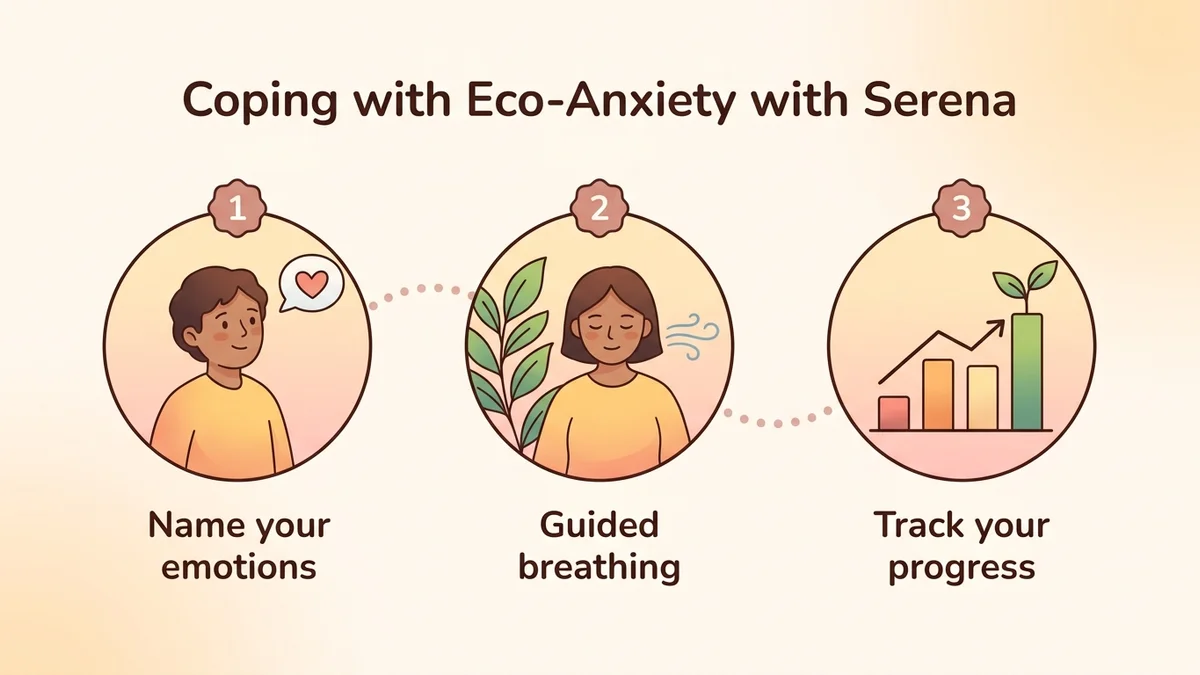
Serena Coach tip: If you recognize yourself in this description, start by naming what you feel. Putting a word to your anxiety is the first step toward managing it. Daily mood tracking helps you identify triggers and the moments when your anxiety is strongest.
Eco-anxiety, solastalgia, eco-emotions: what's the difference?
These terms describe different realities. Mixing them up makes it harder to find the right response.
| Concept | Definition | Time focus | Coined by |
|---|---|---|---|
| Eco-anxiety | Fear anticipating environmental catastrophe | Future (projection) | Véronique Lapaige (1997) |
| Solastalgia | Distress at the observed degradation of one's environment | Present (lived experience) | Glenn Albrecht |
| Eco-anger | Anger at political and collective inaction | Present | - |
| Eco-lucidity | Clear awareness without anxious paralysis | - | - |
Eco-anxiety works like pre-traumatic stress: you anticipate a future danger. Solastalgia is more like grief. You notice that the landscape you loved has changed, that the seasons aren't what they used to be. These two emotions can coexist and reinforce each other.
What are the symptoms of eco-anxiety?
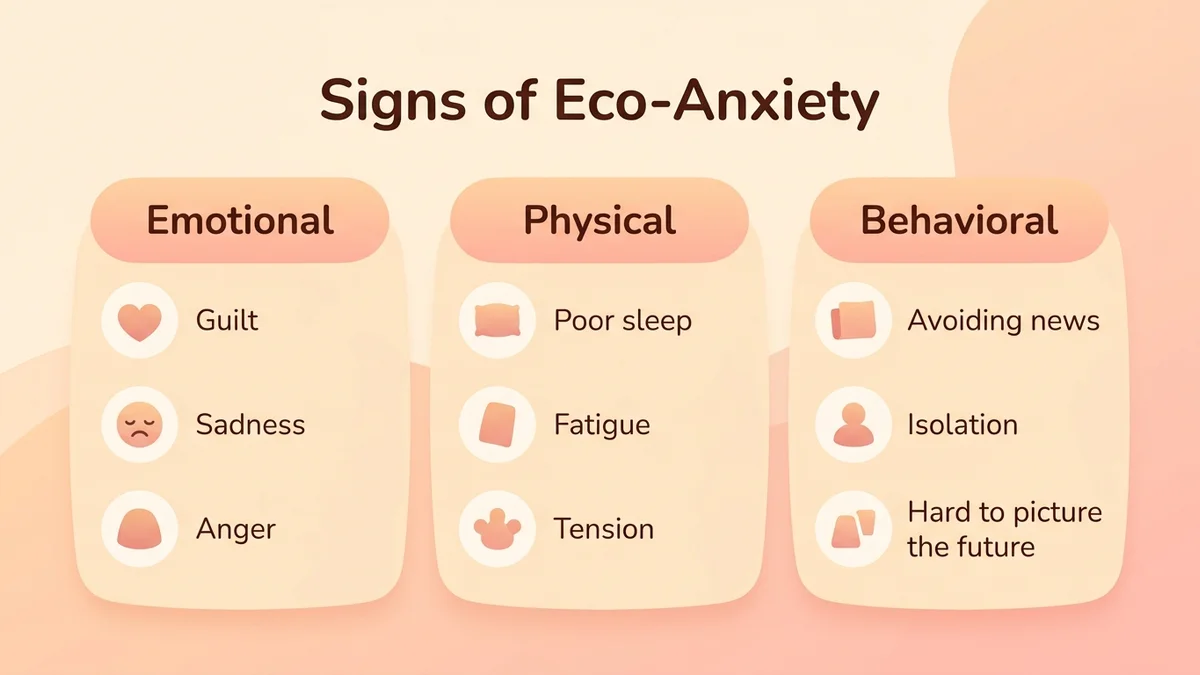
Eco-anxiety symptoms show up on three levels: emotional (sadness, guilt, anger), physical (sleep problems, fatigue, muscle tension) and behavioral (avoiding the news, isolation, difficulty picturing the future). Their intensity varies from person to person.
Emotional symptoms
- A sense of powerlessness in the face of the crisis's scale
- Guilt about your own lifestyle
- Anger at political and economic decision-makers
- Deep sadness, sometimes close to grief
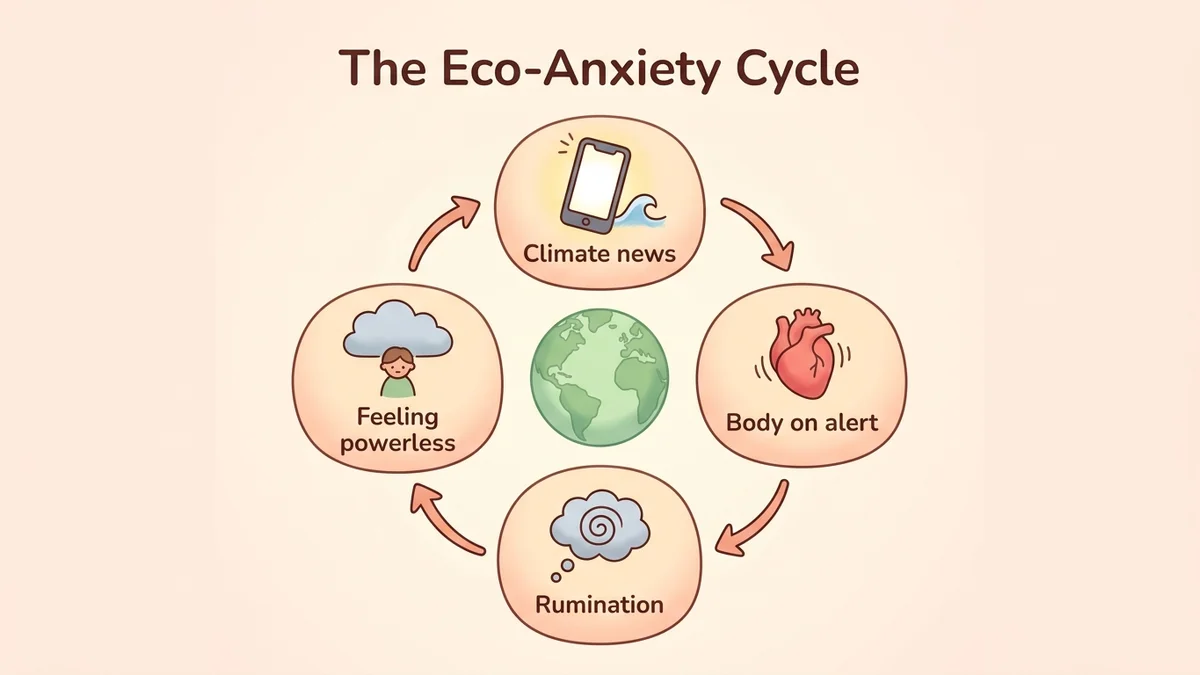
- Constant rumination about worst-case scenarios
Physical symptoms
Your body absorbs this anxiety. Intense forms of eco-anxiety cause physical symptoms similar to chronic stress: insomnia, persistent fatigue, neck tension, digestive problems. Cortisol stays high, keeping the body on alert.
Behavioral symptoms
- Compulsively avoiding the news (or, on the contrary, overconsuming it)
- Social isolation
- Difficulty picturing the future
- Hesitating to start a family (about 4 in 10 young people, according to studies)
- Anxiety attacks in certain situations (supermarkets, flying)
Key point: Eco-anxiety becomes a problem when it keeps you from functioning normally for more than 4 weeks. Below that threshold, it's a healthy adaptive reaction.
Who is affected by eco-anxiety in the United States?
Concern about climate change is widespread in the US, but intense eco-anxiety affects specific profiles more strongly. Here's what the main surveys show:
| Profile | Data | Source |
|---|---|---|
| Americans at least somewhat worried about global warming | 64% | Yale Program on Climate Change Communication, Fall 2025 |
| Americans very worried | 29% | Yale, Fall 2025 |
| Adults with at least a little eco-anxiety | 68% | American Psychological Association |
| Adults 18-34 whose daily life is affected by climate stress | 47% | American Psychological Association |
| Young people 16-25 who find the future frightening | 75% | The Lancet Planetary Health, 2021 |
| Americans who worry about climate change at least weekly | About 1 in 3 | American Psychiatric Association |
Young people on the front line
The study published in The Lancet Planetary Health (2021) surveyed 10,000 young people in 10 countries, including the United States. The result: 59% said they were "very" or "extremely" worried, and 45% said climate anxiety affects their daily lives. Psychiatrist Laelia Benoit has observed signs of eco-anxiety in children as young as 6.
Eco-anxiety at work
The phenomenon doesn't stop at your personal life. Many employees feel a gap between their environmental convictions and their company's practices. This "green dissonance" creates stress, frustration and sometimes burnout.
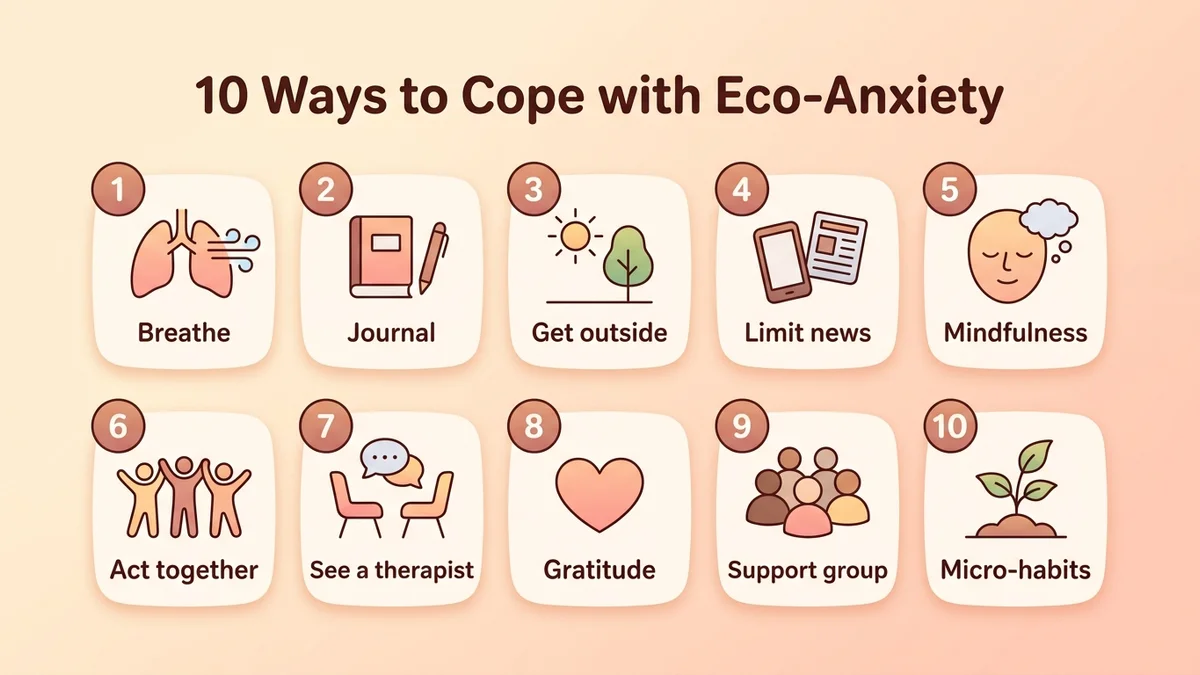
10 concrete ways to cope with eco-anxiety
Managing eco-anxiety doesn't mean ignoring the climate crisis. It means finding a balance between ecological awareness and the ability to live with peace of mind. Here are 10 research-backed approaches.
1. Practice guided breathing
Cardiac coherence is the fastest tool for calming a surge of anxiety. By breathing 6 times a minute (5 seconds in, 5 seconds out) for 5 minutes, you activate the parasympathetic nervous system and lower cortisol by 23% according to the HeartMath Institute.
When a climate headline overwhelms you, put your phone down and do 3 minutes of guided breathing. It's simple, free, and the effects are measurable from the very first session.
2. Keep an eco-emotions journal
Therapeutic journaling is particularly well suited to eco-anxiety. Writing down your thoughts lets you get them out of your head, gain perspective and break the rumination spiral.
A concrete exercise: every evening, write down 3 things:
- What worried you today (name the emotion)
- What you did that was positive for the planet (even something small)
- A pleasant moment you experienced
This practice combines journaling and gratitude, two research-backed approaches for improving wellbeing.
3. Reconnect with nature
Forest bathing (shinrin-yoku) lowers cortisol by 12.4% on average according to a meta-analysis published in Environmental Health and Preventive Medicine (2024). Spending 2 hours a week in nature is the threshold researchers have identified for significant mental health benefits.
Paradoxically, eco-anxious people sometimes avoid nature for fear of seeing its degradation. Yet direct contact with the environment strengthens your emotional bond with it and turns passive anxiety into active motivation.
4. Limit your media exposure
"Doomscrolling" (compulsively scrolling through bad news) is a trap. The more anxiety-inducing news you consume, the more your brain stays on alert. Two simple rules:
- Set a slot of 20 minutes max per day for climate news
- Avoid screens at least 1 hour before bed
5. Practice mindfulness
Mindfulness meditation trains your brain to come back to the present instead of ruminating about the future. According to a meta-analysis published in Clinical Psychology Review (2024), 8 weeks of regular practice reduce rumination by 40%.
For eco-anxiety, mindfulness is especially relevant: it helps you observe catastrophic thoughts without drowning in them.
6. Get involved collectively
Collective action is the best antidote to feeling powerless. Joining a local group, taking part in awareness workshops or getting involved in a community garden significantly reduces anxiety. Climate psychologists consistently observe that eco-anxious people who take action see their symptoms decrease noticeably.
7. See a professional
If your eco-anxiety has disrupted your sleep, work or relationships for more than a month, talk to a professional. Cognitive behavioral therapy (CBT) is the best fit. EMDR also gives good results, especially when eco-anxiety is linked to climate events you've lived through (floods, wildfires, heat waves).
8. Cultivate environmental gratitude
Gratitude isn't denial. It's a rebalancing of attention. Your brain has a natural tendency to overweight threats (negativity bias). Noting one positive thing about nature every day (a sunrise, a bird, an intact forest) counterbalances that bias without denying reality.
9. Join a support group
Talking about your eco-anxiety with people who feel the same way reduces isolation and normalizes the emotion. Organizations like the Good Grief Network, with its 10-step program for climate distress, and the Climate Psychology Alliance offer dedicated spaces to talk.
10. Adopt sustainable micro-habits
Rather than trying to change everything at once (a recipe for frustration), adopt one micro-habit a week. Biking for one trip, buying in bulk, turning down a plastic bag. These small actions add up, reduce the feeling of powerlessness and build a lifestyle aligned with your values.
Real-life scenarios
Jessica's Sunday night
Jessica, 34, opens her phone before bed. An article about disappearing glaciers. Her stomach tightens. She thinks of her two kids. What kind of world will she leave them? It's going to be a long night.
The solution: Jessica sets a digital curfew at 9 p.m. Before bed, she does 5 minutes of cardiac coherence. Within 2 weeks, her climate-related insomnia eases. She writes down the week's positive actions in her journal (composting, biking, buying local).
Ryan's green burnout
Ryan, 28, engineer. He changed jobs to join a "green" company. But he realizes greenwashing is everywhere. His anger turns into exhaustion. He can't stand the sustainability meetings that are just for show anymore.
The solution: Ryan joins a community group on weekends. Concrete action (planting trees, cleanup walks) gives him back a sense of control. He starts an environmental gratitude journal to balance his outlook.
Emma's supermarket panic
Emma, 22, college student. She has anxiety attacks in front of aisles full of plastic at the supermarket. She stopped flying and feels guilty when her friends travel. The people around her brush it off: "You're overreacting."
The solution: Emma sees a psychologist familiar with eco-emotions. At the same time, she practices mindfulness for 10 minutes a day. She learns to distinguish what she can change from what's out of her hands.
What climate distress looks like around the world
As researcher Britt Wray explains in this TED talk, climate distress is no longer a marginal phenomenon — it's a widespread, understandable response to a real threat, and it can become a source of connection and purpose. You can practice the breathing and mood-tracking techniques mentioned in this article directly with Serena, which guides you step by step.
The Serena perspective
At Serena, we see that users who combine guided breathing with daily mood tracking report a drop in their overall anxiety level within 2 to 3 weeks. What stands out from real-world feedback is that theory ("just breathe") isn't enough. You need a daily reminder, guidance, consistency.
Eco-anxiety has one particularity: it has no "resolution." Unlike a one-time fear, the climate threat isn't going away. So the strategy isn't to "cure" it but to learn to live alongside that worry without letting it paralyze your life. That's exactly what emotional regulation tools make possible: cardiac coherence, a gratitude journal and mood tracking.
Serena Coach tip: Start with 5 minutes of cardiac coherence in the morning and 2 minutes of eco-emotions journaling in the evening. This 7-minute daily ritual is the most effective entry point for regaining control over your climate anxiety. Try it for 2 weeks and notice the difference.
Practicing cardiac coherence for 5 minutes three times a day lowers cortisol by 23% and improves heart rate variability, according to the HeartMath Institute.
How Serena can help with eco-anxiety
Serena combines three complementary approaches to manage eco-anxiety day to day:
| Serena tool | Benefit for eco-anxiety |
|---|---|
| Guided breathing | Calms anxiety spikes in 3-5 minutes |
| Mood tracking (Circumplex model) | Identifies triggers (news, conversations, situations) |
| Gratitude journal | Rebalances climate-related negativity bias |
The advantage of an app like Serena over practicing on your own? Consistency. Daily reminders, guided exercises and visual progress tracking turn an intention into a habit. And it's the habit that produces lasting results.
Frequently asked questions
Is eco-anxiety a mental illness?
No. Eco-anxiety isn't listed in the DSM-5 and isn't considered a psychiatric disorder. It's a legitimate psychological distress, an adaptive response to real environmental threats. However, it can develop into an anxiety or depressive disorder in the most vulnerable people.
How do I know if I have eco-anxiety?
If environmental issues occupy your thoughts every day, disrupt your sleep or relationships, and create a persistent sense of powerlessness, you're probably experiencing eco-anxiety. Physical signs like fatigue, muscle tension and digestive problems can also appear. Validated tools such as the Hogg Eco-Anxiety Scale are used by researchers to measure it.
Is eco-anxiety a normal reaction?
Yes. According to psychiatrist Laelia Benoit, worrying about climate change in the face of overwhelming scientific evidence is a rational, healthy reaction. It's a sign of empathy and clear-sightedness. The problem only begins when that worry becomes paralyzing and takes over your daily life.
Can children experience eco-anxiety?
Yes. Laelia Benoit's research shows signs of eco-anxiety in children as young as 6. According to The Lancet Planetary Health (2021), 75% of young people aged 16 to 25 find the future frightening. Talking about it openly, without minimizing or dramatizing, is the best parenting approach.
Which therapies work for eco-anxiety?
Cognitive behavioral therapies (CBT) are the most studied and most effective. They help identify catastrophic thoughts and reframe them. EMDR is useful when eco-anxiety is tied to climate events you've lived through. Mind-body practices and clinical hypnosis can complement these approaches. The Climate Psychology Alliance can help you find a therapist familiar with climate distress.
How do you talk about eco-anxiety with the people around you?
Many eco-anxious people feel misunderstood. Friends and family often downplay it ("you're overreacting") or share the anxiety without knowing how to handle it. Two tips: name what you feel with precise words, and steer the conversation toward solutions rather than problems. Joining a dedicated support group also helps you feel less alone.
Will eco-anxiety increase in the coming years?
Probably. With extreme weather events becoming more frequent, the phenomenon is likely to intensify. Psychiatrists increasingly argue that equipping people with emotional regulation tools is a public health priority.
What is the difference between eco-anxiety and depression?
Eco-anxiety is centered on an identifiable cause (the environmental crisis) and doesn't necessarily affect self-esteem. Depression is more diffuse, affects every area of life and often comes with a general loss of motivation. Be careful: untreated eco-anxiety can develop into a depressive episode. If in doubt, see a professional.
Conclusion
Eco-anxiety is neither a weakness nor an illness. It's a sign that you're clear-sighted and sensitive to a reality no one can ignore. The goal isn't to make that worry disappear, but to learn to live with it without letting it paralyze you.
The 10 solutions in this guide aren't theoretical. They work. Guided breathing calms you in 3 minutes. Journaling soothes within 2 weeks. Collective action gives you back a sense of control. Start with just one. Today.
And if you're looking for a tool to support you every day, Serena combines guided breathing, mood tracking and a gratitude journal. Exactly what your brain needs to turn eco-anxiety into eco-action.