You've been tossing and turning for 45 minutes. The clock reads 11:47 p.m. and your brain refuses to quiet down. What if you could fall asleep in under 60 seconds? 4-7-8 breathing, developed by Dr. Andrew Weil, is a relaxation technique that promises to do exactly that. Nicknamed "a natural tranquilizer for the nervous system," it's used by millions of people worldwide to fall asleep quickly, calm anxiety, and ease everyday stress.
Updated in April 2026, this complete guide walks you step by step through how to master 4-7-8 breathing, why it works according to science, and how to build it into your evening routine to reclaim peaceful nights.
The essentials
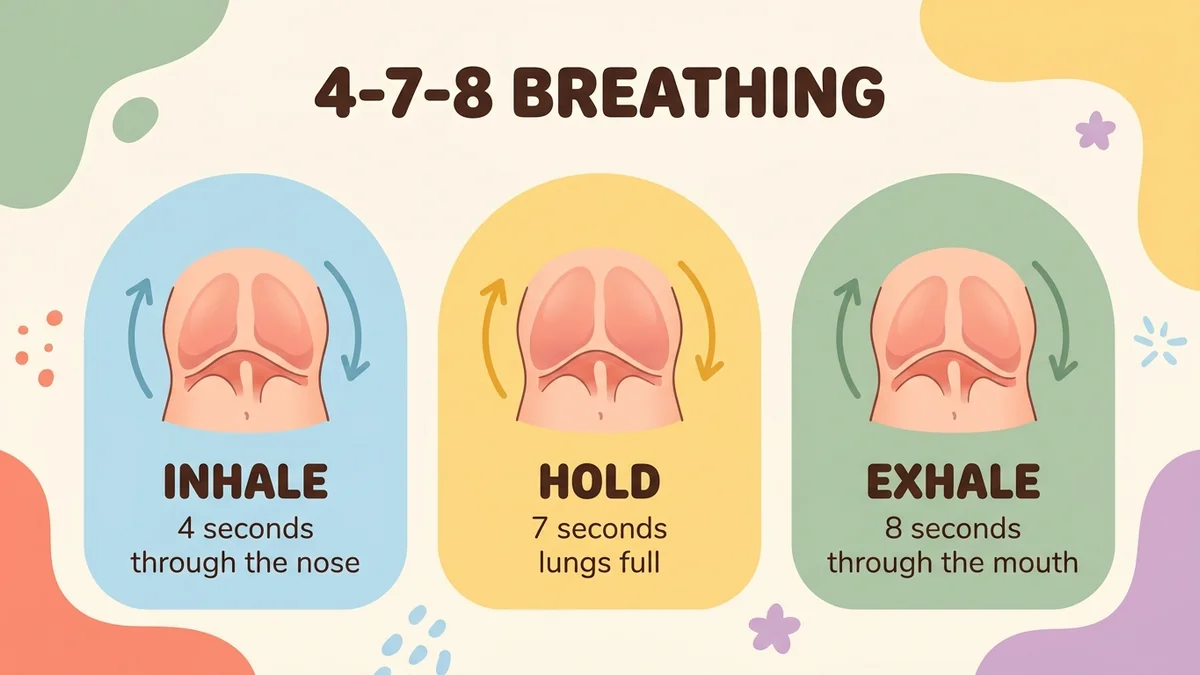
4-7-8 breathing means inhaling through your nose for 4 seconds, holding your breath for 7 seconds, then exhaling through your mouth for 8 seconds. Created by Dr. Andrew Weil, it engages the vagus nerve and the parasympathetic system to help you fall asleep within minutes. Four cycles are all it takes. The practice is free, requires no equipment, and is backed by scientific research.
What is 4-7-8 breathing?
4-7-8 breathing is a rhythmic breathing technique developed by Dr. Andrew Weil, a Harvard-trained physician and pioneer of integrative medicine. It draws on pranayama, an ancient breath-control discipline rooted in Indian yoga and practiced for more than 3,000 years.
The principle is remarkably simple: you inhale for 4 counts, hold your breath for 7 counts, then exhale slowly for 8 counts. This precise ratio, 4:7:8, isn't arbitrary. It was calibrated to maximize activation of the parasympathetic nervous system, your body's "rest mode."
Did you know? According to a study published in the Journal of Clinical Sleep Medicine (2023), slow breathing techniques reduce the time it takes to fall asleep by an average of 42% in people with mild to moderate insomnia.
Dr. Weil himself describes the technique as "a natural tranquilizer for the nervous system," noting that it grows more powerful with regular practice, unlike sleeping pills, which lose their effectiveness over time.
Key takeaway: 4-7-8 breathing isn't just a relaxation exercise. It's a physiological tool that acts directly on the vagus nerve to shift your body from "stress" mode into "rest" mode.
How to practice 4-7-8 breathing: a step-by-step guide
Here are the detailed steps for practicing the 4-7-8 technique correctly. Read them carefully before your first session.
Getting ready
- Settle into a comfortable position, sitting with your back straight or lying down in bed
- Rest the tip of your tongue against the ridge of gum just behind your upper front teeth
- Keep your tongue in this position throughout the exercise
- Close your mouth for the inhale, and open it slightly for the exhale
The 3 phases of each cycle
| Phase | Action | Duration | Breathing |
|---|---|---|---|
| Inhale | Breathe in silently through your nose | 4 seconds | Nose only |
| Hold | Hold your breath | 7 seconds | Lungs full |
| Exhale | Breathe out through your mouth with a soft sound | 8 seconds | Mouth open |
The full sequence
- Exhale completely through your mouth, making a "whoosh" sound
- Close your mouth and inhale silently through your nose while mentally counting to 4
- Hold your breath for a count of 7
- Exhale slowly through your mouth for a count of 8, with the "whoosh" sound
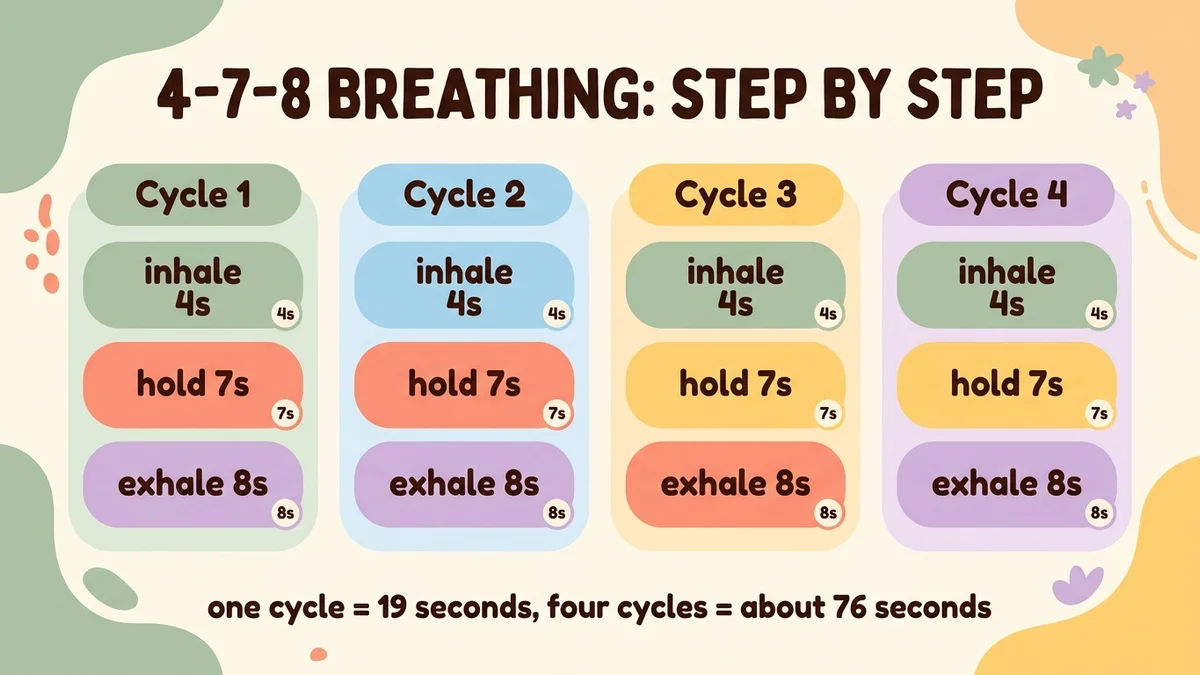
- That's one full cycle. Repeat 3 more times for a total of 4 cycles
One full cycle lasts 19 seconds. Four cycles take about 76 seconds, just over a minute. That's all it takes to trigger your body's relaxation response.
Serena tip: How fast you count doesn't matter. What matters is keeping the 4:7:8 ratio. If you count quickly, your sessions will be shorter. With practice, your counting will naturally slow down.
Key takeaway: Never go beyond 4 cycles during your first few weeks of practice. Dr. Weil stresses this limit to prevent lightheadedness. Build up gradually to 8 cycles after a month of regular practice.
Follow the technique on video
To help you picture the technique, here's a guided demonstration:
The science behind 4-7-8 breathing
The role of the vagus nerve
The vagus nerve is the longest cranial nerve in the human body. It connects the brain to the heart, lungs, digestive system, and many other organs. When you exhale for a long stretch, as you do in the 8-second phase of the 4-7-8 technique, you stimulate this nerve directly.
That stimulation triggers a cascade of reactions:
| Physiological reaction | Mechanism | What you feel |
|---|---|---|
| Slower heart rate | Increased vagal tone | A sense of calm |
| Lower cortisol | Inhibition of the HPA axis | Reduced stress |
| Higher GABA | Parasympathetic activation | Anti-anxiety effect |
| Lower blood pressure | Peripheral vasodilation | Muscle relaxation |
| Melatonin production | Indirect pineal activation | Natural drowsiness |
Why the 4:7:8 ratio is so effective
Each phase plays a specific role in activating the parasympathetic system:
- The inhale (4s) forces a slow nasal breath that filters, humidifies, and warms the air. It stimulates the production of nitric oxide, a natural vasodilator.
- The hold (7s) raises the partial pressure of CO2 in your blood. This mild hypercapnia dilates the blood vessels and improves oxygen delivery to your tissues. It also calms the respiratory center in the brainstem.
- The exhale (8s) is the key phase. A prolonged exhale, longer than the inhale, massively stimulates the vagus nerve and activates the parasympathetic branch of the autonomic nervous system.
According to a Stanford University study published in 2023 in Cell Reports Medicine, breathing techniques with a prolonged exhale are significantly more effective than mindfulness meditation at reducing anxiety and physiological stress.
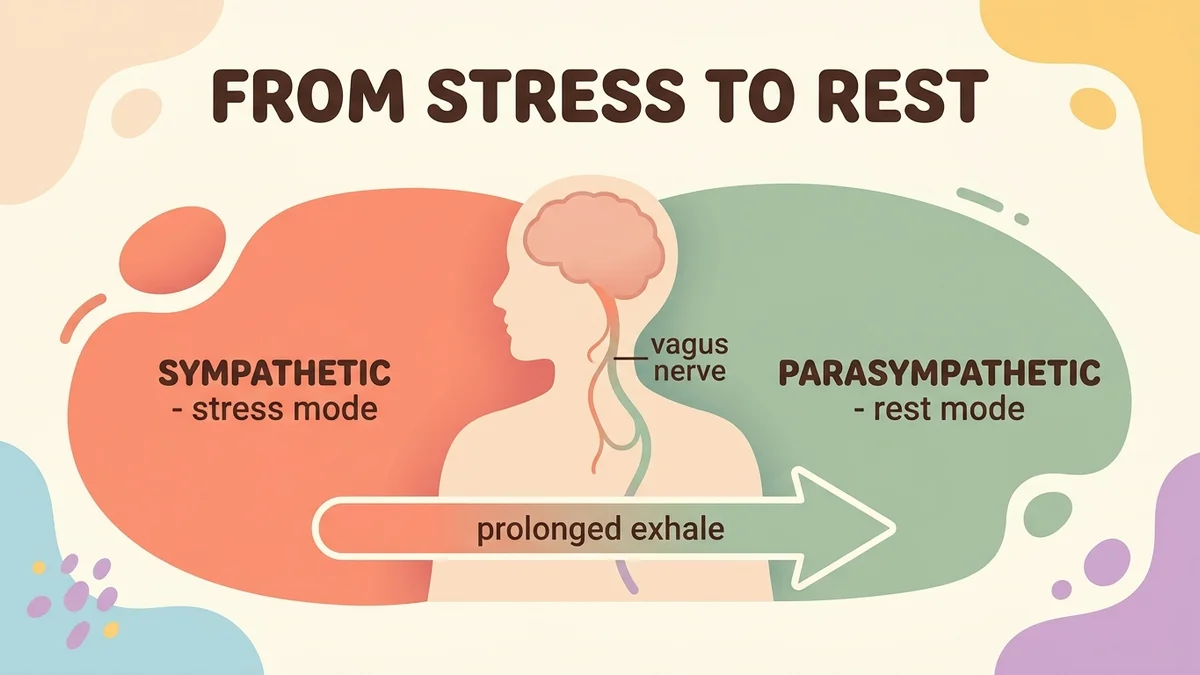
Key takeaway: The prolonged exhale is the secret to the technique. It's what activates the parasympathetic "brake" of your nervous system and prepares your body for sleep.
The proven benefits of 4-7-8 breathing
1. Falling asleep faster
Key figure: Slow breathing techniques cut the average time it takes to fall asleep from 20 minutes to 11.6 minutes, according to a meta-analysis published in Frontiers in Psychiatry (2023).
4-7-8 breathing is especially effective for falling asleep because the 7-second hold interrupts the stream of anxious thoughts, that familiar "brain that won't switch off," while the 8-second exhale flips the nervous system into rest mode.
2. Reducing anxiety
Stimulating the vagus nerve through a prolonged exhale boosts the production of GABA, the brain's main inhibitory neurotransmitter. GABA is the very molecule targeted by benzodiazepines (anti-anxiety drugs), but 4-7-8 breathing activates it naturally, without side effects.
3. Lowering blood pressure
A study published in the Journal of Human Hypertension (2023) shows that 8 weeks of controlled slow breathing lowers systolic pressure by an average of 4 to 6 mmHg, an effect comparable to some first-line blood pressure medications.
4. Managing pain
Holding the breath triggers the release of endorphins, the body's natural painkillers. Several studies show that controlled breathing techniques reduce the perception of pain by 25 to 40%.
5. Sharper focus
By dialing down the "noise" of the sympathetic system (stress, alerts, tension), 4-7-8 breathing frees up cognitive resources. The prefrontal cortex, now better oxygenated, regains its capacity for focus and decision-making.
| Benefit | When it appears | Recommended practice |
|---|---|---|
| Immediate calm | 1-2 cycles (30s) | As needed |
| Easier sleep onset | 1-2 weeks | Every evening |
| Reduced overall anxiety | 2-4 weeks | Twice a day |
| Lower blood pressure | 6-8 weeks | Twice a day |
| Better emotional regulation | 4-6 weeks | Twice a day |
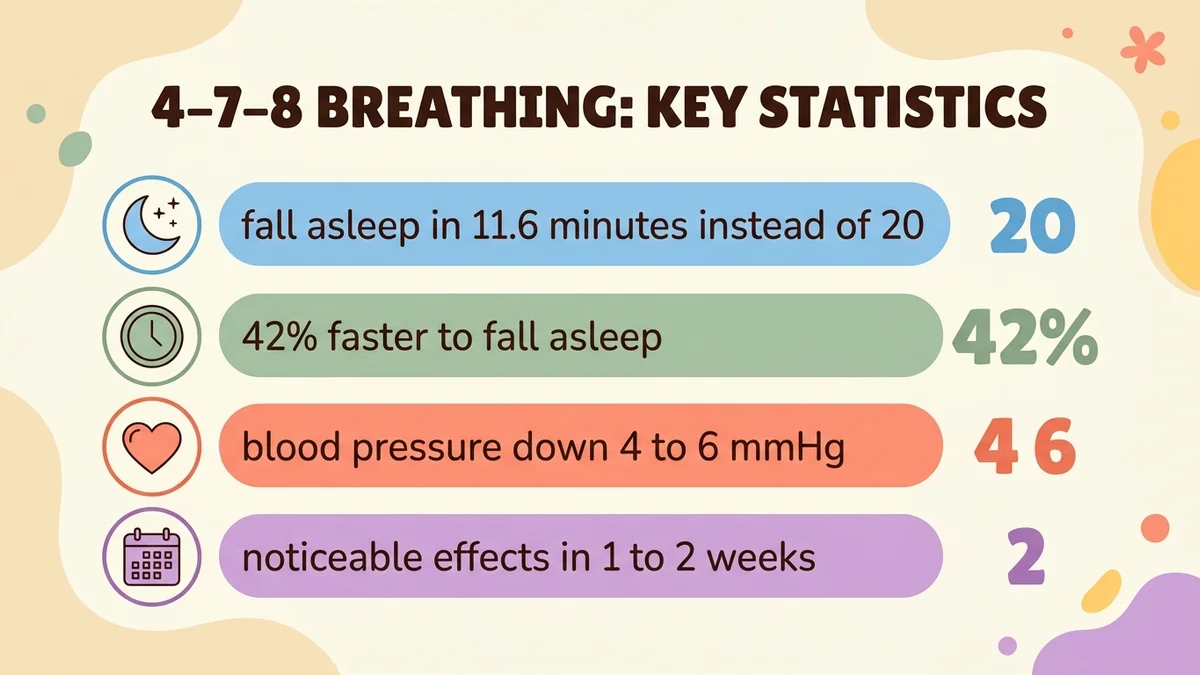
Key takeaway: The benefits of 4-7-8 breathing build on themselves. The more regularly you practice, the more effective the technique becomes and the faster you feel the effects.
Common mistakes to avoid
Even though the technique looks simple, a few mistakes can limit its effectiveness or cause needless discomfort.
Mistake 1: Counting too fast
Many beginners speed up their counting, especially during the hold. The result: the exhale isn't long enough to engage the parasympathetic system. The fix: use a metronome or the Serena app to keep the right pace.
Mistake 2: Inhaling through your mouth
The inhale should happen exclusively through your nose. Nasal breathing filters the air, produces nitric oxide, and activates the nasal nerve receptors that communicate with the parasympathetic system. Your mouth is only for the exhale.
Mistake 3: Doing too many cycles at first
Dr. Weil strictly recommends a maximum of 4 cycles for the first 4 to 6 weeks. Doing 8 cycles right away can cause dizziness, lightheadedness, or a woozy feeling from hyperventilation.
Mistake 4: Forgetting your tongue position
Your tongue should stay behind your upper front teeth for the entire exercise. This position closes an energy circuit according to traditional Chinese medicine and, more practically, keeps you from breathing through your mouth on the inhale.
Mistake 5: Giving up too soon
The technique is a "natural tranquilizer" that strengthens with practice. If you don't feel a dramatic effect after 2 or 3 days, that's normal. Stick with it for 4 to 6 weeks before you judge the results.
Key takeaway: 4-7-8 breathing is a skill you learn. The first sessions can feel uncomfortable, especially the 7-second hold. That's a sign your body is adapting. Be patient and consistent.
4-7-8 breathing: variations and progressions
Once you've mastered the basic technique, you can explore these variations to tailor the exercise to your needs.
Beginner variation: the 2-3.5-4 ratio
If a 7-second hold is too much, start by halving every count: inhale for 2 seconds, hold for 3.5 seconds, exhale for 4 seconds. What matters is keeping the ratio, not the absolute duration.
Deep-sleep variation: 4-7-8 + body scan
After your 4 cycles of 4-7-8 breathing, follow with a 5-minute body scan: mentally move through each part of your body, from your toes to your head, releasing each muscle group on the exhale. This pairing is extraordinarily effective for falling asleep.
Anti-anxiety variation: 4-7-8 in bursts
During a bout of anxiety or panic, running 2 to 3 sets of 4 cycles (with 30 seconds of normal breathing between each set) creates a deep calming effect. This approach is recommended by many cognitive behavioral therapists.
An 8-week progression
| Week | Number of cycles | Frequency | Goal |
|---|---|---|---|
| 1-2 | 4 cycles | Once a day (evening) | Learning |
| 3-4 | 4 cycles | Twice a day (morning + evening) | Reinforcing |
| 5-6 | 6 cycles | Twice a day | Deepening |
| 7-8 | 8 cycles | Twice a day | Full mastery |
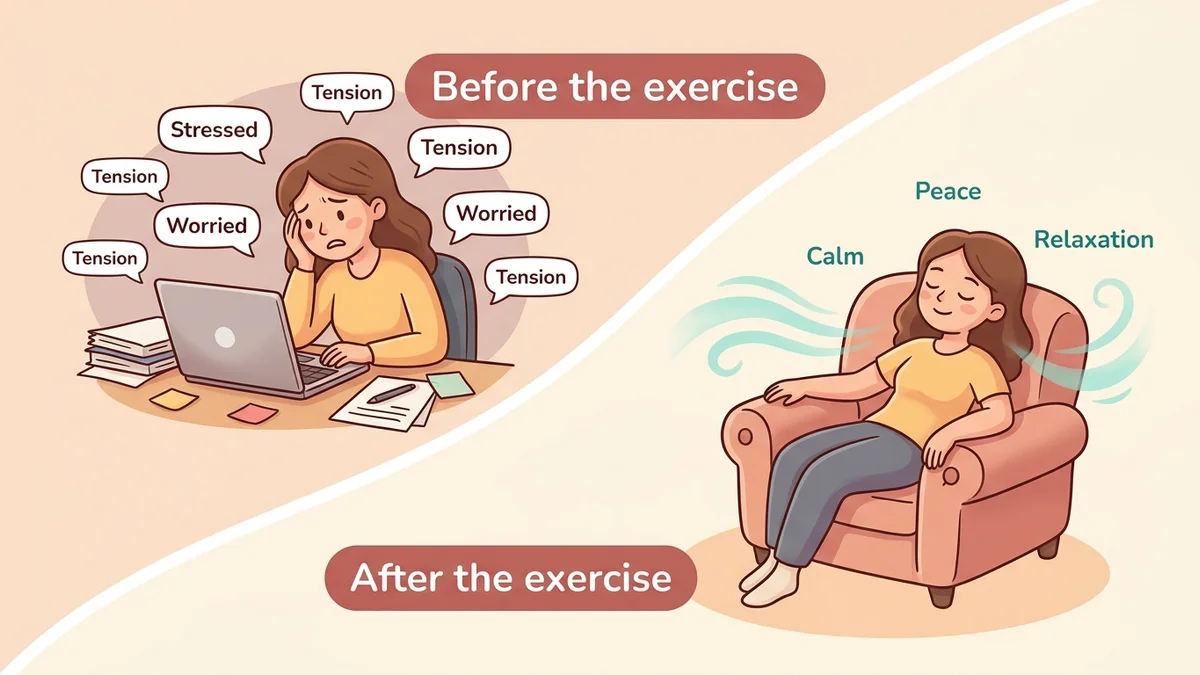
Key takeaway: Adapt the technique to your level. The 4:7:8 ratio is a guide, not a rigid rule. Your comfort and consistency matter more than perfect counting.
4-7-8 breathing vs. other techniques: a comparison
Which breathing technique should you choose for your needs? Here's a detailed comparison.
| Criterion | 4-7-8 breathing | Cardiac coherence 3-6-5 | Box breathing 4-4-4-4 |
|---|---|---|---|
| Main goal | Falling asleep | Nervous-system balance | Focus |
| Session length | 1-2 min (4 cycles) | 5 min | 4 min |
| Breath hold | Yes (7s) | No | Yes (4s) |
| Best time | Evening, at bedtime | 3 times a day | Before a demanding task |
| Difficulty | Moderate | Easy | Moderate |
| How fast it works | Immediate (2nd cycle) | 3-5 minutes | 2-3 minutes |
| Ideal for | Insomnia, anxiety | Chronic stress | Focus, performance |
To explore all these techniques in detail, check out our complete guide to breathing exercises. And if cardiac coherence interests you, our dedicated article walks you through it step by step.
Key takeaway: 4-7-8 breathing is the most effective technique for falling asleep, thanks to the hold phase that "switches off" the mind. For daytime stress, cardiac coherence is often a better fit.
How Serena can help you
Practicing 4-7-8 breathing on your own is good. Practicing it with an audio guide that counts for you is so much easier.
Serena builds the 4-7-8 breathing technique right into its guided breathing module. Here's what the app gives you:
- Visual and audio guidance — an animated circle shows you when to inhale, hold, and exhale. No more counting in your head.
- Adaptable sessions — choose between 4, 6, or 8 cycles depending on your level and your goal.
- Daily reminders — schedule your morning and evening sessions so you never forget.
- Progress tracking — see your consistency and your progress week after week.
- Smart pairing — an automatic 4-7-8 breathing + evening meditation sequence for the best possible sleep.
Serena doesn't stop at breathing. The app offers a complete mental well-being program: gratitude exercises, daily mood tracking, guided meditations, and stress-management techniques. Everything is designed to help you reclaim restorative sleep and calmer days.
Try it for free: download Serena on the App Store and try guided 4-7-8 breathing tonight. Your first night of restorative sleep might be just 60 seconds away.
If you're looking for other ways to sleep better, check out our meditation for sleep guide or try our free online cardiac coherence timer.
Key takeaway: Serena turns 4-7-8 breathing into a simple, enjoyable habit through visual guidance and reminders. No more counting — just let yourself be guided.
Frequently asked questions about 4-7-8 breathing
Does 4-7-8 breathing really work to help you fall asleep?
Yes. The 4-7-8 technique activates the parasympathetic nervous system through the vagus nerve, which slows your heart rate and lowers your blood pressure. Studies show that a prolonged exhale promotes melatonin production and reduces cortisol, helping you drift off within a few minutes.
How many cycles of 4-7-8 breathing should you do?
If you're just starting out, begin with 4 cycles (about 76 seconds). That's Dr. Andrew Weil's recommendation. After several weeks of regular practice, you can gradually build up to 8 cycles per session, morning and evening.
Can you practice 4-7-8 breathing during the day?
Absolutely. The 4-7-8 technique works any time: before a stressful meeting, during a bout of anxiety, or on your commute. It needs no equipment and can be done sitting or standing. The calming effect kicks in as early as the second cycle.
Is the 4-7-8 technique dangerous?
4-7-8 breathing is safe for most people. If you have a chronic respiratory condition (severe asthma, COPD), check with your doctor before practicing. If you feel lightheaded, shorten the hold from 7 to 4 seconds at first.
What's the difference between 4-7-8 breathing and cardiac coherence?
Cardiac coherence uses a steady rhythm (5s in, 5s out) to sync your heart and breath. The 4-7-8 adds a breath hold and a prolonged exhale, which makes it more powerful for falling asleep. Cardiac coherence is ideal during the day; 4-7-8 is better suited to the evening.
How long does 4-7-8 breathing take to work?
The calming effect is noticeable from your very first session, usually after 2 cycles. For faster sleep onset, expect 2 to 4 weeks of daily practice. Dr. Weil recommends practicing twice a day for 6 to 8 weeks for the best results.
Can you combine 4-7-8 breathing with meditation?
Yes, and it's actually recommended. Start with 4 cycles of 4-7-8 to calm the nervous system, then follow with 5 to 10 minutes of meditation or a body scan. This pairing deepens relaxation and sets you up perfectly for sleep. Explore our meditations for sleep.
Is 4-7-8 breathing suitable for children?
Children from age 6 can practice an adapted version: 2-4-4 (inhale 2s, hold 4s, exhale 4s). Move toward the full 4-7-8 ratio from around age 10 to 12. Present it as a game to make it easier to stick with.
Key takeaways
Dr. Andrew Weil's 4-7-8 breathing is one of the most effective and accessible techniques for falling asleep quickly and managing everyday anxiety. Its secret lies in the prolonged exhale that activates the vagus nerve and shifts your nervous system into rest mode.
Start tonight: 4 cycles, 76 seconds, lying in your bed. If you'd like guided support, Serena counts for you and turns this technique into a lasting habit. Your sleep deserves this one minute of attention.