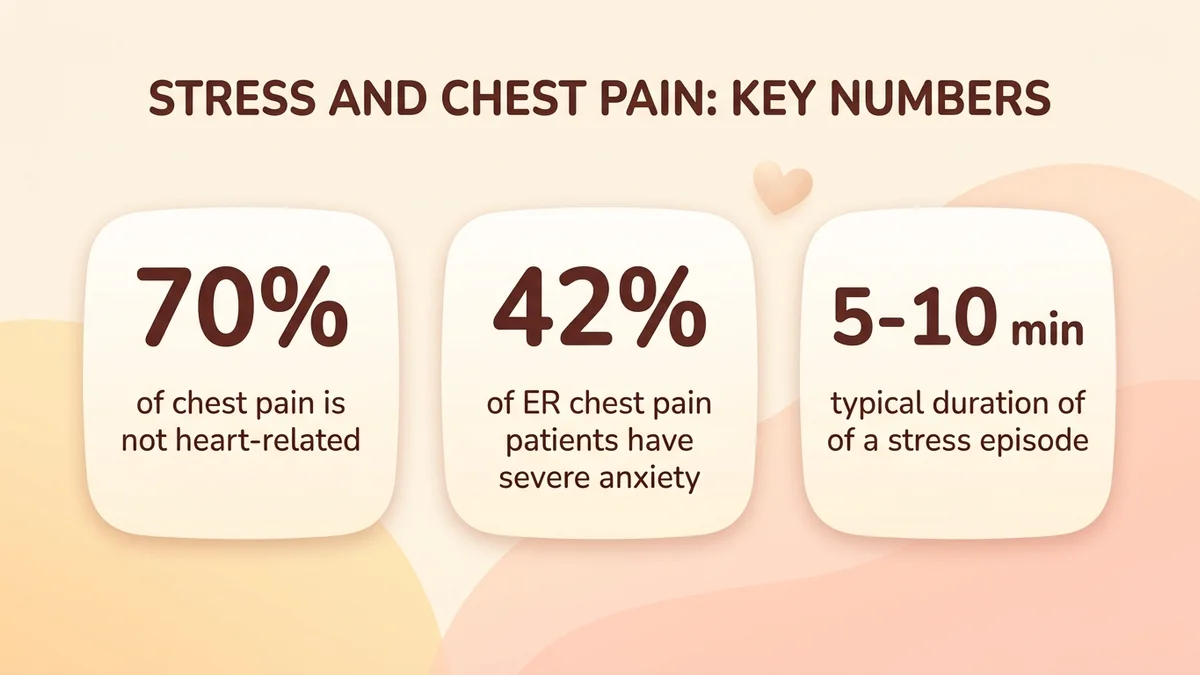
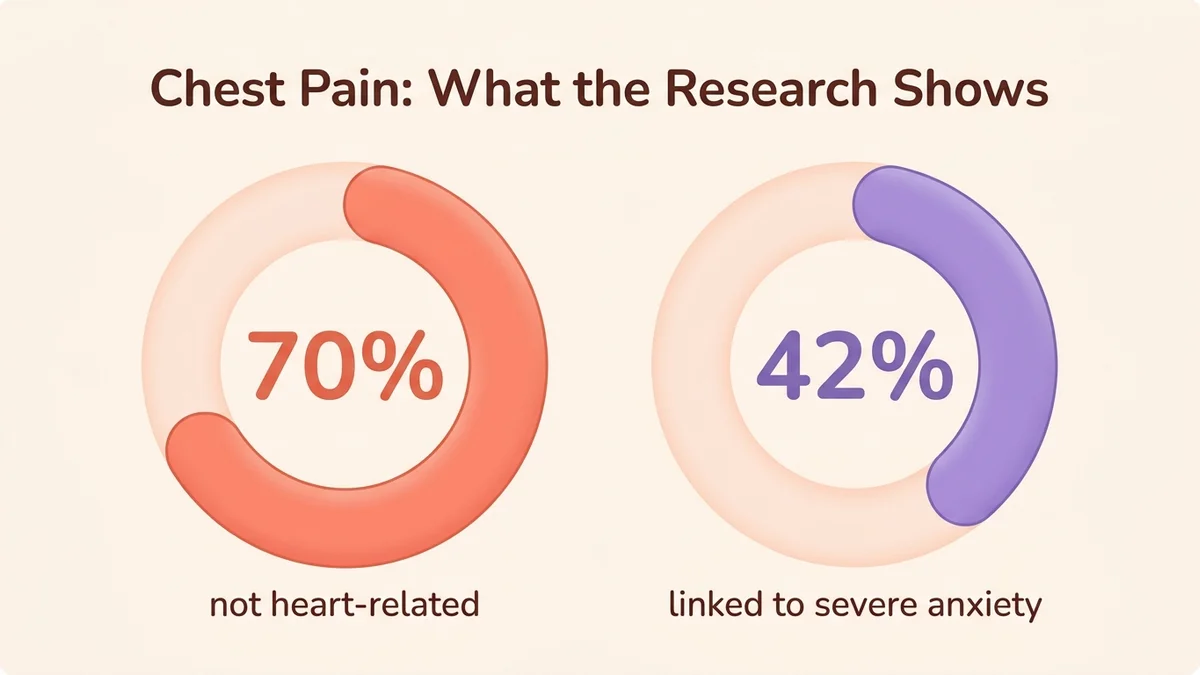
You're at the office, in the middle of a meeting, when suddenly pressure builds in your chest. Your breath gets shorter, your heart races. Panic rises: "What if it's my heart?" You're not alone. Every year, millions of people live this exact scene, and in 70% of cases, chest pain isn't cardiac in origin. Updated in April 2026.
The good news: if your chest pain is linked to stress, it's temporary, explainable and, above all, relievable. According to the PACER clinical trial published in Academic Emergency Medicine, more than 42% of patients who go to the emergency room for chest pain have severe anxiety. And three out of four meet the criteria for panic disorder.
In this article, you'll understand exactly why stress causes this pain, learn to tell it apart from a real heart problem, and discover 6 concrete techniques to relieve it, starting now.
The key takeaways
Stress-related chest pain comes from the fight-or-flight response: adrenaline speeds up your heart rate, tightens the intercostal muscles and changes your breathing, creating real tightness in your chest. It lasts 5 to 10 minutes on average and eases with relaxation. To relieve it quickly, practice diaphragmatic breathing. If there's any doubt about a heart problem, call 911.
Why stress causes chest pain
When your brain detects danger, real or perceived, it triggers a physiological cascade within milliseconds. Understanding this mechanism is already a way of taking back control.
The fight-or-flight response in detail
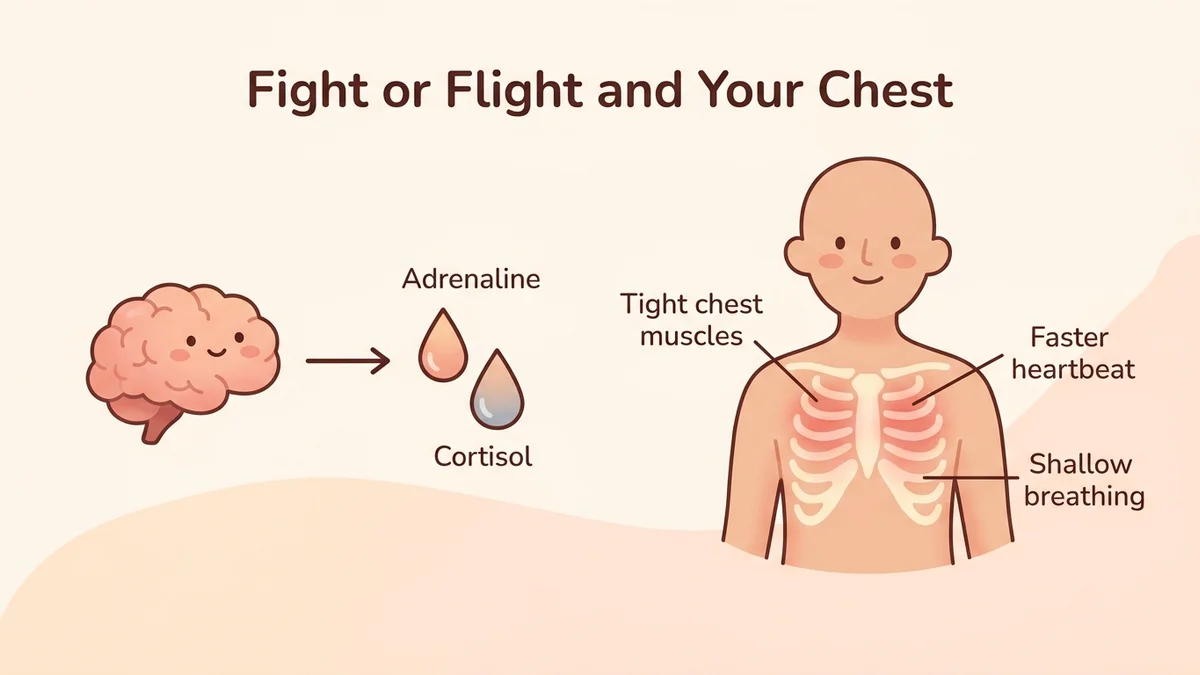
Your brain's amygdala sends an alarm signal to the hypothalamus, which activates the hypothalamic-pituitary-adrenal axis (HPA axis). Your adrenal glands then release two key hormones:
- Adrenaline: speeds up your heart rate, raises blood pressure, opens up the airways
- Cortisol: mobilizes energy, raises blood sugar, puts non-essential functions (digestion, immunity) on hold
This reaction is perfectly normal in the face of immediate danger. The problem arises when it's triggered by a stressful email, an argument or an anxious thought — and repeats day after day.
According to the WHO (2024), chronic stress keeps cortisol permanently elevated, which disrupts the cardiovascular, digestive and immune systems.
If you recognize these mechanisms, our article on the signs your body sends when stress becomes chronic will give you a complete overview.
The 4 mechanisms that create chest pain
The pain you feel in your chest doesn't have a single cause, but four mechanisms that combine:
| Mechanism | What happens | What you feel |
|---|---|---|
| Muscle tension | The intercostal muscles and diaphragm contract under the effect of adrenaline | Tightness, a vise-like feeling |
| Hyperventilation | Fast, shallow breathing throws off the O2/CO2 balance in your blood | Shortness of breath, tingling, dizziness |
| Esophageal spasms | Stress disrupts the digestive system, causing reflux and stomach acid | Burning behind the breastbone |
| Nerve hypersensitivity | A nervous system on alert amplifies every bodily sensation | Jolts, pins and needles, sharp twinges |
It's often the combination of several of these mechanisms that makes the pain so frightening — and so hard to pinpoint.
The Serena perspective: Many Serena users say that simply understanding why their chest hurts already reduces the intensity of the pain. Knowledge is the first antidote to panic.
Stress chest pain or a heart problem: how to tell the difference
This is THE question keeping you up at night. And that's normal: when your chest hurts, your brain immediately jumps to the worst. Here's how to distinguish the two, while keeping one essential reflex: if in doubt, call 911.
Comparison table: stress vs. heart
| Criterion | Stress-related pain | Heart pain |
|---|---|---|
| Trigger | Anxiety-provoking situation, stressful thought, panic attack | Physical exertion, sometimes at rest |
| Location | Diffuse, fluctuating, can affect the whole chest | Crushing, central, spreads to left arm/jaw |
| Duration | 5 to 10 minutes on average | More than 20 minutes |
| How it evolves | Improves with relaxation and breathing | Doesn't improve with rest, worsens with exertion |
| Associated symptoms | Shortness of breath, trembling, dizziness, lump in the throat | Cold sweats, nausea, feeling faint, pallor |
| Sensation | Pressure, tingling, jolts | Vise, crushing, heaviness |
Emergency warning signs
Go to the emergency room or call 911 immediately if:
- The pain lasts more than 20 minutes
- It spreads to your left arm, jaw or back
- You have cold sweats or feel faint
- The pain gets worse with physical exertion
- You have cardiac risk factors (smoking, diabetes, high blood pressure, family history)
Getting medical advice is essential the first time you experience chest pain, even if you suspect stress. Once a doctor has ruled out cardiac causes, you'll be able to face later episodes with more peace of mind.
If you tend to constantly monitor your bodily sensations, you may be experiencing a form of anxiety-related hypervigilance, a mechanism that amplifies how you perceive pain.
The different forms of stress-related chest pain
Not all stress-related chest pain feels the same. Recognizing the forms helps take the drama out of it.
Chest tightness
This is the most common form. It feels like a weight is sitting on your chest, like your rib cage is being squeezed. It often builds gradually, linked to prolonged stress or background anxiety.
A sharp stab near the heart
A sharp, brief, localized pain. It lasts a few seconds and disappears as quickly as it came. Frightening but harmless in a context of stress, it's often caused by a spasm of the intercostal muscles.
Burning behind the breastbone
Stress increases stomach acid production and slows stomach emptying. The result: acid reflux that causes a burning sensation behind the breastbone, sometimes mistaken for heart pain.
Intercostal pain
Pain located between the ribs, often on one side only. It gets worse when you breathe in deeply or change position. It results from prolonged contraction of the intercostal muscles under stress.
Anxiety somatization can show up in many ways throughout the body, not just in the chest. To understand how stress settles into your whole body, read our guide to the physical symptoms of anxiety.
6 techniques to relieve stress chest pain
Let's get practical. Here are 6 techniques you can use right now, ranked from fastest (immediate relief) to deepest (long-term prevention).
1. Diaphragmatic breathing (relief in 2 minutes)
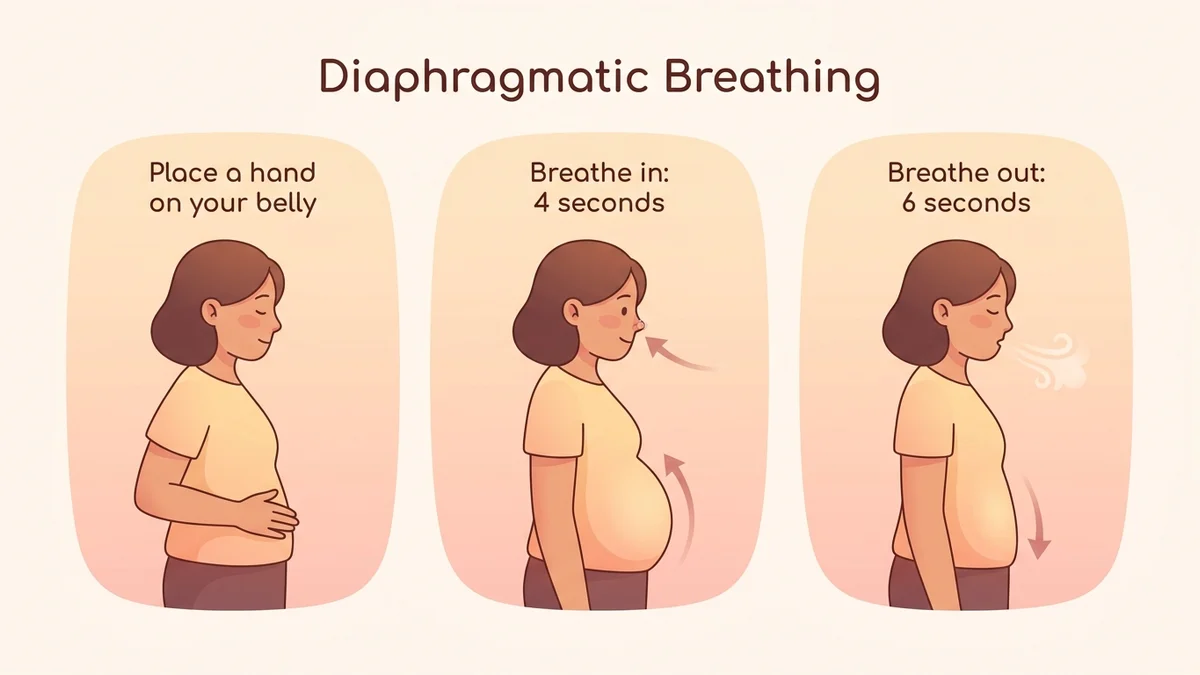
This is your first reflex when the pain appears. Diaphragmatic breathing switches off the stress response by stimulating the vagus nerve, which activates the parasympathetic nervous system — the one that calms you down.
How to do it:
- Place one hand on your belly and the other on your chest
- Breathe in slowly through your nose for 4 seconds — only your belly rises
- Breathe out gently through your mouth for 6 seconds — your belly falls
- Repeat for 2 to 5 minutes
The hand on your chest should barely move. If it's the one rising, you're breathing from your chest — exactly what stress makes you do.
To support your practice, here's a guided resonance breathing exercise, ideal for calming stress-related chest pain:
This video from breathing coach Luke Horton guides you step by step through a 5-minute session at 6 breaths per minute. The Serena app offers similar sessions, tailored to your stress level and available anytime on your iPhone.
2. Cardiac coherence (5 minutes to resync)
Cardiac coherence is a rhythmic breathing technique that regulates your heart rate variability. According to a study published in Psychoneuroendocrinology (2023), it measurably lowers cortisol within 4 to 8 weeks of daily practice.
The 365 protocol:
- 3 times a day
- 6 breaths per minute (5 sec in / 5 sec out)
- for 5 minutes
For guided support, our complete guide to heart coherence details every step with variations for your level.
3. Sensory grounding (stopping the panic spiral)
When chest pain triggers panic ("It's my heart!"), your brain enters an anxious loop that amplifies the pain. Sensory grounding breaks that loop by bringing your attention back to the present moment.
The 5-4-3-2-1 technique:
- Name 5 things you can see
- Name 4 things you can touch
- Name 3 sounds you can hear
- Name 2 smells you can notice
- Name 1 taste in your mouth
This technique is especially effective for cutting off the intrusive thoughts that fuel chest pain. Try it with our guided 5-4-3-2-1 grounding exercise.
4. Progressive muscle relaxation (releasing tension)
Since tension in the intercostal muscles is one of the direct causes of the pain, consciously releasing it is logical — and effective.
How to do it:
- Tense your shoulder muscles for 5 seconds (squeeze hard)
- Let go all at once and notice the feeling of release for 15 seconds
- Do the same with your chest muscles: breathe in and expand your chest, hold for 5 seconds, then release completely
- Finish with your belly: tighten your abs for 5 seconds, then release
The contrast between voluntary tension and release helps your brain "recalibrate" what a normal level of muscle tension feels like.
5. Regular physical activity (your anti-pain shield)
Exercise is one of the most powerful natural anxiety relievers. According to a meta-analysis in the British Journal of Sports Medicine (2024), 30 minutes of moderate exercise 3 times a week reduce anxiety symptoms by 40%.
What works best against stress chest pain:
- Brisk walking: 30 minutes, ideally outdoors
- Swimming: breathing work in the water is particularly beneficial
- Yoga: combines stretching of the chest muscles, breathing and mindfulness
- Light jogging: releases endorphins and reduces muscle tension
What matters is consistency, not intensity. Your goal isn't performance, but regulating your nervous system.
To go further with natural solutions for anxiety, read our article on natural anxiety remedies.
6. CBT and cognitive reframing (breaking the vicious circle)
Cognitive behavioral therapy is the most scientifically validated method for treating anxiety-related chest pain. The PACER trial shows significant results with CBT in patients with anxious chest pain.
How reframing works:
When the pain appears, your automatic thought is often catastrophic: "I'm having a heart attack." That catastrophizing amplifies stress, which amplifies the pain — the vicious circle.
Reframing means replacing that thought with a more realistic assessment:
- ❌ "I'm having a heart attack" → ✅ "My body is reacting to stress, I've been through this before and it passes"
- ❌ "I'm going to die" → ✅ "My heart has been checked, this pain is muscular"
- ❌ "It's getting worse and worse" → ✅ "It lasts 10 minutes at most, and I know the techniques to calm it"
Serena Coach tip: The Serena app offers daily mood tracking that helps you spot patterns between your stress level and your physical symptoms. By identifying your triggers, you can act early, before chest pain sets in.
The pain-anxiety vicious circle: how to get out of it
There's a trap many people with stress-related chest pain fall into: the vicious circle.
The mechanism: Stress causes chest pain → The pain generates anxiety ("Is it serious?") → Anxiety amplifies stress → Stress amplifies the pain → And so on.
This circle can become chronic if you don't step in. Here are the three levers to break it:
- Understanding: Now that you know why your chest hurts, the next episode will be less frightening. Knowledge reduces anxiety.
- Medical confirmation: Get a full cardiac checkup once. When your doctor confirms your heart is healthy, you have a solid foundation of certainty to lean on during future episodes.
- Daily practice: 5 minutes of cardiac coherence morning and evening gradually lowers your baseline stress level. Less background stress = less chest pain.
If stress has been going on for a long time, your cortisol is probably elevated all the time. Our article on how to lower high cortisol gives you complementary strategies.
Chest pain and panic attacks: what to do in the moment
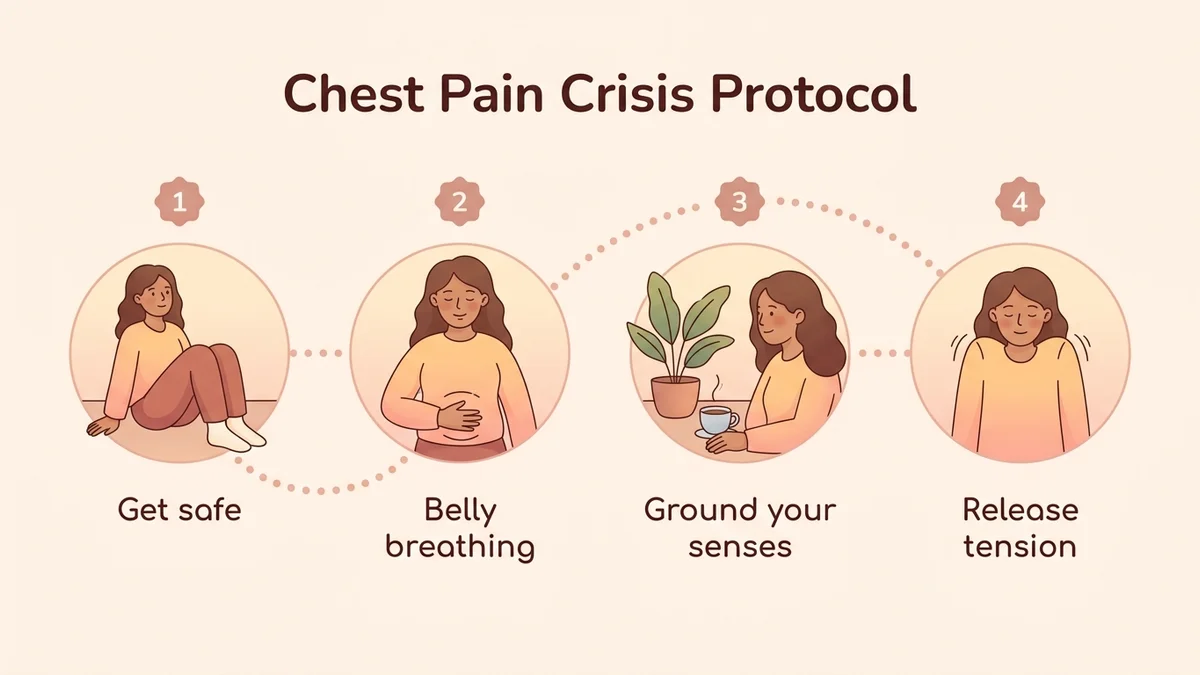
You're in the middle of an episode: your chest tightens, you can't catch your breath, panic is rising. Here's a 4-step protocol to follow in order:
Step 1: Get safe (10 seconds) Sit down or lean against something. Place both feet flat on the floor. Tell yourself, out loud or in your head: "It's not my heart, it's my stress. It will pass."
Step 2: Breathe from your diaphragm (2 minutes) Breathe in for 4 seconds through your nose (belly rising), breathe out for 6 seconds through your mouth. Making the exhale longer than the inhale activates the vagus nerve.
Step 3: Ground yourself (1 minute) Use the 5-4-3-2-1 technique described above to step out of the anxious mental loop.
Step 4: Release the tension (2 minutes) Raise your shoulders up to your ears, hold for 5 seconds, release. Repeat 3 times. Do the same by clenching your fists and then opening them.
This 5-minute protocol is enough to calm the pain in the vast majority of cases. For more exercises specific to acute episodes, read our guide to breathing exercises for panic attacks.
Preventing stress-related chest pain day to day
Relieving the pain when it comes is good. Keeping it from coming back is better. Here are the habits that make the difference over the long term:
An anti-stress lifestyle
- Sleep: Aim for 7 to 9 hours a night. Lack of sleep increases stress reactivity by 60% according to Inserm, France's national health research institute. If you have trouble sleeping, our natural remedies for sleep problems can help.
- Nutrition: Cut back on caffeine (it mimics anxiety symptoms), alcohol and simple sugars. Favor magnesium-rich foods (almonds, dark chocolate, spinach).
- Movement: 30 minutes of moderate activity a day, even just a walk.
- Disconnecting: Limit screens in the evening and anxiety-inducing notifications.
A daily stress management routine
A minimalist but effective program:
| Time of day | Action | Duration |
|---|---|---|
| Morning | Cardiac coherence (5-5) | 5 min |
| Midday | Body scan: where is the tension? | 2 min |
| Evening | Diaphragmatic breathing + gratitude | 5 min |
12 minutes a day. That's all it takes to significantly reduce how often stress-related chest pain occurs.
The Serena perspective: The Serena app supports you in this routine with personalized guided breathing sessions, visual mood tracking and gentle reminders. Many of our users notice a clear reduction in their physical anxiety symptoms within the first two weeks of regular use.
What to remember
Stress-related chest pain is common, explainable and relievable. It comes from concrete physiological mechanisms — muscle tension, hyperventilation, acid reflux, nerve hypersensitivity — not from a heart problem.
Your three priorities:
- Rule out cardiac causes with your doctor (once is enough)
- Practice diaphragmatic breathing as soon as the pain appears
- Build a daily routine of cardiac coherence to lower your background stress
Taking care of your stress means taking care of your heart — literally and figuratively.
Last updated: April 2026. This article is for informational purposes only and does not replace medical advice. If you have persistent or severe chest pain, see a doctor or call 911.