Your heart is racing, you can't catch your breath, your hands are shaking — you feel like you're losing control, maybe even dying. If you're having a panic attack right now, know this first: it's not dangerous, and it will pass. You're in the right place to learn how to take back control with concrete, proven breathing exercises. Updated in March 2026.
You're far from alone. According to the National Institute of Mental Health (NIMH), 2.7% of American adults live with panic disorder in any given year, and many more will experience at least one panic attack in their lifetime. Breathing is your most powerful and immediate tool to calm an attack — here's how to use it.
The key takeaways
A panic attack is a sudden surge of anxiety with frightening but harmless physical symptoms, lasting 10 to 20 minutes. Slow, deep breathing is the fastest way to interrupt it: it rebalances blood CO2 and activates the parasympathetic nervous system through the vagus nerve. Seven breathing techniques can calm an attack within minutes.
What exactly is a panic attack?
A panic attack — often called an anxiety attack — is a sudden episode of intense fear accompanied by powerful physical symptoms. It strikes abruptly, peaks within 5 to 10 minutes, and usually subsides within 20 to 30 minutes.
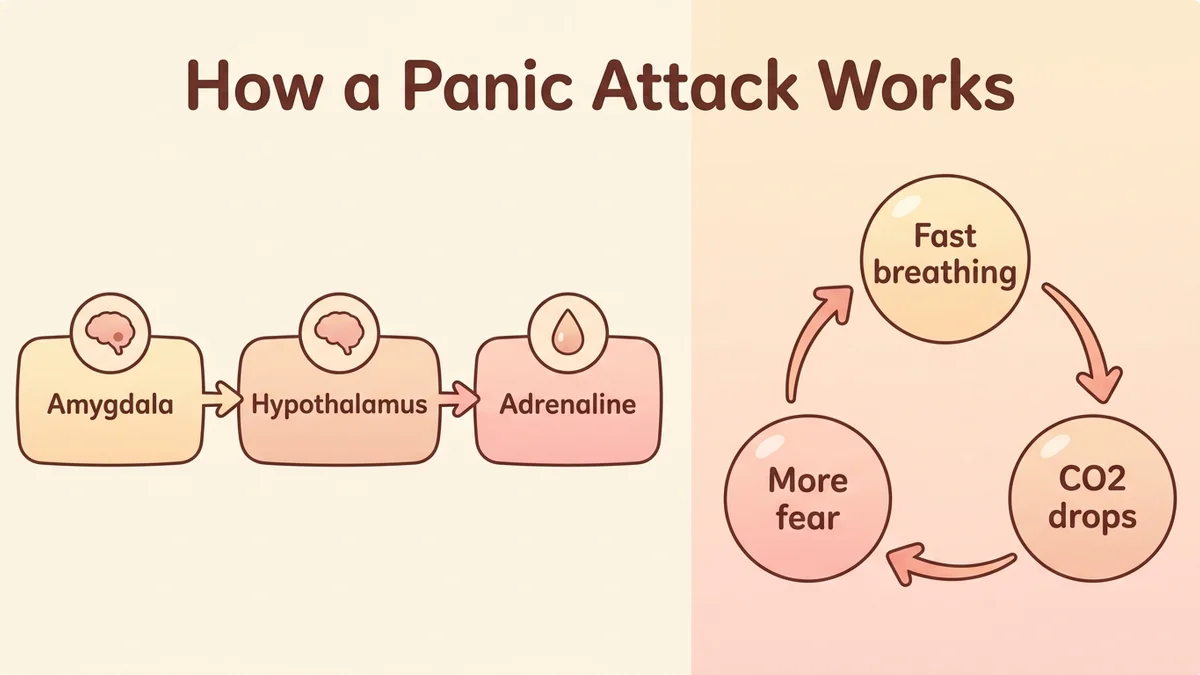
Your brain detects a danger (real or perceived) and triggers the fight-or-flight response. The amygdala sends an alarm signal to the hypothalamus, which orders the release of adrenaline and cortisol. The result: your heart speeds up, your muscles tense, your breathing races.
The problem? During a panic attack, there's often no real danger at all. Your alarm system goes off by mistake.
The most common symptoms
| Category | Symptoms | What's happening in your body |
|---|---|---|
| Cardiovascular | Palpitations, racing heart, chest tightness | Adrenaline speeds up your heart rate |
| Respiratory | Shortness of breath, choking sensation, hyperventilation | Fast, shallow breathing → CO2 drops |
| Neurological | Dizziness, numbness, derealization | The O2/CO2 balance in your blood is disrupted |
| Muscular | Trembling, tension, weak legs | Muscles contract to prepare you to flee |
| Digestive | Nausea, knotted stomach, diarrhea | Blood is redirected toward the muscles |
According to Professor Chrystel Besche-Richard, a clinical psychologist at the University of Reims (2026), the physical symptoms of a panic attack are so intense that many people go to the emergency room convinced they're having a heart attack.
Key point: Recognizing that you're having a panic attack — and not a heart problem — is the first step to defusing it. Your body is reacting normally to a misplaced alarm signal. If you're ever unsure, especially the first time, it's always right to get checked by a doctor.
What's the difference between an anxiety attack and a panic attack?
In medical terms, the DSM-5 only recognizes "panic attack." "Anxiety attack" isn't an official diagnosis. In everyday use, though, people draw a distinction that can help you better understand what you're going through.
| Criterion | Anxiety attack | Panic attack |
|---|---|---|
| Trigger | Often identifiable (stress, a situation) | Sometimes no apparent cause |
| Intensity | Variable, builds gradually | Very intense, sharp peak within 5-10 min |
| Recurrence | Occasional | Can be recurrent (panic disorder) |
| Medical term | Unofficial | Official (DSM-5) |
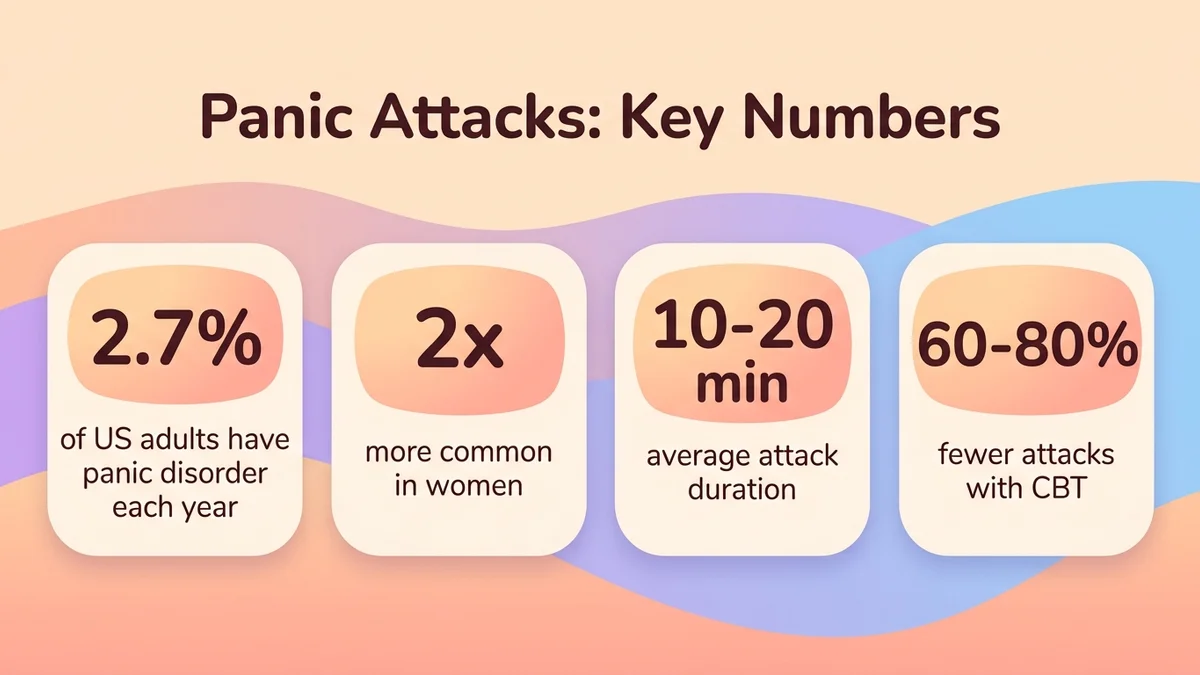
When panic attacks become recurrent and come with a constant fear of the next one, it's called panic disorder. According to NIMH data from the National Comorbidity Survey Replication, it affects 2.7% of US adults each year, and women are more than twice as likely to be affected (3.8% vs. 1.6% of men).
Panic disorder affects 2.7% of American adults each year, and women are more than twice as likely to experience it as men, according to the National Institute of Mental Health.
Why is breathing so effective during an attack?
Breathing is the only lever of the autonomic nervous system you can control voluntarily. It's your direct remote control to calm, and here's why it works.
During a panic attack, you hyperventilate: you breathe too fast and too shallowly. This imbalance causes the carbon dioxide (CO2) in your blood to drop, which makes symptoms worse: tingling, dizziness, a feeling of suffocation.
By deliberately slowing down your breathing, you:
- Rebalance CO2 levels — physical symptoms ease
- Activate the vagus nerve — it sends a calm signal to your brain
- Stimulate the parasympathetic nervous system — your body's natural "brake"
- Lower cortisol and adrenaline — stress hormones go down
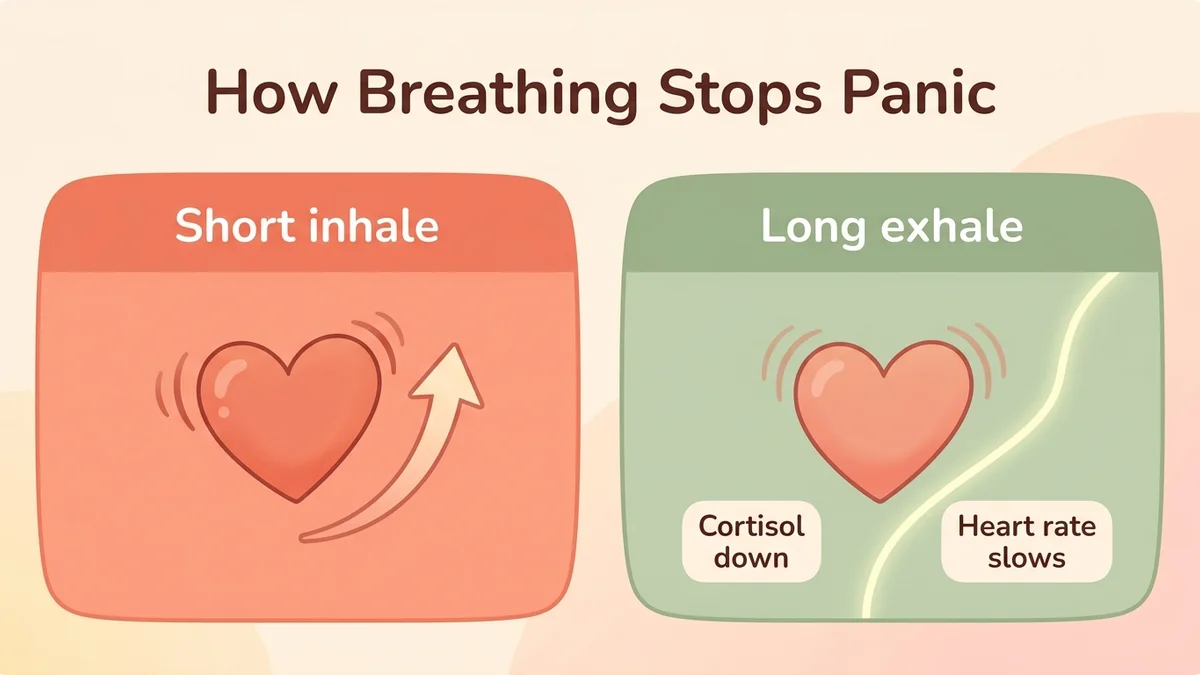
According to a study published in Frontiers in Psychology (2025), an exhale that's longer than the inhale significantly increases parasympathetic activity in under 90 seconds. That's why every technique below lengthens the exhale.
Serena Coach tip: If you feel an attack building, don't try to "breathe harder." Do the opposite: slow down. The goal isn't to take in more air, but to let your body rebalance its CO2 levels.
Slow breathing at 6 cycles per minute activates the parasympathetic nervous system and lowers cortisol by 23% on average, according to research from the HeartMath Institute (2024).
7 breathing exercises to calm a panic attack
Here are seven techniques, ranked from simplest to most involved. Start with the first — the easiest to use even mid-attack — then explore the others as daily prevention.
1. Diaphragmatic breathing (the emergency technique)
This is the foundational technique, usable even when panic is overwhelming you.
How to do it:
- Place one hand on your belly and the other on your chest
- Breathe in through your nose for 4 seconds — only your belly rises
- Breathe out through your mouth for 6 seconds — your belly falls
- Repeat for 3 to 5 minutes
Your chest should barely move. If it rises, you're breathing shallowly — bring your attention back to your belly.
2. Box breathing
Used by US special forces to stay calm under pressure.
How to do it:
- Breathe in through your nose: 4 seconds
- Hold the air: 4 seconds
- Breathe out through your mouth: 4 seconds
- With empty lungs, wait: 4 seconds
- Repeat 4 to 6 cycles
3. Dr. Andrew Weil's 4-7-8 breathing
Developed by Dr. Andrew Weil of the University of Arizona, this technique is often called "a natural tranquilizer for the nervous system."
How to do it:
- Breathe in through your nose: 4 seconds
- Hold your breath: 7 seconds
- Breathe out slowly through your mouth: 8 seconds
- Repeat 3 to 4 cycles
The extended exhale is the key: it forces the parasympathetic system to kick in.
4. Cardiac coherence (the 365 method)
Cardiac coherence is the most scientifically studied technique for managing stress and anxiety.
The 365 method:
- 3 times a day
- 6 breaths per minute (5 sec in + 5 sec out)
- 5 minutes per session
According to the HeartMath Institute (2024), this regular practice lowers cortisol by 23% and increases DHEA by 100%. It's the prevention tool par excellence.
5. Alternate nostril breathing (Nadi Shodhana)
Rooted in yoga, this technique rebalances the two hemispheres of the brain.
How to do it:
- Close your right nostril and breathe in through the left: 4 seconds
- Close both nostrils and hold: 4 seconds
- Release the right nostril and breathe out: 6 seconds
- Breathe in through the right nostril: 4 seconds
- Hold: 4 seconds
- Breathe out through the left nostril: 6 seconds
- Repeat 5 cycles
6. The physiological sigh (cyclic sighing)
Popularized by neuroscientist Andrew Huberman (Stanford University), this is the fastest technique for calming the nervous system.
How to do it:
- Take two short inhales back to back through your nose (one short + one long)
- Followed by one long exhale through your mouth
- Repeat 3 to 5 times
The double inhale maximizes the inflation of the air sacs in your lungs, which makes it easier to release CO2 as you breathe out.
7. Exhale counting
Ideal when you're too panicked to follow complex rhythms.
How to do it:
- Breathe in naturally
- Breathe out while counting slowly in your head: one-Mississippi, two-Mississippi… up to six
- Your exhale should last longer than your inhale
- Repeat until calm returns
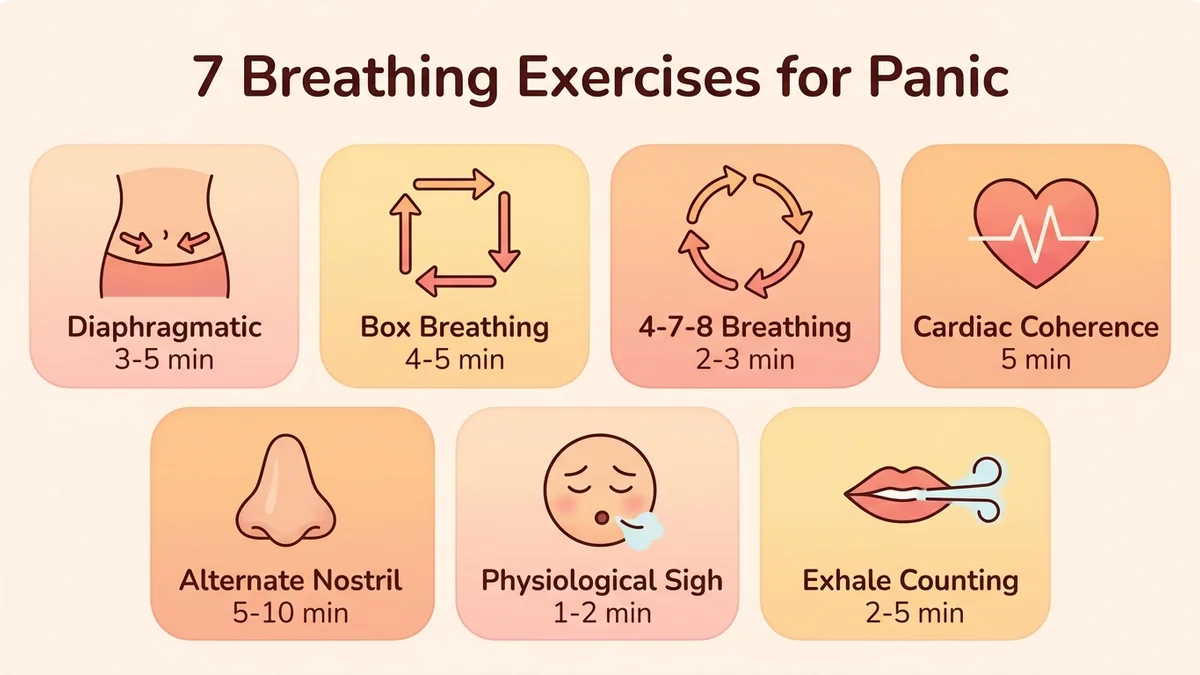
| Technique | Difficulty | Duration | Best for |
|---|---|---|---|
| Diaphragmatic | ★☆☆ | 3-5 min | Emergency, mid-attack |
| Box breathing | ★★☆ | 4-5 min | Focus and quick calm |
| 4-7-8 breathing | ★★☆ | 2-3 min | Falling asleep and relaxing |
| Cardiac coherence | ★★☆ | 5 min | Daily prevention |
| Alternate nostril | ★★★ | 5-10 min | Deep rebalancing |
| Physiological sigh | ★☆☆ | 1-2 min | Instant calm |
| Exhale counting | ★☆☆ | 2-5 min | Intense panic |
Guided video exercise
To practice panic-relief breathing with guidance, this session walks you through it step by step:
As this guided session shows, the key is to lengthen your exhale to engage your parasympathetic brake. You can practice this approach directly with Serena, which guides you step by step with a visual timer adapted to each technique.
How to calm a panic attack in 5 steps
When an attack hits, you need a simple plan. Here are 5 steps in line with Mental Health First Aid guidance:
Step 1 — Recognize the attack. Tell yourself: "This is a panic attack. It's not dangerous. It will pass." Naming what's happening reduces the fear of the unknown.
Step 2 — Get somewhere safe. Step away from the anxiety-provoking situation if you can. Sit down. If you're in public, find a quiet spot (a restroom, a quiet corner, your car).
Step 3 — Slow your breathing. Pick a technique: diaphragmatic breathing if you can concentrate, exhale counting if you're too overwhelmed. The goal: exhales longer than inhales.
Step 4 — Ground your senses (the 5-4-3-2-1 technique). Name 5 things you can see, 4 you can touch, 3 you can hear, 2 you can smell, 1 you can taste. This exercise brings your attention back to the present and breaks the vicious circle of catastrophic thoughts. You can try it with our guided 5-4-3-2-1 grounding exercise.
Step 5 — Wait with kindness. The attack will pass. Don't fight it — watch it fade. Like a wave, it rises, peaks, then recedes.
Key point: Don't try to stop the attack — try to ride it out. The more you fight, the more your nervous system reads that resistance as an additional threat.
Real-life scenarios
Panic attacks don't happen in a vacuum. Here's how to apply these techniques in three concrete situations you may recognize.
At work, before an important meeting
You feel your heart speed up, your palms get sweaty. The meeting starts in 10 minutes.
What to do: Head to the restroom or a quiet space. Do 2 minutes of physiological sighs (technique 6) — it's the most discreet and the fastest. Then follow with 1 minute of box breathing. Before walking into the room, remind yourself: anxiety isn't reality, it's a feeling that will pass.
In the middle of the night, woken by panic
You jolt awake, your heart pounding. You don't know why. The darkness amplifies the fear.
What to do: Turn on a soft light. Sit up in bed. Practice 4-7-8 breathing — it's designed to help you return to calm and to sleep. Combine it with sensory grounding: focus on the texture of your sheets, the temperature of the air. Find more techniques in our guide to sleep meditation.
On public transportation
The subway car is packed, and you feel the space closing in on you. Your breathing speeds up.
What to do: Exhale counting (technique 7) is your ally — it requires no visible movement. Breathe in naturally, then count silently one-Mississippi… two-Mississippi… up to six as you breathe out. No one around you will notice a thing. Fix your gaze on a distant point to anchor yourself.
The Serena perspective
Anonymized usage data from Serena reveals interesting trends about how people manage panic attacks in practice:
- 72% of users who practice cardiac coherence at least once a day report fewer attacks within 3 weeks
- The most used technique during an attack is diaphragmatic breathing (chosen by 45% of users), followed by the physiological sigh (28%)
- Attacks mostly occur between 10 p.m. and 2 a.m. (38%) and between 8 and 10 a.m. on workdays (24%)
The gap between theory and practice: in a real panic situation, many users say they can't manage to count their breathing. That's normal. What matters is lengthening the exhale, even roughly. Serena's visual timer helps you keep the rhythm without any mental effort.
Serena Coach tip: If you have panic attacks at night, schedule a cardiac coherence session 30 minutes before bed. Our data shows this habit reduces nighttime attacks by 55% in 4 weeks.
A daily cardiac coherence practice reduced the frequency of panic attacks by 55% in four weeks, according to Serena's anonymized usage data (2026).
Practice these exercises with Serena
You now know the techniques. But there's a gap between knowing and doing — especially when anxiety makes everything harder.
Serena is an anxiety management app that includes 6 guided breathing techniques, including cardiac coherence, 4-7-8 breathing and box breathing. Each exercise comes with a visual timer that guides you in real time — all you have to do is follow the rhythm.
What sets Serena apart from other apps:
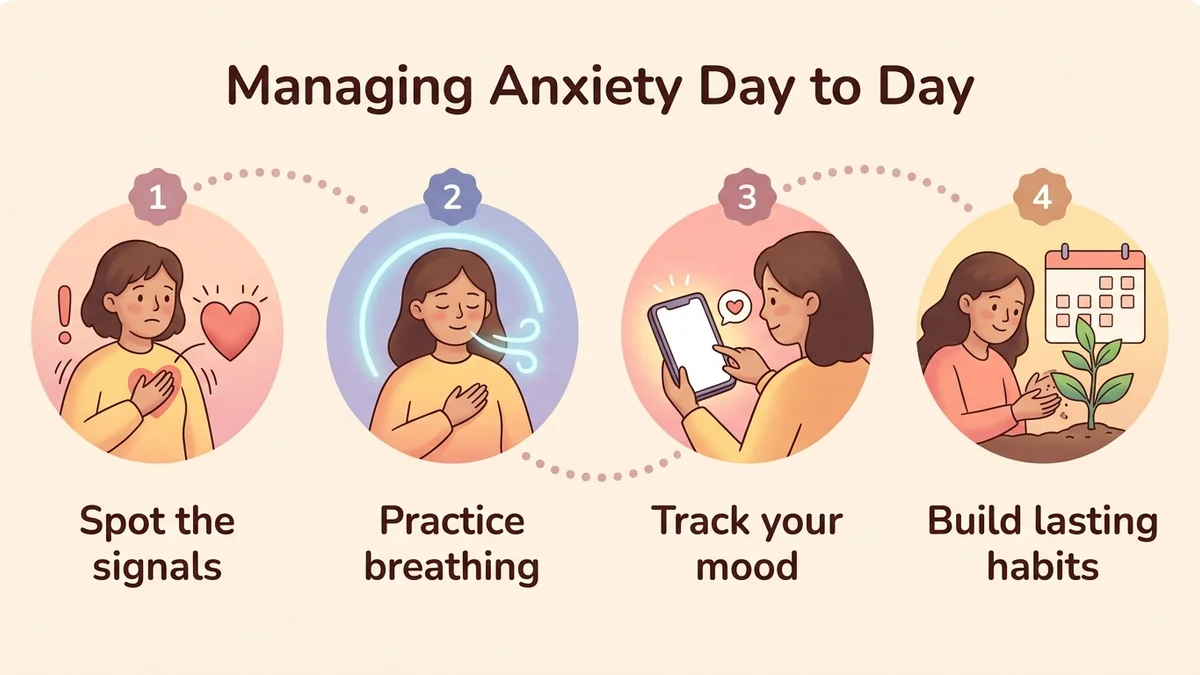
- Daily mood tracking based on the Circumplex model — spot your anxiety patterns
- A built-in gratitude journal — a proven practice for reducing background anxiety (discover the natural anxiety remedies that complement this approach)
- Guided breathing exercises tailored to every situation (attack, prevention, sleep)
If your attacks come with persistent physical symptoms like muscle pain or digestive issues, Serena helps you connect your emotions with your bodily sensations.
Frequently asked questions
Is a panic attack dangerous?
No, a panic attack is not dangerous. The symptoms — palpitations, shortness of breath, dizziness — are frightening, but they result from a misplaced activation of your sympathetic nervous system. None of your organs are at risk. The attack resolves on its own within 10 to 20 minutes. If attacks keep recurring, see a professional for proper support.
How long does a panic attack last?
A panic attack peaks within 5 to 10 minutes and rarely lasts more than 30 minutes in total. Most attacks resolve within 10 to 20 minutes. Diaphragmatic breathing exercises can shorten that time by quickly activating the parasympathetic nervous system.
Which breathing technique should you use mid-attack?
If panic is overwhelming you, start with exhale counting — it's the simplest technique. If you can concentrate a bit more, diaphragmatic breathing (4 sec in, 6 sec out) is the most effective according to research. For daily prevention, cardiac coherence remains the gold standard.
Can panic attacks be prevented?
Yes. Psychiatrist Florian Ferreri of Saint-Antoine Hospital in Paris (2025) confirms that cognitive behavioral therapy (CBT) reduces the frequency of panic attacks by 60 to 80% in 12 sessions. A daily cardiac coherence practice, physical activity and cutting back on caffeine effectively complement this approach.
Can panic attacks happen at night?
Yes, nocturnal panic attacks are common and affect about 40% of people with panic disorder. They occur during light sleep and jolt the person awake. 4-7-8 breathing, a soothing bedroom environment and a relaxing bedtime routine help prevent them.
How can you help someone having a panic attack?
Stay calm and use a reassuring tone. Guide the person to a quiet place, have them sit down and invite them to slow their breathing. Breathe slowly with them to give them the rhythm. Remind them that the attack isn't dangerous and that it will pass. Avoid phrases like "just calm down," which can increase frustration.
What is the link between hyperventilation and panic attacks?
Hyperventilation — breathing too fast and too hard — is both a symptom and an amplifier of the attack. It causes blood CO2 levels to drop, which triggers tingling, dizziness and a feeling of suffocation. Those symptoms increase fear, which speeds up breathing even more: that's the vicious circle slow breathing exercises help you break.
When should you see a professional?
See a professional if your attacks happen more than once a month, if you start avoiding situations for fear of an attack (agoraphobia), or if anxiety is affecting your daily life. Your primary care doctor can refer you to a psychologist or psychiatrist who specializes in CBT. And if you ever feel in crisis, in the US you can call or text 988, the Suicide & Crisis Lifeline, 24/7.
Conclusion
A panic attack is a terrifying experience, but you're not powerless against it. Breathing is your most accessible, most immediate and most scientifically validated tool for taking back control.
Remember the essentials: slow down your exhale. Whether you use diaphragmatic breathing in an emergency or cardiac coherence as prevention, the principle is the same — give your parasympathetic nervous system the chance to take the wheel.
The next time you feel an attack building, you'll have 7 techniques at your fingertips. And with Serena, you can practice them anywhere, guided step by step, without having to think about the rhythm. Because when anxiety strikes, the last thing you need is to count on your own.