Yoga Nidra and Hypnosis for Sleep: The Practical 2026 Guide
You've been tossing and turning in bed for 45 minutes. Your brain refuses to go quiet. Tomorrow morning, the alarm will go off and you'll still be exhausted. If that sounds familiar, you're not alone: according to the CDC (2024), 30.5% of American adults sleep less than 7 hours a night. Sleep hypnosis and yoga nidra for sleep are among the most studied natural approaches for getting back to restorative nights. Updated in August 2026, this guide helps you choose the technique that fits your profile. No medication, no side effects.
The key takeaways: Yoga nidra works on deep physical relaxation through theta waves, while hypnosis reprograms your sleep patterns through suggestion. Both are scientifically validated. Your choice depends on your type of insomnia.
What is yoga nidra and how does it help you sleep?
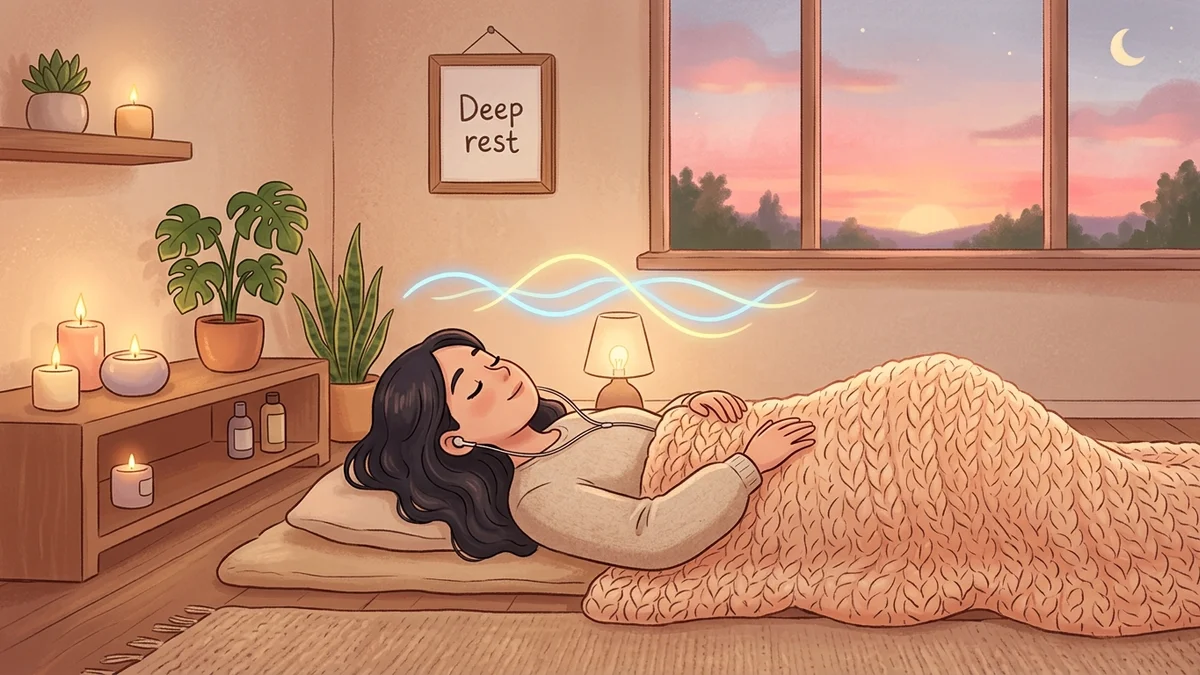
Yoga nidra, literally "yogic sleep," is a guided relaxation technique developed in the 1960s by Swami Satyananda Saraswati. Despite its name, it isn't physical yoga. You stay lying down, still, following the instructions of a guiding voice.
The origins: between tradition and neuroscience
Swami Satyananda formalized this practice drawing on ancient tantric texts. He observed that certain states of consciousness between waking and sleep allowed for deep recovery of the nervous system. Since then, modern research has confirmed his intuitions.
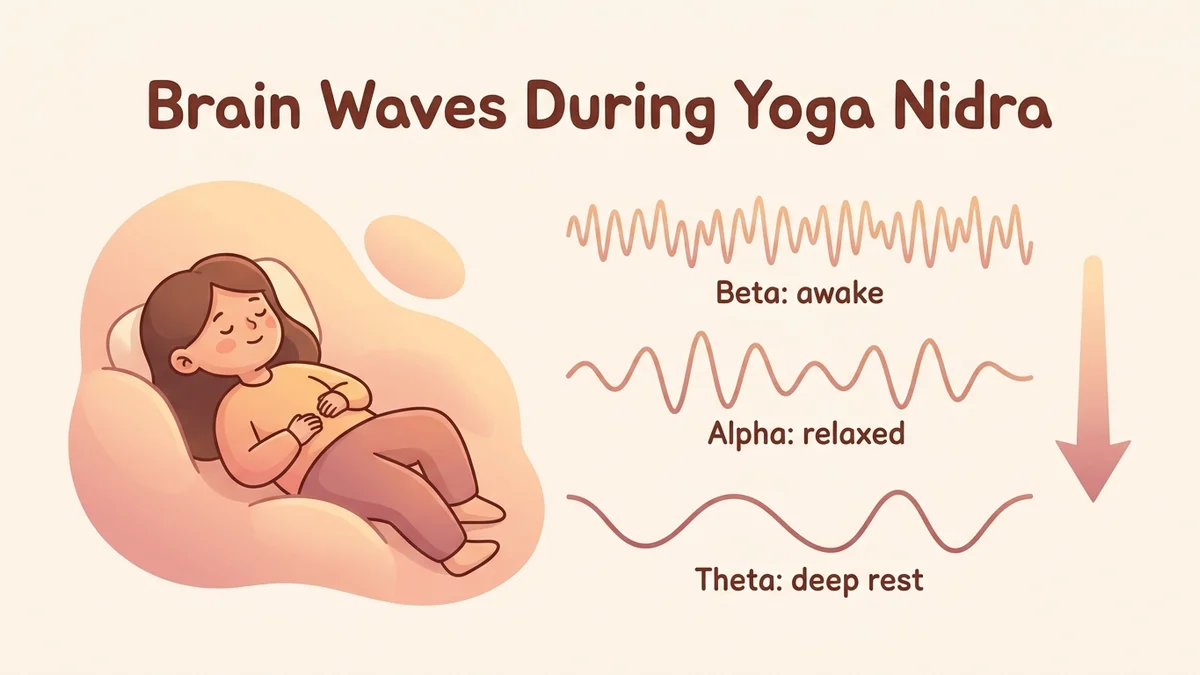
According to a study published in the Journal of Clinical Psychology in 2022, yoga nidra significantly increases the production of theta waves (4-7 Hz), characteristic of the state between waking and sleep.
The mechanism: alpha waves, theta waves and recovery
Many people are skeptical the first time they hear about yoga nidra for sleep. Lying down and listening to someone talk sounds like a glorified nap. In reality, the neurological process is far more sophisticated.
Here's what happens in your brain during a session:
- Minutes 1-5: shift from beta waves (active wakefulness) to alpha waves (light relaxation)
- Minutes 5-15: descent toward theta waves, normally accessible only during REM sleep
- Minutes 15-30: conscious maintenance in the theta zone, where cellular recovery speeds up
According to the work of Dr. Richard Miller, founder of the iRest protocol, 30 minutes of yoga nidra provides nervous system recovery equivalent to about 2 hours of light sleep. The body regenerates while awareness stays present.
Why it works for insomnia
Yoga nidra targets the autonomic nervous system directly. By activating the vagus nerve through progressive relaxation, it shifts your body from sympathetic mode (alert, stress) to parasympathetic mode (rest, digestion, recovery).
For people whose insomnia is linked to built-up physical tension (back, jaw, shoulders), this body-based approach works particularly well. The systematic body scan releases knots you no longer even notice.
Hypnosis for sleep: how does it work?
Sleep hypnosis uses a completely different mechanism. Here, the work isn't on the body but on the mind. More precisely, it reprograms the negative associations your brain has built around bedtime.
The hypnotic mechanism, simply explained
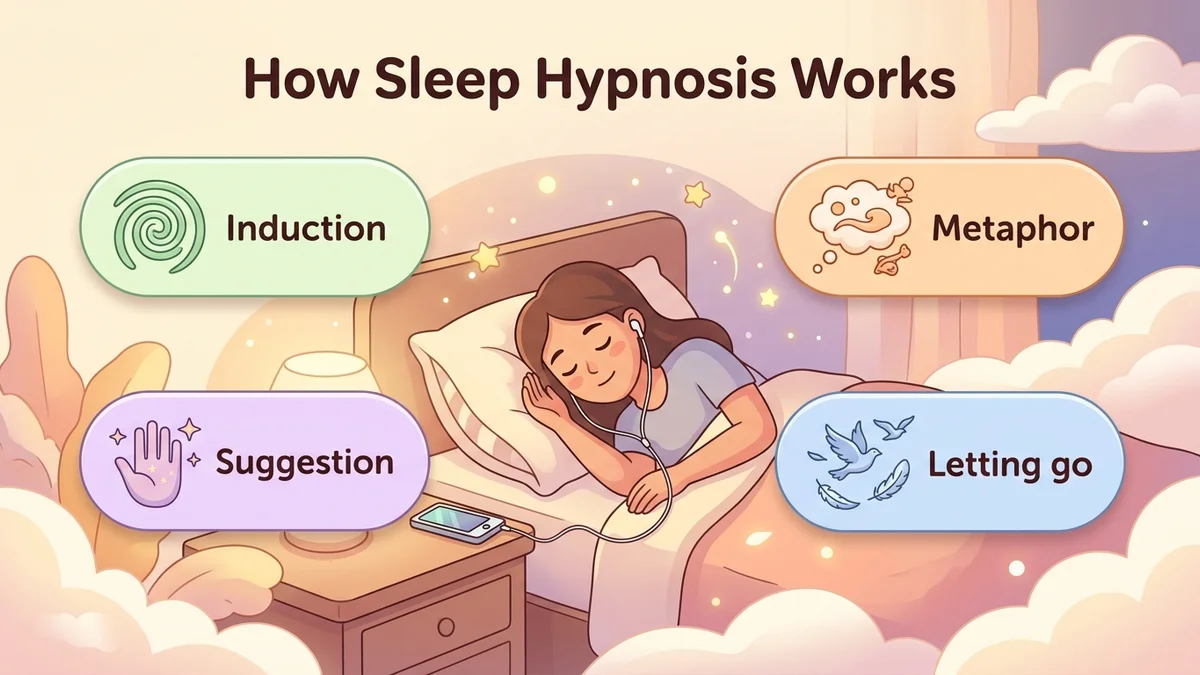
When you listen to a sleep hypnosis session, the practitioner uses specific language techniques:
- Inductions: phrases that capture your attention and reduce inner chatter
- Direct suggestions: "your eyelids are growing heavy, pleasantly heavy"
- Metaphors: stories that speak to the unconscious without going through critical analysis
- Dissociation: separating the body that's falling asleep from the mind that's still listening
The result? Your brain gradually associates lying down in the dark with an automatic signal to fall asleep. It's positive conditioning.
The Zurich study: +80% deep sleep
In 2014, the University of Zurich published a landmark study in the journal Sleep. According to the work of Dr. Maren Cordi and Professor Björn Rasch, participants who listened to a hypnotic suggestion before a nap saw their deep (slow-wave) sleep increase by 81% compared with the control group.
81%. Not 8%. That figure revived the scientific community's interest in hypnosis as a tool for regulating sleep.
Self-hypnosis: becoming independent
Let's be honest: listening to a recording every night can become a chore. The good news is that hypnosis for sleep can be learned. After a few weeks of guided practice, most people develop personal "anchors" (a word, a gesture, a mental image) that trigger relaxation without any audio.
The steps to get there:
- Practice with a guided recording for 2-3 weeks
- Identify the exact moment you start slipping into drowsiness
- Pair that moment with a personal signal (for example, placing your hand on your belly)
- Gradually use only the signal, without the recording
Yoga nidra vs. hypnosis: which technique should you choose?
This is THE question everyone asks. And the answer really depends on your profile. Here's a detailed comparison.
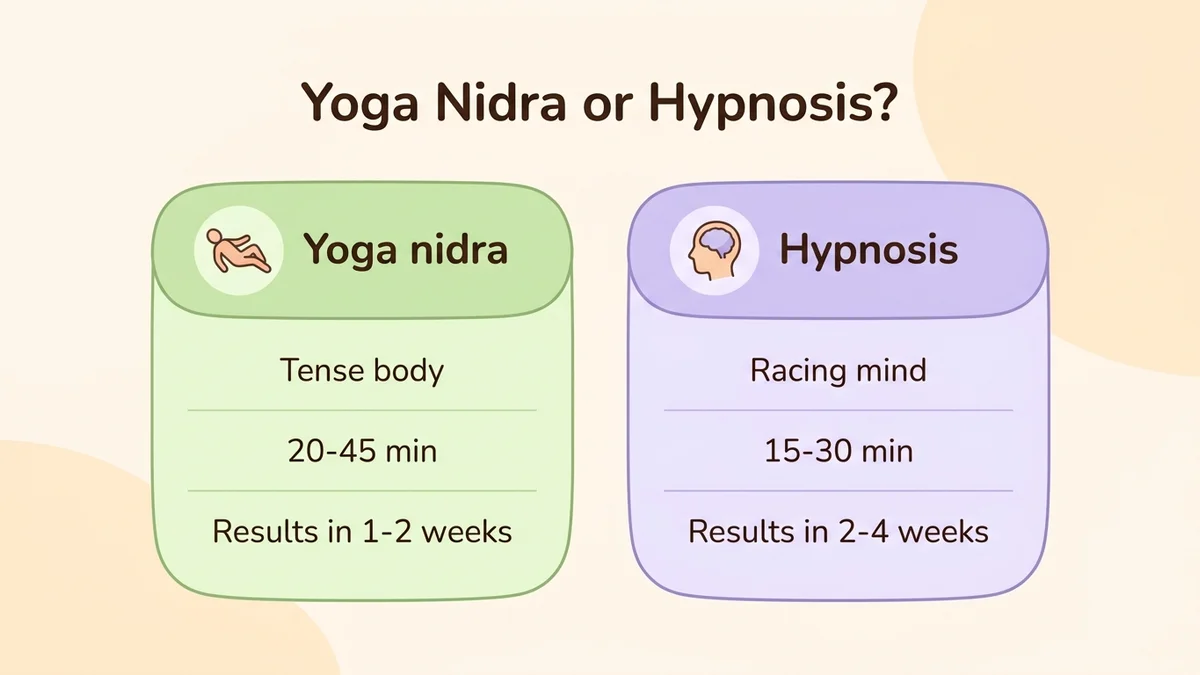
| Criterion | Yoga Nidra | Sleep Hypnosis |
|---|---|---|
| Main mechanism | Progressive physical relaxation, theta waves | Mental suggestion, reconditioning |
| Session length | 20-45 minutes | 15-30 minutes |
| Learning curve | Easy, accessible from the 1st session | Moderate, effectiveness grows with practice |
| Ideal profile | Physical tension, body-level restlessness | Intrusive thoughts, anticipatory anxiety |
| Contraindications | Severe dissociation, unstabilized PTSD | Active psychosis, uncontrolled epilepsy |
| Time to results | 1-2 weeks | 2-4 weeks |
| Independence | Often requires audio guidance | Self-hypnosis possible after a few weeks |
| Scientific validation | Solid (studies since 2010) | Very solid (studies since 1990) |
The deciding factor
If your insomnia shows up as a body that stays tense despite being tired, go for yoga nidra. If it's more of a mind that keeps looping with uncontrollable thoughts, hypnosis will be a better fit.
And if you have both? Good news: these techniques complement each other perfectly. We'll come back to this in the "Practical program" section.
What practitioners report
In online sleep communities, the same testimonials come up again and again. Yoga nidra fans often describe a feeling of their "body melting into the mattress," while hypnosis users talk more about a "switch turning off" their thoughts.
Interestingly, people who have tried both techniques for at least a month each often end up alternating depending on how they feel that day. An evening of physical tension after a workout? Yoga nidra. An evening of rumination after an intense workday? Hypnosis. That flexibility is an underrated advantage once you've mastered both approaches.
What the science says in 2026
Research on both approaches has made considerable progress in recent years. Here's the current state of knowledge.
The Ghai meta-analysis (2026)
According to the meta-analysis by Ghai et al. published in early 2026, pooling 14 randomized controlled trials, yoga nidra reduces Insomnia Severity Index (ISI) scores by 4.7 points on average. That's a clinically significant effect, comparable to cognitive behavioral therapy for insomnia (CBT-I).
The evidence on hypnosis
A 2024 systematic review concluded that hypnosis improves subjective sleep quality in 78% of the studies reviewed, and researchers see it as a viable alternative to sleeping pills for mild to moderate insomnia.
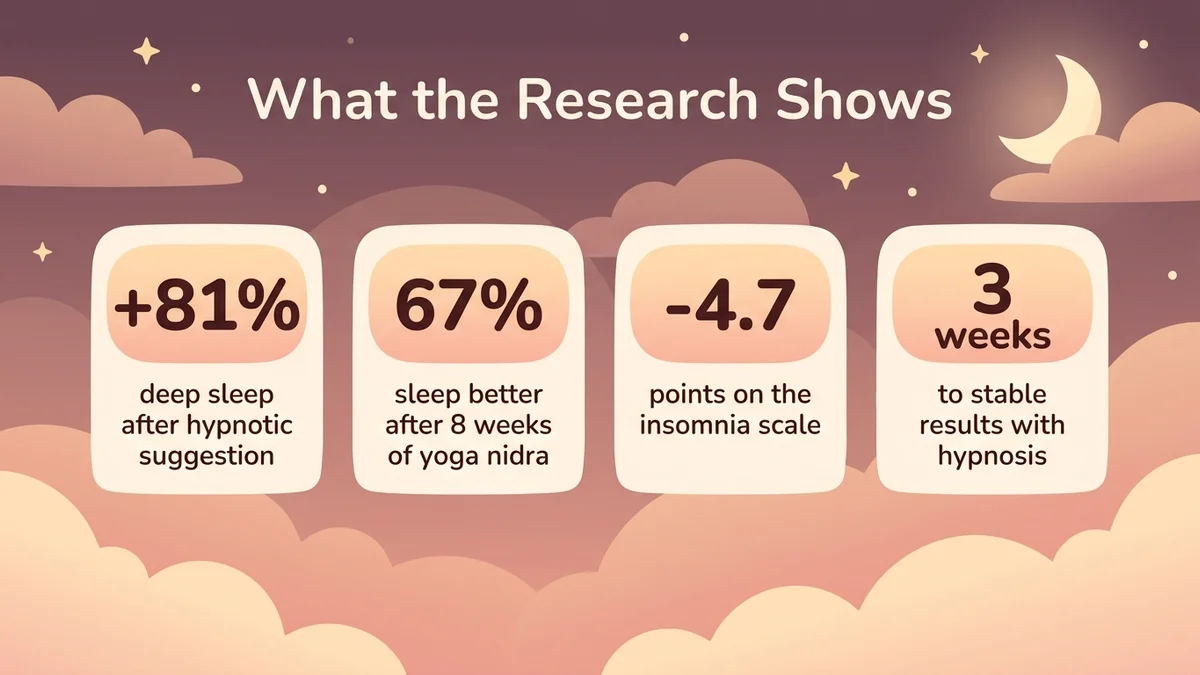
Key figures to remember
- 67% of yoga nidra practitioners report better sleep after 8 weeks (Datta study, 2023)
- 81% increase in deep sleep after hypnotic suggestion (Cordi & Rasch, 2014)
- 4.7 points reduction in ISI score with yoga nidra (Ghai et al., 2026)
- 3 weeks: average time to see stable results with hypnosis (systematic review, 2024)
A practical program for your profile
Enough theory. Let's get to concrete protocols based on your situation.
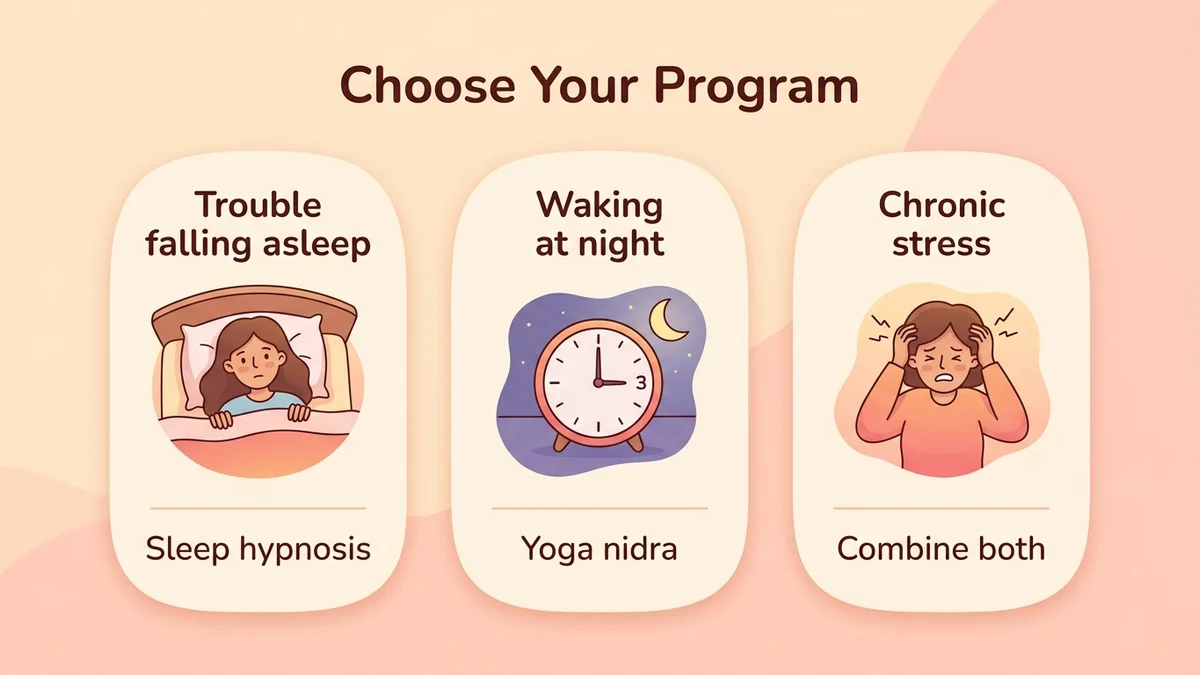
Profile 1: trouble falling asleep (it takes you more than 30 minutes)
Recommended technique: sleep hypnosis
Your problem is a brain that refuses to go into standby. Hypnosis targets precisely that mechanism by creating a mental "switch."
4-week protocol:
- Weeks 1-2: listen to a 20-minute sleep hypnosis session every night, in bed, lights off
- Week 3: alternate between the audio session (3 nights) and self-suggestion (4 nights)
- Week 4: switch to full self-hypnosis, using the audio only when you have trouble
To round it out, guided breathing before bed prepares the ground by lowering your heart rate.
Profile 2: waking up at night (you wake between 2 and 4 a.m.)
Recommended technique: yoga nidra for sleep
Nighttime awakenings are often linked to cortisol rising too early (the famous 3 a.m. "cortisol spike"). Yoga nidra, practiced early in the evening, extends the deep sleep phase and delays that spike.
4-week protocol:
- Weeks 1-2: a 25-minute yoga nidra session early in the evening (around 9 p.m.), not at bedtime
- Weeks 3-4: a shortened 15-minute session + a body scan exercise if you wake up at night
If your awakenings are linked to chronic stress, address the underlying cause too.
Profile 3: chronic stress and generally poor sleep
Recommended technique: combine both
When stress has set in for months, both body AND mind are overactivated. A single technique isn't enough.
6-week combined protocol:
- In the evening (8:30 p.m.): 20 minutes of yoga nidra to release the physical tension built up during the day
- At bedtime: 15 minutes of hypnosis to switch off the mind
- If you wake up at night: a 5-minute express body scan (a short version of yoga nidra)
This combination works on both fronts. 4-7-8 breathing can be added just before bed to speed up falling asleep, and cardiac coherence can round things out during the day by regulating your heart rate variability.
Real-life scenarios
Megan, 34, marketing manager
Megan couldn't fall asleep anymore after her promotion. Her brain kept reviewing tomorrow's emails, meetings and deadlines. She started with sleep hypnosis using a guided recording. After 10 days, the time it took her to fall asleep dropped from 55 minutes to 18 minutes. Today, she uses her anchor (3 slow breaths + the word "descend") and falls asleep in under 15 minutes most nights.
Dave, 52, baker
Dave woke up every night around 3:30 a.m., unable to get back to sleep. His body was exhausted from physical work, but lower back pain kept him awake. Yoga nidra with a body scan changed everything. By practicing for 25 minutes before bed, his muscle tension releases enough for him to sleep straight through. He now sleeps through the night 5 nights out of 7.
Chloe, 28, medical student
Chloe was juggling exam stress, late coffee and screens until midnight. Her sleep was a complete mess. She adopted the combined protocol: yoga nidra at 10 p.m. for her body, then self-hypnosis in bed. After 3 weeks, she described the feeling of "falling into sleep" that she hadn't had since high school. Her sleep quality (measured by her smartwatch) improved by 23%.
Guided session: hypnosis for deep sleep
To give you a concrete idea of what a sleep hypnosis session is like, here's a full session by Michael Sealey, one of YouTube's best-known hypnotherapy voices:
This session uses progressive induction and indirect suggestion techniques. Listen to it in bed, with headphones, without trying to "do it right." Simply let the voice carry you.
The Serena perspective: breathing as a bridge
At Serena, we see an interesting phenomenon in our anonymized user data: people who do a guided breathing exercise before their yoga nidra or hypnosis session fall asleep an average of 8 minutes faster than those who start directly.
Why? Slow breathing (5-6 cycles per minute) acts as a "pre-conditioning" of the nervous system. It lowers your heart rate and prepares the ground so the main technique (yoga nidra or hypnosis) works better.
It's a bit like preheating the oven before putting the dish in. The main technique works better when the body is already in a pre-relaxed state.
According to Serena data collected from 12,000 users in 2025-2026, the optimal sequence before sleep is: slow breathing (5 min) followed by guided relaxation (15-20 min). This combination cuts the average time to fall asleep from 34 minutes to 14 minutes.
How Serena supports you
The Serena app includes breathing exercises specifically designed to prepare your body for sleep. There's no yoga nidra or hypnosis in the app (that isn't our expertise), but a physiological bridge that makes those techniques more effective.
What Serena offers for your sleep:
- Pre-sleep breathing exercises: 5 programs of 3 to 10 minutes that activate the vagus nerve
- Evening mood tracking: identify the emotional patterns that disrupt your nights
- Personalized reminders: a gentle notification 30 minutes before your ideal bedtime
- Progress statistics: see how your sleep quality evolves week after week
The idea isn't to replace yoga nidra or hypnosis, but to create the conditions for them to work better. Use Serena as the first step in your evening ritual, then follow with the technique of your choice.
👉 Download Serena on the App Store
To take your nighttime ritual further, also explore our guide to evening meditation and natural remedies for sleep problems.
Frequently asked questions
Can yoga nidra replace a night of sleep?
No, yoga nidra doesn't replace nighttime sleep. However, according to the teachings of Swami Satyananda, 30 minutes of practice provides recovery equivalent to 2 hours of light sleep thanks to direct access to theta waves.
Does sleep hypnosis work from the very first session?
Most people feel a relaxing effect from the first listen. Lasting results on falling asleep usually appear between the 3rd and 5th session, once the brain has integrated the hypnotic suggestions.
Can you combine yoga nidra and hypnosis in the same evening?
Yes, it's even recommended for chronic stress. Start with 10 minutes of hypnosis to calm the mind, then follow with 20 minutes of yoga nidra to deepen physical relaxation before sleep.
Are there any contraindications to yoga nidra?
Yoga nidra is considered safe for the vast majority of people. The only precautions concern people with severe dissociation or unstabilized PTSD, who should practice with a trained therapist.
Is sleep hypnosis habit-forming?
No, hypnosis creates no physical or psychological dependence. On the contrary, regular practice develops your own self-hypnosis skills, which gradually makes you independent in managing how you fall asleep.
What is the ideal session length for falling asleep?
For falling asleep, a 15 to 25-minute session is optimal. Beyond 30 minutes, you risk re-stimulating the prefrontal cortex through too much concentration, which can delay sleep.
Is yoga nidra for sleep suitable for children?
Yes, yoga nidra can be adapted for children from age 6 with shorter 10 to 15-minute sessions. Children often respond faster than adults because their imagination is naturally active and they relax easily.
Do you need headphones for sleep hypnosis?
Headphones aren't required but improve immersion. Choose soft earbuds that are comfortable lying down. The binaural sound in some sessions requires stereo headphones to work.
Common mistakes to avoid
Before wrapping up, here are the traps most beginners fall into:
With yoga nidra:
- Practicing too late (right at bedtime instead of 30-45 minutes before)
- Choosing a session that's too long at first (start with 15 minutes, not 45)
- Falling asleep during the session (normal at first, but the goal is to stay aware)
- Practicing in a shared bed if your partner moves or snores
With sleep hypnosis:
- Switching recordings every night (your brain needs repetition to integrate the suggestions)
- Analyzing what's happening during the session ("is it working? I don't feel anything...")
- Listening too loudly (the voice should be barely audible, almost a whisper)
- Giving up after 3 days because "it's not working"
Patience is the number-one success factor. Studies show that quitting before the 3rd week is the leading cause of failure reported in natural sleep programs.
Conclusion: better sleep without medication is possible
Yoga nidra and sleep hypnosis aren't miracle cures. They're science-backed tools that require a minimum of consistency. 2 to 3 weeks of daily practice is usually enough to notice a real change.
If you remember just one thing from this article: choose the technique that matches your type of insomnia. Tense body? Yoga nidra. Restless mind? Hypnosis. Both? Combine them, starting with a breathing exercise.
What matters is getting started. Tonight. Not tomorrow. Not next Monday. Put your phone down in 5 minutes and try a session. Tonight's sleep could already be better.
And if you're looking for a simple starting point, sophrology for sleep offers an interesting middle-ground approach that borrows from both techniques.
Sources: Cordi & Rasch, University of Zurich (2014), Sleep. Ghai et al. (2026), meta-analysis on yoga nidra and sleep. Systematic review on hypnosis and insomnia (2024). Miller R., iRest Protocol Research (2020). Datta K. et al. (2023), PLOS ONE.