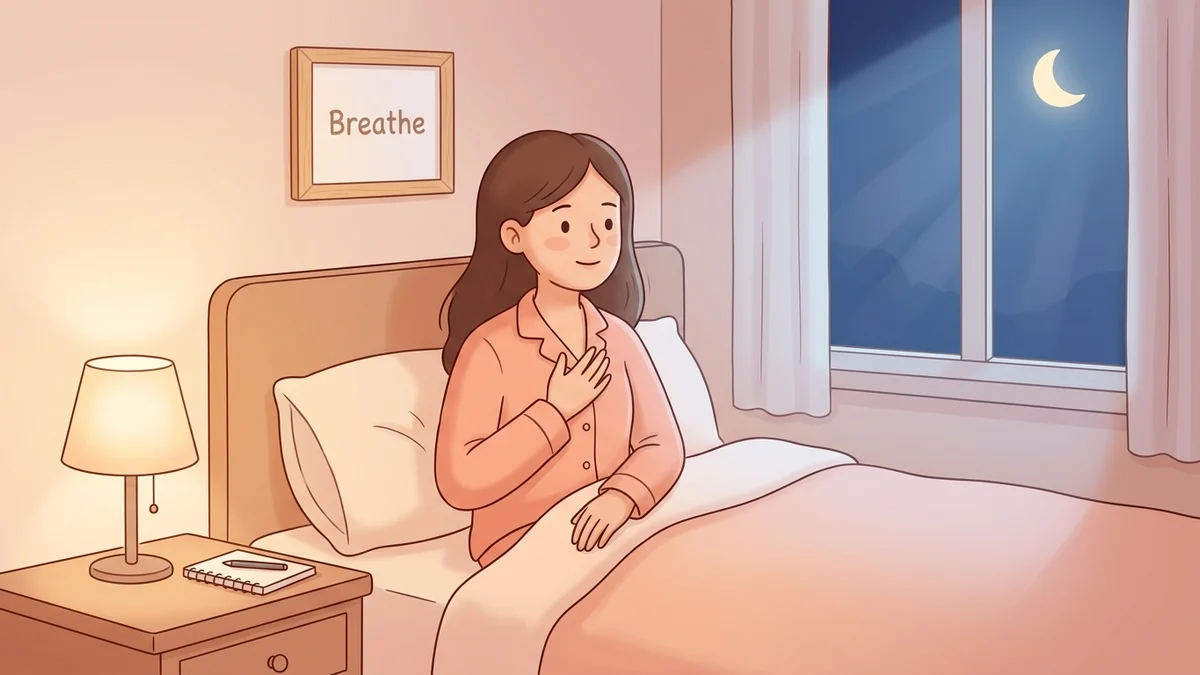
It's 3 a.m. You jolt awake, heart pounding, throat tight, a heavy pressure on your chest. Your first thought: something serious is happening. Yet everything around you is fine. What you're experiencing has a name: nighttime anxiety. And you're not alone. According to the CDC (2024), 18.1% of American adults have trouble staying asleep, and anxiety is one of the most common causes of those broken nights. Updated in August 2026.
The good news? There are concrete ways to calm these episodes quickly and make them less frequent over time. This guide gives you the keys to understand what's happening in your body and take back control of your nights.
The key takeaways
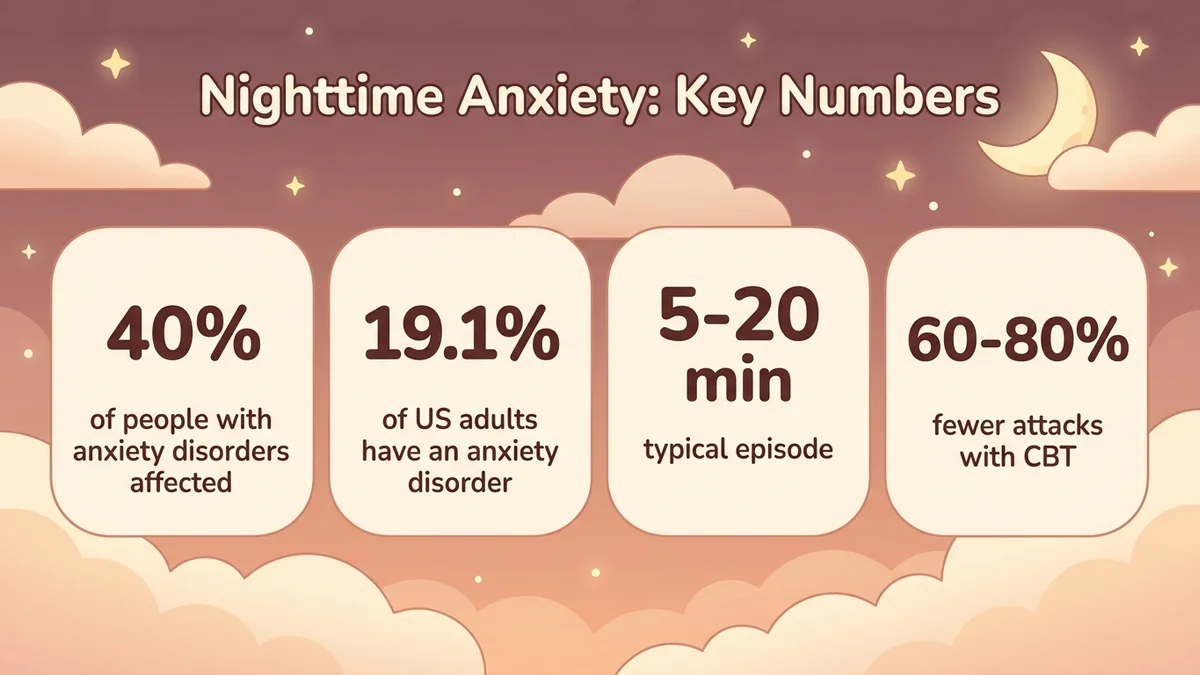
Nighttime anxiety is an episode of intense anxiety that happens during the night, with frightening but harmless physical symptoms. It affects about 40% of people with an anxiety disorder. Breathing techniques (cardiac coherence, 4-7-8) calm an episode within minutes. Over the long term, CBT reduces attacks by 60 to 80%. A structured evening routine is the best prevention.
What exactly is nighttime anxiety?
Nighttime anxiety is a sudden episode of intense fear that happens at night, at bedtime or in the middle of sleep. It shows up as physical and psychological symptoms that can last from 5 to 20 minutes. It's also called a nocturnal panic attack or anxiety at night.
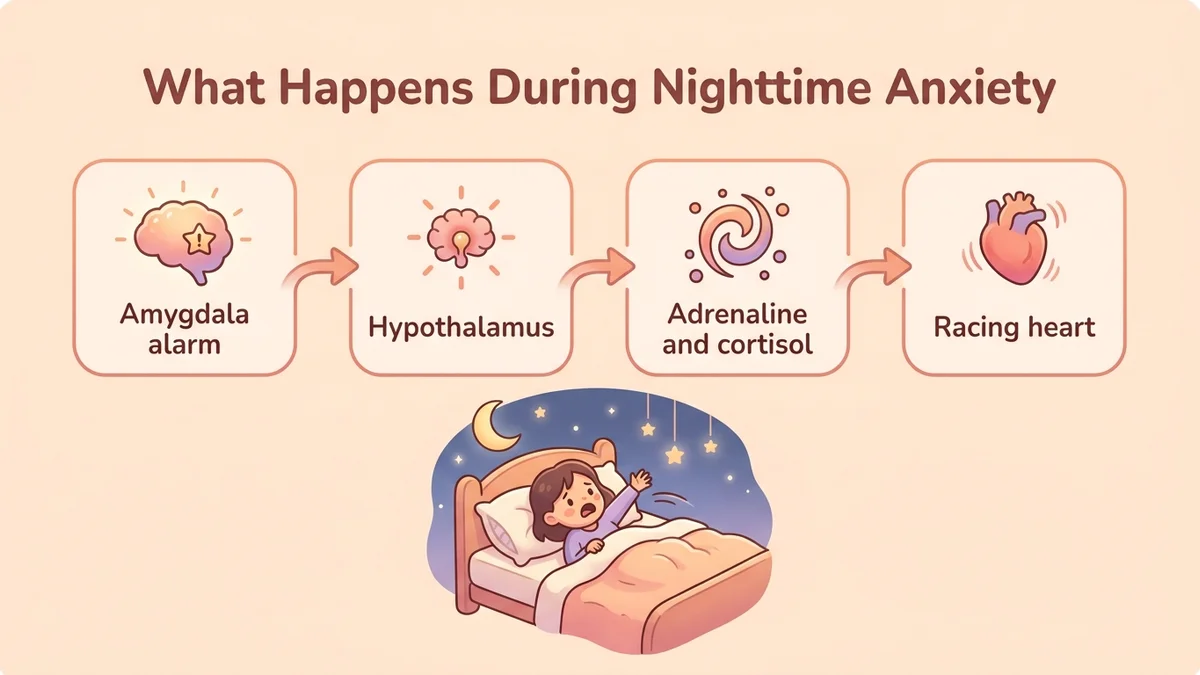
In practical terms, your brain detects a danger that doesn't exist. The amygdala, your alarm center, sends a stress signal to the hypothalamus. That triggers the release of adrenaline and cortisol. Your heart speeds up, your muscles tense, your breathing races. Your whole body switches into "fight or flight" mode — except there's nothing to fight and nowhere to run.
Key point: According to Dr. David Barlow, professor of psychology at Boston University, nocturnal panic attacks typically occur during light sleep (stages N1-N2), not during REM sleep.
The telltale symptoms
Wondering whether what you're experiencing at night is really nighttime anxiety? Here are the most common symptoms:
| Category | Symptoms | What's happening |
|---|---|---|
| Heart | Palpitations, racing heart, chest pain | Adrenaline speeds up your heart rate |
| Breathing | Shortness of breath, choking sensation, tight throat | Hyperventilation and tense chest muscles |
| Neurological | Dizziness, trembling, cold sweats | The sympathetic nervous system fires in a chain reaction |
| Psychological | Terror, a sense of impending doom, derealization | The amygdala sends a maximum danger signal |
| Digestive | Nausea, stomach pain, a knot in your stomach | Blood leaves the digestive system for the muscles |
According to a study published in the Journal of Clinical Psychology (2024), nighttime attacks involve more pronounced breathing symptoms than daytime attacks. A choking sensation is often the dominant symptom at night.
Why does anxiety strike at night?
Night is the perfect terrain for anxiety. And for a simple reason: your rational brain lets its guard down. The prefrontal cortex, the area that helps you keep things in perspective, reduces its activity during sleep. Meanwhile, the amygdala stays on standby. Without the "brake" of reasoning, fears take over.
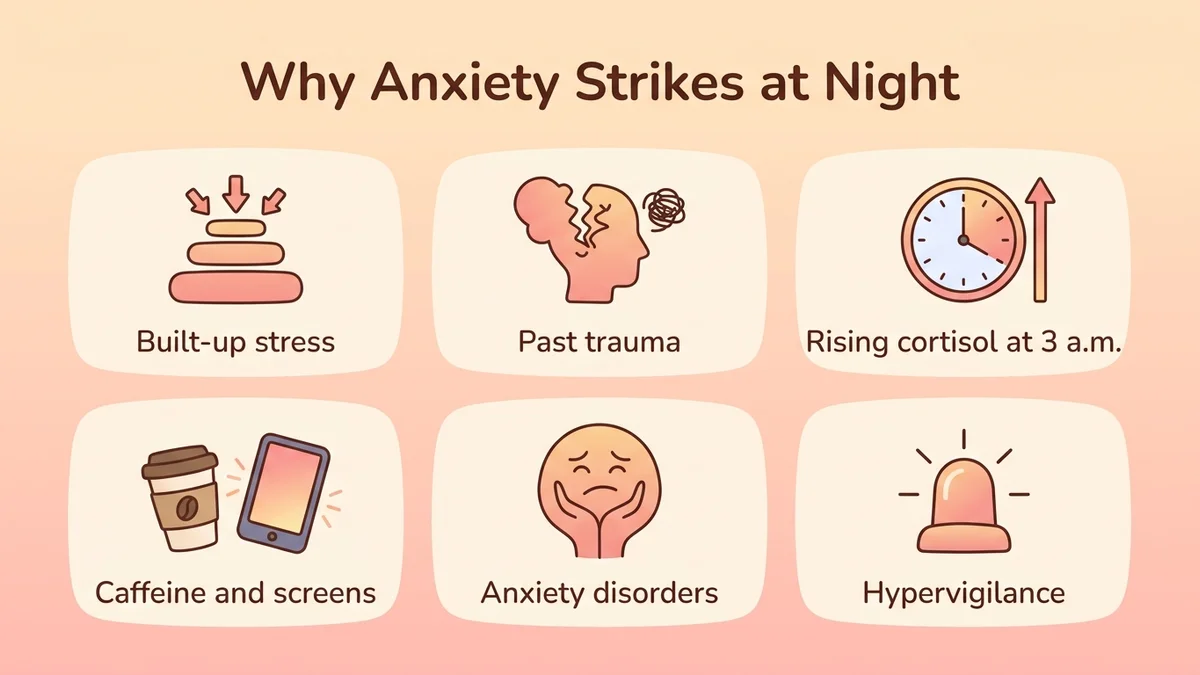
But that's not the only explanation. Here are the main causes identified by specialists:
Stress built up during the day
Let's be honest: most of us stack up stress all day long without ever "emptying" it. Emails, meetings, traffic, mental load. In the evening, when calm finally arrives, all that stress resurfaces at once. Your body no longer has distractions to mask the tension it's been holding.
According to the American Psychological Association's Work in America survey (2023), 77% of US workers reported work-related stress in the past month. That daily pressure is one of the most frequent triggers of nighttime anxiety.
The role of cortisol
Cortisol follows a circadian rhythm. Its level is at its lowest around midnight, then gradually rises from about 3 a.m. to prepare you to wake up. That's why anxious awakenings often happen between 3 and 5 a.m.: your cortisol is rising while your rational brain is still asleep.
Trauma and PTSD
Sleep plays a central role in processing emotional memories. Trauma, even old trauma, can resurface at night because the brain is trying to "digest" it. According to research by Walker and van der Helm published in Current Biology, REM sleep normally helps defuse the emotional charge of memories. When that process malfunctions, nighttime anxiety appears.
Underlying anxiety disorders
Nighttime anxiety is rarely isolated. Behind it, there's often generalized anxiety disorder, panic disorder, post-traumatic stress disorder or depression. According to the National Institute of Mental Health, 19.1% of US adults have an anxiety disorder in a given year.
How do you calm nighttime anxiety in the middle of the night?
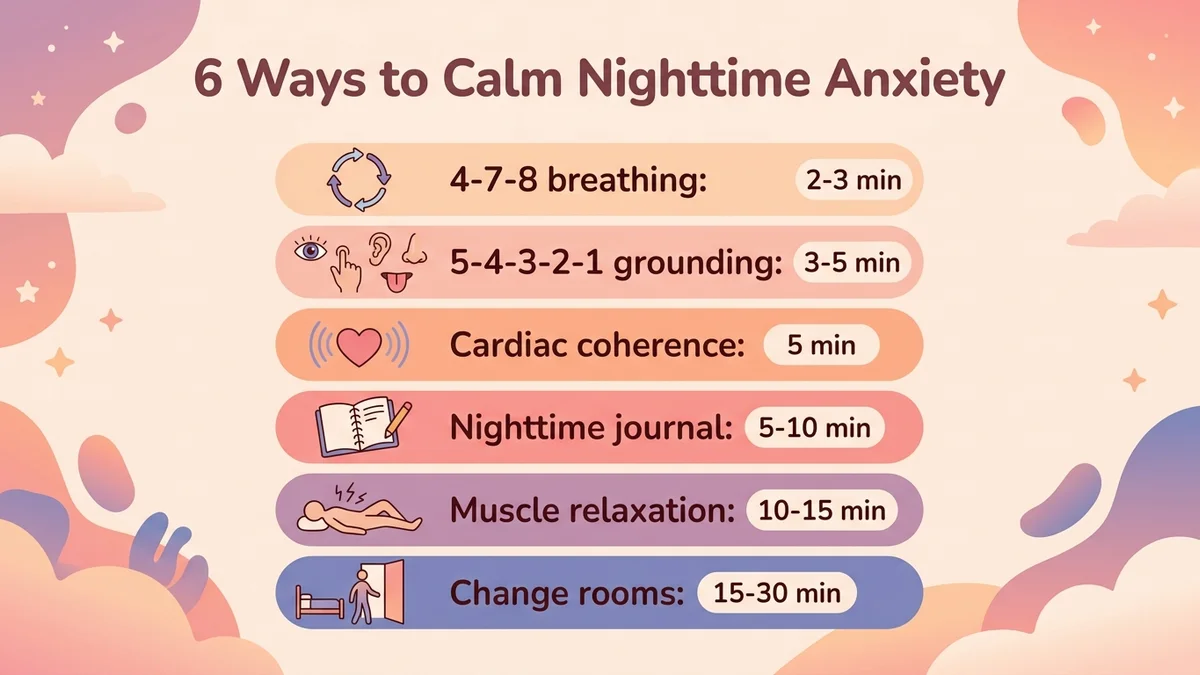
You're in the middle of an episode at 3 a.m. Not the time for theory. Here are 6 concrete techniques, ranked from fastest to deepest.
1. 4-7-8 breathing
This is the emergency technique par excellence. Developed by Dr. Andrew Weil, it activates the vagus nerve and forces your parasympathetic nervous system to take back over.
- Breathe in through your nose for 4 seconds
- Hold your breath for 7 seconds
- Breathe out slowly through your mouth for 8 seconds
- Repeat 4 cycles
By making the exhale longer than the inhale, you send a safety message to your brain. Your heart rate slows, muscle tension eases. Within 2 to 3 minutes, the episode starts to recede.
2. The 5-4-3-2-1 grounding technique
Widely used by psychologists, this method reconnects you with the present moment and pulls your brain out of the anxiety spiral:
- Name 5 things you can see (the shadows, the alarm clock, the ceiling)
- Name 4 things you can touch (the sheet, the pillow, your skin)
- Name 3 things you can hear (the silence, your breath, a distant sound)
- Name 2 things you can smell (the scent of your bedding, the cool air)
- Name 1 thing you can taste (your saliva, a lingering taste)
You can practice it with our guided 5-4-3-2-1 grounding exercise.
3. Cardiac coherence
Breathe in for 5 seconds, breathe out for 5 seconds. 6 breaths per minute, for 5 minutes. This technique, validated by the HeartMath Institute, synchronizes your heart rhythm with your breath and lowers cortisol by 23% on average.
Serena Coach tip: Among our users, we see that those who practice cardiac coherence for 5 minutes before bed cut the frequency of their anxious awakenings in half within 3 weeks. The secret: consistency, not perfection.
4. Get up and change rooms
It may seem counterintuitive when you want to sleep, but staying in bed during an episode reinforces the bed = danger association in your brain. Sleep specialists recommend that you:
- Get up calmly
- Go to another room (living room, kitchen)
- Do something calm (read a paper book, sip herbal tea)
- Go back to bed only when you feel sleepy again
5. A nighttime thought journal
Keep a notebook and pen on your nightstand. When rumination takes over, pour it onto paper. Writing for 5 minutes clears the "buffer" of your working memory. You don't need to reread these notes — the act of writing is enough to lower the intensity of your thoughts.
6. Progressive muscle relaxation
Lying on your back, tense and then release each muscle group, from your feet up to your head:
- Curl your toes for 5 seconds, release for 10 seconds
- Tighten your calves, release
- Squeeze your thighs, release
- Work your way up to your face
According to a University of Oxford study (2024), this technique reduces pre-sleep anxiety by 31% on average.
| Technique | Duration | Effectiveness during an episode | Difficulty |
|---|---|---|---|
| 4-7-8 breathing | 2-3 min | Very fast | Easy |
| 5-4-3-2-1 grounding | 3-5 min | Fast | Easy |
| Cardiac coherence | 5 min | Fast | Easy |
| Changing rooms | 15-30 min | Moderate | Easy |
| Nighttime journal | 5-10 min | Moderate | Easy |
| Muscle relaxation | 10-15 min | Gradual | Medium |
A video to better understand nighttime anxiety
To go deeper into these techniques, this video from licensed therapist Emma McAdam (Therapy in a Nutshell) shares two essential skills for dealing with anxiety at night.
As the video explains, a behavioral approach is often the most effective way to break the cycle of nighttime anxiety. You can complement these exercises with guided breathing sessions in Serena, which walks you step by step through managing your anxiety.
Real-life scenarios
Scenario 1: The sudden 3 a.m. wake-up
Nina, 34, jolts awake with her heart beating at 120. She feels like she can't breathe. In reality, she's hyperventilating. Her first reflex now: 4-7-8 breathing. Four cycles, and her heart rate comes back down to 80. She stays lying down for another 5 minutes, breathing slowly. The next day, she logs the episode in her journal to spot patterns.
Scenario 2: Bedtime dread
Greg, 42, dreads going to bed. As soon as he turns off the light, the thoughts start scrolling: the overdue project, the argument with his wife, the bills. He set up a ritual: 20 minutes before bed, he puts down his phone, does 5 minutes of cardiac coherence with Serena, then writes down 3 positive things from his day. In three weeks, his bedtime anxiety dropped by 70%.
Scenario 3: Recurrent episodes after trauma
Ashley, 28, has had nighttime attacks since a car accident two years ago. Nightmares wake her in a panic. After 6 months of CBT with her psychologist and daily progressive muscle relaxation, her attacks went from 4 a week to 1 a month.
Preventing nighttime anxiety: the evening ritual
Calming an episode is good. Keeping it from coming back is better. Here's an evening protocol backed by chronobiology research:
| Step | Timing | Action | Why |
|---|---|---|---|
| 1 | 3 hours before bed | Last coffee or tea | Caffeine stays active for about 6 hours |
| 2 | 2 hours before | Last big meal | Digestion disrupts falling asleep |
| 3 | 1 hour before | Screens off | Blue light blocks melatonin |
| 4 | 30 min before | Herbal tea (passionflower, chamomile) | Mild natural calming effect |
| 5 | 20 min before | 5 min of cardiac coherence | Lowers cortisol and heart rate |
| 6 | 10 min before | Gratitude journal (3 items) | Positive cognitive reframing |
| 7 | In bed | Bedroom at 61-66°F (16-19°C) | Supports melatonin production |
Nighttime notifications are a sneaky sleep disruptor: a phone that lights up or buzzes can pull you out of light sleep. Switching your phone to airplane mode is one of the simplest, most effective ways to protect your sleep.
Key point: A regular bedtime matters more than how long you sleep. Your brain needs time cues to anticipate rest and produce melatonin at the right moment.
The Serena perspective
In our experience with app users, we see an interesting gap between theory and practice. The scientific literature recommends 5 minutes of cardiac coherence. In reality, our anonymized data shows that users who keep a routine of 3 minutes of guided breathing every evening already get significant results. The main barrier isn't duration — it's consistency.
We also see that users who combine breathing with Serena's mood tracking identify their nighttime anxiety triggers more quickly. For example, 62% of users who track their mood in the evening notice a link between their stress level in the afternoon and the quality of their night. That awareness is often the first step toward improvement.
Serena Coach tip: Don't aim for perfection. If you miss an evening, pick it back up the next day without guilt. At Serena, we believe 3 imperfect minutes are worth more than 20 perfect minutes you never do.
When should you see a professional?
Occasional nighttime anxiety is normal. Anyone can experience it after a stressful period. But some signs should get your attention:
- Attacks happen more than twice a week for more than a month
- You develop a fear of going to bed (anticipatory anxiety)
- Daytime fatigue affects your work or your relationships
- You use alcohol or medication to sleep
- Attacks come with recurring nightmares linked to trauma
The gold-standard treatment is cognitive behavioral therapy (CBT). According to a meta-analysis published in Psychological Medicine (2025), CBT reduces the frequency of panic attacks by 60 to 80% in 12 to 16 sessions. In the US, many health plans cover CBT with a licensed therapist, and telehealth has made it easier to find one. If you're ever in crisis, you can call or text 988 at any time.
Medications (benzodiazepines, SSRI antidepressants) may be prescribed as a complement, but benzodiazepines are meant for short-term use only because of their risk of dependence. They don't replace therapeutic work.
How Serena can help you get back to peaceful nights
If you experience nighttime anxiety, Serena is designed to support you. The app offers guided breathing exercises (cardiac coherence, 4-7-8, belly breathing) that are just a few taps away, even at 3 a.m. with your screen in night mode.
Daily mood tracking helps you identify the days when anxiety is likely to strike. And the built-in gratitude journal gives you a concrete tool to reframe your thoughts before bed.
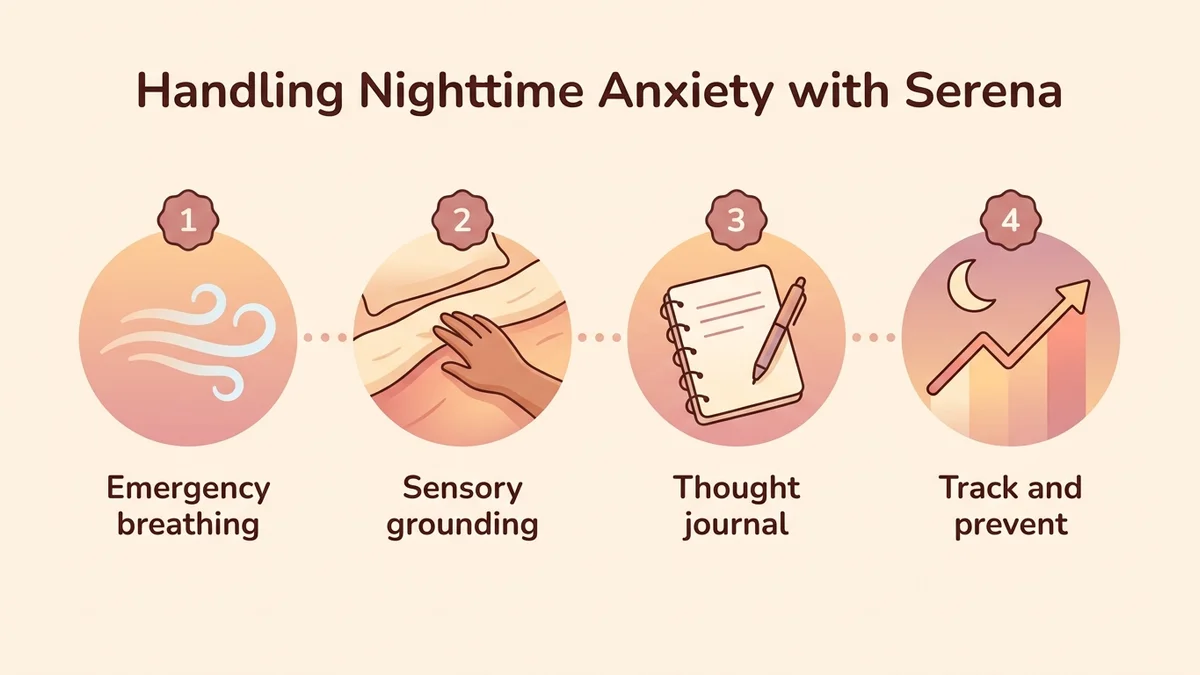
At Serena, we believe managing nighttime anxiety shouldn't be complicated. Three minutes of guided breathing every evening, regular tracking of your emotions and the right reflexes during an episode: it's a simple program that gets concrete results.
Try Serena for free and take back control of your nights.
Frequently asked questions
Can you die from a nighttime anxiety attack?
No, a nighttime anxiety attack poses no danger to your life. The physical symptoms (palpitations, tightness, choking sensation) are frightening, but they result from a misplaced stress response. No organ is at risk. The attack resolves on its own within 5 to 20 minutes. If symptoms last beyond 30 minutes, see a doctor to rule out a heart-related cause.
Why is anxiety worse at night?
At night, your prefrontal cortex (the area of logical reasoning) reduces its activity. The amygdala, however, stays active. Without that rational filter, fears seem overwhelming. Distractions disappear too: no work, no conversations to divert your attention. Paradoxically, nighttime calm becomes fertile ground for rumination.
Can children have nighttime anxiety?
Yes, and it's more common than you might think. Nighttime anxiety in children often appears between ages 3 and 12. It's different from night terrors, which are a parasomnia. Common causes include school stress, a move or parents separating. Breathing exercises adapted for children are very effective.
What is the difference between nighttime anxiety and night terrors?
Nighttime anxiety happens during light sleep, and the person is aware of it. They remember the episode when they wake up. Night terrors happen during deep sleep (stage N3): the person may scream or thrash but has no memory of it. Nighttime anxiety is linked to anxiety; night terrors are a neurological parasomnia.
How long does a nighttime anxiety attack last?
On average 5 to 20 minutes, peaking within 2 to 5 minutes. An attack rarely lasts beyond 30 minutes. Slow breathing (an exhale longer than the inhale) can cut that time in half by activating the vagus nerve and the parasympathetic nervous system.
Should you get out of bed during a nighttime anxiety attack?
Yes, specialists often recommend getting up and changing rooms. Staying in bed during an episode can create a negative bed-anxiety association that makes the problem worse over time. Go to the living room, do a calm breathing exercise, and go back to bed when you naturally feel sleepy again.
Do sleeping pills work for nighttime anxiety?
Sleeping pills and anti-anxiety medications relieve symptoms in the short term, but they don't treat the cause. Benzodiazepines are intended for short-term use only because of the risk of dependence, which the FDA highlights in a boxed warning. Cognitive behavioral therapy delivers lasting results and remains the gold-standard treatment.
Does diet affect nighttime anxiety?
Directly. Caffeine consumed after 2 p.m. keeps you on alert for about 6 hours. Alcohol, contrary to popular belief, fragments REM sleep and encourages anxious awakenings in the second half of the night. A light dinner rich in tryptophan (bananas, nuts, dairy) supports serotonin and melatonin production.
To go further
Nighttime anxiety can ruin your nights, but it isn't a life sentence. You now have 6 concrete techniques to calm an episode, an evening protocol to prevent them, and the guideposts to know when to see a professional.
The three most effective actions to put in place tonight:
- Put your phone down 1 hour before bed and switch to airplane mode
- Practice 3 to 5 minutes of guided breathing with Serena before falling asleep
- Keep a notebook on your nightstand to empty out rumination if it comes
Every peaceful night is a victory. And those victories add up.
To dig deeper, read our guides on breathing exercises for panic attacks, 4-7-8 breathing to fall back asleep, evening meditation techniques, heart coherence, sophrology for sleep and natural remedies for sleep problems.