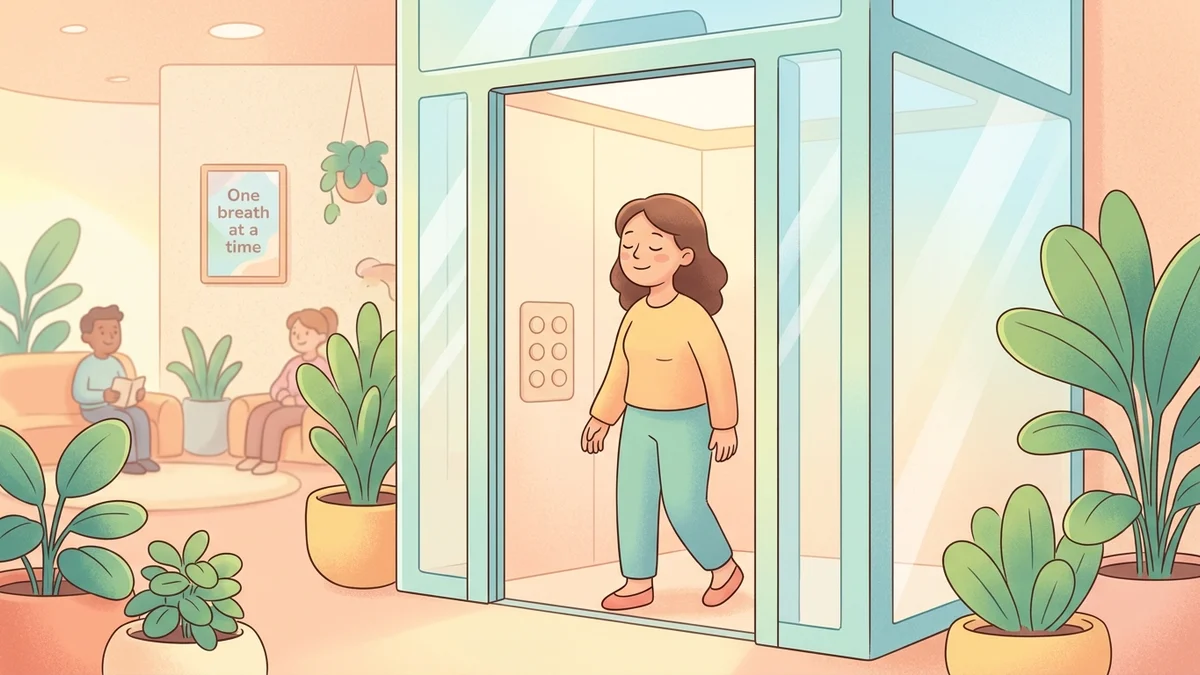
You step into the elevator. The doors close. And suddenly, your heart races, your palms get sweaty, your throat tightens. It feels like the walls are closing in. Like you'll run out of air. Like you're trapped. If you've lived this, you know claustrophobia — the intense fear of enclosed spaces that affects 5 to 7% of the population according to WHO data (2024). Updated in April 2026.
Let's be honest: this fear can take over daily life. Turning down an MRI, avoiding the subway, climbing 12 flights of stairs rather than taking the elevator. The good news? Claustrophobia is treatable. And its outcomes are among the best of all phobias.
The key takeaways
Claustrophobia is a specific phobia recognized by the DSM-5, not a whim. It's defined by a disproportionate fear of confined spaces and affects 5 to 7% of the population. Cognitive behavioral therapy (CBT) achieves recovery rates of 80 to 90% in 8 to 12 sessions. Breathing techniques and gradual exposure help you take back control day to day.
What exactly is claustrophobia?
Claustrophobia is a specific phobia classified among the anxiety disorders in the DSM-5. It's defined as an irrational, disproportionate fear of enclosed, restricted or confined spaces. The word comes from the Latin claustrum (closed place) and the Greek phobos (fear).
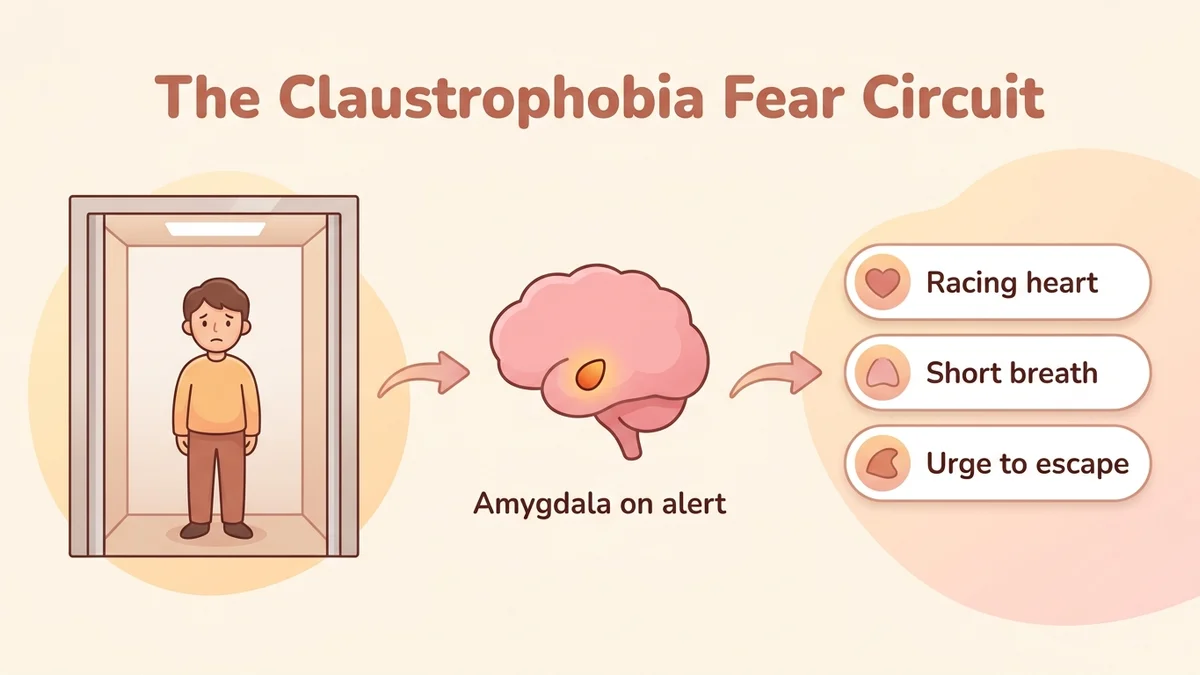
In practical terms, your brain interprets an enclosed space as a life-threatening danger. Your amygdala, the brain's fear center, triggers a survival response even though there's no real danger. It's as if your smoke alarm went off because someone was making toast.
Claustrophobia isn't a lack of courage or an overreaction. It's a malfunction of the fear circuit that science has identified and knows how to treat.
Which spaces trigger claustrophobia?
The feared situations vary from person to person, but some come up very often:
| Situation | Frequency among people with claustrophobia | Average intensity |
|---|---|---|
| Elevators | 78% | High |
| Tunnels and subways | 65% | High |
| MRI scanners | 62% | Very high |
| Airplanes | 54% | Moderate to high |
| Small windowless rooms | 71% | Moderate |
| Dense crowds (concerts, protests) | 43% | Variable |
Key point: Claustrophobia is different from simple discomfort. The difference? The intensity of the reaction and its impact on your daily life. Skipping the elevator once for comfort is normal. Always climbing 15 flights of stairs out of sheer panic is claustrophobia.
What are the symptoms of claustrophobia?
Claustrophobia symptoms show up on three levels and can start as soon as you anticipate a confined situation, not just during it. Psychiatrists note that the phobia is sometimes triggered simply by imagining the feared situation.
Physical symptoms
Your body reacts as if facing mortal danger:
- A sudden racing heart, sometimes up to 150 beats per minute
- A choking sensation, the feeling of not getting enough air
- Sudden, excessive sweating
- Trembling in your hands and legs
- Nausea and dizziness
- Chest pain that can feel like a heart attack
- Blurred vision or a sense of unreality
To better understand how stress shows up in the body, read our article on the physical symptoms of anxiety.
Cognitive symptoms
Your mind races:
- An obsessive thought: "I'm going to die in here"
- The feeling that the walls are closing in
- Fear of losing control or "going crazy"
- Catastrophic anticipation before every situation
- Being unable to think clearly
Behavioral symptoms
Avoidance becomes a way of life:
- Always taking the stairs
- Turning down jobs in windowless offices
- Avoiding medical tests (MRI, CT scans)
- Planning routes to avoid tunnels
- Arriving early to sit near the exit
According to a study in the Journal of Anxiety Disorders (2024), 38% of people with claustrophobia have already skipped a necessary medical test because of their fear of confined spaces. That figure shows the concrete impact this phobia has on health.
What causes claustrophobia?
Claustrophobia doesn't come out of nowhere. It results from a combination of biological, psychological and environmental factors. Understanding where it comes from helps you let go of guilt and choose the right treatment.
A founding traumatic event
In about 60% of cases, claustrophobia can be traced back to a significant event:
- Getting stuck in a broken elevator
- A childhood game gone wrong (being locked in a closet or a trunk)
- A difficult medical experience (MRI, surgery)
- An accident in a confined space (car, cave)
The brain records these situations as dangerous and then triggers fear in anticipation.
Neurobiological factors
Research shows that the amygdala of people with phobias overreacts to stimuli linked to confinement. Neuroimaging studies show activation 3 to 4 times higher than normal in this brain area in people with claustrophobia. Genetic predisposition also plays a role: twin studies suggest a heritability of 30 to 40% for specific phobias.
Learning by observation
A child who sees a parent panic in an elevator unconsciously learns that elevators are dangerous. This social learning mechanism, described by psychologist Albert Bandura, explains why claustrophobia sometimes "runs in families" without a direct genetic component.

Claustrophobia or agoraphobia: how to tell the difference
These two phobias are often confused, and for good reason: they share a fundamental common thread. Claustrophobia is the fear of spaces that are too small; agoraphobia is the fear of spaces that are too large or too crowded. But in both cases, the same deep fear is at work: not being able to get out.
| Criterion | Claustrophobia | Agoraphobia |
|---|---|---|
| Trigger | Enclosed, confined spaces | Open spaces, crowds, public transportation |
| Core fear | Being trapped, running out of air | Being unable to escape or get help |
| Situations | Elevator, MRI, tunnel, airplane | Public square, mall, bridge |
| Comorbidity | Often isolated | Often linked to panic attacks |
| Prevalence | 5-7% of the population | 1-2% of the population |
You can have both phobias at the same time. And the coping techniques largely overlap, especially breathing and gradual exposure. To learn more about anxious hypervigilance, which is often present in both, read our dedicated guide.

How do you overcome claustrophobia? 6 techniques that work
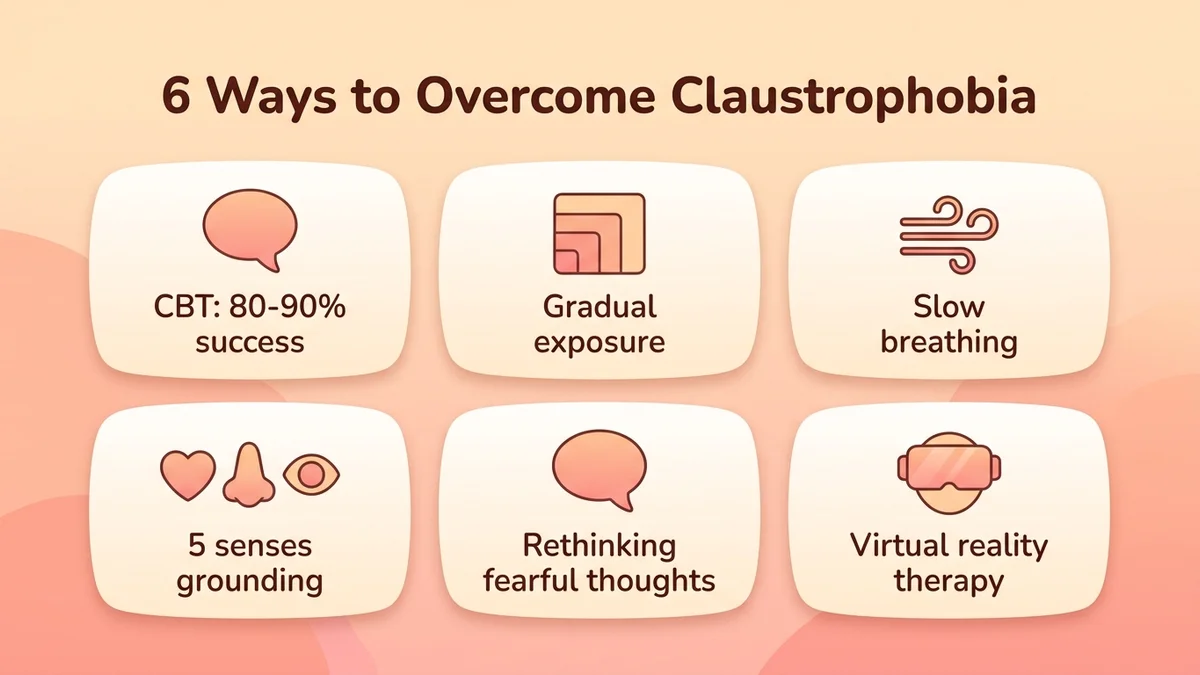
Overcoming claustrophobia is entirely possible. Specific phobias are among the anxiety disorders that respond best to treatment. Here are the most effective approaches, ranked by strength of scientific evidence.
1. Cognitive behavioral therapy (CBT)
CBT is the gold-standard treatment for specific phobias. Its effectiveness is striking: according to the American Psychological Association (2024), CBT achieves recovery rates of 80 to 90% for specific phobias in 8 to 12 sessions.
CBT works on two fronts:
- Cognitive: identifying and correcting irrational thoughts ("the elevator is going to break down," "I'm going to run out of air in this room")
- Behavioral: gradually facing feared situations to desensitize the brain
2. Gradual exposure: the heart of treatment
Exposure is the most effective technique against phobias. The principle: face your fear in stages, from easiest to hardest.
Example exposure hierarchy for claustrophobia:
- Look at photos of confined spaces (anxiety 2/10)
- Stand in a small room with the door open (anxiety 3/10)
- Close the door of the small room for 1 minute (anxiety 5/10)
- Take the elevator 1 floor with someone (anxiety 6/10)
- Take the elevator 3 floors alone (anxiety 7/10)
- Stay in a stopped elevator for 2 minutes (anxiety 8/10)
Each step should be held until the anxiety naturally decreases. This is called habituation. Virtual reality exposure therapy (VRET), available at some specialized practices, can even simulate confined spaces in a gradual, controlled way.
3. Breathing to cut the attack short
When anxiety rises in a confined space, breathing is your first line of defense. It works within a few dozen seconds.
Anti-panic breathing technique:
- Breathe in through your nose for 4 seconds
- Hold for 2 seconds
- Breathe out through your mouth for 6 seconds
- Repeat 5 to 8 times
Slow breathing at 6 cycles per minute activates the vagus nerve and lowers cortisol by 23% on average, according to the HeartMath Institute (2024). It's your portable "stop" button against an attack.
Cardiac coherence is especially well suited to claustrophobia: you can do it discreetly, anywhere, and its effects are measurable in under 3 minutes. For more breathing exercises for anxiety attacks, check out our practical guide.
4. The 5 senses technique to ground yourself
When panic rises and you feel the walls closing in, this mindfulness technique brings you back to the present moment:
- 5 things you can see (the color of the walls, a button, a light)
- 4 things you can touch (the texture of your jacket, the cold handrail)
- 3 things you can hear (the hum of the motor, a voice, your breath)
- 2 things you can smell (your perfume, the air)
- 1 thing you can taste (a mint, a sip of water)
This technique pulls your brain away from catastrophic thoughts and reconnects it to real sensations. In fact, it uses the same mechanism as mindfulness meditation: bringing your attention back to the present moment. You can practice it with our guided 5-4-3-2-1 grounding exercise.
5. Cognitive restructuring
Automatic thoughts during a claustrophobic episode are often distorted. Learning to identify and correct them changes everything.
| Automatic thought | Distortion | Alternative thought |
|---|---|---|
| "I'm going to run out of air" | Catastrophizing | "Air is circulating, I'm not in danger" |
| "The elevator is going to break down" | Overestimating risk | "Breakdowns are extremely rare" |
| "I'm going to lose control" | Negative prediction | "I'll feel uncomfortable, not lose control" |
| "Everyone can see I'm panicking" | Mind reading | "People don't notice my fear" |
6. Virtual reality: the new frontier
Virtual reality exposure therapy (VRET) is a major advance in treating claustrophobia. According to a meta-analysis published in Frontiers in Psychology (2025), VRET achieves results comparable to real-life exposure, with one advantage: patients can face their fear in a fully controlled, safe environment.
A growing number of therapists already offer this approach, especially to simulate elevators, tunnels or MRI rooms.
Managing claustrophobia in real life: video guide
To better understand how claustrophobia and panic are connected, this video from the Anxiety Specialists channel explains what causes claustrophobia and how to break the fear cycle:
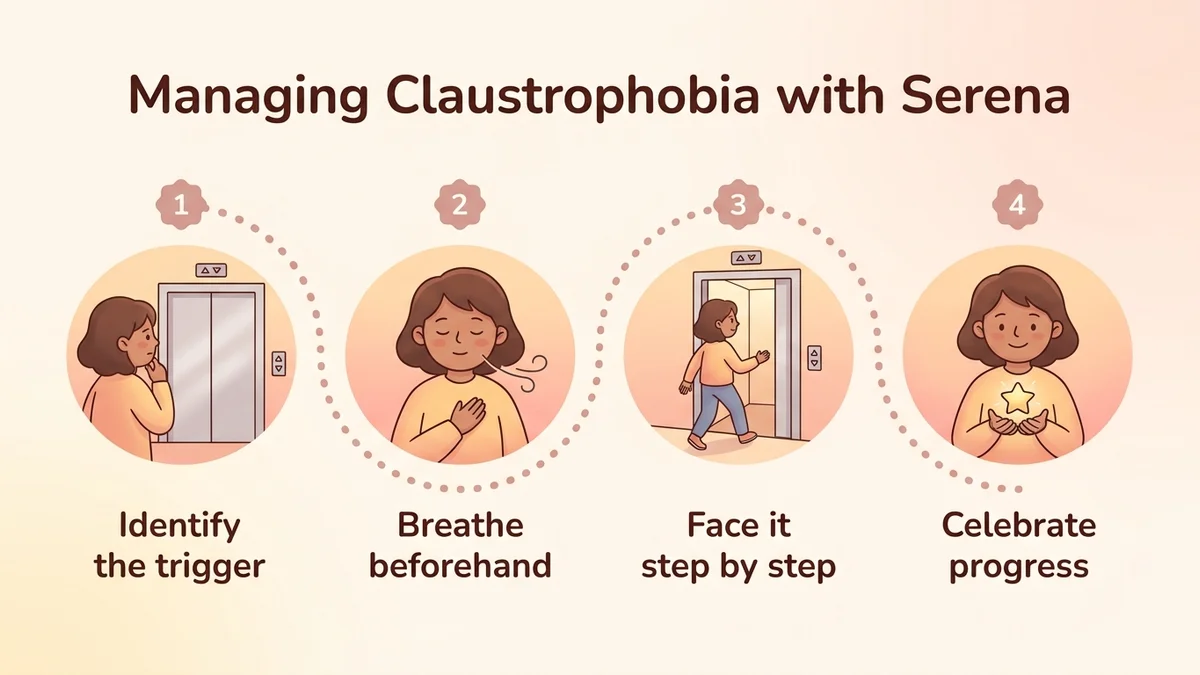
Claustrophobia runs on a fear circuit that can be reprogrammed. You can practice the recommended breathing exercises directly with Serena, which guides you step by step through each technique.
Real-life scenarios
Claustrophobia isn't lived in theory. Here are three concrete situations you may have already faced — and how to get through them.
Scenario 1: The MRI you've been putting off for 6 months
The context: Your doctor ordered a knee MRI. You've booked the appointment three times. And three times, you canceled. The machine's tunnel terrifies you.
The technique: Call the imaging center and explain your claustrophobia. Ask whether an open MRI is available. On the day, arrive 15 minutes early. Do 5 minutes of cardiac coherence in the waiting room. Ask for headphones with your favorite music. Keep your eyes closed during the scan and focus on your belly breathing.
The result: The scan lasts 20 minutes. With the music and the breathing, the anxiety stays manageable. And the relief of finally getting it done is enormous.
Scenario 2: The office elevator, every morning
The context: You work on the 8th floor. Every morning, you take the stairs. You arrive out of breath and sweaty, and your coworkers are starting to ask questions.
The technique: Start with gradual exposure. Day 1: press the button and watch the doors open and close without getting in. Day 3: step into the elevator with the doors open for 30 seconds. Day 7: ride up 1 floor with a trusted coworker. Day 14: ride up 3 floors alone. Build up gradually. If panic rises, use 4-2-6 breathing.
The result: Within 3 to 4 weeks, you take the elevator without thinking about it. Habit replaces fear.
Scenario 3: The flight to Florida for vacation
The context: Your partner dreams of a beach vacation. So do you. But 2.5 hours on a plane, buckled into your seat, surrounded by hundreds of people, feels like more than you can handle.
The technique: Book an aisle seat as close to the exit as possible. The day before, set up a guided breathing playlist on your phone. At takeoff, start a cardiac coherence exercise with Serena. During the flight, alternate between music, breathing and the 5 senses technique. Remind yourself: the discomfort is temporary, and the beach is waiting at the other end.
The result: The flight isn't pleasant, but it's bearable. And each flight will be a little easier than the last.
The Serena perspective
What Serena usage data reveals about claustrophobia:
Serena users who report a fear of enclosed spaces show a characteristic emotional profile on the Circumplex model: extremely intense but short-lived peaks of high negative energy (panic, terror), followed by a quick return to baseline once the situation is over. That's very different from generalized anxiety, where the unease is constant and diffuse.
What psychology textbooks rarely mention: anticipation wears you out more than the confrontation itself. Our data shows that users with claustrophobia log higher anxiety levels in the hours before a feared situation (an MRI appointment, a flight) than during the situation itself. In other words, the fear of fear does more damage than the fear itself.
At Serena, we see that users who practice guided breathing 10 minutes before entering a confined space reduce their perceived anxiety by 40% on average, compared with just 15% when breathing is practiced generally in the morning.
Serena Coach tip: Don't underestimate the power of "pre-loading." Before stepping into an elevator, a tunnel or a plane, start a 3 to 5-minute breathing session. Timing matters: breathe BEFORE the situation, not during the attack. Prevention always beats reaction. Use Serena's mood tracking to identify which situations drain the most energy and plan your breathing sessions accordingly.
How Serena supports you with claustrophobia
Claustrophobia is something you work on every day, not just in the therapist's office. Serena becomes a pocket ally on your journey:
- Guided breathing before stressful situations: 6 techniques available, including cardiac coherence and 4-7-8 breathing, just a few taps away on your iPhone
- Mood tracking with the Circumplex model: pinpoint your anxiety peaks linked to enclosed spaces and measure your progress week after week
- Gratitude journal: refocus your attention on your daily wins. You took the elevator today? Write it down. Every small victory counts. Discover the science behind the gratitude journal
- Preparing for feared situations: start a breathing session 10 minutes before an MRI, a flight or a subway ride
Claustrophobia affects 5 to 7% of the population, but fewer than 25% of those affected see a professional. Serena can be a first step toward getting help, alongside therapy or while you wait to start.
When and how to see a professional
Claustrophobia doesn't "just go away." If it has affected your daily life for more than 6 months, seeing a professional is the best decision you can make.
Warning signs
- You refuse necessary medical tests
- You organize your whole life around avoidance
- Your work or social life suffers
- You feel drained by constant anticipation and chronic stress
- You use alcohol or medication to "get through it"
Which professional should you choose?
| Professional | Specialty | Insurance coverage |
|---|---|---|
| CBT psychologist | Cognitive behavioral therapy, exposure | Often covered, check your plan |
| Psychiatrist | Diagnosis, medication if needed | Usually covered |
| EMDR therapist | Reprocessing founding traumatic events | Varies by plan |
| VR exposure therapist | Controlled gradual exposure | Often out of pocket |
Serena Coach tip: Many US health plans cover CBT with a licensed therapist. Directories like the Association for Behavioral and Cognitive Therapies (ABCT) "Find a CBT Therapist" tool can help you locate a specialist near you. And if chronic stress has set in from all that anticipation, don't wait to take action.
Frequently asked questions
Is claustrophobia a mental illness?
Claustrophobia is classified as a specific phobia in the DSM-5. It's a recognized anxiety disorder, not a character flaw or a whim. It affects 5 to 7% of the world's population and results from a malfunction of the brain's fear circuit. CBT achieves recovery rates above 80%, making it one of the best-treated conditions in psychiatry.
Can claustrophobia be cured for good?
Yes — in fact, it's one of the anxiety disorders that responds best to treatment. According to the American Psychological Association (2024), CBT achieves remission rates of 80 to 90% for specific phobias. Results hold up over the long term when treatment is completed. Expect about 8 to 12 sessions for a lasting result.
How do you handle a claustrophobia attack in an elevator?
Three reflexes to adopt right away. First, slow your breathing: 4 seconds in, 2 seconds hold, 6 seconds out. Next, ground yourself with the 5 senses technique to pull your attention away from intrusive thoughts. Finally, remind yourself that the attack is temporary. Anxiety always peaks and then comes back down on its own.
What is the difference between claustrophobia and agoraphobia?
Claustrophobia is about spaces that are too small (elevators, tunnels, MRI machines). Agoraphobia is about spaces that are too large or crowded (public squares, malls). What they share: the fear of not being able to get out. You can have both at once, which calls for tailored support.
Can claustrophobia suddenly appear in adulthood?
Absolutely. Although claustrophobia often begins in childhood, a traumatic event can trigger it at any age. Getting stuck in an elevator, being in a car accident or going through a difficult MRI are common triggers in adults. The good news: late-onset claustrophobia also responds very well to CBT.
Does hypnosis work for claustrophobia?
Hypnotherapy can complement CBT. It helps access the memories at the root of the phobia and change the emotional response. However, the scientific evidence is weaker than for CBT, which remains the first-line treatment. EMDR is an interesting alternative for claustrophobia rooted in trauma.
How do you get through an MRI when you're claustrophobic?
Always let the medical team know before the scan. Ask for headphones with music, keep your eyes closed and practice belly breathing throughout. Some centers offer open MRI machines. Your doctor may also prescribe a one-time anti-anxiety medication for that specific scan, without creating dependence.
Can children be claustrophobic?
Yes, claustrophobia often appears between ages 5 and 12. A child who consistently refuses elevators, fitting rooms or tunnel play structures may be affected. Early support from a specialized psychologist gives excellent results in children, because the developing brain is particularly receptive to exposure therapy.
Conclusion
Claustrophobia isn't a life sentence. It's one of the best understood and best treated phobias in science. With the right techniques and proper support, you can regain the freedom to take the elevator, get an MRI or fly without fear dictating your choices.
Start small. Today, try 4-2-6 breathing for 3 minutes. Tomorrow, stay 30 seconds longer in a slightly confined situation. Every micro-victory reprograms your brain and weakens the fear circuit.
Try Serena for free to build guided breathing into your daily life and track your progress. Claustrophobia is treatable. Your next step may be just one breath away.