Updated in March 2026.
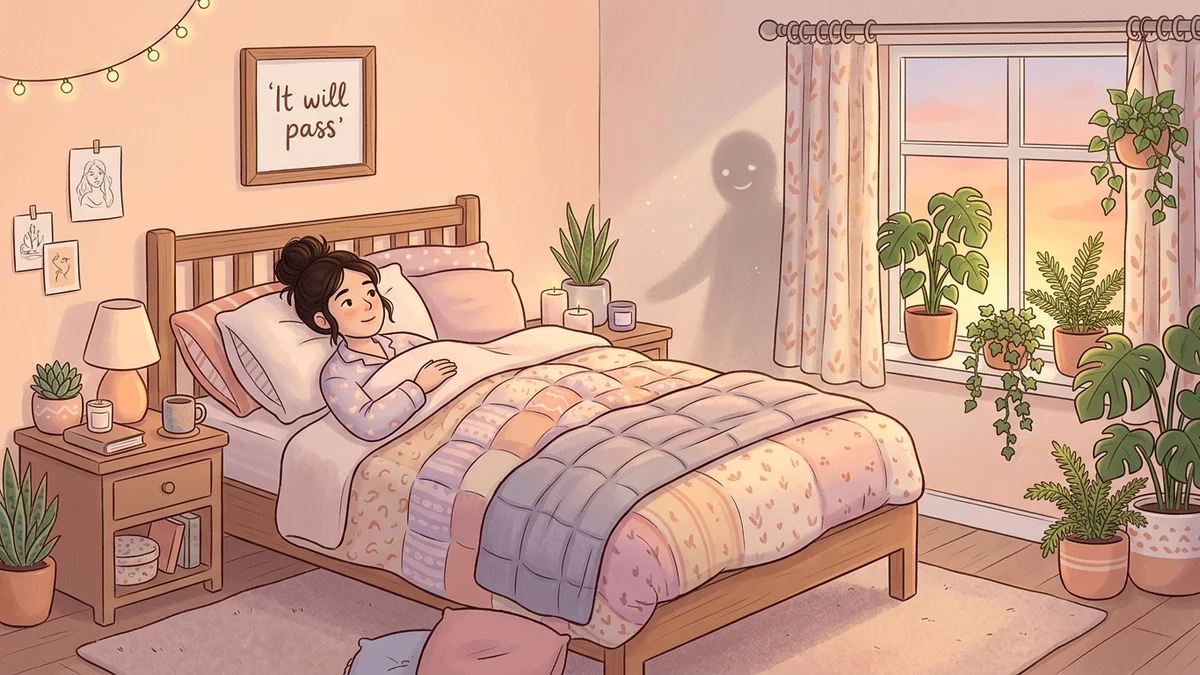
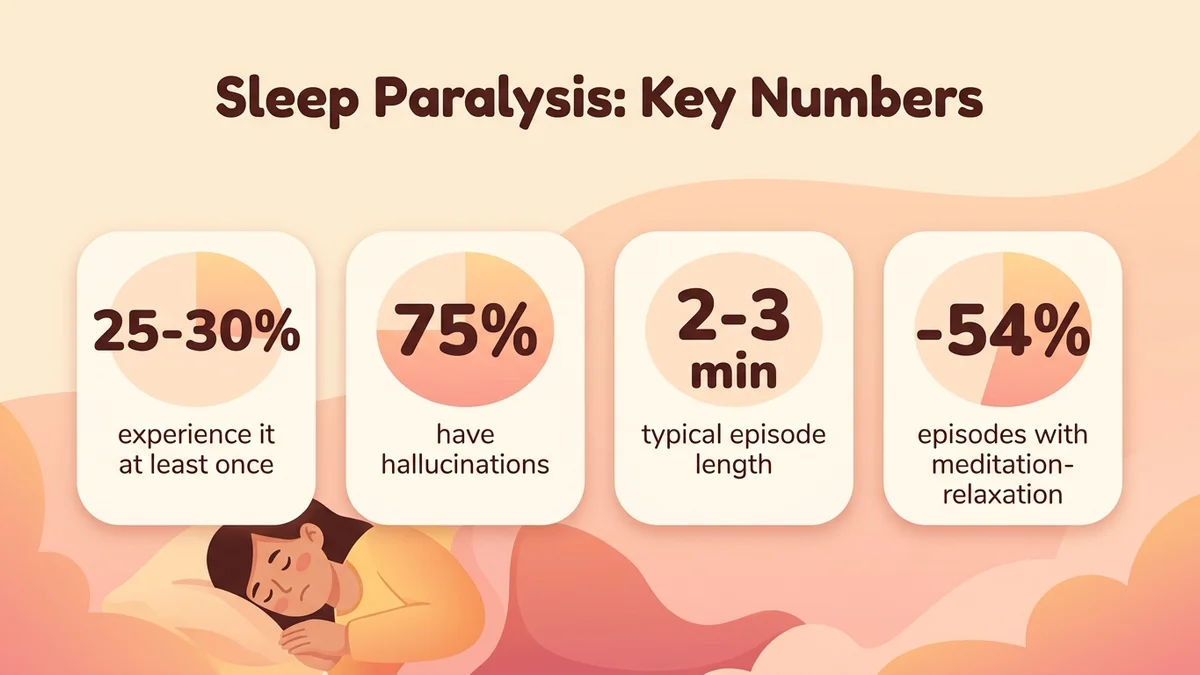
You open your eyes in the middle of the night. You're fully conscious, but your body won't move. You can't scream, can't lift a finger. A shadow takes shape in the corner of your room. Your heart pounds. Know that terror? You've just experienced sleep paralysis, and you're not alone: according to the most recent epidemiological data, 25 to 30% of people have had at least one episode in their lifetime (Sharpless and Barber, 2011).
The good news: sleep paralysis is completely harmless. It lasts only a few seconds to a few minutes and goes away on its own. In this complete guide, you'll understand exactly why it happens, what's going on in your brain, and above all how to dramatically reduce how often it happens with science-backed solutions.
The key takeaways
Sleep paralysis is a harmless phenomenon linked to REM sleep. The brain wakes up before the muscle paralysis of REM wears off, creating a temporary inability to move. Affecting about 8% of people on a recurring basis, it's triggered by stress, lack of sleep and sleeping on your back. Meditation-relaxation reduces episodes by 54% according to the University of Cambridge (2020).
What exactly is sleep paralysis?
Sleep paralysis is a parasomnia that happens during the transition between REM sleep and wakefulness. In practical terms, your brain wakes up, but your body stays temporarily "locked" in the state of muscle rest typical of REM sleep.
During REM sleep, your brain is extremely active: it's the phase of the most vivid dreams. To protect you, your body releases a neurotransmitter called glycine, which inhibits spinal motor neurons and causes muscle atonia. It's a safety mechanism: it keeps your body from physically acting out your dreams.
Sleep paralysis happens when this protective mechanism lingers after your consciousness has already returned. You're awake, but your muscles stay paralyzed for a few moments.
| Type | When | Frequency |
|---|---|---|
| Hypnagogic | When falling asleep | Less common (about 20% of cases) |
| Hypnopompic | When waking up | More common (about 80% of cases) |
| Isolated | Without another sleep disorder | Most cases |
| Associated with narcolepsy | With daytime sleepiness | 0.02-0.05% of people |
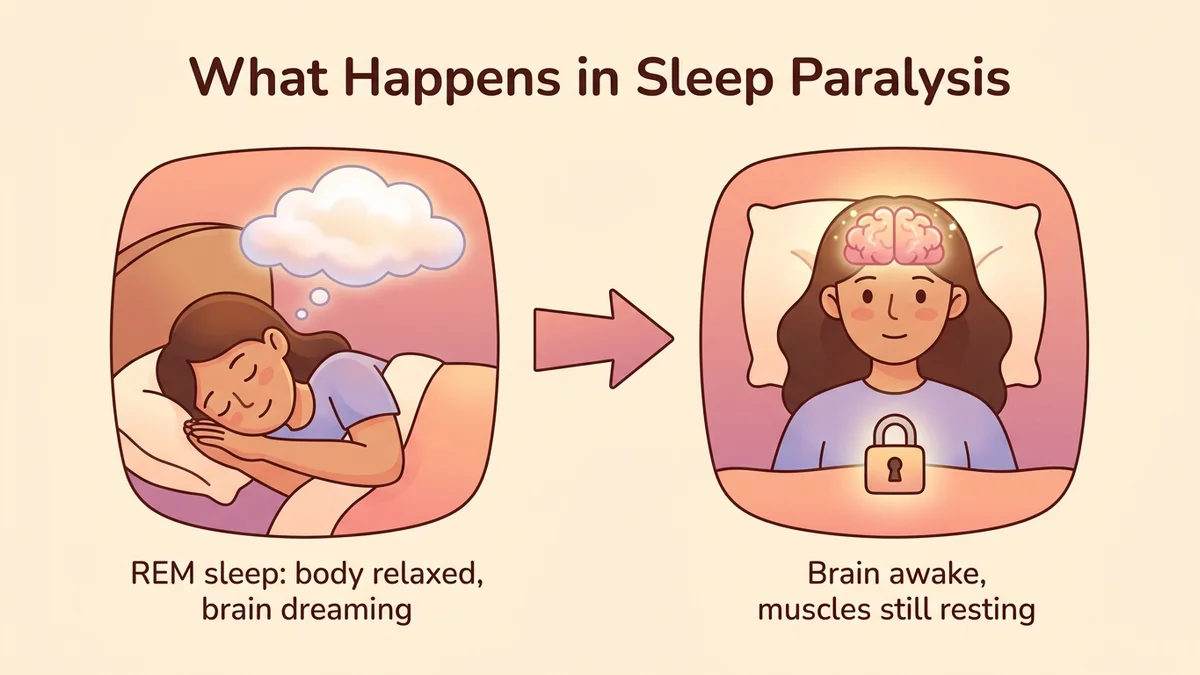
Key point: Sleep paralysis is a temporary "glitch" between two states of consciousness. Your brain is awake, but glycine is still holding your muscles in standby. It's a normal, harmless neurological phenomenon.
What causes sleep paralysis?
Why do some people have recurring episodes while others never experience it at all? The answer lies in a combination of factors that disrupt the transition between REM sleep and wakefulness.
The main triggers
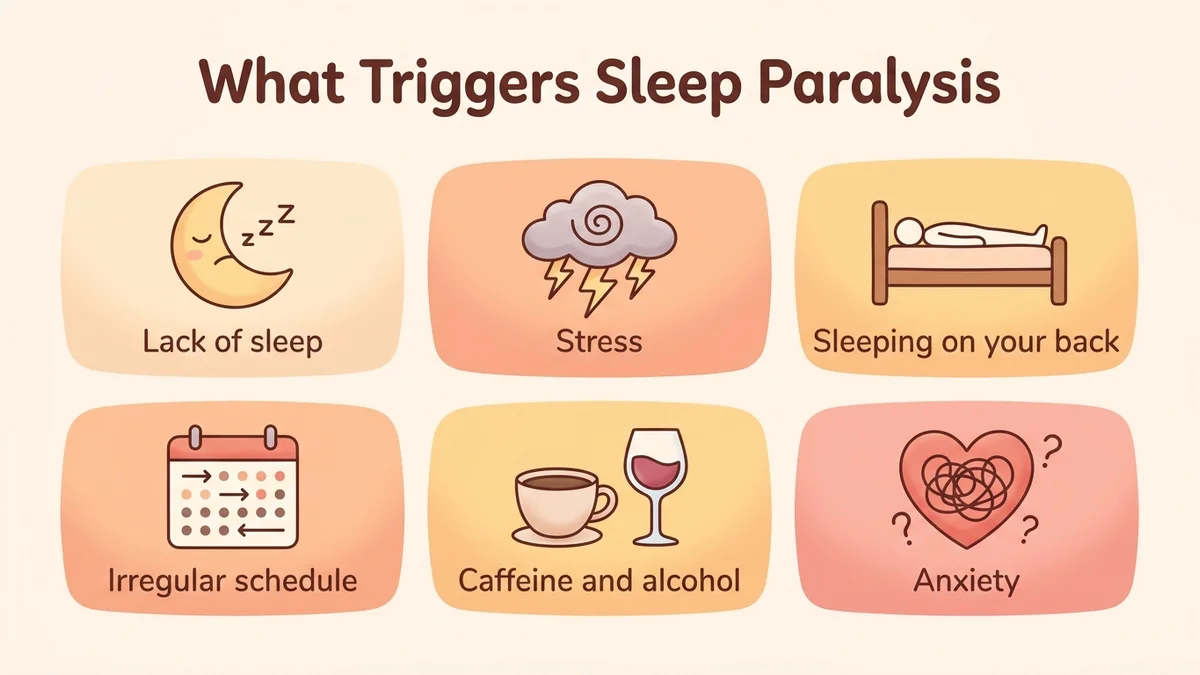
According to a meta-analysis by Sharpless and Barber published in Sleep Medicine Reviews (2011), the following factors significantly increase the risk:
- Lack of sleep: sleeping less than 6 hours disrupts sleep architecture and encourages REM intrusions
- Stress and anxiety: an overactive sympathetic nervous system fragments sleep cycles
- Irregular schedules: shift work, jet lag or all-nighters destabilize the body clock
- Sleeping on your back: the supine position is the postural factor most associated with episodes
- Stimulants: caffeine, alcohol or psychoactive substances before bed
Aggravating factors
Poor sleep is widespread: according to the CDC's National Health Interview Survey (2024), 30.5% of American adults sleep less than 7 hours a night. This general decline in sleep quality helps explain why sleep paralysis is so common.
| Risk factor | Impact on frequency | Level of evidence |
|---|---|---|
| Lack of sleep (<6h) | Risk multiplied by 2-3 | High |
| Chronic stress | 40-60% increase | High |
| Sleeping on your back | Significant increase | Moderate |
| Irregular schedules | Risk multiplied by 1.5-2 | High |
| Family history | Partial genetic component | Moderate |
| Anxiety/depression | Risk multiplied by 2-4 | High |
If you're dealing with chronic stress that disrupts your sleep, targeted breathing exercises can help calm your nervous system before bed.
Why do you hallucinate during sleep paralysis?
Hallucinations are the most terrifying part of sleep paralysis. About 75% of people who have an episode report accompanying hallucinations. But rest assured: they have a perfectly rational neurological explanation.
A brain still in "dream" mode
During sleep paralysis, your visual cortex and your amygdala remain partially activated in REM mode. Your brain keeps producing dream images while also receiving real sensory information from your bedroom. The result: dream and reality overlap, creating intense and often frightening visions.
According to research from the University of Waterloo, the amygdala — responsible for fear responses — is especially active during these episodes, which explains the feeling of terror.
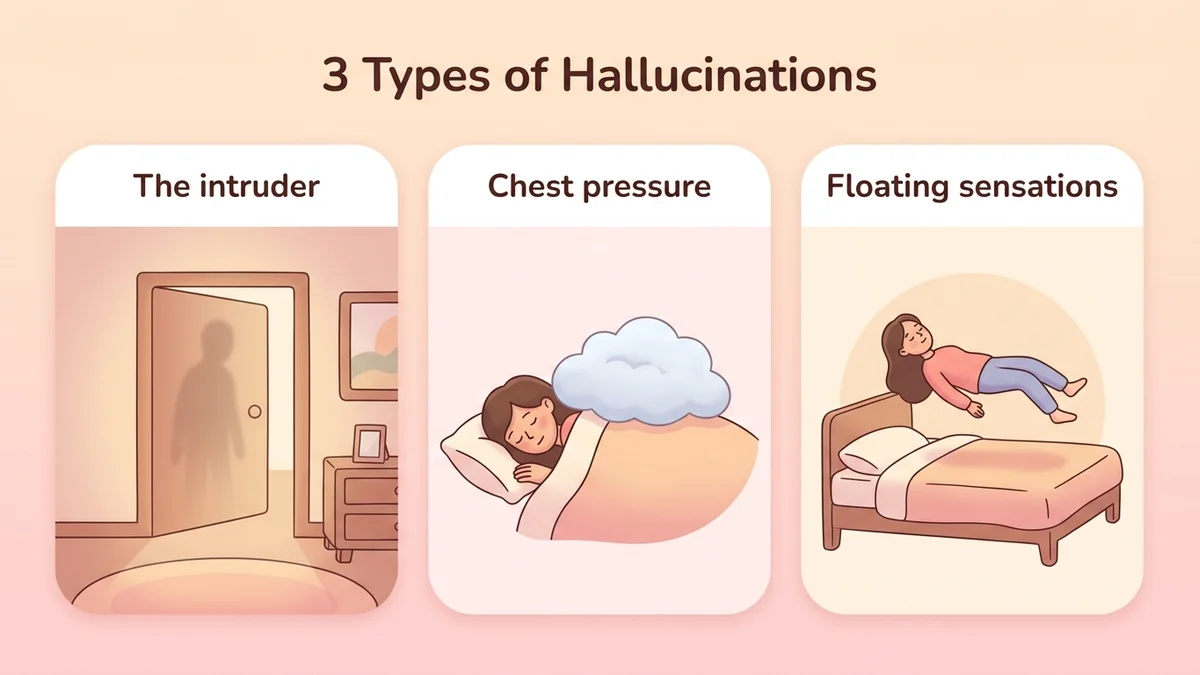
The three types of hallucinations
Based on the classification established by Dr. Baland Jalal of the University of Cambridge:
- The intruder: the sense of a threatening presence in the room, sometimes with visions of shadows or silhouettes. This is the most common hallucination.
- The incubus: a feeling of pressure on the chest, of being crushed or suffocated, as if someone or something were sitting on you.
- Vestibular-motor experiences: sensations of floating, leaving your body, falling or levitating. Some people describe a feeling of "taking off."
Only 5% of people experience all three types of hallucinations at once (Denis et al., 2018). Most episodes are limited to a sense of presence without a direct vision.
Key point: Sleep paralysis hallucinations are not a sign of a psychiatric disorder. They result from residual activation of the visual cortex and amygdala during the transition to full wakefulness.
How do you get out of sleep paralysis? The 4-step technique
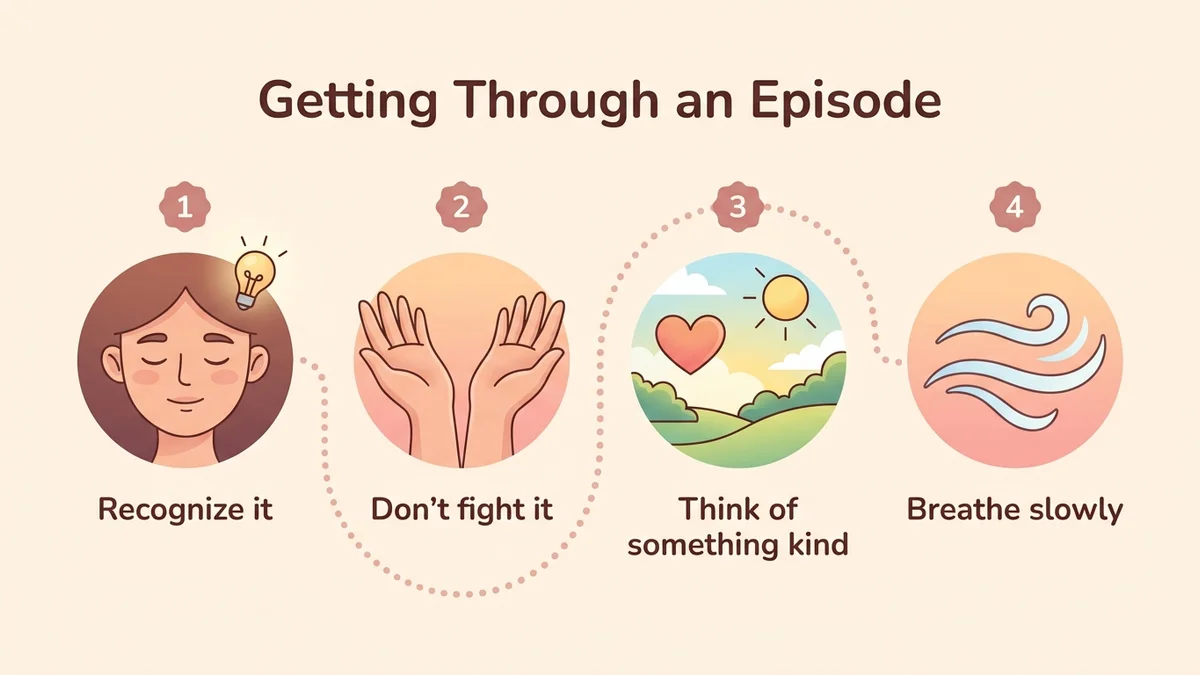
You're in the middle of an episode, conscious but unable to move. What should you do? Most guides just say "stay calm." But in concrete terms, here's a 4-step protocol developed by Dr. Baland Jalal of the University of Cambridge (2020), scientifically tested and shown to reduce episodes by 54%.
Step 1: Recognize and accept
As soon as you realize you're in sleep paralysis, tell yourself: "This is sleep paralysis. It's temporary and harmless." This cognitive reappraisal partially switches off the amygdala's fear response.
Step 2: Create emotional distance
Don't fight the paralysis. The harder you try to move or scream, the more your anxiety rises and the longer the episode lasts. Accept the stillness as a passing state, as if you were watching the scene from the outside.
Step 3: Turn your attention inward
Focus on a positive, comforting mental image: a happy memory, a peaceful place, the face of someone you love. Redirecting your attention moves the brain from "threat" mode to "safety" mode.
Step 4: Control your breathing
Focus on your breath. Even though your voluntary muscles are paralyzed, your diaphragm works normally. Consciously slow down your breathing: breathe in slowly through your nose for 4 seconds, breathe out for 6 seconds. This slow breathing activates the parasympathetic nervous system and speeds up the end of the episode.
Serena Coach tip: Our users who regularly practice guided breathing report handling their sleep paralysis episodes much more calmly. Daily training builds a reflex: even in the middle of an episode, the body "knows" how to slow its breathing.
Sleep paralysis and anxiety: a vicious circle to break
Sleep paralysis feeds a vicious circle with anxiety. Here's how it works:
- The episode causes intense terror
- Fear of going to sleep sets in
- Anticipatory anxiety delays falling asleep
- Lack of sleep increases the risk of another episode
- Back to step 1
According to a study published in Sleep Medicine (2024), people with generalized anxiety are 3 to 4 times more likely to have recurrent episodes of sleep paralysis.
The key to breaking this cycle: separate the experience from the fear. Understanding that sleep paralysis is a common neurological phenomenon, not a threat, greatly reduces the emotional impact of future episodes.
Anxiety management techniques can help you lower your overall stress level and, by extension, how often episodes happen.
Real-life scenarios
Scenario 1: Ethan's first sleep paralysis, age 22
Ethan is a graduate student. During finals, he sleeps less than 5 hours a night and drinks coffee after coffee. One night, he wakes up unable to move. He sees a dark shape at the foot of his bed. For what feels like an eternity (actually 90 seconds), he's convinced he's experiencing something supernatural.
What he did: in a panic, he fought with all his strength, which dragged the episode out. The next day, he searched "sleep paralysis" online and was reassured by the scientific explanations. By regulating his sleep schedule and cutting caffeine after 2 p.m., he hasn't had an episode in 8 months.
Scenario 2: Maria, 35, recurring episodes
Maria has 2 to 3 episodes a month and has for years. She developed anxiety about going to bed. Her doctor referred her to a sleep specialist, who ruled out narcolepsy and recommended Dr. Jalal's meditation-relaxation method.
What she did: she added 10 minutes of guided breathing every evening with Serena. After 8 weeks, her episodes dropped to one a month. Daily breathing practice gave her a "mental tool" to stay calm when an episode happens.
Scenario 3: Tom, 42, shift worker
Tom works rotating shifts. Switching between days and nights deeply disrupts his circadian rhythm. He has sleep paralysis mostly when his shifts change.
What he did: he started always sleeping on his side (with a pillow behind his back to keep him from rolling over), practicing cardiac coherence for 5 minutes before every bedtime, and building a stable sleep ritual despite his changing hours. The result: an 80% reduction in episodes.
How can you prevent sleep paralysis naturally?
Prevention rests on three pillars: sleep hygiene, stress management and sleep position habits.
Pillar 1: Stabilize your sleep cycles
- Go to bed and get up at the same time, weekends included (± 30 minutes max)
- Sleep 7 to 9 hours a night — lack of sleep is the number-one trigger
- Avoid long naps (> 20 minutes) late in the afternoon
- Turn off screens at least 1 hour before bed
Pillar 2: Reduce stress and anxiety
Dr. Baland Jalal's pilot study (University of Cambridge, published in Frontiers in Neurology, 2020) showed that an 8-week meditation-relaxation protocol reduced sleep paralysis episodes by 54% and the number of days affected by 50% in treated patients, with no improvement in the control group.
Validated techniques include:
| Technique | Duration | Proven effectiveness |
|---|---|---|
| Meditation-relaxation (MR therapy) | 10-15 min/day | -54% episodes (Jalal, 2020) |
| Cardiac coherence | 5 min/day | Lowers cortisol by 23% (HeartMath, 2024) |
| 4-7-8 breathing | 2-3 min at bedtime | Helps you fall asleep in < 60 seconds |
| Evening sophrology | 10-15 min | Improves sleep quality (SO-WELL, 2023) |
To discover suitable breathing techniques, read our guide to breathing exercises.
Pillar 3: Adjust your sleep position
- Avoid sleeping on your back: it's the position most associated with episodes
- Favor your left or right side with a pillow between your knees
- Practical trick: sew a tennis ball into the back of your pajama top to keep yourself from rolling over without realizing it
As the American Academy of Sleep Medicine explains, understanding the mechanism is the first step toward taking the fear out of the experience. You can complement this approach with guided breathing exercises in Serena, which walks you through them step by step.
Breaking the cycle: Dr. Baland Jalal explains sleep paralysis
In this TEDx talk, Dr. Baland Jalal — the Cambridge neuroscientist behind the meditation-relaxation method — explains why sleep paralysis feeds on fear and how to break the vicious cycle. Ideal for reducing the anticipatory anxiety that keeps episodes coming back.
The Serena perspective
Anonymized data from our users reveals a strong link between anxiety and sleep disruption. Among Serena users who report sleep paralysis episodes, 82% also show a high level of anxiety at the time of the episode.
Theory recommends 20 to 30-minute meditation sessions to improve sleep. In practice, our data shows that short 5 to 10-minute sessions, practiced regularly, produce better results than an occasional long session. Sticking with it is the key factor.
The most striking observation: users who practice guided breathing at least 5 evenings out of 7 for 4 weeks report a 60% decrease in their bedtime anxiety. And it's exactly that anticipatory anxiety that fuels the sleep paralysis cycle.
Serena Coach tip: If you have recurrent sleep paralysis, don't start by trying to "change everything." Simply add 5 minutes of guided breathing every evening for 2 weeks. That's often enough to kick off a virtuous circle: less anxiety → better sleep → fewer episodes.
When should you see a doctor about sleep paralysis?
Isolated, occasional sleep paralysis doesn't usually require a medical visit. However, see your doctor if:
- Episodes are very frequent (several times a week)
- They come with excessive daytime sleepiness
- You have episodes of sudden muscle weakness (cataplexy) during the day
- Fear of sleeping significantly affects your quality of life
- You suspect a link with narcolepsy or another sleep disorder
Diagnosis mainly relies on a clinical interview. In some cases, an overnight sleep study (polysomnography) may be ordered to assess your sleep architecture and rule out other conditions.
How Serena can help reduce sleep paralysis
Dr. Jalal's study showed that meditation-relaxation is the most effective non-drug approach to sleep paralysis. Serena puts that approach within reach with:
- 6 guided breathing techniques, including cardiac coherence and 4-7-8 breathing, to calm your nervous system every evening
- Daily mood tracking to identify periods of high stress (and therefore higher risk)
- Sleep meditation exercises designed to ease the transition into sleep
- Gradual guidance that walks you step by step, from 3 minutes in the first week to your ideal rhythm
By combining a scientific understanding of sleep paralysis with a daily relaxation practice, you can significantly reduce how often and how intensely episodes happen.
Try Serena for free and start your evening breathing routine tonight.
Frequently asked questions
Is sleep paralysis dangerous?
No, sleep paralysis is a harmless, temporary phenomenon that poses no danger to your health. An episode lasts from a few seconds to a few minutes and resolves on its own. Even though the experience is terrifying, your body keeps working normally: your heart beats, your diaphragm breathes — only your voluntary muscles are temporarily immobilized.
How long does sleep paralysis last?
A sleep paralysis episode usually lasts from a few seconds to 2 or 3 minutes. In rare cases, it can stretch to 20 minutes. The person then regains full movement, either on their own or thanks to an outside stimulus such as a noise or a touch.
Can you die from sleep paralysis?
No, it's impossible to die from sleep paralysis. The feeling of chest pressure and difficulty breathing is linked to the inhibition of the intercostal muscles, but the diaphragm keeps working normally. Your breathing is never actually compromised.
Why do I keep having sleep paralysis?
Recurrent episodes are most often linked to chronic lack of sleep, high stress or irregular sleep schedules. According to Sharpless and Barber (2011), 0.3 to 6.2% of people experience recurrent episodes. If that's you, see a doctor to rule out narcolepsy and adopt a strict sleep routine.
Is sleep paralysis hereditary?
Recent studies suggest a partial genetic component. However, environmental factors (stress, lack of sleep, irregular schedules) remain the main triggers. Having a parent who has experienced sleep paralysis slightly increases your likelihood, but doesn't make it inevitable.
How can you prevent sleep paralysis naturally?
The most effective prevention strategies include: regular bedtimes, enough sleep (7-9 hours), sleeping on your side, managing stress through guided breathing or meditation, and limiting caffeine after 2 p.m. The Cambridge study (2020) confirms that meditation-relaxation reduces episodes by 54%.
Does sleeping on your back cause sleep paralysis?
Sleeping on your back is the postural factor most correlated with sleep paralysis episodes. Several studies confirm that it significantly increases the risk. If you're prone to sleep paralysis, favor sleeping on your side and use a positioning pillow if needed.
What is the link between sleep paralysis and narcolepsy?
Sleep paralysis is one of the four core symptoms of narcolepsy, along with excessive daytime sleepiness, cataplexy and hallucinations. If your episodes are very frequent and come with uncontrollable daytime sleep attacks, a specialist evaluation is strongly recommended.
Conclusion
Sleep paralysis is a deeply unsettling but perfectly harmless experience. Understanding its mechanism — the muscle atonia of REM sleep lingering for a few moments after waking — is the first step toward taking the drama out of it.
You now have concrete tools: Dr. Jalal's 4-step technique during an episode, the three pillars of prevention (sleep hygiene, stress management, sleeping on your side), and the scientific certainty that this phenomenon is temporary and harmless.
If you'd like to build a guided breathing routine to improve your sleep and reduce your episodes, Serena supports you with tailored exercises — and the basic breathing exercises are free.
Your sleep deserves to be a place of rest, not terror. With the right knowledge and the right tools, it can be again.