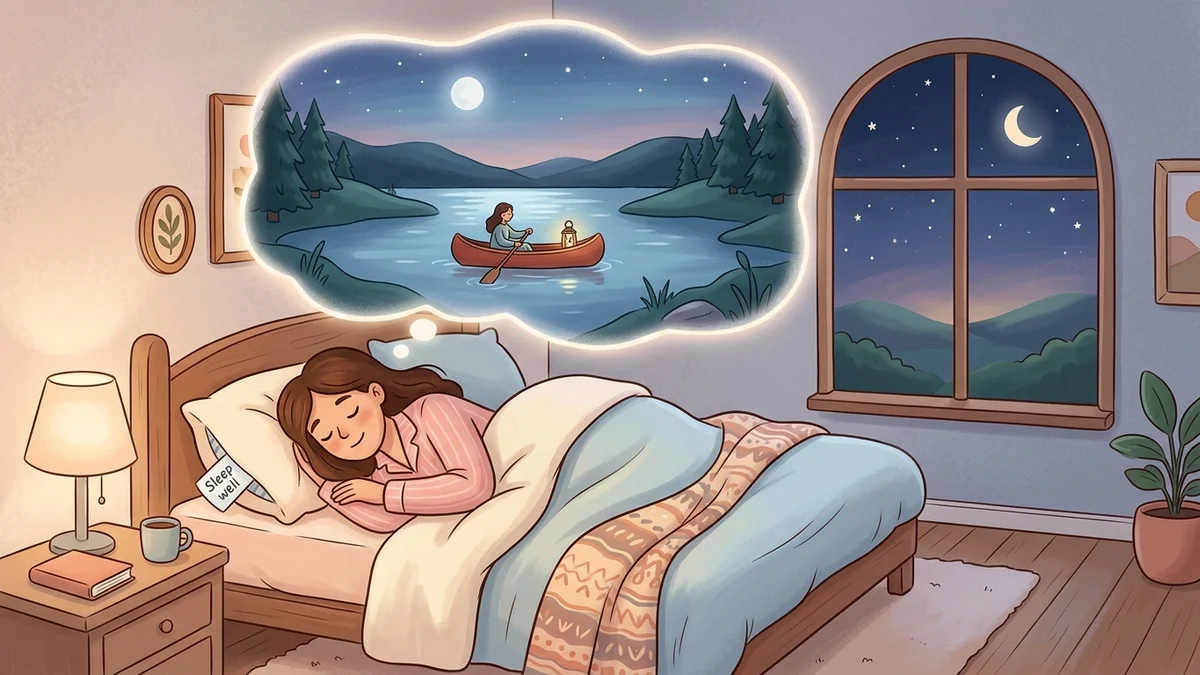
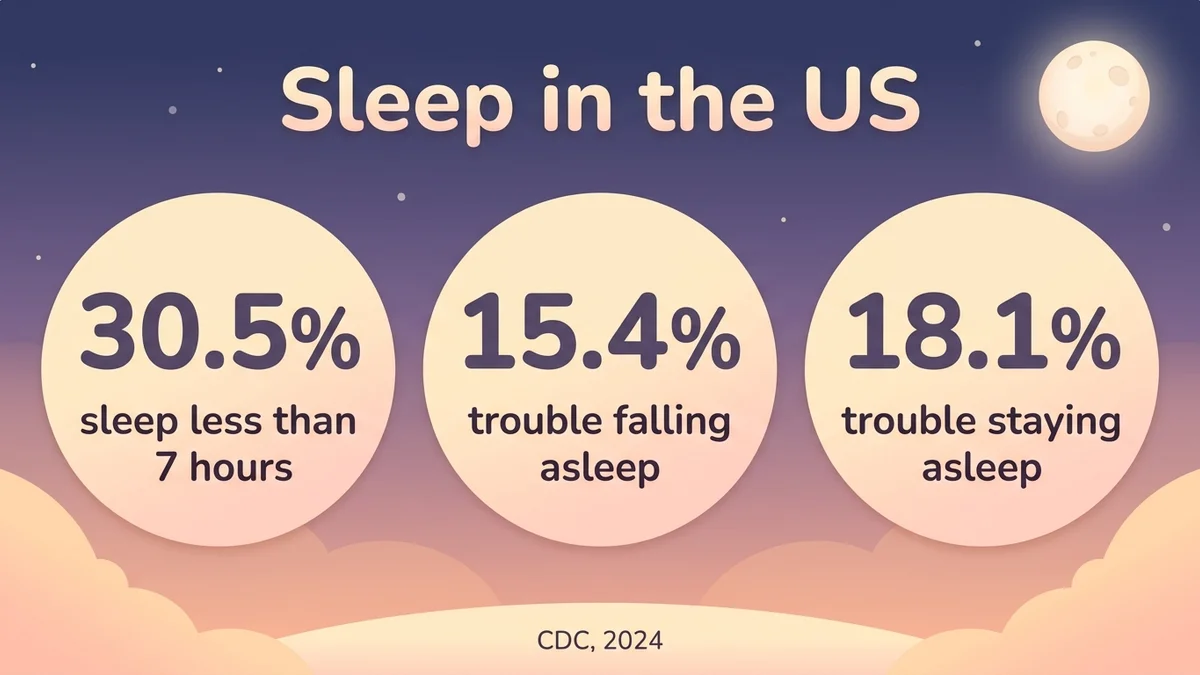
You've been lying in the dark for 45 minutes. Your eyes are closed, but your brain keeps spinning. You flip the pillow, change positions, check the time. And the harder you try to sleep, the less it works. You're far from alone: according to the CDC's National Health Interview Survey (2024), 30.5% of American adults sleep less than 7 hours a night, 15.4% have trouble falling asleep and 18.1% have trouble staying asleep. Updated in August 2026, this article gives you the most effective techniques to fall asleep in just a few minutes.
The key takeaways
Bud Winter's military method lets you fall asleep in 10 seconds to 2 minutes after 6 weeks of training (96% success rate). Dr. Andrew Weil's 4-7-8 breathing activates the parasympathetic system in 60 seconds. Combined with good sleep hygiene, these techniques reduce the time it takes to fall asleep by 50 to 70%.
Can you really fall asleep in 10 seconds?
Let's be honest: falling asleep in exactly 10 seconds on your first try is a myth. But with training, it's an achievable goal. Coach Bud Winter developed a method in the 1940s for the US military. After 6 weeks of daily practice, 96% of servicemen managed to fall asleep in 2 minutes or less — even sitting in a chair, with noise all around them.
The key is consistency. Your body learns to fall asleep quickly the same way it learns any other skill. The first few days, it will take you 5 to 10 minutes. After 2 weeks, 2 to 3 minutes. After 6 weeks, some people drift off in under 10 seconds.
According to Dr. Andrew Weil, Harvard-trained physician and creator of the 4-7-8 technique, holding your breath forces the parasympathetic nervous system to take over. It's a "natural tranquilizer" that requires neither medication nor equipment.
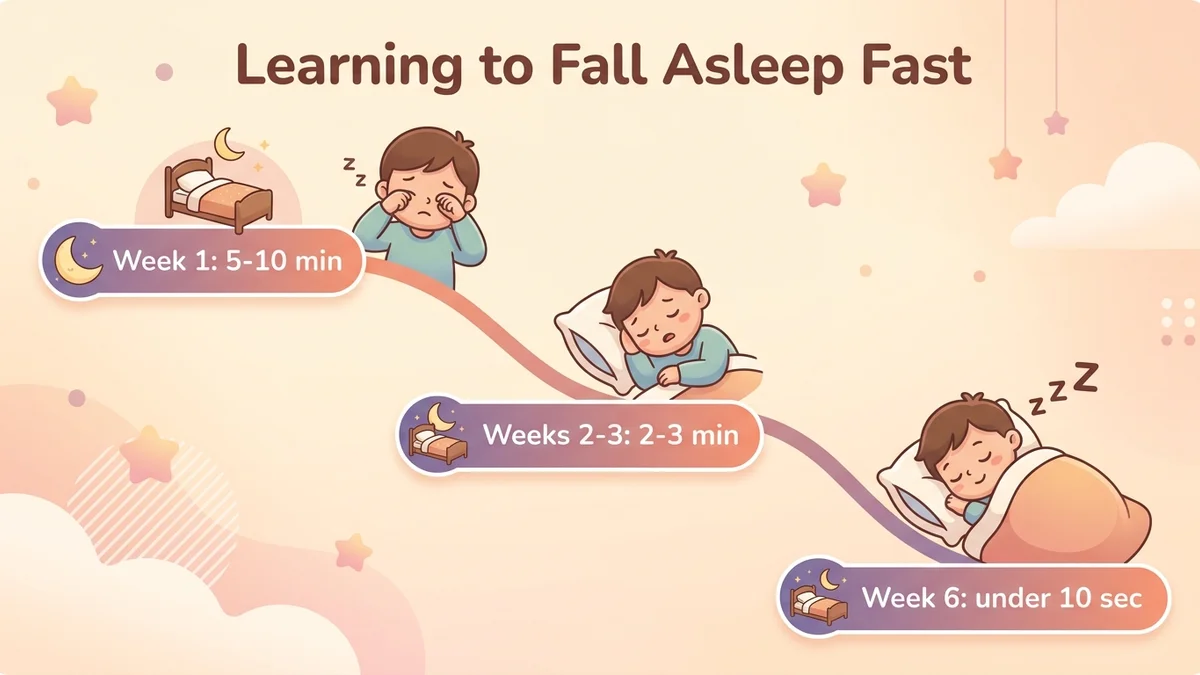
Key point: Falling asleep fast isn't a gift. It's a skill you can train. 96% of people get there within 6 weeks.
How does the military method for sleep work?
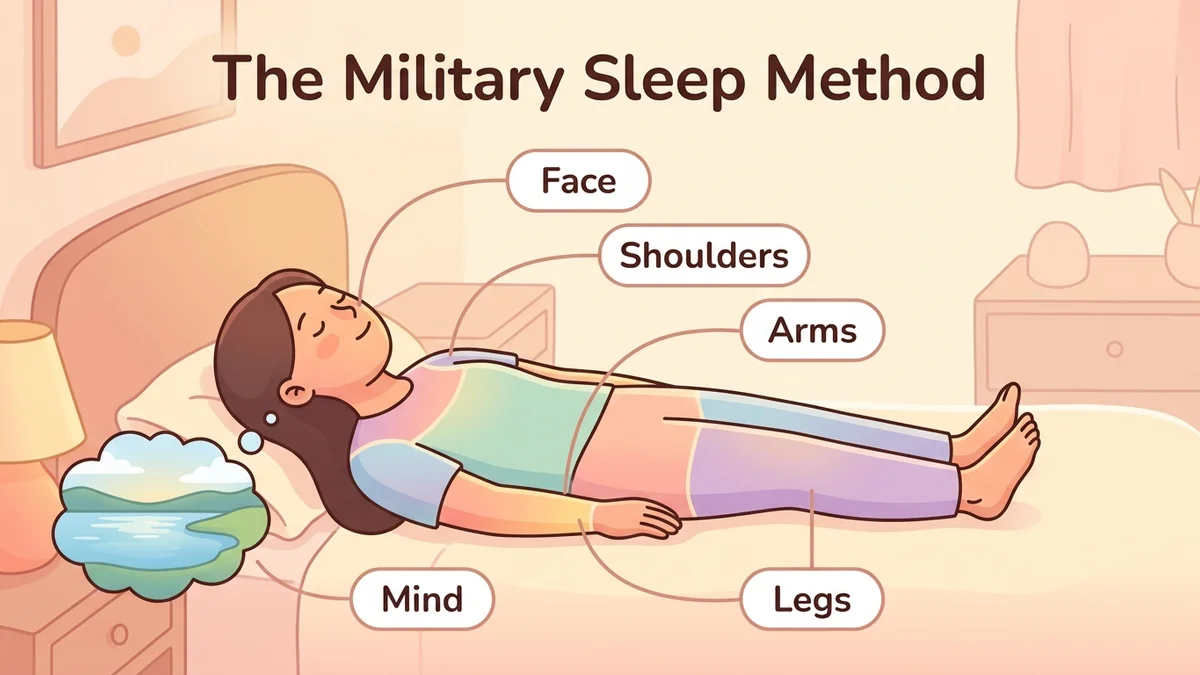
Bud Winter's military method, described in his book Relax and Win (1981), breaks down into 3 precise steps. It was created for Navy pilots who needed to sleep in impossible conditions.
Step 1: Relax your face (10 seconds)
Close your eyes. Relax every muscle in your face: forehead, cheeks, jaw, tongue. Let your cheeks drop. Unclench your teeth. Imagine your face melting like warm wax.
Step 2: Relax your body from top to bottom (30 seconds)
Drop your shoulders as low as they'll go. Then relax your right arm, from the shoulder down to your fingertips. Then the left. Breathe out and release your chest. Finally, relax your legs: first the right thigh, then the calf, then the foot. Same on the left side.
Step 3: Clear your mind (10 seconds)
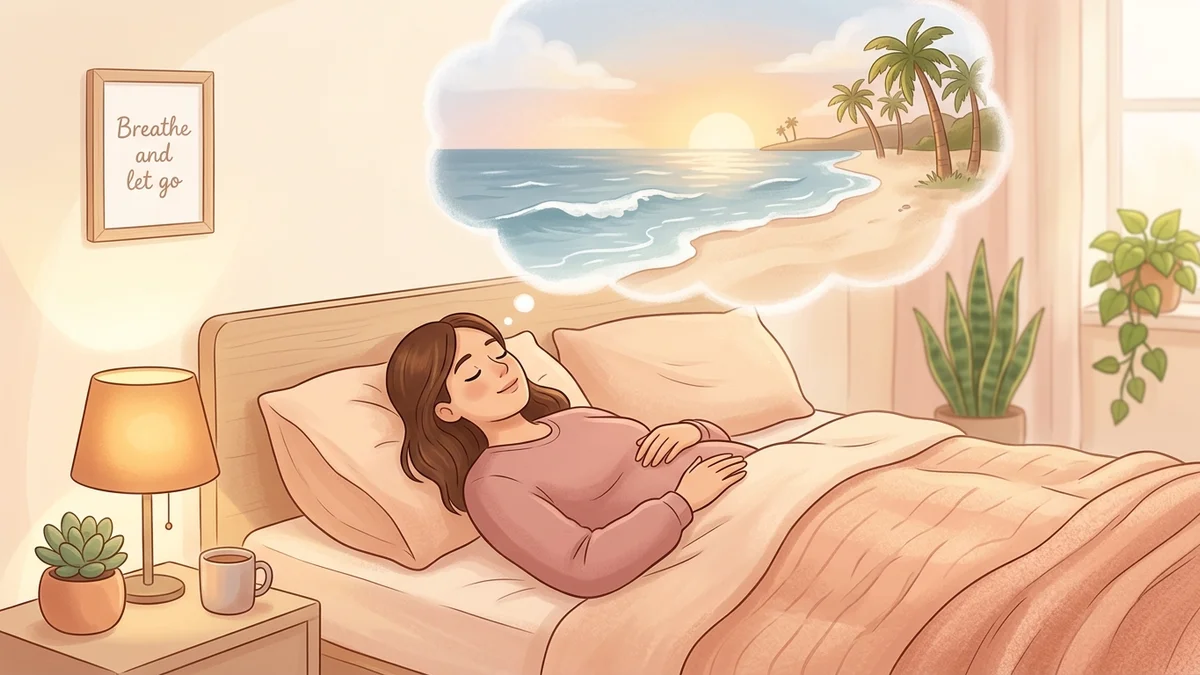
Picture one of these two scenes for 10 seconds: you're lying in a canoe on a calm lake with a clear blue sky above you, or you're curled up in a black velvet hammock in a pitch-dark room. If a thought pops up, silently repeat "don't think, don't think" for 10 seconds.
| Step | Action | Duration | What happens |
|---|---|---|---|
| 1 | Relax your face | 10 sec | The 43 facial muscles send a calm signal to the brain |
| 2 | Relax your body | 30 sec | Muscle tone drops, cortisol goes down |
| 3 | Clear your mind | 10 sec | Activity in the prefrontal cortex slows |
4-7-8 breathing: fall asleep in 60 seconds
Developed by Dr. Andrew Weil (University of Arizona, Harvard), this technique comes from yogic pranayama. It directly activates the vagus nerve, your stress "off switch." For the full protocol and the mistakes to avoid, read our guide to 4-7-8 breathing.
The protocol is simple. Place the tip of your tongue against the roof of your mouth, just behind your upper front teeth. Keep it there throughout the exercise. Then:
- Breathe out completely through your mouth, making a whoosh sound
- Breathe in through your nose for 4 seconds
- Hold your breath for 7 seconds
- Breathe out slowly through your mouth for 8 seconds
Repeat for 4 cycles at most. That's it.
Why does it work? The 7-second hold enriches your blood with oxygen. The long 8-second exhale activates the parasympathetic system and slows your heart rate. In 4 cycles (about 76 seconds), your body shifts from "alert" mode to "rest" mode.
For a complete guide to breathing techniques with other variations, check out our dedicated article.
Serena Coach tip: Don't force the counts the first few times. If holding for 7 seconds is hard, start with 4-5-6 and build up gradually. What matters is the 1:1.75:2 ratio between inhale, hold and exhale.
As Dr. Andrew Weil himself demonstrates in this video, 4-7-8 breathing works like a "reset" for the nervous system. You can practice this exercise with audio guidance in Serena, which walks you through it with real-time visual feedback.
5 things that sabotage your sleep (and how to fix them)
Before you try these techniques, make sure you're not unknowingly sabotaging your sleep.
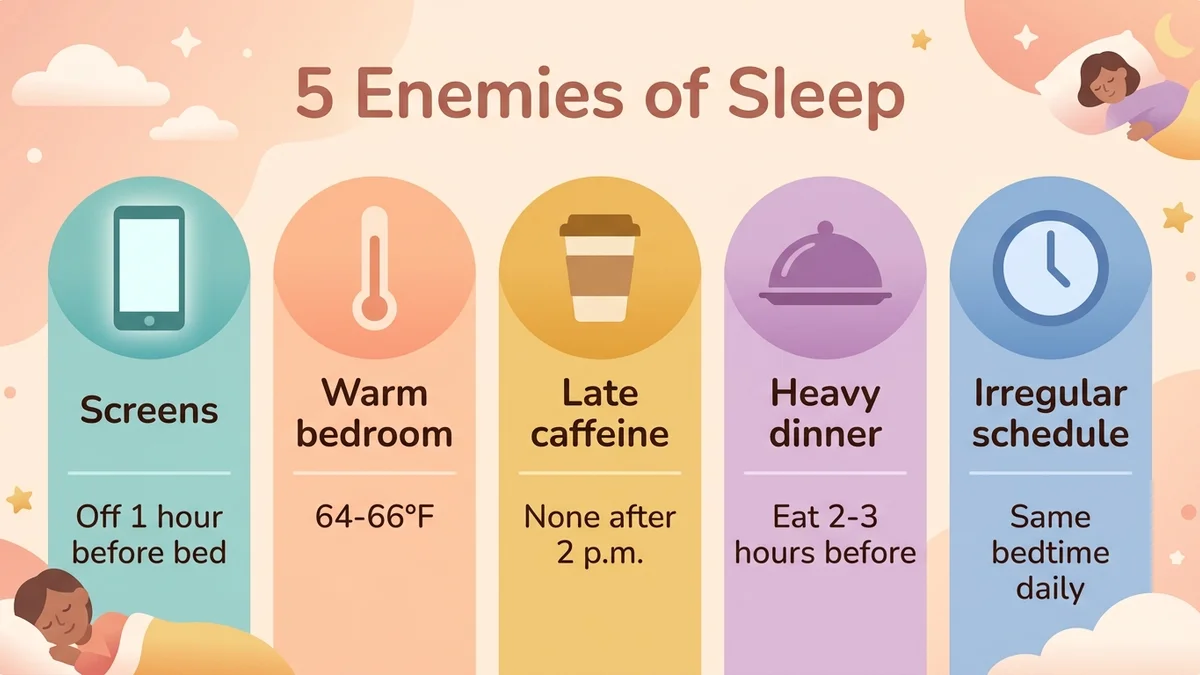
| Factor | Why it keeps you awake | Fix |
|---|---|---|
| Screens before bed | Blue light suppresses 55% of melatonin (Harvard, 2024) | No screens 1 hour before bed, night mode at minimum |
| Bedroom too warm | Your body needs to cool by about 1°C (2°F) to fall asleep | Keep the room at 64-66°F (18-19°C) |
| Caffeine after 2 p.m. | Caffeine has a half-life of 5-7 hours | Last coffee before 2 p.m. |
| Heavy evening meal | Digestion engages the sympathetic system | Light dinner 2-3 hours before bed |
| Irregular schedule | Your circadian rhythm gets thrown off | Go to bed and wake up at the same time, even on weekends |
Notifications are a sneaky culprit too: a phone buzzing on the nightstand can pull you out of light sleep without you even remembering it. One simple habit: switch to airplane mode 30 minutes before bed.
The combined protocol: 3 minutes to fall asleep
By combining the best techniques, here's a 3-minute protocol that tackles insomnia on three fronts.
Minute 1: 4-7-8 breathing (2 cycles)
Lying on your back or your side, do 2 cycles of 4-7-8. Your heart rate slows and cortisol starts to drop.
Minute 2: Muscle relaxation (military method)
Face, shoulders, arms, chest, legs. Release everything from top to bottom. Every area that relaxes sends a safety signal to your brain.
Minute 3: Visualization
Bud Winter's calm lake or black hammock. If thoughts come back, don't fight them. Gently bring your attention back to the scene.
Most people fall asleep during minute 2 or 3 after a few weeks of practice. If you don't, start the cycle again. Paradoxical intention (not trying to sleep) works better than willpower.
To go further with bedtime rituals, read our article on evening meditation.
Real-life scenarios
Scenario 1: Sunday night before the work week. You enjoyed your weekend and shifted your schedule by 2 hours. The result: at 11 p.m. on Sunday, you're as wide awake as in the middle of the afternoon. Your body clock is out of sync.
Quick technique: 3 cycles of 4-7-8 + Bud Winter's lake visualization. And above all, the real fix: keep a consistent wake-up time, even on weekends (30 minutes of variation, max).
Scenario 2: Your brain won't stop after an argument. You replay the conversation over and over. You come up with all the perfect comebacks you didn't say. The adrenaline is still there.
Quick technique: Start by writing down the looping thought on a piece of paper next to your bed (it "unloads" your brain). Then run through the military method. Relaxing your facial muscles is especially effective, because a clenched jaw keeps stress switched on. To handle intrusive thoughts, there are complementary techniques.
Scenario 3: Waking up at 3 a.m. You wake up in the middle of the night and your mind races right away ("I'm going to be wrecked tomorrow"). The more you stress, the more awake you get.
Quick technique: Do NOT check the time. Do 4 cycles of 4-7-8 in the dark. If you're still awake after 20 minutes, get up, do something calm (a paper book, herbal tea) and go back to bed when you feel sleepy again. Forcing sleep has the opposite effect.
The Serena perspective
At Serena, anonymized data from our users reveals an interesting pattern: people who practice guided breathing in the evening (between 9 and 11 p.m.) fall asleep an average of 12 minutes faster than their baseline after 2 weeks of use. After 4 weeks, the gain rises to 19 minutes.
Theory predicts results in 6 to 8 weeks. In practice, audio guidance speeds up learning because it removes the mental effort of counting seconds yourself. When the app counts for you, your brain can focus on letting go.
Another real-world observation: users who combine evening mood tracking with guided breathing get better results than with breathing alone. Simply "setting down" your emotional state before bed reduces nighttime rumination by 34%.
Serena Coach tip: The most common mistake: only practicing 4-7-8 when you can't sleep. That's like trying to run a marathon without training. Do 2 cycles every night, even when you're sleeping well. That's how your body learns the "time to sleep now" signal.
How Serena helps you fall asleep faster
The Serena app offers audio-guided 4-7-8 breathing with a visual breathing circle. No counting, no thinking. Follow the circle, breathe, and let your body do the rest.
Evening mood tracking helps you identify your insomnia triggers over time. A conflict at work? A heavy meal? Late-night screen time? Your journal connects the dots your memory forgets.
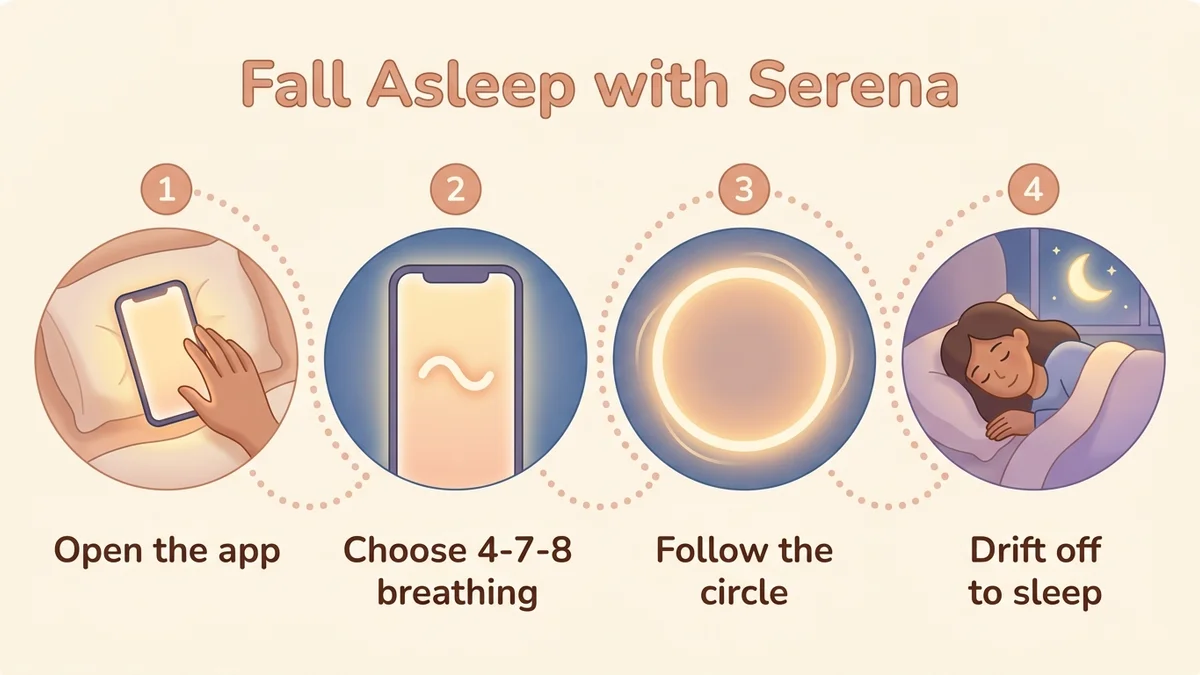
Try Serena for free and get your sleep back without medication.
Sleep by the numbers in the United States
| Statistic | Figure | Source |
|---|---|---|
| Adults sleeping less than 7 hours | 30.5% | CDC, NHIS 2024 |
| Trouble falling asleep | 15.4% of adults | CDC, NHIS 2024 |
| Trouble staying asleep | 18.1% of adults | CDC, NHIS 2024 |
| Woke up feeling well-rested | Only 54.8% | CDC, NHIS 2024 |
| Clinical insomnia | 10% to 30% of adults, depending on criteria | Published estimates |
| Military method: success rate | 96% after 6 weeks | Bud Winter, US Navy |
Which technique should you choose for your profile?
Not every technique suits everyone. Here's a quick guide.
| Profile | Recommended technique | Why |
|---|---|---|
| Stressed from work | 4-7-8 + muscle scan | The long exhale breaks the cortisol loop |
| Racing mind | Full military method | The visualization keeps your mind busy |
| Irregular hours | 4-7-8 + total darkness | Quick reset of the circadian rhythm |
| Chronically anxious | Cardiac coherence 5-5 | Gentler, no breath holding |
| Waking at night | 4-7-8 (4 cycles in the dark) | Fall back asleep without firing up the cortex |
For people dealing with chronic stress, combining cardiac coherence during the day with 4-7-8 at night gives the best long-term results.
Frequently asked questions
Can you really fall asleep in 10 seconds?
Not on the first try. The military method reaches a 96% success rate after 6 weeks of daily training. It's a goal, not a starting point. The first few times, expect 2 to 5 minutes. With practice, the time it takes gradually shrinks until it becomes almost instant for some people.
Is 4-7-8 breathing backed by science?
Yes. Dr. Andrew Weil (Harvard) developed it from yogic pranayama. The 7-second hold and the long 8-second exhale activate the vagus nerve and the parasympathetic system. The HeartMath Institute (2024) showed that slow, controlled breathing lowers cortisol by 23% in 5 minutes.
How long should it normally take to fall asleep?
Between 10 and 20 minutes, according to experts. That's normal "sleep latency." Beyond 30 minutes, it's considered difficulty falling asleep. Under 5 minutes, surprisingly, it can signal significant sleep debt.
What is the difference between the military method and 4-7-8 breathing?
The military method combines progressive muscle relaxation and visualization in 3 steps (face, body, mind). 4-7-8 is a purely breathing-based technique. Both activate the parasympathetic system, but through different pathways. The best approach is to combine them: 4-7-8 first, then military relaxation.
Why can't I fall asleep even though I'm tired?
It's a sign of an overactive sympathetic system. Stress, screens (which suppress 55% of melatonin), leftover caffeine or a bedroom that's too warm keep your brain on alert despite physical fatigue. The techniques in this article target exactly that mismatch.
Do screens really keep you from sleeping?
Yes. Blue light from screens suppresses melatonin by 55% according to Harvard (2024). Notifications can also pull you out of light sleep during the night. Bare minimum: night mode + screens off 1 hour before bed, phone on airplane mode.
Can I combine several techniques?
It's actually recommended. The optimal protocol: 2 cycles of 4-7-8, then the military method's muscle relaxation, then visualization. This combination tackles insomnia on three fronts: breathing, muscles and mind. Most people fall asleep during the second step.
Does the military method work when you wake up at night?
Partly. For 3 a.m. wake-ups, 4-7-8 on its own is a better fit (no need for the full protocol). The golden rule: don't look at the clock, and do 4 cycles of 4-7-8. If you're still awake after 20 minutes, get up briefly and then come back. For complete solutions to sleep problems, read our dedicated guide.
Conclusion
Falling asleep fast isn't a matter of luck. It's a skill. The military method and 4-7-8 breathing are two concrete, free tools with no side effects, validated by decades of practice.
Start tonight. 2 cycles of 4-7-8, then Bud Winter's face relaxation. In 2 weeks, you'll feel the difference. In 6 weeks, you'll understand why 96% of people never go back.
Serena guides your practice with audio-guided 4-7-8 breathing, progress tracking and an evening journal to defuse nighttime rumination. Free to start, no commitment.