You feel tense, drained and disconnected from yourself. Your days blur together between screens, commutes and obligations. What if the answer was waiting among the trees? Forest bathing, or shinrin-yoku in Japanese, isn't just a walk in the woods. It's a recognized wellbeing practice that can shift your body and mind in a matter of minutes. Updated in May 2026.
The key takeaways
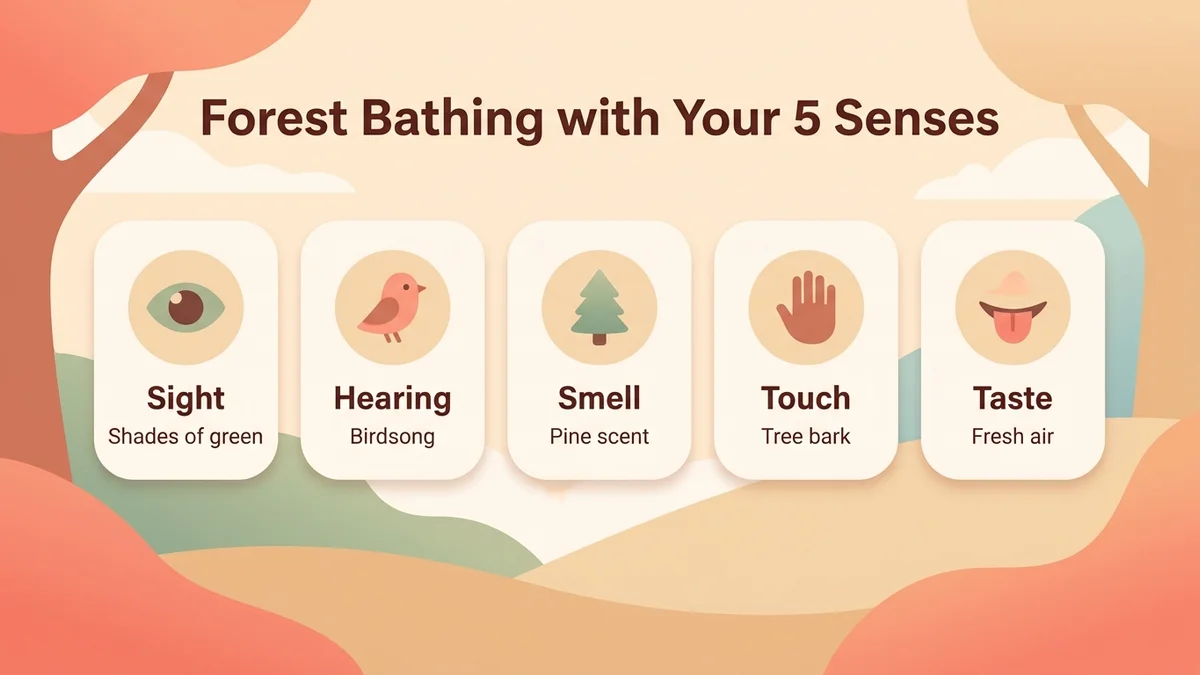
Forest bathing (shinrin-yoku) means immersing yourself in the forest atmosphere by engaging all five senses. Research shows lower cortisol, a roughly 50% increase in immune NK cell activity after a multi-day trip, and a significant drop in anxiety. Twenty minutes is enough to feel the first effects. This Japanese practice, part of the country's preventive health culture since 1982, is now studied worldwide.
What exactly is forest bathing?
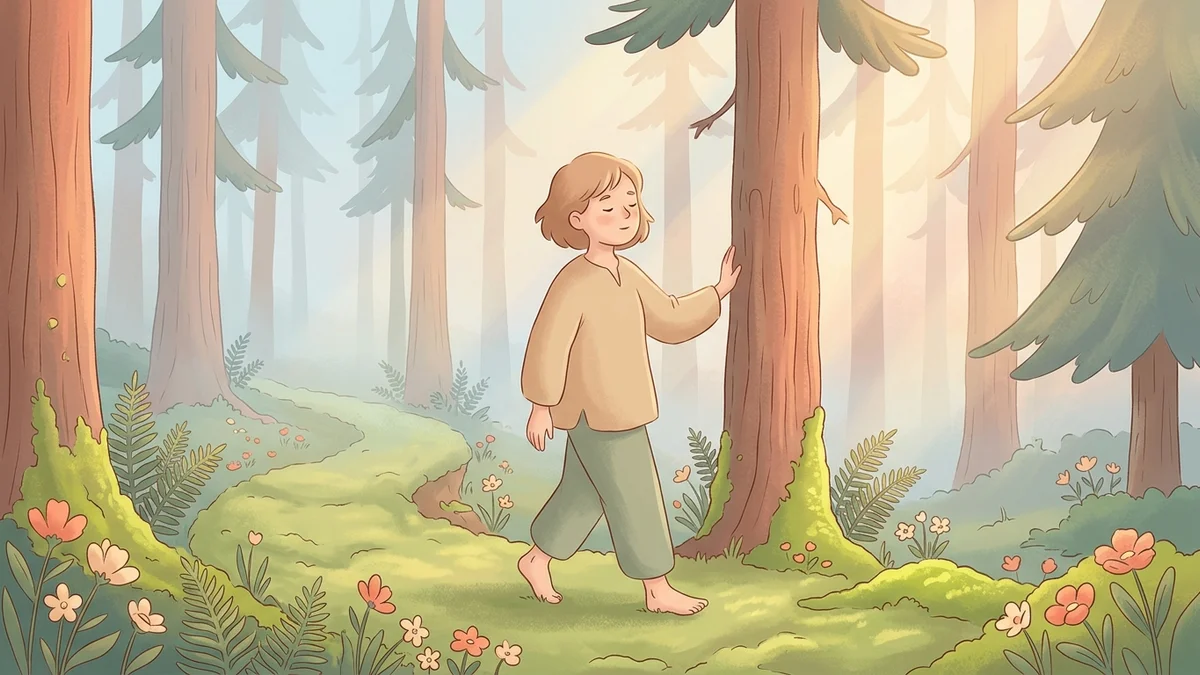
Forest bathing is a slow, mindful sensory immersion in a forest environment. Unlike hiking, there's no destination and no physical performance. You walk very slowly, stop, breathe, touch tree bark and listen to the wind in the leaves.
The term "shinrin-yoku" was coined in 1982 by Japan's Forestry Agency. "Shinrin" means forest, and "yoku" means bath. Since then, Japan has certified more than 60 official "forest therapy bases" as part of its public health efforts.
In the United States, the practice has grown quickly. The Association of Nature and Forest Therapy trains guides across the country, and more doctors now encourage time in nature as a preventive tool — some even "prescribe" park visits through programs like Park Rx America.
Key point: Forest bathing isn't hiking. It's a mindset of opening your five senses to the forest environment, with no goal of distance or speed.
How does forest bathing reduce stress and cortisol?
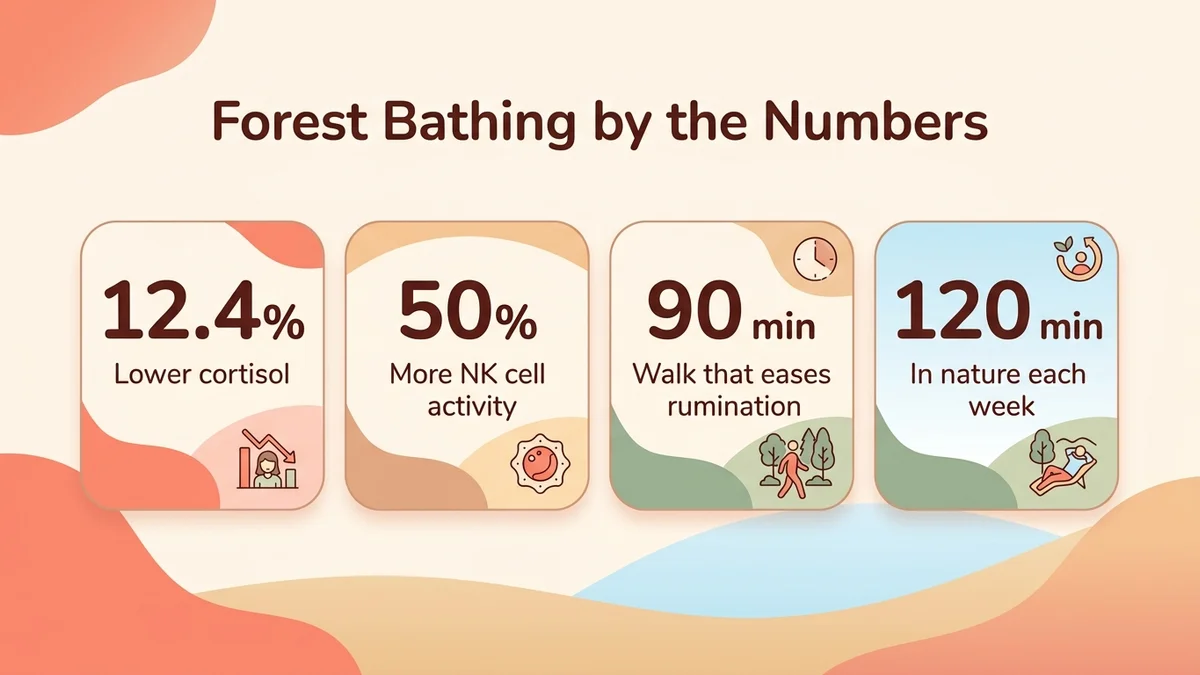
Spending time in the forest activates the parasympathetic nervous system and lowers stress hormones. In a large Japanese field study across 24 forests (Park et al., Environmental Health and Preventive Medicine, 2010), forest environments were associated with 12.4% lower salivary cortisol, a 6% lower pulse rate and lower blood pressure compared with city settings.
The mechanism works on three levels. First, the absence of urban stimuli (noise, artificial lights, crowds) lets the brain shift into rest mode. Second, the phytoncides released by trees appear to interact with the body's immune and stress systems. Third, natural light and greenery support mood and the body clock.
According to Dr. Qing Li, an immunologist at Nippon Medical School in Tokyo and author of Forest Bathing: How Trees Can Help You Find Health and Happiness (2018), benefits can start within the first 20 minutes in the forest — and they build with longer immersion.
In Park and colleagues' study of 24 Japanese forests, forest environments lowered cortisol, pulse rate and blood pressure while increasing parasympathetic nervous activity compared with urban environments.
Phytoncides: the trees' secret
Trees release volatile organic compounds called phytoncides: alpha-pinene, beta-pinene, limonene, camphene. These molecules protect trees from bacteria and insects. When you breathe them in, they may affect your body too.
| Phytoncide | Main source | Suggested effects |
|---|---|---|
| Alpha-pinene | Pines, firs | Anti-inflammatory, may open airways |
| Limonene | Conifers, citrus | May ease anxiety and lift mood |
| Camphene | Cypress, cedar | Studied for effects on cholesterol |
| Beta-myrcene | Broadleaf trees, bay laurel | Muscle relaxant, calming |
Let's be honest: breathing forest air works on you without you having to do anything. You just have to be there.
What are the 7 proven benefits of forest bathing?
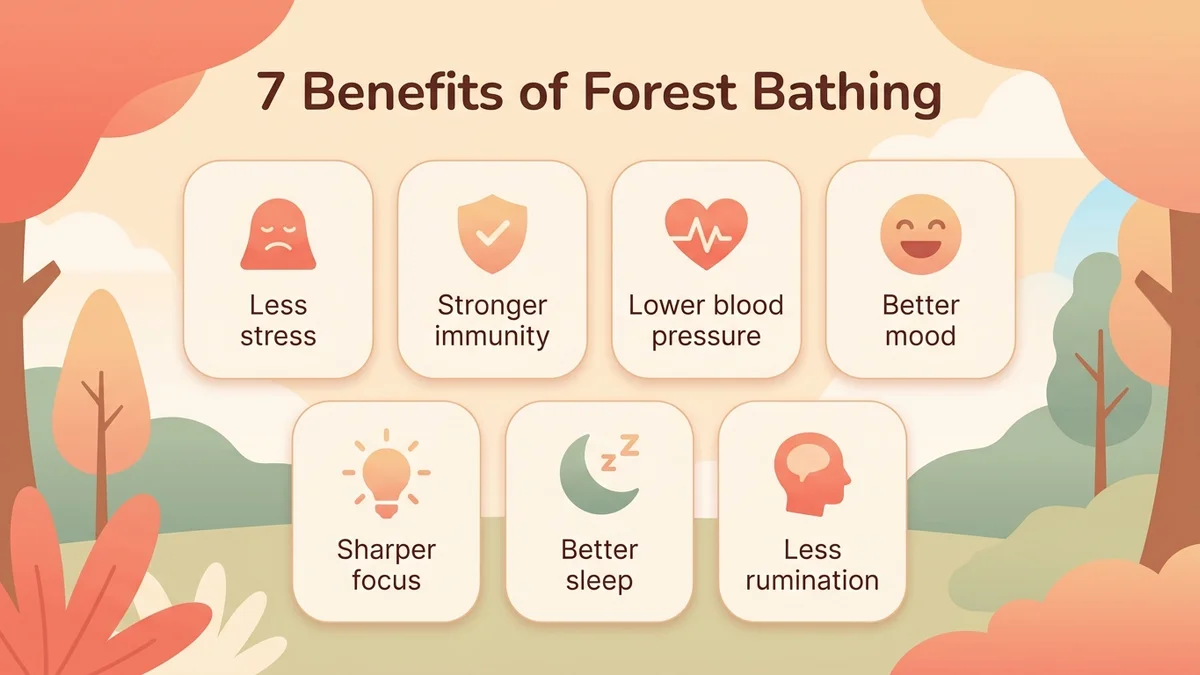
Research accumulated over 40 years by universities in Japan, South Korea, Europe and the United States points to at least seven major benefits for physical and mental health. Here's what the science supports.
1. Less stress and anxiety
Stress reduction is the best-documented benefit of forest bathing. Reviews of the research consistently find lower cortisol, lower heart rate and reduced feelings of tension, anxiety and fatigue after time in the forest — sometimes after just 15 minutes of immersion.
2. A stronger immune system
In studies published in 2008 and 2010, Dr. Qing Li's team found that a 3-day forest trip increased the activity of natural killer (NK) cells by about 50%. These immune cells play a central role in fighting infected and cancerous cells. The boost lasted for more than a week, and in one study up to a month after the trip.
3. Lower blood pressure
Research published in Environmental Health and Preventive Medicine (2010) shows that forest bathing lowers blood pressure. A later meta-analysis of studies on forest environments confirmed reductions in both systolic and diastolic blood pressure, with the strongest effects in people with higher blood pressure.
4. Better mood
Exposure to nature supports mood-regulating systems in the brain. Studies using standard mood questionnaires consistently find that forest bathing significantly lowers scores for depression, anger, fatigue and confusion, while raising vigor.
5. Better focus and creativity
Natural environments restore tired attention. Psychologists Rachel and Stephen Kaplan called this "attention restoration theory." In the forest, the brain shifts from "directed attention" (draining) to "soft fascination" (restorative).
6. Better sleep
Natural light and physical relaxation help regulate the circadian rhythm. A Japanese study (Morita et al., 2011) found that 2-hour forest walks improved sleep duration and quality in people with sleep complaints, especially when the walks took place in the afternoon.
7. Less rumination
In a Stanford University study (Bratman et al., PNAS, 2015), a 90-minute walk in a natural area reduced self-reported rumination and decreased activity in the subgenual prefrontal cortex, a brain region associated with repetitive negative thinking — while a walk along a busy road did not.
Key point: The benefits of forest bathing aren't anecdotal. They're measured through biological markers (cortisol, NK cells, blood pressure) in controlled studies.
How do you practice forest bathing? A step-by-step guide
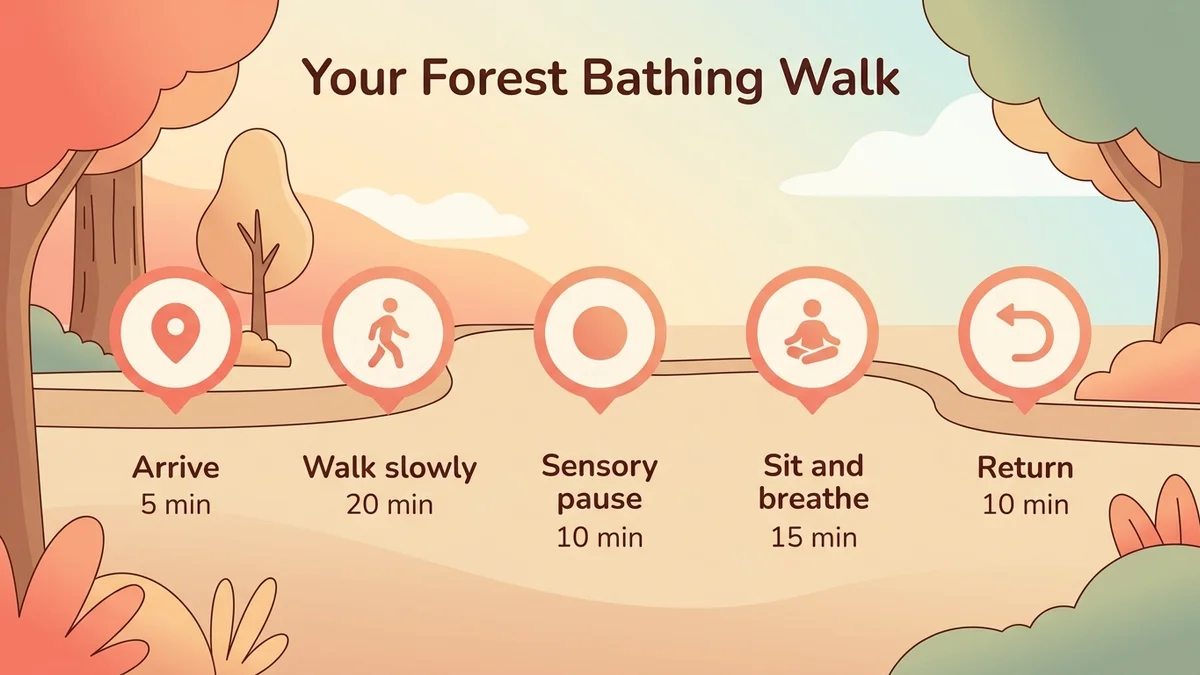
You don't need special equipment or prior experience. Here's a simple 5-step protocol inspired by the approach of M. Amos Clifford, founder of the Association of Nature and Forest Therapy.
| Step | Duration | Action |
|---|---|---|
| 1. Arrival | 5 min | Put your phone in airplane mode. Stand with your feet grounded. Close your eyes. Take three deep breaths. |
| 2. Slow walk | 20 min | Move slowly with no destination. Notice the colors, shapes and movements around you. |
| 3. Sensory pause | 10 min | Stop. Touch a tree. Smell the soil, the leaves, the bark. Listen to the birds. |
| 4. Seated meditation | 15 min | Sit at the foot of a tree. Close your eyes. Let the forest sounds surround you. Breathe with cardiac coherence. |
| 5. Return | 10 min | Stand up slowly. Walk back to your starting point. Notice how you feel. |
Beginners often want to go too fast. The good news is there's nothing to "achieve." The only rule: slow down.
5 sensory exercises to deepen the experience
- Circle listening: close your eyes and identify 5 different sounds around you (birds, wind, creaking branches, water, insects)
- Bark touching: place your hands on 3 different trees and compare their textures (smooth, rough, damp, warm)
- Phytoncide breathing: breathe in deeply through your nose for 4 seconds, hold for 4 seconds, breathe out for 6 seconds
- Peripheral vision: fix your gaze on a point ahead and widen your field of vision without moving your eyes
- Barefoot walking: if the ground allows, take off your shoes and walk for 5 minutes on moss or grass
Forest bathing on video
To better understand the practice, here's Dr. Qing Li himself explaining the art and science of forest bathing.
As Dr. Li explains, forest bathing is accessible to everyone, whatever your fitness level. You can extend this connection to nature every day with Serena, which offers breathing and mindfulness exercises inspired by shinrin-yoku.
Real-life scenarios
The anti-anxiety Sunday morning
You wake up on a Sunday with that knot in your stomach. The week ahead is already making you anxious. Instead of scrolling on your phone, you put on your shoes and drive 15 minutes to the nearest woods. You walk for 40 minutes in silence. When you get back to the car, the knot has loosened. Your body did the work.
The lunch break in a city park
It's noon and you step out of the office. Instead of eating in front of your computer, you walk for 20 minutes in the tree-lined park next door. You sit on a bench under an oak and close your eyes for 5 minutes. That afternoon, your focus is sharper. A coworker asks what's changed.
Wednesday night insomnia
You've been struggling to sleep for three nights. Your doctor suggests spending more time in nature. On the weekend, you do a 2-hour forest bathing session. That night, you fall asleep 30 minutes earlier than usual. The fresh air, natural light and gentle fatigue of slow walking have done their job.
The Serena perspective
At Serena, we see that users who combine guided breathing exercises with time in nature make faster progress in managing stress. Anonymized app data shows that cardiac coherence sessions practiced outdoors produce calm scores 18% higher than those done indoors.
In reality, forest bathing and breathing techniques reinforce each other. The forest naturally slows your rhythm. Guided breathing amplifies that slowing effect. It's a virtuous circle.
Serena Coach tip: Before your next forest bathing session, download a 4-7-8 breathing exercise in Serena. Start it during your seated pause at the foot of a tree. Pairing the forest with controlled breathing multiplies the anti-stress effect.
Serena Coach tip: If there's no forest nearby, start with 10 minutes of mindfulness meditation at home with Serena. Research suggests that even viewing or imagining natural scenes can have a calming effect.
When and where to practice forest bathing in the US
Forests cover roughly a third of the United States — about 766 million acres — from national forests and state parks to local nature preserves. For most people, some wooded area is within a short drive.
The best conditions
| Criterion | Recommendation |
|---|---|
| Season | Spring and summer (peak phytoncide levels) |
| Time of day | Morning (6-10 a.m.) for cool air and quiet |
| Weather | After rain (scents are stronger) |
| Forest type | Conifers (more phytoncides) or mixed forest |
| Minimum duration | 20 minutes for the first effects |
| Ideal duration | 2 hours for a full session |
| Frequency | At least 120 minutes a week in nature (Scientific Reports, 2019) |
Many state and national parks now offer guided forest bathing walks, and the Association of Nature and Forest Therapy lists certified guides in most states. Check your local park district or nature center for sessions near you.
And what if forest bathing is your first step toward letting go of everyday pressures?
Forest bathing and Serena: your everyday nature companion
You don't always have time to get to the forest. That's normal. Serena helps you cultivate the same principles at home, at the office or in a park.
The app offers:
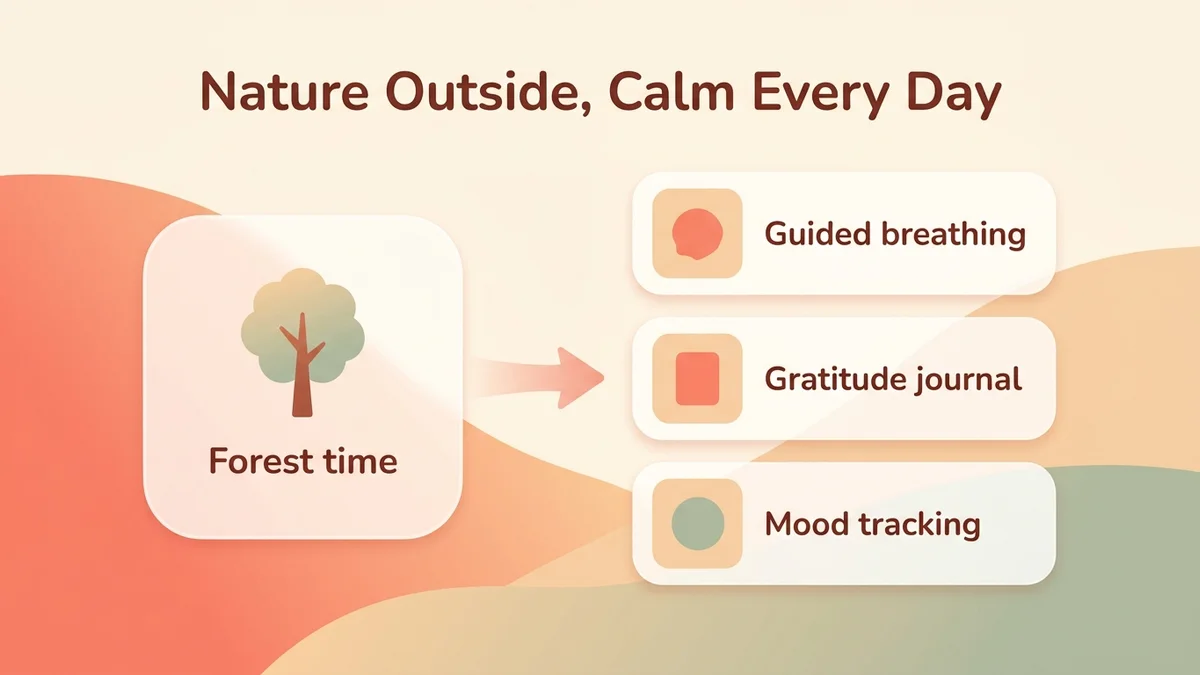
- 6 guided breathing techniques, including the 4-7-8 breathing that pairs well with shinrin-yoku
- A gratitude journal to extend your emotional connection with nature, following the science of gratitude journaling
- Mood tracking based on the Circumplex model to measure the impact of your time outdoors
- Mindfulness exercises inspired by evening meditation and sophrology
The next time you feel chronic stress building, put on your shoes and head for the nearest trees. Then open Serena to anchor the benefits in your daily life.
Frequently asked questions
How long does a forest bathing session last?
A full forest bathing session ideally lasts about 2 hours. According to Dr. Qing Li's research, benefits begin within about 20 minutes in the forest. For lasting effects on immune NK cells, his studies used forest trips of 2 to 3 consecutive days.
Does forest bathing replace therapy?
No. Forest bathing is a complement, not a substitute. It fits into a holistic approach to wellbeing, alongside medical care when needed. It shouldn't replace treatment for persistent low mood or severe anxiety.
Do you need a guide to practice shinrin-yoku?
No, you can start on your own. The essentials are walking slowly, engaging your five senses and putting your phone in airplane mode. A certified guide can enrich the experience with targeted sensory exercises, especially for your first session.
Can you practice forest bathing in a city?
Yes. Wooded urban parks offer measurable benefits. A Stanford University study (2015) found that a 90-minute walk in a natural area reduced rumination compared with an urban walk. Look for parks with mature, varied trees.
Do tree phytoncides really work?
Research suggests they contribute. Dr. Qing Li's studies found that forest trips boosted NK cell activity by about 50%, and that breathing phytoncides from cypress oil indoors also raised NK activity. Conifers (pines, firs, cedars) release some of the highest concentrations of phytoncides.
How often should you practice forest bathing?
A study of nearly 20,000 people published in Scientific Reports (2019) found that at least 120 minutes a week in nature was linked to significantly better health and wellbeing. That time can be spread across several shorter visits.
Is forest bathing suitable for children?
Yes, children especially benefit from time in nature. Research by Frances Kuo and Andrea Faber Taylor (2004) found that green outdoor activities reduced symptoms in children with ADHD. Adjust the length (30 to 45 minutes) and add sensory games to hold their attention.
What's the difference between forest bathing and forest therapy?
Forest bathing (shinrin-yoku) is the sensory immersion practice that originated in Japan. Forest therapy often refers to a broader, guided approach that may include structured invitations, sensory exercises, tree contact and guided meditation in the forest.
Conclusion
Forest bathing isn't a trend. It's a wellbeing practice supported by 40 years of scientific research and part of Japan's preventive health culture since 1982. The evidence keeps growing: lower cortisol, stronger immunity, better sleep, less anxiety.
All you need is 20 minutes and a wooded space. Start this weekend. And to anchor these benefits in your daily life, download Serena: guided breathing, a gratitude journal and mood tracking support you between forest visits.