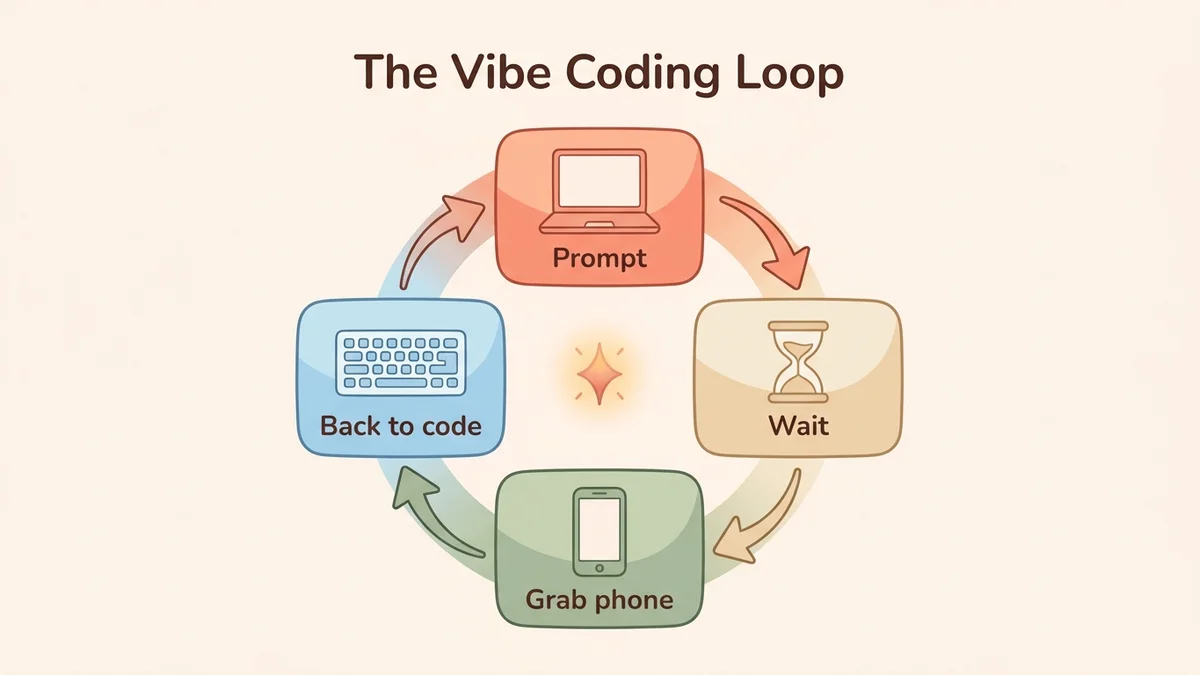
You type your prompt. You hit Enter. While Claude Code or Cursor generates, you pull out your phone — Instagram, X, some random article. Thirty seconds later, you come back. You skim the code, accept it, and run another prompt. Enter. Phone. Back. Enter. Phone. Back.
Notice how much that looks like scrolling social media?
Updated in March 2026 — Vibe coding has exploded since Andrej Karpathy coined the term in February 2025. AI coding tools are now part of most developers' daily workflow. But behind this productivity revolution lies a reality few people talk about: vibe coding drains your brain — and you don't feel it coming. This guide explains why, and above all, how to protect yourself.
The key takeaways
Vibe coding activates the same dopamine circuits as slot machines and social media. The "prompt → wait → phone → return" loop fragments attention, triggers screen apnea and erodes the capacity for deep thinking. A 2025 METR study found that experienced developers using AI took 19% longer to complete tasks, while believing they were 20% faster. Structured breaks and controlled breathing are the most effective antidotes.
What exactly is vibe coding?
Vibe coding is a way of developing software where you describe what you want in natural language and an AI (Claude Code, Cursor, Replit Agent) writes the code for you. The term was coined by Andrej Karpathy, a co-founder of OpenAI, on February 2, 2025, on X, describing a new way of coding where you "fully give in to the vibes" and "forget that the code even exists."
In plain terms: you're no longer coding. You're prompting. You describe, you approve, you iterate — but your fingers no longer write logic. Your brain no longer builds algorithms.
| Traditional development | Vibe coding |
|---|---|
| You think through the problem | You describe the problem |
| You write code line by line | The AI generates whole blocks |
| You debug by understanding | You say "fix this bug" |
| A handful of context switches a day | Many per hour |
| Constant learning | Constant delegation |
Collins Dictionary named "vibe coding" its Word of the Year for 2025. But behind the buzz, a paradox is emerging: the tools meant to make us more productive are making us more mentally vulnerable.
Key point: In the 2025 Stack Overflow Developer Survey, 72% of professional developers said vibe coding wasn't part of their professional work. But among those who have adopted it, signs of cognitive fatigue are worth taking seriously.
Why does vibe coding turn your brain into a scrolling machine?
You may have already noticed it without putting a name to it. That strange feeling after 3 hours of vibe coding: you've "produced" a lot, but you feel... empty. Like after scrolling Instagram for an hour. That's no coincidence — it's the same neurological mechanism.
The vibe coder's dopamine loop
When you type a prompt and hit Enter, your brain anticipates a reward. Will the code run? Will the AI understand? During those 30 seconds of waiting, you're in a state of anticipation — just like in front of a slot machine.
Vibe coding works on the principle of variable ratio reinforcement: unpredictable rewards delivered at random intervals. It's one of the most compelling reinforcement patterns known to psychology — the one behind casinos, social media feeds and mobile games.
Here's what happens in your brain:
- Prompt → Dopamine rises (anticipation)
- Wait → You grab your phone (craving stimulation)
- Result → A dopamine spike if it works, frustration if not
- New prompt → The cycle starts again
The problem? You're training your brain to expect constant rewards between tiny bursts of thinking. Over time, that wears down your attention span.
"The prompt-generate-test loop has the structural properties of a highly engaging reinforcement schedule" — the core idea of fast.ai's analysis of vibe coding (2026).
The toxic wait: Enter → Phone → Back
This is the most insidious part. While the AI generates, you have 15 to 60 seconds of "dead time." Not enough to think deeply. Just enough to check your notifications.
A developer in a vibe coding session can switch contexts many times an hour. And each interruption has a cost: research by Dr. Gloria Mark at the University of California, Irvine found it takes an average of about 23 minutes to get back on track after an interruption.
| Cognitive metric | Traditional dev | Vibe coding |
|---|---|---|
| Context switches per hour | Few | Many |
| Time to refocus | ~23 min per switch | Never fully reached |
| Attention residue | Low | High |
| Type of fatigue | Physical + mental | Purely mental |
| How it feels | "I got a lot done" | "I'm drained but did nothing" |
Key point: AI waiting time isn't "free time" — it's an attention trap. If you fill it with micro-stimulation (social media, news), you build up what psychologist Sophie Leroy calls "attention residue," which degrades all of your performance.
Screen apnea: vibe coding literally takes your breath away
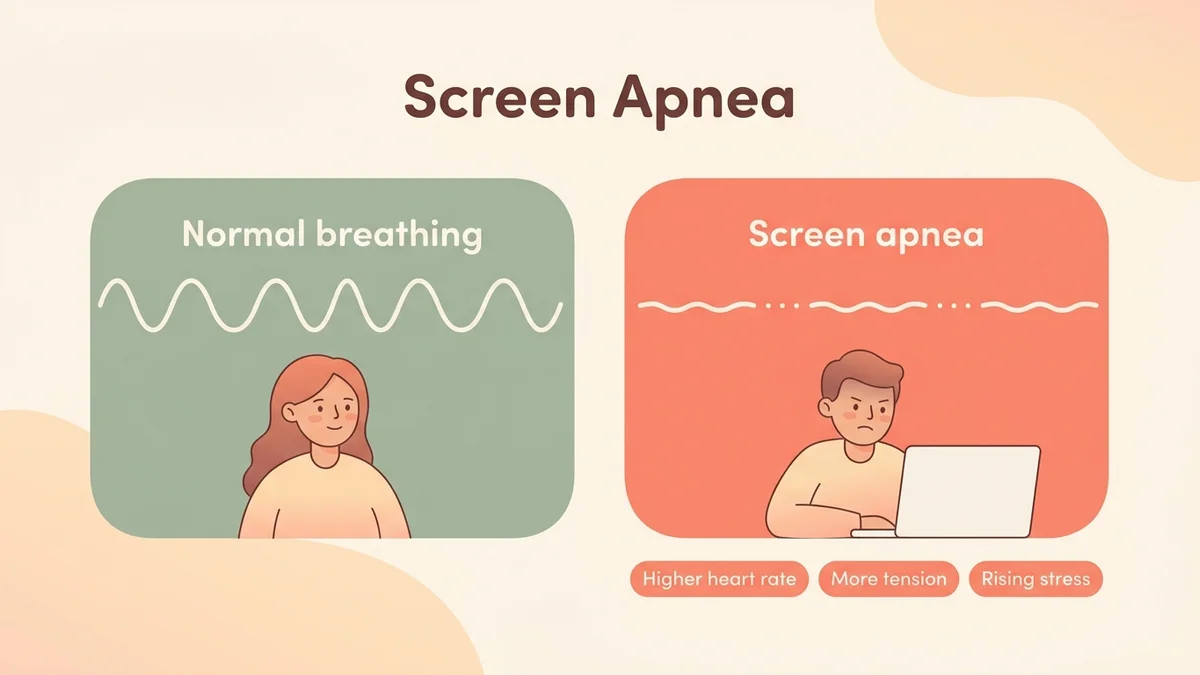
Did you know you might be holding your breath right now? If you're reading this on a screen, there's a good chance your breathing is shallow or suspended. This phenomenon is called screen apnea.
The term was coined by Linda Stone, a former executive at Apple and Microsoft, after she noticed that most people she observed stopped breathing normally while focused on screens — she estimated as many as 80%. For vibe coders, it's even worse: each prompt-wait-result cycle creates a micro-pause in breathing.
What happens physiologically
When you're waiting for your prompt's result, your nervous system shifts into sympathetic (alert) mode. You hold your breath. Your cortisol rises. If the code runs, you get a spike of relief. If it fails, frustration builds — and your breathing stays blocked.
Chronic shallow breathing keeps the body in a low-grade stress state, with higher heart rate and more baseline tension. Accumulated over a full day of vibe coding, it adds up to hours of continuous low-level stress.
The solution is as simple as it is powerful: a deliberate sigh every 10 minutes resets the nervous system. And between sessions, 5 minutes of cardiac coherence brings your physiology back into balance. For more breathing techniques suited to screen work, see our guide to breathing exercises.
Key point: Screen apnea is widespread among screen workers, according to Linda Stone. For vibe coders, the prompt-wait cycle amplifies it. A simple conscious sigh is the fastest reset available to you.
Why does vibe coding erode your capacity for deep thinking?
Here's the most troubling paradox of vibe coding: you produce more, but you think less. And over time, you can lose the ability to think deeply.
The passive brain
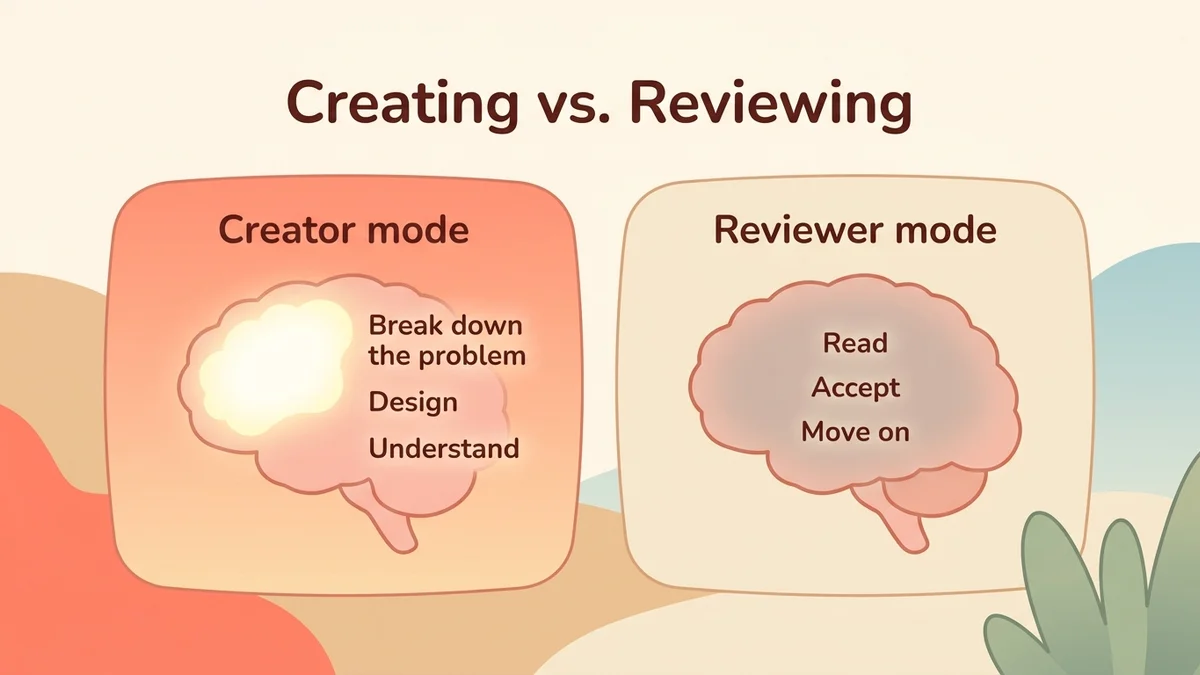
In traditional development, your brain is in creator mode. You break down a problem, design an architecture, write logic, and debug by understanding. Each step engages the prefrontal cortex — the part of the brain responsible for complex reasoning.
In vibe coding, your brain switches to evaluator mode. You read code you didn't write, judge whether it looks right, and accept or reject it. It's a fundamentally different cognitive mode — and a far less stimulating one.
According to a study published by METR in July 2025, experienced developers working on their own open-source projects took 19% longer to complete tasks when using AI — while believing afterward that the AI had made them 20% faster. That's a perception gap of nearly 40 percentage points.
The erosion of curiosity
Many developers describe the same shift: the impulse to ask why? is gradually replaced by the habit of asking how? — and if you do that long enough, you stop being a builder and become an operator of a black box.
This erosion is gradual and silent. You don't feel it coming because the results are there — features ship, bugs get fixed. But you're exercising your deepest problem-solving skills less and less.
Some well-known developers have publicly described falling into this trap: weeks of generating huge amounts of code without truly understanding it, absorbed in a state that felt like flow but wasn't.
Relying on AI for every answer risks replacing curiosity with compliance — you stop asking why the code works and only ask what to prompt next.
Key point: Research on attention by Gloria Mark shows that average attention on a single screen has fallen dramatically over the past two decades — to under a minute in recent studies. AI waiting times give that fragmentation even more openings.
Dark flow: when vibe coding feels like a casino
In January 2026, Rachel Thomas, co-founder of fast.ai, published an analysis titled "Breaking the Spell of Vibe Coding" that resonated widely in the tech community: vibe coding doesn't produce a state of flow — it produces dark flow.
Flow vs. dark flow
The concept of flow, developed by psychologist Mihaly Csikszentmihalyi, has a toxic cousin that researchers call "junk flow" or "dark flow" — the absorbed state that gamblers experience in front of slot machines. The difference is crucial:
| Characteristic | True flow | Dark flow (vibe coding) |
|---|---|---|
| Feedback | Clear and reliable | Misleading (code runs ≠ code is good) |
| Challenge/skill balance | Yes | No (the AI does the hard part) |
| Sense of control | Real | Illusory |
| After the session | Energized, satisfied | Exhausted, empty |
| Learning | Yes | Minimal |
Just as modern slot machines create "losses disguised as wins" with celebratory animations, vibe coding creates an illusion of productivity: lots of lines of code, several features shipped — but hidden bugs, poor maintainability, and a developer who hasn't learned anything.
Vibe coding produces a state similar to dark flow — an absorption that looks like positive flow but, like a slot machine, drains you instead of nourishing you. (Based on Rachel Thomas, fast.ai, 2026)
Impostor syndrome, AI edition
This dark flow fuels a new kind of impostor syndrome. In a survey on the anonymous workplace app Blind, 58% of tech workers reported experiencing impostor syndrome — before the vibe coding era.
Now imagine: you ship a complete feature in 2 hours. Your manager is impressed. But deep down, a little voice whispers: "Claude did all of it. If someone asks me to explain this code tomorrow, I won't be able to."
This isn't the classic "I don't deserve to be here." It's a more insidious version: you objectively know it isn't entirely your work, yet you're rewarded as if it were. The gap between the recognition you receive and your actual contribution creates chronic cognitive dissonance. Our guide to impostor syndrome and our self-confidence exercises offer concrete ways to rebuild confidence.
Real-life scenarios
The morning that slips by without a single real thought
It's 9 a.m. You open Cursor and launch your first prompt. By 12:30, you've shipped 3 features. Your Jira board is empty. But when a coworker asks, "How did you implement the cache?", you stumble. You don't know. You accepted the AI's code without understanding it. For the rest of the day, that feeling of being a fraud sticks to you.
The late-night session that spirals
You tell yourself, "one more prompt, just one." It's 11 p.m. You're in a daze — dry eyes, shallow breathing, brain on autopilot. You haven't eaten since 7. You've switched between your IDE and your phone 47 times. Tomorrow morning you'll wake up exhausted without understanding why — you were "just sitting in front of a screen."
The technical meeting where you're lost
Sprint review. It's your turn to present. You demo the feature and it works perfectly. Then the technical question comes: "Why did you choose this architecture?" Silence. You didn't choose it. The AI did. You improvise a vague answer, heart pounding. Meeting stress piles on top of the impostor feeling.
The Serena perspective
Serena usage data reveals an interesting pattern: users who identify as developers or tech workers make up a growing share of new sign-ups in 2026. Their usage shows distinct characteristics:
- Usage peaks between 10 p.m. and 1 a.m. — matching the end of late coding sessions
- Short breathing exercises (3-5 min) are the most used — a need for quick resets rather than long meditations
- Mood tracking shows sharper swings — energy spikes followed by crashes, typical of the dopamine loop
Academic theory says flow improves productivity and wellbeing. Our field observations suggest vibe coding "flow" is deceptive: the developers who spend the most time in it also report the most mental fatigue. The true indicator of wellbeing isn't the number of features shipped — it's the quality of recovery between sessions.
Serena Coach tip: Set up a "decompression ritual" between vibe coding sessions. Three minutes of cardiac coherence (6 breaths per minute) is enough to reset your nervous system and regain clarity. It's not a break — it's a cognitive investment.
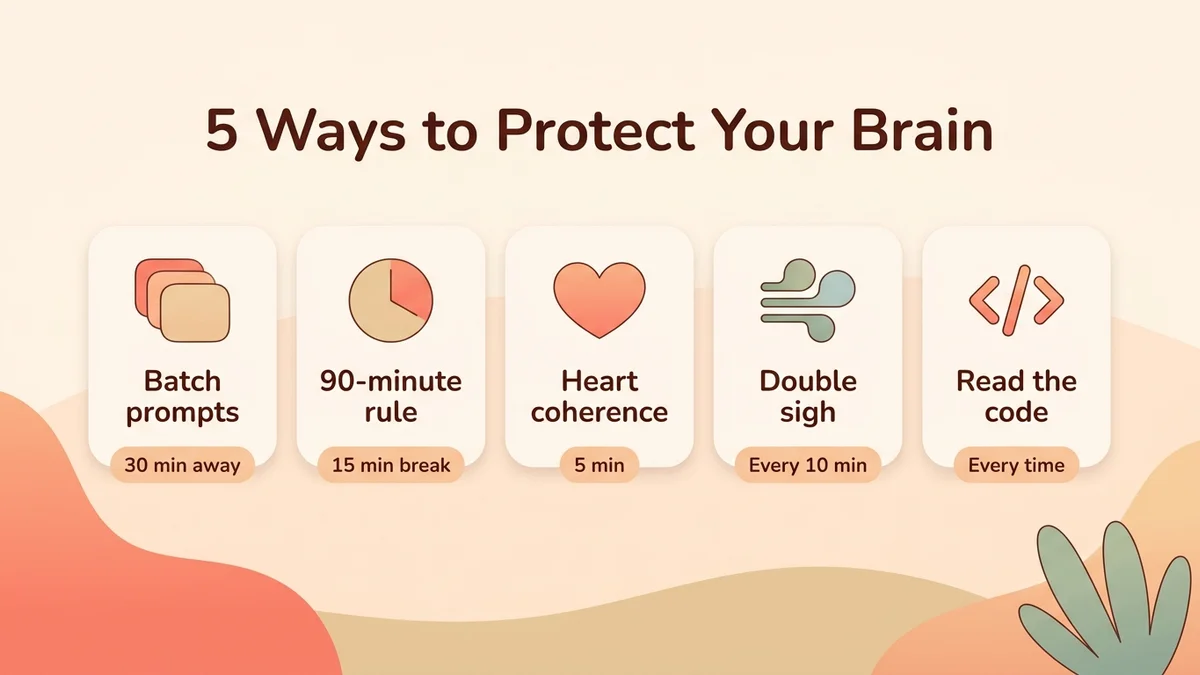
5 techniques to protect your vibe coder brain
1. Batch prompting: stop micro-switching
Instead of launching a prompt, waiting, checking your phone and coming back, group 5 to 10 tasks. Launch them in parallel. Then physically step away from your computer for 30 minutes.
It's not laziness. It's cognitive hygiene. Your brain needs stimulation-free time to consolidate what it has processed.
2. The 90-minute rule
Never vibe code for more than 90 minutes without a break. Sleep researcher Nathaniel Kleitman proposed that the brain runs on roughly 90-minute "basic rest-activity cycles" throughout the day. Pushing past that point without rest tends to degrade focus.
During your break, no screens. Walk, stretch, breathe. 15 minutes is enough.
3. Cardiac coherence: the 5-minute reset
Between sessions, do 5 minutes of cardiac coherence — 6 breaths per minute (breathe in for 5 seconds, out for 5 seconds). According to the HeartMath Institute, this technique lowers cortisol by 23%. Our free cardiac coherence timer keeps the rhythm for you.
It's one of the best breathing exercises you can do between coding sessions. Five minutes to reset what hours of vibe coding have thrown off balance.
4. The physiological sigh against screen apnea
Every 10 minutes, do a double sigh: two short inhales through the nose, followed by a long exhale through the mouth. A Stanford study led by David Spiegel and Andrew Huberman (Balban et al., Cell Reports Medicine, 2023) found that 5 minutes a day of this "cyclic sighing" reduced anxiety and boosted positive mood — with a bigger mood lift than mindfulness meditation.
Set a reminder on your phone. Or better yet, use Serena for breathing reminders built into your day.
5. Actually read the code
Before accepting generated code, read it line by line. Not to hunt for bugs — to understand it. Ask yourself: "Could I explain this logic to a coworker?" If the answer is no, take the time to understand it before approving.
This habit alone fights impostor syndrome, keeps your skills sharp and turns vibe coding from a crutch into a real tool.
As this 90-second Stanford Medicine video explains, cyclic breathing is one of the fastest ways to relieve stress — perfect between two prompts. You can practice guided breathing directly with Serena, which walks you through personalized breathing exercises step by step.
How Serena supports vibe coders every day
Serena was designed for exactly this kind of modern stress — the kind that doesn't come from a toxic boss or an impossible deadline, but from an unregulated relationship between your brain and your tools.
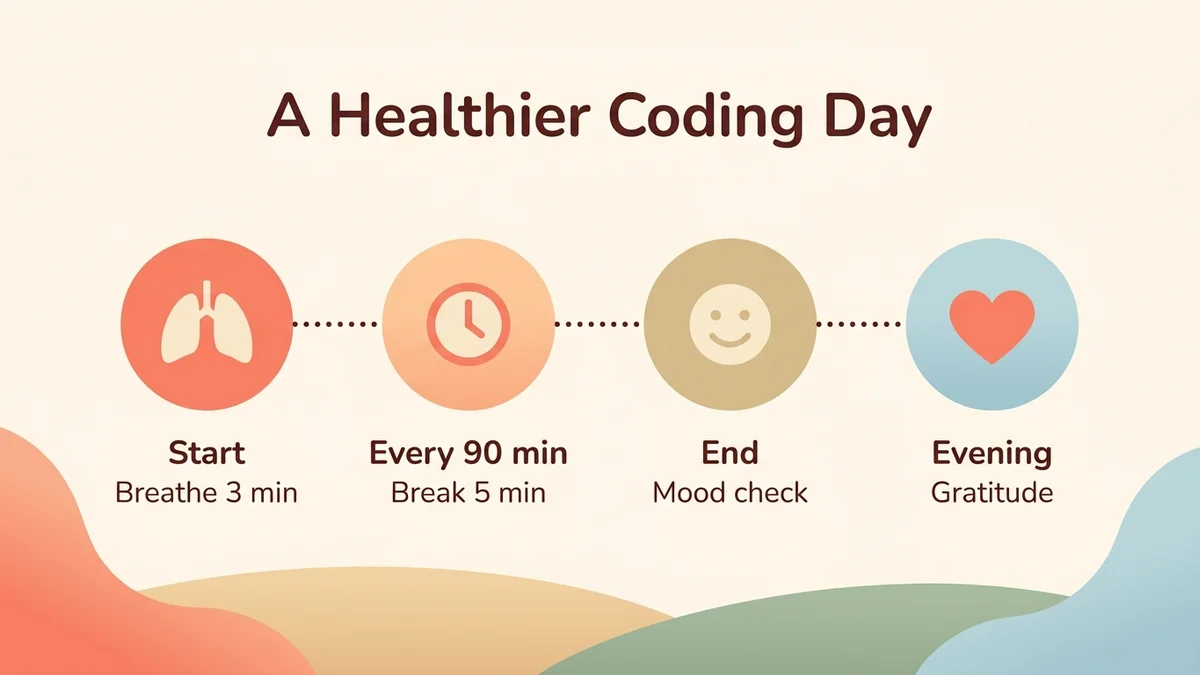
Here's how Serena fits into a vibe coding day:
| Moment | What Serena does | Duration |
|---|---|---|
| Start of session | Grounding breathing exercise | 3 min |
| Every 90 min | Break reminder + guided cardiac coherence | 5 min |
| End of session | Mood check-in (Circumplex model) | 2 min |
| Evening | Gratitude journal + 4-7-8 breathing | 10 min |
The basic breathing exercises are free. The full experience adds mood tracking, the journal and all 6 guided breathing techniques.
Try Serena for free and discover how 5 minutes of breathing can transform your relationship with code.
Frequently asked questions
Is vibe coding addictive?
Vibe coding activates the same reward circuits as slot machines: variable rewards at unpredictable intervals. According to Rachel Thomas of fast.ai (2026), this pattern creates "dark flow" — an absorbed state that looks like flow but drains you instead of nourishing you. It isn't a clinical addiction in the DSM-5 sense, but the reinforcement mechanism is similar.
Why am I so tired after a vibe coding session?
Vibe coding can involve many more context switches than traditional development. Each switch leaves "attention residue" — part of your brain stays stuck on the previous task. After 3 hours, your mind is fragmented across dozens of unresolved contexts.
How do I know if vibe coding is affecting my mental health?
Warning signs: fatigue out of proportion to physical effort, trouble concentrating away from screens, increased irritability, a sense of emptiness after "productive" sessions, being unable to explain your own code, and the reflex to check your phone during every wait. If you check 3 or more, it's time to adjust your habits. See our guide to the signs of chronic stress and, if exhaustion is building, our article on burnout symptoms. You can also take our free stress test.
Is meditation suitable for developers?
Yes, especially mindfulness meditation. A meta-analysis in JAMA Internal Medicine (Goyal et al., 2014) found that mindfulness programs improve anxiety and depression. For developers, short formats (3-5 minutes) between sessions are the most effective and the easiest to stick with.
Can you vibe code in a healthy way?
Absolutely. Vibe coding isn't the problem — an unregulated relationship with the tool is. With structured breaks, conscious breathing and the habit of reading and understanding the code, vibe coding becomes an accelerator without sacrificing your mental health. The goal: stay an augmented developer, not an exhausted prompter.
Will vibe coding replace developers?
Despite spectacular predictions (in March 2025, Anthropic CEO Dario Amodei said AI could be writing 90% of code within months), reality is more nuanced. Vibe coding automates coding, not software engineering. Critical thinking, architecture and creativity remain irreplaceable.
Final word
Vibe coding is an extraordinary tool — when it's used mindfully. The danger isn't AI itself, but the autopilot state it can pull us into. Every time you hit Enter and grab your phone, you're choosing stimulation over recovery.
Next time your prompt is running, try something else: close your eyes. Breathe. Five seconds in, five seconds out. Feel your body. Return to the code when you're ready — not when the AI is done.
Your brain will thank you.