The short version
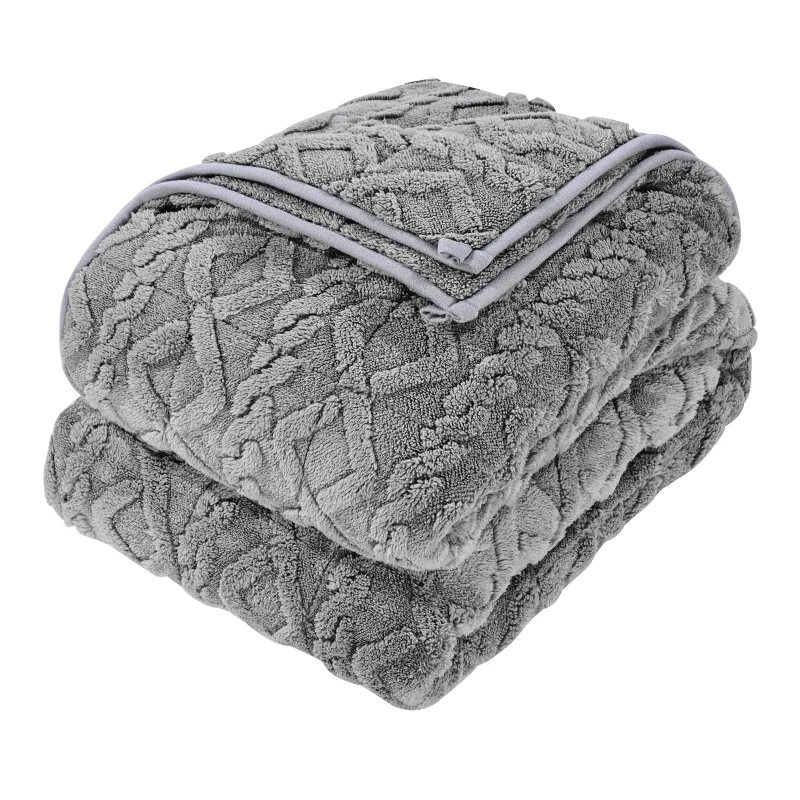
A weighted blanket for adults, in 20 lbs Queen and 25 lbs King, shipped from a US warehouse in 3 to 8 days with no customs. It is the only product in this shop backed by real randomized clinical trials — and we are going to give you the numbers, including the inconvenient ones. It is not a medical device, it treats nothing, and it is not for children.
The weight of a hand on your shoulder
When someone rests a hand on your shoulder, something happens that you did not decide. The body settles slightly. It is involuntary, immediate, and it lasts exactly as long as the contact does.
A weighted blanket tries to reproduce that across the whole body, all night. The principle is called deep pressure, and occupational therapists have used it for a long time. The blanket does not put you to sleep. It gives a body that will not settle a physical reason to.
For some people that lands immediately. For others it is just a heavy blanket that feels stifling. We cannot predict which one you are, and neither can anyone else.
What the research actually says
This is the point where most sellers write "scientifically proven" and stop. Here is the file instead.
The strongest trial
In 2020, a Swedish team published a randomized controlled trial in the Journal of Clinical Sleep Medicine covering 120 patients with insomnia alongside depression, bipolar disorder, ADHD, or generalized anxiety disorder. For four weeks, half slept under a weighted metal chain blanket, half under a light plastic chain control blanket.
The result was clear: patients in the weighted group were far more likely to see their insomnia severity cut in half, and far more likely to reach remission. The benefits held through a twelve-month open follow-up.
It is a good trial. It is also the best one in the file, and it did not study people who sleep normally.
What the two 2024 reviews found
Two meta-analyses came out the same year, and they are more measured.
The first, in the Journal of Psychiatric Research, pooled 9 studies and 553 patients. On anxiety it found a real but small effect: standardized mean difference of −0.47 (95% CI: −0.68 to −0.25). The authors flagged the limits themselves — heterogeneous outcome reporting, too few well-designed RCTs, small samples.
The second, in Complementary Therapies in Medicine, pooled 8 randomized trials and 426 patients. Anxiety effect: small again (0.40). On insomnia the result is shakier than you will read elsewhere — across three studies the difference did not reach significance (p = 0.06), and only became significant once the most discordant study was excluded. One finding that matters for safety, though: no serious adverse events were reported.
The melatonin study, and what it does not say
You will often see a 2023 Journal of Sleep Research study cited: in 26 healthy young adults, salivary melatonin in the hour before lights-out was about 32% higher under a weighted blanket than under a light one.
Much less often quoted: in that same study, no other difference was found. Not in subjective sleepiness, not in total sleep duration, not in cortisol, not in oxytocin, not in sympathetic nervous system activity. The authors state plainly that whether the melatonin bump means anything therapeutically remains to be determined.
The honest summary
| Claim | Status |
|---|---|
| Reduces insomnia severity in psychiatric patients | Supported by a solid randomized trial |
| Reduces anxiety | Real but small effect, in clinical populations |
| Improves sleep for someone who already sleeps fine | Not studied |
| Raises melatonin at bedtime | One study, 26 people, no measured effect on sleep itself |
| Safe for a healthy adult | No serious adverse events in the trials |
| Safe for a child | False, and documented by deaths |
| Treats insomnia, anxiety, ADHD, or autism | False |
One limitation nobody can design around: in this kind of trial, blinding is impossible. You know perfectly well whether your blanket is heavy. Some of the measured effect is necessarily expectation. That does not erase it — it argues for modesty.
Safety, and why this page presses on it
This is not a harmless object, and it is the only one in this shop whose misuse has killed someone.
It is not a children's product. In April 2022, two girls aged 4 and 6 died of asphyxiation after becoming entrapped in a weighted blanket cover. That December, Target recalled about 204,000 Pillowfort weighted blankets. The CPSC advises against weighted blankets for infant sleep. We do not sell a children's version and we will not.
You have to be able to get out from under it alone. That rule covers all the others. A blanket you cannot push off unaided should not be used for sleep.
Ask your doctor first if any of these apply to you: sleep apnea, severe asthma, COPD, or another respiratory condition; circulation problems, low blood pressure, diabetic neuropathy, or a cardiac condition; limited mobility; claustrophobia.
On sleep apnea specifically, we would rather be precise than reassuring: no trial has ever enrolled a diagnosed cohort and measured apnea indices or oxygen desaturation. Not "it is dangerous," not "it is fine" — nobody has run the study. Which is exactly why the question belongs with someone who has your chart in front of them.
Choosing your weight
The common rule is roughly 10% of your body weight. It is reasonable, it is everywhere, and it is worth knowing it is a practitioner convention rather than a demonstrated threshold: the clinical trials worked with fixed weights of 13 and 18 lbs, and the melatonin study went to 12%.
| Blanket weight | Suits roughly | Size |
|---|---|---|
| 20 lbs | 180 to 220 lbs | Queen, 60 × 80 in |
| 25 lbs | 230 to 280 lbs | King, 88 × 104 in |
If you weigh under about 175 lbs, neither of these is right for you. At 150 lbs the rule puts you near 15 lbs, and our lightest US option is 20 lbs — enough of a gap to matter. We stock these two weights because they are what our US warehouse actually holds. We would rather tell you that than sell you a blanket you will abandon.
Pick the weight first, the size second. A weighted blanket is not a comforter: it does not need to tuck in, it needs to cover your body. The King size fits a king bed but is still meant for one person.
Shipped from inside the United States
This matters more than it sounds. The US de minimis exemption was suspended for China and Hong Kong on May 2, 2025, then for every country on August 29, 2025, and Congress voted to repeal Section 321 outright effective July 1, 2027. Nothing enters duty-free anymore. A blanket shipped to you from a Chinese warehouse today can arrive with a customs bill attached, collected at your door by the carrier.
We source this blanket from a warehouse inside the United States, so your package moves domestically. The price you see is the price you pay — no duty, no brokerage fee, no surprise at delivery.
What we do not know yet about this blanket
One thing, and we would rather write it than bury it.
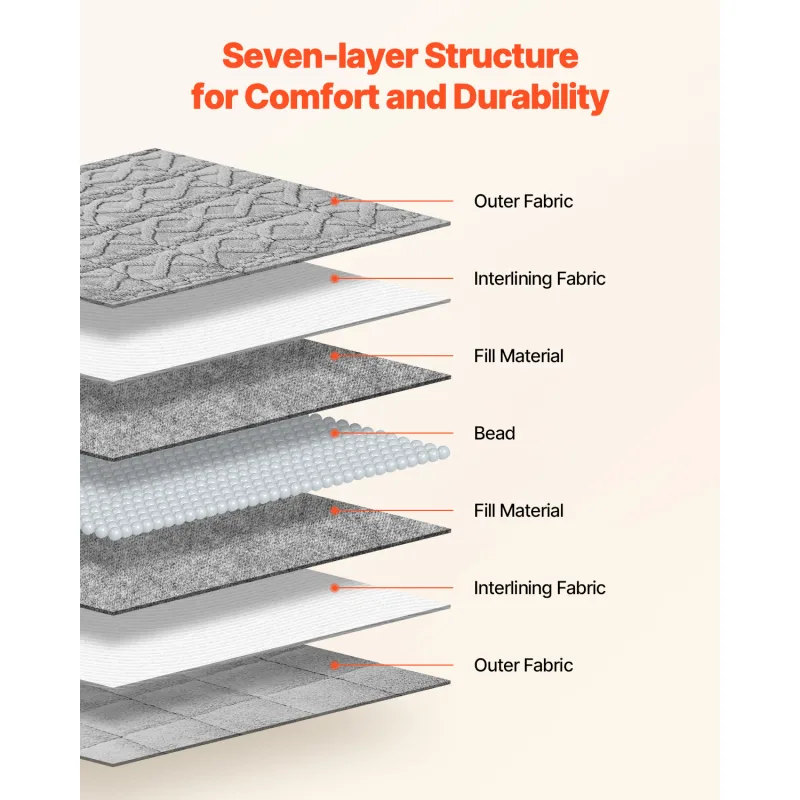
The supplier's own listing contradicts itself on fiber content. It declares "100% wool" while describing a sherpa fleece and jacquard fleece shell — and fleece is polyester. Both cannot be true. Under the Textile Fiber Products Identification Act, blankets sold in the United States must carry a label stating fiber content by percentage, the manufacturer or marketer, and the country of manufacture. We are going to read the sewn-in label on our own inspection unit and publish what it actually says, rather than repeat a spec sheet we do not believe.
Care
Machine wash cold, gentle cycle, no fabric softener — softener clogs the quilting and stiffens it over time.
Drying is the critical step. Flat, always. Never a tumble dryer, never hung. A soaked weighted blanket is far heavier than a dry one, and hanging it drives all the fill toward the bottom, permanently deforming the pockets.
Check your washer's capacity before washing the 25 lb King: wet, it is beyond what many home machines will take. A removable duvet cover washed separately solves this and stretches the interval between full washes.
If it does not suit you, send it back
Thirty days to change your mind after delivery, no explanation required — including "I could not stand the feeling."
This is an object you genuinely cannot judge from a photograph. Weight on the body is not something you can imagine accurately, and tolerance varies enormously from one person to the next. You should get to try it for real.